Survey of London: Volume 36, Covent Garden. Originally published by London County Council, London, 1970.
This free content was digitised by double rekeying. All rights reserved.
'St. Paul's Church', in Survey of London: Volume 36, Covent Garden, ed. F H W Sheppard (London, 1970), British History Online https://www.british-history.ac.uk/survey-london/vol36/pp98-128 [accessed 30 April 2025].
'St. Paul's Church', in Survey of London: Volume 36, Covent Garden. Edited by F H W Sheppard (London, 1970), British History Online, accessed April 30, 2025, https://www.british-history.ac.uk/survey-london/vol36/pp98-128.
"St. Paul's Church". Survey of London: Volume 36, Covent Garden. Ed. F H W Sheppard (London, 1970), British History Online. Web. 30 April 2025. https://www.british-history.ac.uk/survey-london/vol36/pp98-128.
In this section
Chapter V - St. Paul's Church
The First intimation of the building of the church (Plates 11, 12, 13, 14, 15, 16, 17, 18, 19, 20, 21, 22, 23, 24, 25) is in May 1631, when the 'new intended Churchyarde' is mentioned. (fn. 57) Work began on 5 July of that year, (fn. 58) and the clerk of works was paid for seventy-four weeks' attendance. (fn. 59) It is not known whether that period was continuous: if it was, building must have ended about December 1632. In September of that year, however, some stone had still been awaiting shipment from Portland, (fn. 60) and it is likely that the seventy-four weeks' employment was discontinuous in the winter, which would probably have carried the work into the summer or autumn of 1633. (fn. 1) A contemporary reference to the cross erected on the east end of the roof is probably not later than that year (fn. 62) (see page 322), and the substantial completion of the church by then would be consistent with the known employment of some of the workmen on the 'portico houses' in the Piazza, which were probably begun in about 1633 (see page 78). When the fourth Earl of Bedford obtained a confirmatory building licence on 30 June 1635 this gave retrospective permission for the construction of the church, which had not been specifically mentioned in his licence of 1631, and which was said to be then finished. (fn. 63) By February 1635/6 the Earl had disposed of his pew in the motherchurch of St. Martin in the Fields. (fn. 64) A dispute with the vicar of that parish, however, delayed the consecration of the new church until 27 September 1638. (fn. 65) (fn. 2)
The church is probably best known in the anecdote of the Earl of Bedford and Inigo Jones, published by Horace Walpole in 1765 as told to him by Arthur Onslow (1691–1768), Speaker of the House of Commons. 'When the Earl of Bedford sent for Inigo, he told him he wanted a chapel for the parishioners of Covent-garden, but added, he wou'd not go to any considerable expence; in short, said he, I wou'd not have it much better than a barn.—well! then, replied Jones, you shall have the handsomest barn in England.' (fn. 70) The possible relevance of the story to Jones's search for an elemental classicism has been explained by Sir John Summerson. (fn. 71) But the evidential value of the anecdote may be little more than that of an ex post facto joke, and the relationship between the church consecrated in 1638 and the church first intended is more difficult to determine than the downright attitudes of the anecdote suggest. (fn. 3)
Designed by the Court architect, paid for by a Puritanically inclined grandee aloof from the royal circle, subject to the authority of churchmen militant against the vigorous unconformity of Londoners, the Covent Garden church was very apt to be influenced in its genesis by strong contrary forces. And as the first completely new Anglican church to be built in London since the mid sixteenth century, strikingly novel in its architecture, and conspicuously part of a 'newsworthy' enterprise, it was the more liable to comment and criticism. The liturgical questions posed by the building of the church were bitterly contested in the 1630's, and these conflicts did affect very significantly its initial development. That there seems nevertheless to be only one important reference to the church in contemporary controversy is somewhat remarkable: possibly the very diversity of the powerful interests concerned in building the church deterred the polemicists of any one faction.
That the King's concern with the building of the church was real is suggested by an entry in the Privy Council's registers on 31 August 1632. This recorded the grant of a safe-conduct for the shipment by sea of 'a great quantity of Stone provided at Portland . . . to be brought to London, and ymployed for his majesty's service at Whytehall, and the Church in Coven Garden, and other places'. (fn. 73) The Earl of Bedford's financial responsibility for the work is not in question; but, no doubt by reason of Jones's employment on the design, some of the privileges of royal building-operations were evidently made available to the Earl.
His own attitude, in one of its aspects, is no doubt indicated fairly enough by Walpole's anecdote. The existence of a church on the estate helped the disposal of leases (as an unsympathetic inhabitant noted in 1642 (fn. 74) ), and the careful building accounts suggest that the Earl had some regard for economy. (fn. 4) But the social level at which the estate was developed makes it unlikely that he can ever have thought that his tenants would tolerate untransmuted cheapness in the design of the church. Nor is it likely that the Earl, whose concern with religious questions is demonstrated in his common-place books, would have been unaffected by contemporary disputes over forms of worship and its material modes. Jones's Roman Catholic chapels at Somerset House and St. James's were not outwardly elaborate; but the almost harsh plainness of the temple in Covent Garden seems eloquent of aspirations to the purity of the early uncorrupted church. The Pauline dedication may be thought consistent with this.
Such ideals, if they existed, would not necessarily have been unacceptable to Laud as Bishop of London. It does appear, however, that in fact the Earl was originally willing to see his church in definitely anti-Laudian terms.
Of Laud's opponents in the early 1630's the best organized were probably the London Puritans known as the feoffees for the purchase of impropriations. (fn. 76) From about 1625 onwards they had bought up ecclesiastical revenues in lay hands in order to finance the maintenance of Puritan ministers. In January 1632/3 the Attorney General prosecuted them in the Court of Exchequer; and for want of incorporation their activities were declared illegal and their funds confiscated. In the course of the suit the Attorney General asserted that they had tried to purchase the patronage of some churches that were as yet uncompleted. Among others 'they treated . . . for the new Church in Covent Garden . . . and they deale with [blank in original] to procure the same to be settled upon the feoffees, And for this they offer to the Earle of Bedford by the said [blank] 1000 li. . . .' The feoffees did not deny this, except to imply that the Earl initiated the proposal. In their version, 'A Lord sent his solicitor to them about the Church in Covent Garden whoe proposed the thing unto them, but nothing more was done . . .' The Attorney General did not pursue the matter, telling the feoffees that he had mentioned Covent Garden 'but to shew your vast appetite to get many Churches and to obteyne supreme Patronage'. (fn. 77) (fn. 5)
The one important reference to the church that has been found in the literature of the liturgical controversy is yet more significant, as bearing directly on its architectural form. The author is William Prynne, and his testimony, although biased, may be believed, since it accounts for what is otherwise puzzling. This is the siting of the church with its grand portico leading to nothing more than a false door behind the communion table. Prynne tells us that the explanation lies in a frustrated attempt to defy the traditional orientation of churches. Writing in 1636 he sought to question the Laudian insistence on an eastern altar by citing churches where this custom was not observed. Among them had been 'the new Church in Court [sic for Covent] Garden, which as it stands not now perfectly East and West, so at first the Chancle of it stood towards the West part; Which some Prelates (without Law, Canon, and reason, I know not upon what superstitious overweaning conceit) commanded to be altered and transformed to the other end, to the great expence of the builder, the hindrance, and deformity of that good worke'. (fn. 78)
Of the circumstances of this enforced transformation nothing is known. It was presumably the act mainly of Laud as Bishop of London, before his translation to Canterbury in September 1633, for the building accounts, which suggest that work began at the west end, contain a number of references to alterations evidently made fairly soon after the commencement in July 1631. (fn. 79) The personal relationship between the Earl and the ecclesiastical authorities in this episode is obscure. (fn. 6)
No more is known or can be inferred of Jones's attitude to the doctrinal aspects of the change. The successful designer of Roman Catholic chapels, but described by a papal agent as Puritanissimo fiero and by a Capuchin Father as senza religione, (fn. 82) he may have been indifferent to the internecine conflicts of Anglicanism.
Despite this alteration, the deliberated severity and scholarly primitivism of the church as built seem to have survived any modification, to express one of Jones's profoundest creative impulses. (fn. 7) There is, nevertheless, an indication that, apart from the reversal of plan, the conception of the church may originally have been even nearer to simplicity of form. The vestry and belfry attached to the church are mentioned in the building accounts and were certainly built contemporaneously with it. In a document recorded in Strype's Survey and dated 1632 or earlier, however, a site at the north-east corner of Henrietta Street is said to be 'preserved for a Vestrv-House'. (fn. 83) This intention was not carried out and by 1633 two houses had been built on the site, (fn. 84) but Jones's scheme may originally have required neither of the buildings attached to the church, which impair its integrity of form. In this respect Hawksmoor's later representation of St. Paul's as a 'Tuscan temple' (fn. 85) (fig. 3 on page 66) perhaps comes near to Jones's first idea. (fn. 8)
Even as built, the church ignored tradition by virtue of its unitary basic form; yet in the end it conformed well enough to the requirements of the Laudian church. The communion table was set against the east wall, (fn. 87) elevated by one step, and probably railed-in on a black and white marble pavement. (fn. 88) The eastward third or so of the church (35 feet 7 inches in depth) was designated a chancel. (fn. 89) It was raised one step above the body of the church, and pews were placed 'about the Chancell', perhaps collegiate-fashion. (fn. 90) (fn. 9); The great flat ceiling (hardly smaller than that of the Banqueting House) was painted in perspective with 'Groteske and other ornaments'. (fn. 94) A designedly 'Puritan' church would probably have had galleries, which St. Paul's at first did not, although the lack was soon remedied by the inhabitants. Outside, the plain wooden crosses at each end of the roof were apt to give offence to Puritans. (fn. 10) By the standards of Victorian ecclesiology much was certainly wanting. The basic form rejected the architectural separation of nave from chancel. There was no stained glass, and no organ. Nor, as far as the Earl's accounts indicate, was there an altarpiece, and the communion table was plain and cheap compared with the carved white marble font and the yet more expensive carved pulpit and reader's desk. (fn. 11) The bishop, indeed, evidently felt the need to order the addition of 'ornaments' before the consecration. (fn. 96) But judged by the tenets of Caroline churchmanship St. Paul's was as un-Puritan as it was Protestant.
The account of the Earl's expenses in building the church, which survives among the archives of the Bedford estate, (fn. 58) makes no mention of Jones (or of any payment to a supervising architect or surveyor). It should therefore be said that the attribution of the design to him need not be doubted. The most direct evidence of his authorship has been noticed by Sir John Summerson in Jones's annotated copy of Vitruvius, where his comment on a mistake commonly made in the interpretation of the term antepagmenta—'and so I did in Covent Garden'—refers to the great cornice of the church. (fn. 97) His responsibility for the design is stated by his pupil Webb. (fn. 98) At the consecration Jones was among those present. (fn. 99) (fn. 12)
A contemporary reference to Jones's authorship of the design should be mentioned here. In 1636 Samuel Hartlib, the educationalist, made some notes in his journals about the poet and courtier, Sir Francis Kynaston, who had established an academy in Covent Garden (see pages 254–8), and with whom he had recently become acquainted. Of Kynaston he writes: 'No friend to Indigo Jones [sic] nor Webbe. The Surveyor committed a great fault in building the ch. in Common-garden, having over-swayed the K. to direct alone that building, a foule error against Art'. (fn. 102) It is difficult to assess the significance of this remark. If it derives, as seems likely, from Kynaston it may be invalidated by a presumed animus against Jones. As it stands, it is at least consistent with the indications that an initial design was distorted or mutilated, perhaps as a consequence of the architect's failure to consult the authorities concerned with the building's use. (fn. 13)
The church-building account contains two names which can be associated with Jones. The clerk of works was Robert Cooke, who was about to be employed in the same capacity at the repair of St. Paul's cathedral. Of greater importance was the signatory of the account, Edward Carter, who was to sign the cathedral repair accounts as Jones's substitute from 1633 to 1641. (fn. 103) He subsequently succeeded to Jones's post as surveyor in the Office of Works. (fn. 104) It is not clear from the account whether Carter signed it on behalf of the Earl or Jones. He was to become a prominent inhabitant of Covent Garden and resided in a large house in King Street from 1633 to 1650. (fn. 105) In 1638–9 he figured in chapelry matters, acting as nominee for the Earl and, it seems, advising him. (fn. 106) He became one of the 'governors' or vestrymen of the parish in 1646. In 1645–8 he was one of the 'triers' of candidates for eldership in the Presbyterian organization of London churches (fn. 107) and was probably the Edward Carter who was put on various taxation and militia committees for Middlesex or Westminster by Parliamentary ordinances between 1643 and 1652. Conceivably indicative of a connexion with the Russells is the presence of an Edward Carter on such committees for Bedfordshire in 1643 and 1652. (fn. 108) (fn. 14);
The accounts (which are printed on pages 271– 281) show that the work was distributed among many contracting tradesmen. Apart from Cooke, bills were paid to twenty-one building tradesmen or partnerships (twenty-five tradesmen in all), to five tradesmen who dug the foundations, to twenty-three builders' merchants, and to six tradesmen providing carriage or scaffolding. (fn. 15)
Some of these tradesmen—the glazier, Bagley, one or both of the bricklayers, Benson, the painter, Goodericke, the masons, Mason and Styles, the joiner, Penson, the carpenters, Ryder and Poole, and the woodcarver, Tailor—had received or were receiving payment from the Office of Works, (fn. 109) and Mason, Styles, Penson, the stonecarver Carne, and the plumber Charley, were to work on the repair of St. Paul's cathedral. (fn. 103) (fn. 16)
The cost of the work as contained in the Bedford estate account (which, as will be seen, is not quite the same as the Earl's total outlay, or the final cost to him) amounted to £4,886 5s. 8d. Excluding a few trivial payments, about £3,100 was paid to building tradesmen, £1,419 to builders' merchants, £312 for scaffolding, carriage and digging, and £45 to the clerk of works. The last was paid about 2s. a day, the same rate as at St. Paul's cathedral.
Of the main materials used, the timber, bricks, tiles, sand and lime were bought from builders' merchants: the 884,500 bricks at rates of 11s.– 14s. per thousand and the 23,290 Flanders pantiles at £5 12s. 6d. per thousand. (fn. 17) A partial exception, however, is the purchase of some of the timber from the carpenter, Richard Ryder, who was also paid 'for horse hire and rideing charges into the West Country to buy oaken Timber'. (fn. 112) The other materials, including stone, marble and paving, were not paid for separately, being provided by the tradesmen who worked them. The shipment of stone from Portland under royal safe-conduct has already been noted.
Some subdivision is apparent in the allocation of work. Different bricklayers tiled over the body of the church and over the portico. The leadwork was divided between two independent plumbers. Inside, the joiner's work was performed by two tradesmen, one chiefly on the south and east sides, the other chiefly on the north and west. The woodwork of the pulpit was divided between the carpenter, joiner and carver.
Two entries throw some light on the method of work. Payment was made for fencing an area 'where the Roufe of the Church was Framed', (fn. 112) and for the construction of 'a Flower [floor] to draw out the Tracerie of one of the great Collumes', (fn. 113) that is, presumably, its entasis. Jones's care for the exact achievement of his intention appears in two other items. The painter's work on the eaves included 'shaddowing the squares of 92 great pannells betweene the Cantelivers', (fn. 114) and payment was made for red, black and yellow ochre to colour the mortar in which the red and black glazed pantiles of the roof were set. (fn. 115)
Two journeys were made during the course of the work to consult with the Earl or his agents, one to Woburn when it was found that a sewer would cross the City's water pipes, (fn. 116) and one for an unspecified purpose 'to my Lord of Bedford which then was at Sherbourne'. (fn. 117) (fn. 18)
The total outlay of some £4,886 particularized in the Bedford estate account included the pews and other major furnishings of the church. A contemporary manuscript in the British Museum records additional items of expenditure, evidently by the Earl, totalling some £487. (fn. 19); Part of this was spent on the consecration itself, the plate, bible, service-books and upholstery. Some £139 of it, however, was said to have been spent on 'buildinge of brick walls', 'masons worke about the chancell' and 'alteracion of the Chancell and pewes'. It is less likely that this refers to the complete reorientation already mentioned than to a late change required by the bishop 'for the greater decency of the said Chappell', after wainscoting had been virtually completed. (fn. 119)
The Earl's total outlay thus probably amounted to about £5,373. It seems, however, that before the consecration he and the inhabitants of Covent Garden agreed that he should be reimbursed by them for his expenses on the pews and the items mentioned in the British Museum document, amounting to some £1,066. This was to be effected by the sale to the inhabitants of lifeinterests in the pews. A dispute arose, but the agreement was confirmed and enforced in 1639 by the Bishop of London and the Privy Council. (fn. 119) In 1657, after the Earl's death, his outlay on the church procured an abatement of £7,000 in the fine levied on the Covent Garden property of the fifth Earl and his brothers, in the Act to prevent the increase of building in London. (fn. 120) Thus the bread cast by the fourth Earl on the waters was found again in the next generation.
Until 1638 the church remained without consecration, a ceremony very offensive to many Puritans. In 1636 Prynne commented that the building 'must not be used for a Church, because not consecrated by a Bishops conjuring white Rocher; which consecration I have manifested to be against Law, & utterly exploded as a Romish Relique'. (fn. 78) The cause of the delay was a dispute over the parochial independence of the precinct and the patronage of the living between the Earl and the vicar of St. Martin in the Fields, William Bray. The vicar (one of Laud's chaplains) argued that an Act of Parliament was necessary to create a new parish out of St. Martin's. In April 1638 the Privy Council decided in his favour. It ordered that when a Parliament was next held the church should be made parochial, with the patronage vested in the Earl, but that meanwhile the church should be consecrated as a chapel of ease to St. Martin's. The vicar of that parish was to provide the curate and his stipend. (fn. 121)
On 26 September 1638 the Earl and the inhabitants of Covent Garden on the one hand, and Bray and the churchwardens and parishioners of St. Martin's on the other, signed an agreement delimiting the physical boundaries and the degree of independence of the new chapelry. Its inhabitants were charged with the repair of the church, 'except that parte which concernes the viccar of St. Martins', perhaps the eastward third which the agreement delimited and designated as the chancel. (fn. 122) On the same day the Earl made an act of donation of the site of the church and churchyard, measuring 251 feet by 145 feet 3 inches, and the three entrance passages to north, south and west. (fn. 123)
On the next day, 27 September 1638, the church was consecrated by William Juxon, Bishop of London, and dedicated to St. Paul. (fn. 20) The servants of a nobleman close to the King, the Duke of Lennox, were paid by St. Martin's for pitching a tent 'against the Bishopps coming'. (fn. 110) At the ceremony the royal family was represented by Sir Edmund Verney. Others present included the Earl, Jones, Carter, the vicar of St. Martin's, and another of Laud's chaplains, William Haywood, vicar of St. Giles in the Fields. (fn. 99) The determination of the authorities of St. Martin in the Fields to retain their parochial rights over the new chapelry perhaps explains the fact that in the St. Martin's churchwardens' accounts the ceremony is throughout described as the consecration of a 'new churchyard' without any intimation that a place of worship stood in it. (fn. 110)
On 6 October the first curate, Samuel Porter, M.A., was admitted to his office in the chapel. (fn. 125) Among the later incumbents the names of Thomas Manton (1656–62) and Simon Patrick (1662–89) reflect the attraction of the Covent Garden pulpit for distinguished churchmen of various persuasions. Perhaps the greatest, however, to be associated with St. Paul's was James Ussher, Archbishop of Armagh, who was living in Covent Garden at the end of 1640, (fn. 126) and preached regularly in the chapel in 1641 and 1642, with the support of voluntary subscriptions from the inhabitants. (fn. 127) It was while preaching here that he was summoned to join four other bishops in advising the King whether to consent to Strafford's execution. (fn. 128)
The fabric of the church was not to remain untouched for long. Its history in the next twenty troubled years or so is obscure. This is partly owing to the paucity or illegibility of surviving records. (fn. 21) It is also in part owing to the tendentious nature of their testimony, as the affairs of the chapelry became involved in an entanglement of disputes, between the Earl and some of the inhabitants, between the inhabitants themselves, and between the inhabitants and the parochial authorities of St. Martin's. As early as the November after the consecration some petitioners to the Privy Council against the Earl's demand for pewmoney were complaining, among other things, that the church was 'defectively built in the Roofe'. (fn. 129) Their petition was found to be generally baseless, (fn. 130) but the strictures on the roof seem to have been justified. (fn. 22) A churchwarden from 1640 to 1644 spoke in 1650 of a time during his period of office when 'the Roofe of the Church was in danger to fall', (fn. 132) and repairs were made to it at various times in the 1640's. By November 1646 the dormer windows which disfigured Jones's pantiled slopes until the late eighteenth century had been inserted. (fn. 133)
A greater change was the construction of galleries inside the church. The south gallery was built by virtue of an agreement of May 1643 to which the fifth Earl and some of the inhabitants were parties. Work was in progress in 1647 and 1649, (fn. 133) and by 1655 a north gallery had also been built. (fn. 134) Whether galleries were built all round the church at this period is not certain. By 1670 there was a gallery at the east end. (fn. 135) In 1674–5 there was still room at the west end to build a gallery there. (fn. 136)
This mutilation of Jones's interior scheme in the 1640's and 1650's occasioned a further blemish on the exterior, the erection of the outside staircases on the north and south sides near the east end. The steps at the north (and also, presumably, south) end of the portico were added about this time. (fn. 23)
The overthrow of the Laudian church brought its own changes, and St. Paul's was 'dispoyled' of its chancel. (fn. 137) The greatest alteration was evidently the removal of the communion table to the north wall. This is known only from a later rector, writing in 1756 to the Duke of Bedford, who stated that at a period subsequent to the Restoration the altar was moved back 'from the North side to the East as it now stands'. (fn. 138) The imperfect contemporary records do not mention this explicitly but reveal that the marble paving was taken up by the churchwardens, and in 1649 sold for £5 17s. 6d. to Mr. Styles (doubtless one of the tradesmen who had supplied it). A new communion table was evidently provided, as in October 1646 a joiner was paid £10 towards his bill 'for Communion Table and forms'. The pulpit was moved to a different position, and altered, in 1647; the changes involved mason's and bricklayer's work. The iron, wood-encased pillars which had supported the pulpit were sold in 1649 to the carpenter, Ryder. In 1647 also, the carved font was removed, and replaced by a 'stone bason', costing £2 10s. (fn. 133) (fn. 24);
In the period 1640–4 the 'Clock and hand' had been 'sett up', for which the clockmaker, Nurce or Nurse, was paid £24 12s. (fn. 132) This was perhaps the clock in the tympanum of the eastern pediment shown in Hollar's view of the Piazza (Plate 12a). (fn. 25)
On 7 January 1645/6 an ordinance of the Lords and Commons declared the precinct of Covent Garden parochial. (fn. 148) At the Restoration this was replaced by an Act of Parliament, of 29 December 1660. (fn. 149)
The ordinance, confirmed by the Act, vested the patronage of the living in the fifth Earl and his heirs, who retained it until 1938, when it was transferred to the Bishop of London. (fn. 150)
With the return of the King and the reestablishment of the Anglican hierarchy some of the previous changes were reversed, and adornments introduced that probably went beyond the earlier simplicity; again, however, the evidence for these changes is imperfect.
A joiner, Green, was paid £21 for 'the Branch' early in 1662. (fn. 136) The more important changes, however, had to await the replacement of the Presbyterian Thomas Manton as rector by Simon Patrick in September of that year. (fn. 151) The Bishop of London thereupon authorized a select vestry to remedy the despoliation of 'the Font Chauncell Communion table plate and other holy Utensills and ornaments' which had occurred 'by the Iniquity of ye late tymes of trouble'. (fn. 152) Evidence of the subsequent changes is fragmentary, but in 1668–9 payments are recorded for embellishments. The east end was wainscoted and carved by a City craftsman, the joiner William Cleare, and inscribed with gilt lettering. Two 'models' were drawn, one of 'perspective worke for the wall behind the Comunion Table' by a 'limner', Edward Kickins (or Kickius), and another of 'wainscot for the communion table' by a joiner, Kennard (perhaps Thomas Kinward, Master Carver of the Office of Works). 'Capt. Rider' was paid a guinea for 'surveyghing ye Church' and 'ordering' the wainscot at the east end, which was thus perhaps of his designing. These changes doubtless betoken the restoration of the communion table to the east end, despite the existence of an east gallery by about this time. (fn. 26) A joiner, Joseph Dawson, provided a font cover, gilded by James Newman, and decorated with an eagle carved by the City carver, Richard Cleare. Brass branches were provided by Joseph Sylvester for the pulpit, desk and pillars. Church plate was also bought at this period. (fn. 153) (fn. 27)
The crosses on the roof had probably been removed and were perhaps not replaced, as a 'vane' is mentioned in 1675. (fn. 136)
In 1671 'the Picture' was put up, (fn. 136) probably the painting of Charles I on the north side of the chancel, which showed him 'kneeling, with a Crown of Thorns in his Hand, his Crown and Scepter lying by'. (fn. 154) In 1674–5 a gallery was built at the west end, costing some £312. (fn. 155) (fn. 28) By 1681 the painted ceiling and ceiling-joists badly needed attention and repairs were ordered. The King's arms were ordered to be set up at the same time, (fn. 156) but payment seems not to have been made until 1685, when Lord, carver, Knight, joiner, and Clothier, painter and gilder, received £55 for the work. (fn. 157)
In the latter year the vestry paid £2 3s. to a Captain Johnson (perhaps Henry Johnson of James Street (fn. 105) ) 'for Surveying ye Church and a Draught of a Mapp as the Church now is and as it was desined to be altered'. (fn. 145) Two years later the church was again surveyed by 'Capt. Ridder [Richard Ryder], Mr Petite and others', (fn. 157) and the vestry made an order 'for Repaireing and Amending the Church, Church porch and Belferey'. (fn. 158) The churchwardens' bills for builders' work in 1687 are not very large. (fn. 157) They do not survive, however, for the following year, and the date 1688 carved on the great west door in Sandby's view published in 1766 (Plate 15a) suggests that considerable work may have been done. (fn. 159)
One payment was for 'Guilding ye ball of Cuppillo' (fn. 157) which perhaps indicates that by this time the bell-turret (presumably of timber) had been built at the west end of the main roof, as shown on Richard Blome's map of c. 1686 and in the 1717 volume of Vitruvius Britannicus (Plates 6, 13). (fn. c1) Campbell shows it to have been 10 feet square in plan, with a simply panelled shaft forming the base of the belfry stage. Each face of this contained an opening having a splay-sided head, framed with an architrave and flanked by plain-shafted Doric pilasters supporting forward breaks in the entablature. The leaded roof of ogee profile was crowned with a small pedestal, surmounted by a gilt ball and weather vane.
In 1694–5 'two figures of St. Paul' were set up 'in the Church and Vestry', as the gift of Edward Parr, glazier: (fn. 160) two figures of apostles executed in painted glass by Parr in the windows at the east end are said to have borne the date 1695. (fn. 159)
In 1701 the belfry on the south-west side of the church was ordered to be fitted as a schoolroom. (fn. 161)
The early years of Anne's reign saw further embellishment of the church. At the east end the 'Altar and Communion Table' was overshadowed by the gallery above it, and in 1704 the bishop authorized the removal of part of the gallery to accommodate a new altarpiece, to be paid for by voluntary contributions. (fn. 162) The altarpiece (Plate 23a), which had been installed by 1708, occupied almost the full height of the east end and incorporated the round window into its design: (fn. 157) (it was altered, at no great cost, in 1726). (fn. 163) The gallery, being found still obstructive, seems to have been taken away entirely by 1714. (fn. 164) The pulpit was moved between 1703 and 1705, but its position is not known. (fn. 165) The second Duke of Bedford gave £212 10s. towards the cost. (fn. 166) In 1705 and again in 1706 the churchwardens reported to the vestry that the roof was in very bad repair, and were ordered to amend it. (fn. 167)
In 1708 the first extensive description of the church (which tells us, among other things, that the exterior walls were not then of bare brick) was given in Hatton's New View of London: (fn. 159)
'As to the Nature and Order of the Building, the Walls are of Brick rendered over, but the Coins are Stone, Rustic Work, their Roof within is flat, painted of the Ionic Order, but somewhat decay'd. It is covered with Pantiles, which together with the Gable end extends (the former like a large Barge-Course) several Foot Ed from the E. end of the upright Walls of the Church, and is supported with strong Stone Columns of the Tuscan Order, constituting a Piazza, where the Poll is often taken for Parliament Men for the City and Liberty of Westminster, accounted the greatest in England. The Church has 3 Iles, and is paved with Stone, and there are handsom Windows of the Tuscan Order; but tho' the Church is broad, there are no Pillars that support the Roof.
'As to its Ornament and Finishing, it's Wainscotted (about the Chancel) 8 Foot high with Deal, and Pewed with Oak; the Galleries extend on the S. W. N. and E. sides of the Church, which last very much obstructs the view of the new AltarPiece, which is adorned with 8 fluted Columns painted, in imitation of Prophiery of the Corinthian Order, and an Entablature painted white and vein'd: the Intercolumns are the Commandments done in black Characters on white, under a Glory, environ'd with painted Cherubims within an Alcove, and these betn 2 Seraphins carved: Above all which, is an Arch, with the Queen's Arms on the Key-Piece, betn 2 handsom Vases, and all under a painted Festoons-Curtain extending on part of the Roof, so as supposed to let fall before the whole. Two handsom Figures, design'd (I suppose) for Pourtraits of Apostles, are in the Windows at the E. end standing on Pedestals, well painted on the Glass, with these Characters, Edward Parr, 1695; and the Window on the N. side of the Chancel, is adorned with other Devices painted also on the Glass; and near this a spacious Picture of Char. I. with Angels adorned with twisted Columns, etc. and the Jambs of the Windows in the Chancel are also imbellish'd with painted Cherubims, IncensePots, Leaves, etc. And opposite to the said Picture and Window on the N. side, is a Triumphal Arch; on the S. side of the Chancel, whereon is placed the Queens Arms carved, gilt and depicted. At the W. end of the Church within, is a Dial, and another without at the E. end of the Church, with this Motto,
Ex hoc Momento pendat Eternitas.
'Le. of the Church is 99 Foot, Breadth 48,
Altitude about 38, but no Tower, nor Bells to
ring in Peal.'
The roof continued to give trouble and in May 1714 it was surveyed by the carpenters Thomas Rathbone and Robert Jeffes (in lieu of Nicholas Launce). They recommended repairs estimated to cost some £388, and other work on the railings at the west end of the church estimated at either £234 or £541 (according to the specifications adopted). The alterations were carried out in 1714–15. The largest payment was to the carpenter, Thomas Barlow, whose bill amounted to between £500 and £600, and included charges for flooring-over the ceiling (£125) and for providing and working 533 cubic feet of yellow deal in the roof (£80). He also put up a pole for the 'Union Flag' which the parish bought in September 1714 to celebrate the accession of George I and which adds a touch of bravura to Nebot's view of the Piazza in 1735 (Plate 28a). The cost of all the work finally rose to c. £1,648, and payment, by a church rate, occasioned some difficulty and an appeal to the Duchess of Bedford for assistance. (fn. 168) (fn. 28)
The date 1715 is shown on the clock-case in the eastern pediment in the 1717 volume of Vitruvius Britannicus, and perhaps indicates that the inscription recorded by Hatton was changed to the Sic transit gloria mundi shown in Hogarth's Morning, published in 1738 (Plate 30a). Campbell shows a clock-case that seems generally similar to those depicted in the mid seventeenthcentury views. A wide panelled pedestal extended beyond and below the square face framing the dial, which had scrolls at each side and was surmounted by a swan-necked pediment flanking a figure, perhaps symbolizing Time.
Within the church, the decayed condition of the ceiling-painting was remarked on in Strype's Survey of 1720, (fn. 169) although Vertue, writing about the same time, discovered 'many admirable Partes of a good Pencil'. (fn. 170) Strype tells us that the galleries were hung with tapestry.
In that year, 1720, the vestry decided to buy an organ, by voluntary subscription, and that 'any Inhabitant. . . may Apply to any of their Friends who are Organ Makers to bring in Proposalls'. Tenders were received from five organ-builders, (John) Knoppell, Mr. Harris (presumably one of the sons of Renatus, senior), Mr. Gerard Smith, Mr. Christian Smith (presumably nephews of Father Schmidt), and (Christopher) Schrider. Selection was to be by the majority vote of subscribers, who had one vote for each guinea contributed. (fn. 171) However, objection was made to some of the tenders (fn. 172) and the matter lapsed until 1726 when an organ (15 by 16 feet on plan) and two small galleries for the charity-school children were erected at the west end. (fn. 173) The organ was the work of the English organ-builder, Abraham Jordan. (fn. 163) The first organist was John Travers who was elected in November 1726 on the recommendation of the third Duke of Bedford 'and severall other Persons of distinction'. His salary was £30 per annum. (fn. 174)
By the 1720's Jones's architecture was no longer merely respected but revered as a vivifying source of inspiration by the neo-Palladians of Lord Burlington's circle. They rarely emulated the compact forcefulness of Covent Garden church, but its prestige in their eyes was demonstrated in 1727. The Weekly Journal reported in April of that year: 'The Right Honourable the Earl of Burlington out of Regard to the Memory of the celebrated Inigo Jones, and to prevent our Countrymen being exposed for their Ignorance, has very generously been at the Expence of three or four hundred Pounds to restore the Portico of Covent-Garden Church, now one of the finest in the World, to its primitive Form; 'tis said, it once cost the Inhabitants about twice as much to spoil it.' (fn. 175) The vestry minutes are entirely silent on this restoration, but in June the churchwardens twice waited on Lord Burlington 'about the alteration to be done at the Church'. (fn. 176) This suggests further work than that reported in April, but there seems to be no clue to what was done. (fn. 30)
In the years 1732–4 further repairs were carried out, under the bricklayer, Joseph James, probably costing some £612 in all. This included a small sum spent on the renewal of the painted glass over the altar by a Mr. Price, perhaps the glass-painter William Price, junior. (fn. 177)
The cross-section of the portico and roof published by Batty Langley in 1736, but surveyed in or before 1734, shows that strengthening timbers had by then been added to the original roof-structure. They had perhaps been inserted after 1717, as they are not shown in volume 11 of Vitruvius Britannicus (Plates 13b, 14a). (fn. 31)
In 1744 Daniel Grignon was paid £30 'for making a new Time peice to the East End of the Church and Repairing the old Clock'. (fn. 136) Later representations of the Piazza show that the old form of clock-case in the pediment depicted in early views (and in Hogarth's Morning of 1738), was retained. Daniel Grignon's clock was subsequently replaced by another provided at an unknown date by Thomas Grignon, who succeeded Daniel about 1760 and died in 1784: this had a plain round dial. (fn. 180) (fn. 32)
In 1746 some £910 was spent on repairs to the church, under a supervising surveyor, Mr. Saunders or Saunderson (who was paid £15 15s. and was possibly the John Sanderson employed elsewhere by the fourth Duke). New windows were provided, for which the glazier and smith gave in 'Skeems'. New deal doors were fitted at the west end, and new oak posts set up outside the east end. (fn. 182) Sandby's view of the west end shows the date 1746 on the clock on the bell turret (Plate 15a). (fn. 33)
For the next forty years or so there is little record of alterations to the church, although repairs continued to be made. In 1756 the fine Queen Anne altarpiece was found to be 'out of an upright' because its foundations were 'greatly sunk'. The opportunity was therefore taken to make a brick burial vault beneath it 'capable' (as the rector wrote to the Duke) 'of containing 100 Bodies, which, at 10£ apiece, will in the course of some years bring in 1000£ to the Parish'. The work cost some £1,250. (fn. 183) (fn. 34); In 1760 a surveyor, Phillips, was paid £3 3s. (fn. 136) The organ was repaired by 'Mr [William] Bailey Send & Co.' in 1763. (fn. 184) A pair of brass chandeliers, provided by the Duke of Bedford, was hung up in 1766. (fn. 185) In 1770 a newspaper reported: 'The elegant Portico of Covent Garden is now render'd visible, the Pillars being painted white, and the Pediment (with all the rest) of a Royal Yellow'. (fn. 186)
In 1778 a vestry office was made in the original belfry, which had been vacated by the charity school, (fn. 187) and an additional vestry room made in 1786 for which the surveyor, Joseph Cantwell, was paid £5 5s. (fn. 188)
A drawing by J. W. Hiort of about this period (Plate 14b) shows that a gradual but important change was taking place in the appearance of the church. The level of the Piazza was gradually being raised, and only four steps appear at the east end where originally there were probably six or seven. (fn. 189) (fn. 35) In 1823 Britton and Pugin were to show only two, a drawing of 1876 only one, and a drawing of 1887 none (Plates 16, 18b, 18c). (fn. 191)
By the 1780's it was becoming necessary to spend considerable sums yearly on repairs, (fn. 192) and finally a thorough renovation was determined upon. The decision was reached in March 1787, when a preliminary estimate of the cost was £2,610. The undertaking was to be conditional on the receipt of a contribution from the fifth Duke. (fn. 193) This was forthcoming, to the amount of £500, and in February 1788 the architect Thomas Hardwick was asked to make a more detailed estimate. (fn. 194) In March a committee was appointed by the vestry, (fn. 195) and in April, after other estimates had been received from Joseph Cantwell (at £3,255) and 'Brettingham' (at £3,050), Hardwick was chosen to direct the alterations. (fn. 196) A bishop's faculty was granted in May. (fn. 197) An Act of Parliament was obtained in June, authorizing a body of trustees to carry on the work and raise the necessary funds by the sale of annuities on the security of a church rate. (fn. 198)
The sum authorized was £6,000, for by this time the scope of the work had been enlarged. Important changes were made to the exterior. On the roof, the pantiles and dormer windows were replaced by uninterrupted Westmorland slates. The walls, in order 'to prevent the great inconvenience and frequent expence of repairing the stucco', were cased in Portland stone. (fn. 199) The gallery-access staircases on the north and south sides were taken away. In the portico the iron railings and lamp-irons were removed and placed at the foot of the steps. (fn. 36)
Inside, the old ceiling was replaced by one of floated plaster with a plain block cornice. A screen was made at the west end, and the north and south galleries extended to meet the east wall. A new pulpit and reader's desk was provided, together with new pews (those in the galleries being of painted deal). The old altarpiece was retained, with new gilding, and veining to imitate Siena marble. The former brass chandeliers, branches and candlesticks were also retained. (fn. 200) The Act of Parliament provided that henceforward no alterations should be made to the appearance of the pews by their owners, under a penalty of £100. On the completion of the work the trustees recommended to the vestry that no inscriptions should be placed on the gallery fronts. (fn. 201)
In the churchyard, new iron gates were set up at the Bedford Street entrance. The bishop's faculty provided that the two eastern gates out of the Piazza, hitherto of plastered brick, were to be rebuilt or refaced in stone up to the level of the pediments: it was later said that at this time 'a more decided form' was 'given to the profiles'. (fn. 202) (fn. 37)
By April 1789 it was known that the cost would be much greater than expected. (fn. 196) One reason was that the roof had (again) been found to be defective: later, when the church was reopened, it was said that it had been 'entirely new roofed', as well as slated. (fn. 203) Another reason was that the window architraves had been found to be of stucco, not stone. This is difficult to explain, as the original building accounts had contained substantial payments to the mason for these items. In June 1789 a second Act of Parliament authorized the raising of a further £4,000 for the additional work. (fn. 204)
In the end, the expenditure on the main workmen's bills amounted to about £9,340, (fn. 38) on other workmen or tradesmen £804, (fn. 39); on legal and clerical expenses £699, and on surveyors' fees £563. Of this last item, Hardwick was paid £521 17s., at 5 per cent of the building costs. The clerk of works, William Chipchase, was paid a guinea a week. Including some miscellaneous expenses of £317 the total cost was about £11,723. (fn. 196) (fn. 40)
A newspaper of the time commented that complete rebuilding would probably not have been much more expensive, but no one in the parish was 'so deficient in understanding as to propose rebuilding a church, which for a century and an half has been the admiration of scientifick men, from all quarters of the globe'. The 'elegant simplicity' of the interior was praised, and the quality of the workmanship. (fn. 203) Whatever the excellence of the joinery and ironwork, however, the masonry, as will be seen, was probably defective.
The church was reopened on 1 November 1789. (fn. 203) In November of the previous year the trustees had insured it, for one year, to the value of £10,000, and recommended the churchwardens to continue this precaution. (fn. 206) They did not do so. (fn. 207)
Some six years later plumbers were carrying out trifling work on the bell-turret. At their midday break, on 17 September 1795, they left a fire unguarded, and from this a conflagration spread that rapidly gutted the church. Only the walls, portico and south-west wing remained. Thus the vestry was confronted with the nearly complete destruction of 'that beautiful Edifice, which was once the pride of this Parish, and the admiration of Strangers'. (fn. 208)
Apart from an abortive attempt to prosecute the plumbers, the vestry's first thought was to discover if the parts still standing could be retained in the rebuilding. Hardwick and four others, Joseph Cantwell, Goodall, (Richard) Jupp, and Little, were invited to report. (fn. 208) (fn. 41) They were unable to make up their mind about the walls and asked for the help of (C. A.) Craig, George Dance and Richard Holland (or Mr. Hobson of Horslevdown). (fn. 209) In October Hardwick told the vestry that he, Cantwell, Dance, Goodall, Jupp, Hobson and Holland (who were paid five guineas each (fn. 196) ) had examined the remains, and all but Cantwell and Goodall had signed a report. This was to the effect that the walls had suffered little injury and would serve in the rebuilding, although the stone facing would need some repair. On the other hand, the 'Columns of the Portico and what they support have received such material injury that they ought to be taken down'. (fn. 210)
The vestry communicated its hope of rebuilding the church 'on its original foundation and Plan' to the Duke of Bedford, professing that 'habits derived from many former obligations conferred' impelled them to ask for his advice and support. They thought the cost would be 'at least £12,000', which was to prove a better estimate than most such. (fn. 210)
In the same month of October Hardwick was appointed surveyor to the parish, and produced an estimate of £10,300, plus the cost of a new organ, furnishings, and surveyor's fees. The vestry decided to accept the additional expense of oak rather than deal pews, but to dispense with a cupola on the roof and to house the bells in turrets on the north and south wings of the church. (fn. 211)
The need for such an expensive undertaking, in wartime and so soon after the outlay of 1788–9, obviously posed great problems, and the parish authorities went so far as to obtain an interview with the Prime Minister, Pitt, to ask for governmental assistance. The rector had to report to the vestry, however, in February 1796, that Pitt would not create such a precedent. (fn. 212) The vestry decided to apply for a brief to raise contributions, (fn. 212) but this was not done (fn. 213) and the chief source of funds was that employed in 1788, the sale of annuities on the security of a parochial rate. An Act of Parliament in April 1796 authorized a body of trustees to raise up to £18,000 by this means, and to levy a rate at not more than 1s. in the £. (fn. 214) It is not known how far the Duke of Bedford contributed to the expenses. (fn. 42)
On 29 April the trustees accepted Hardwick's plan of the previous October. In the following month it was evidently decided to reverse the decision not to build a cupola on the body of the church. Few details of the progress of the work are known, but the church was completed for reconsecration on 1 August 1798. (fn. 216)
Apart from the cupola of Hardwick's designing, the main external lines of Jones's church were faithfully preserved (Plate 18a). Whether Jones's columns were re-erected in the portico is uncertain. The mason's bill was for £1,933 9s. 10d., (fn. 217) but as it is not known how much work was necessary on the masonry of the walls, or whether the cupola was of stone or (more probably) wood, it is not possible to decide whether he supplied new columns. Either at this time or during the alterations of 1788–9 architraves were substituted for the rusticated surrounds of the side doors into the church from the portico.
Hardwick's bell-turret, a simple neo-classical version of its predecessor, was probably constructed of timber though apparently finished to resemble stone. A plain pedestal, stepped back near the top and finished with a bold cavetto, supported the belfry stage where each face contained a plain round-arched opening, framing a louvred grille below a clock dial. A Doric pilaster projected from each splayed angle to support an entablatureblock of which the cornice alone was continued across each face, below a plain blocking-course. A hemispherical dome of lead rose from the moulded top of a low drum, and was surmounted by a ball-finial and weather-vane.
It seems that after the repairs the masonry of the walls was left in a faulty condition, which may indeed have dated from the original ashlaring of 1788–9. When this stone facing was removed in 1888 it was stated by A. J. Pilkington, the architect for the alterations, that it was, on average, only 2½ to 3 inches thick, and fastened to the brickwork by iron cramps. The old brick facing was roughly cut away to an average depth of 7 in., and the space between it and the ashlar filled with chalk, lime, brick and stone chippings, thrown in carelessly. The bond stones were few in number and useless as bond, the stone ashlar depending entirely on the iron cramps….' Pilkington thought the ashlar dated from 'about thirty years after the completion of the church by Inigo Jones in 1641'. (fn. 218) It must, however, have been Hardwick's masonry, and would seem to bring some discredit on him as architect and (possibly) on his fellow-signatories to the report of October 1795.
The new clock and bells in the cupola were provided by Thomas Grignon, the younger, of Russell Street, a member of the local family of clockmakers. He was paid some £261 for them. (fn. 219) For the next twenty years the pediment at the east end of the church was without a clock. The eastern weather-vane was also not replaced.
In the new roof Hardwick adopted a quite different and superior construction to Jones's (unless, as is possible, he had already made the change in 1788). The form chosen was essentially that anticipated in the 1730's by Francis Price in The British Carpenter. (fn. 43)
The interior was virtually all of Hardwick's design, including the furnishings and fittings. Some of the furniture was of great refinement. (fn. 223) The austerity of effect was deliberate, and the rebuilding Act strengthened the earlier provision against the alteration of the pews by prohibiting any alteration not authorized by a majority of the vestry. The three-decker pulpit was placed centrally in front of the new reredos, which blocked Jones's central round window (fn. 224) (Plates 16, 17b).
The choice of organ-builder was referred by the vestry to the joint organists of the parish, and J. W. Callcott recommended either John Avery or William Gray. (fn. 225) The latter was chosen, and subsequently retained to tune the organ at 8 guineas per annum. (fn. 44) The total cost of the instrument, for which Hardwick designed the case, was £577 10s. It was tried and approved by Doctor Burney before the consecration. (fn. 227)
The main workmen's bills amounted to some £10,105. (fn. 45) Other workmen's and tradesmen's bills amounted to about £812. (fn. 46); Legal and clerical expenses were about £505, and other sundry expenses, including the wages of the clerk of works, Thomas Wilkinson, about £400. Surveyors' fees totalled £636 15s., of which £600 was paid to Hardwick. His remuneration included a gratuity of £55 13s. With the bills for the clock and organ the total cost was thus some £13,297. (fn. 230)
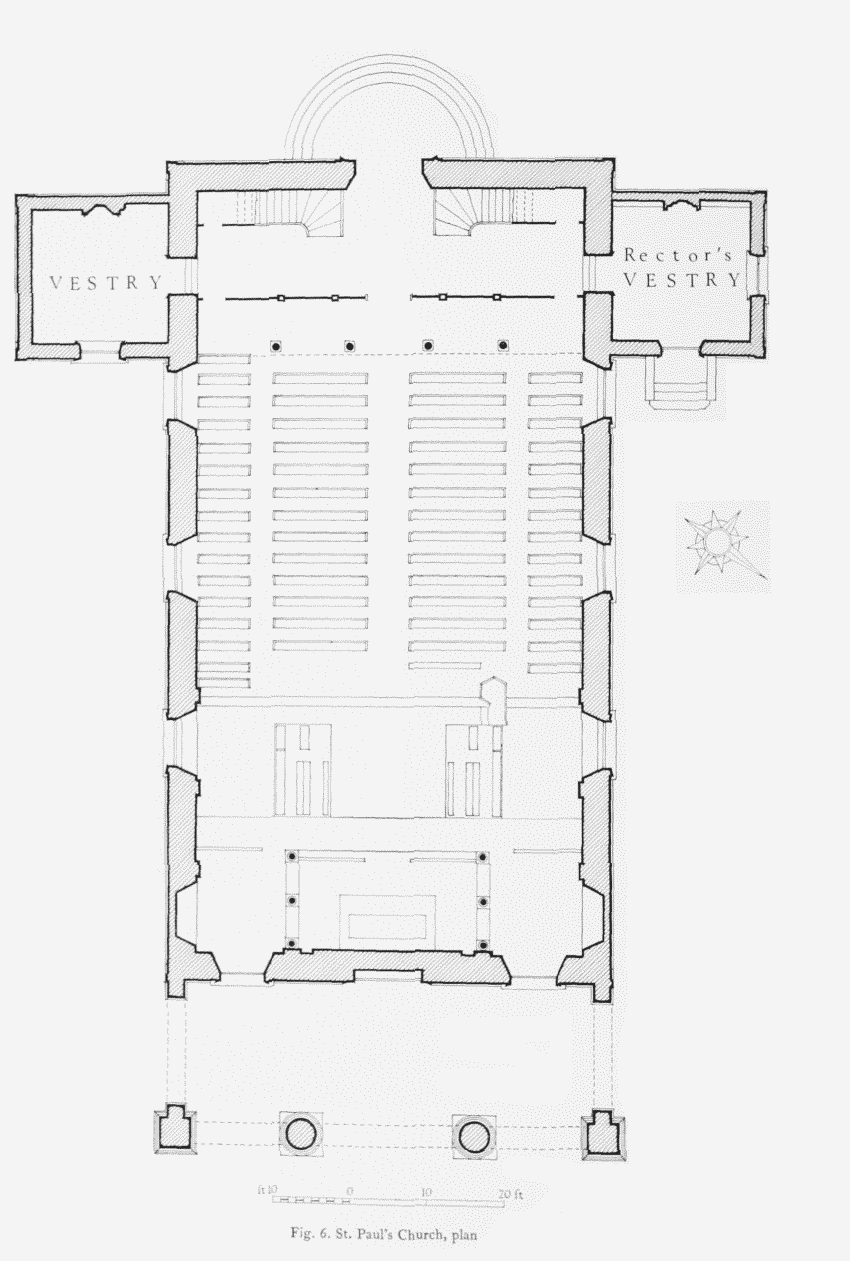
St. Paul's Church, plan
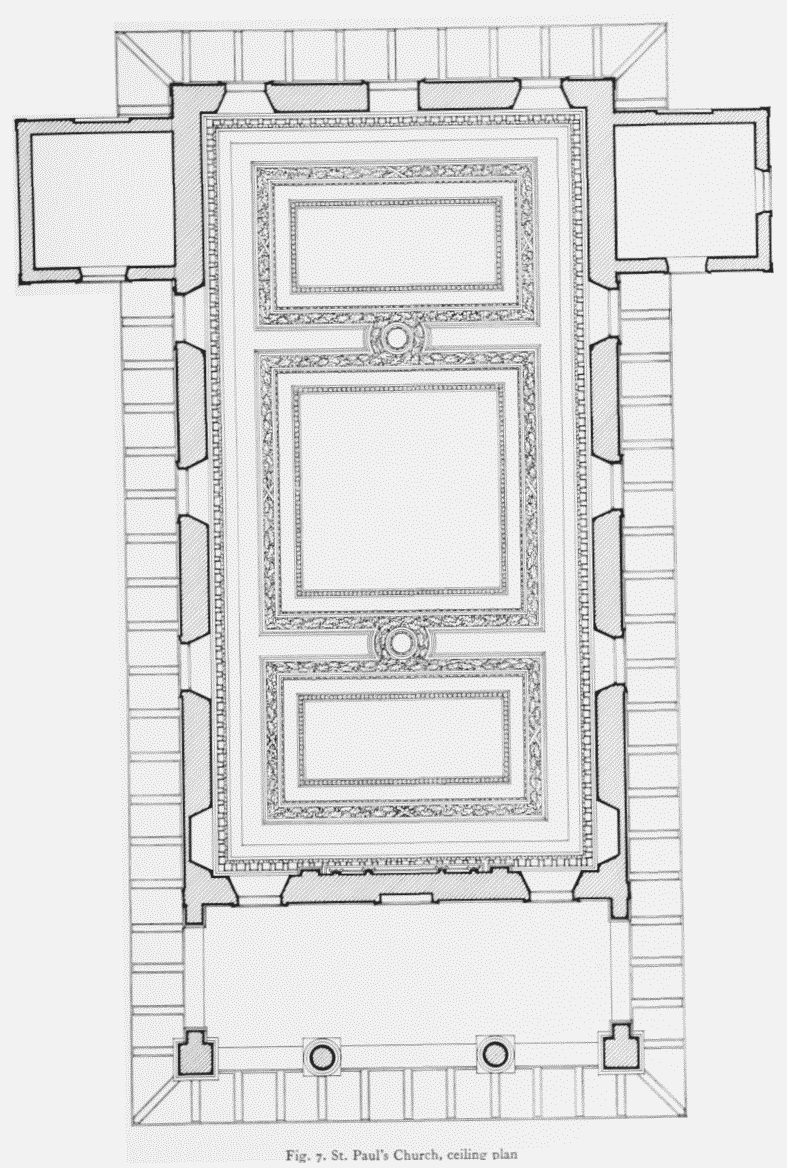
St. Paul's Church, ceiling plan
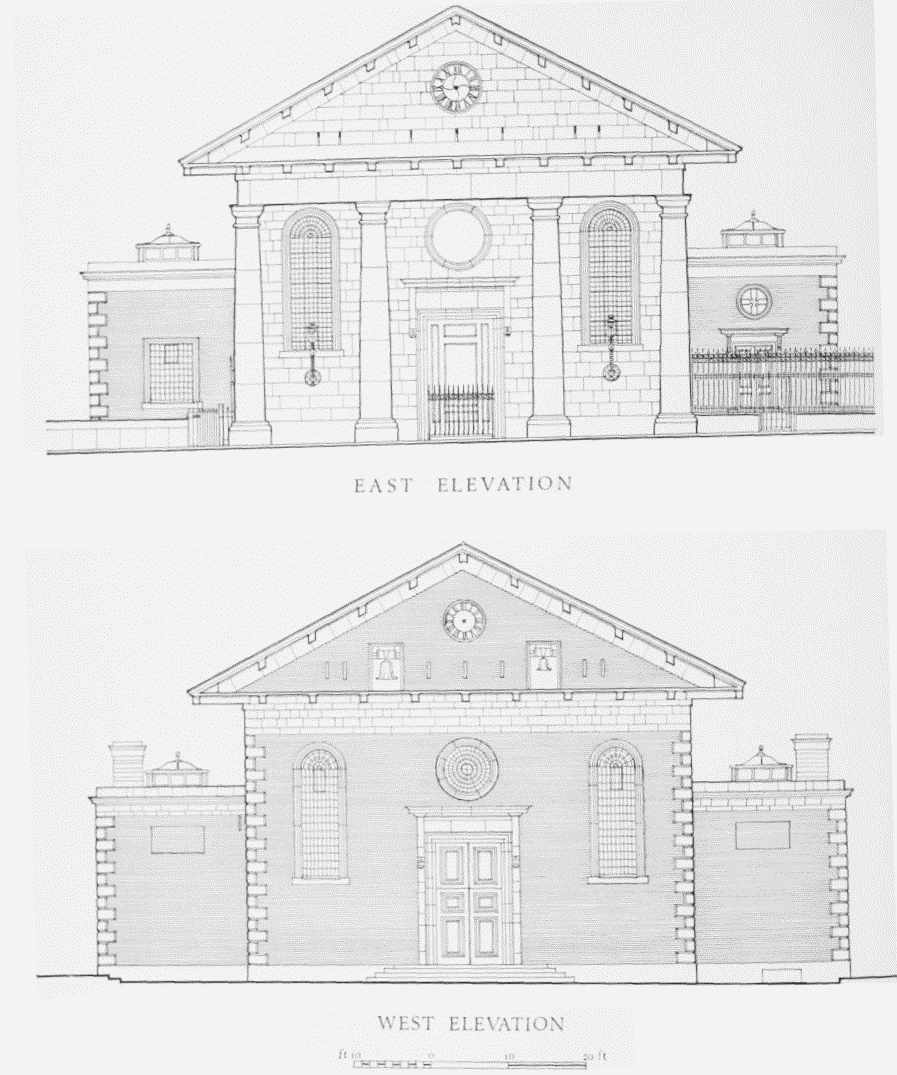
St. Paul's Church, east and west elevations
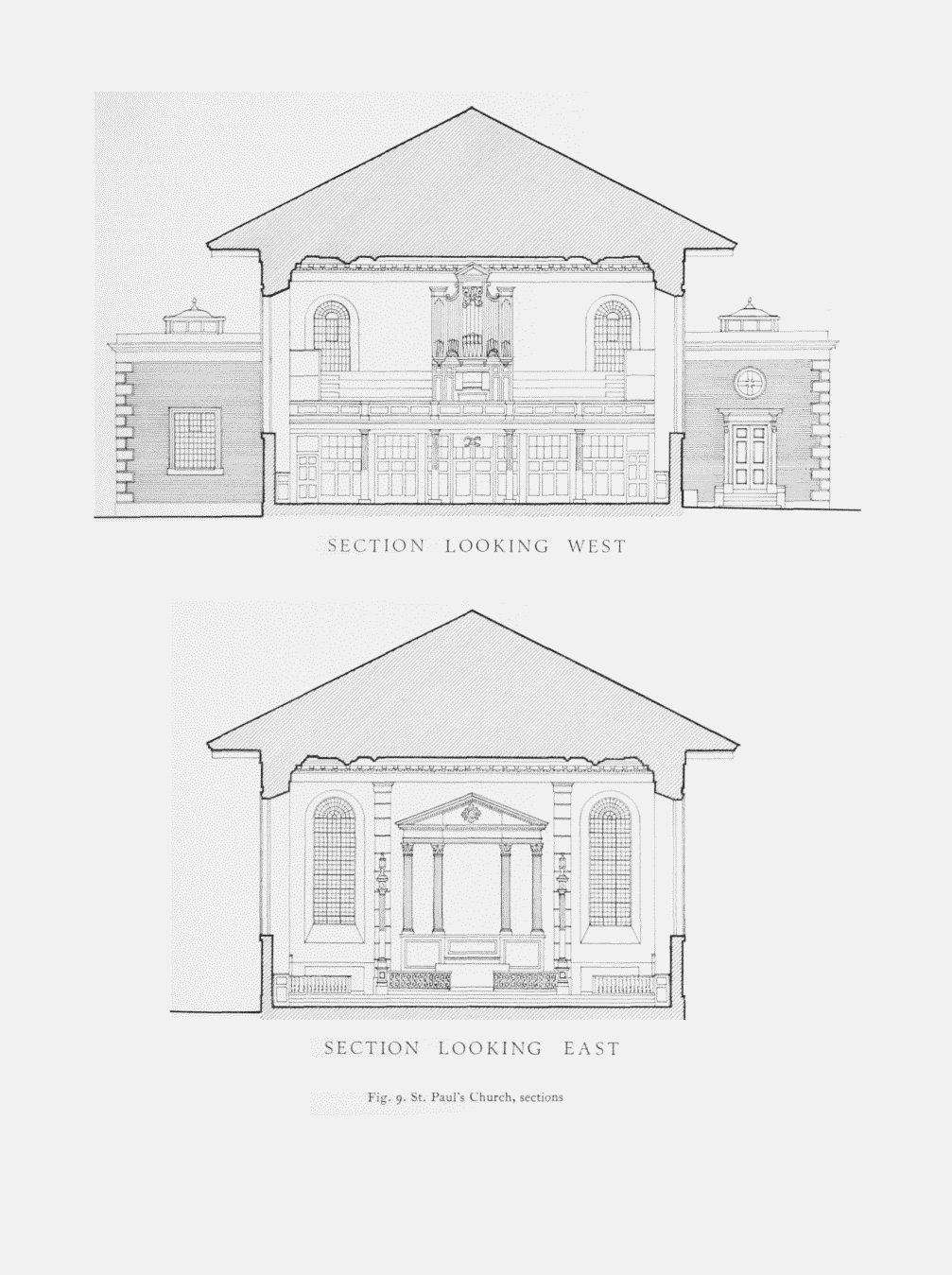
St. Paul's Church, sections
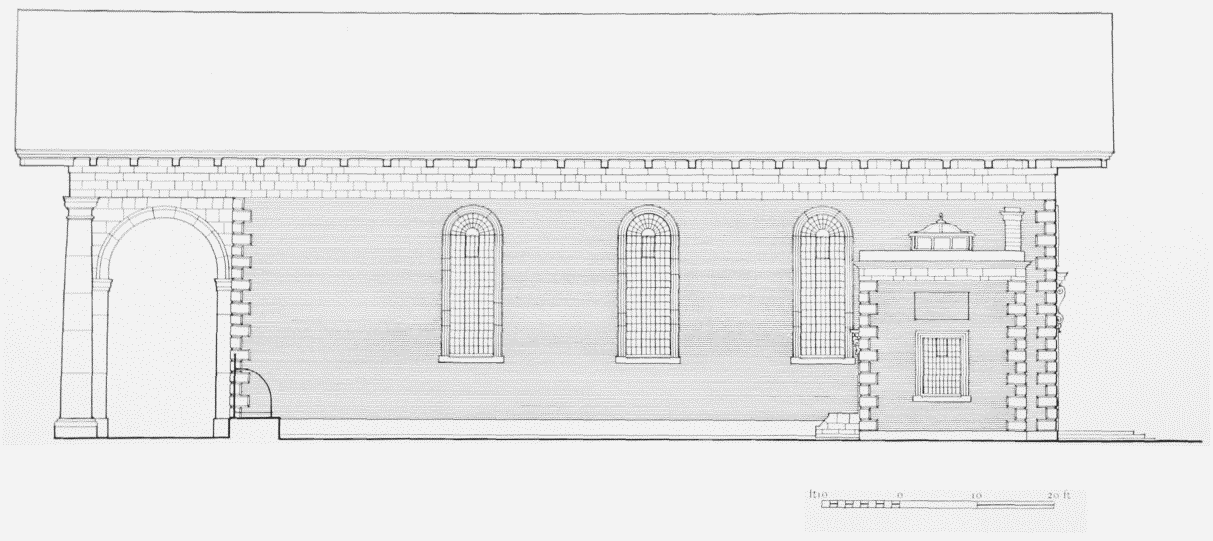
St. Paul's Church, north elevation
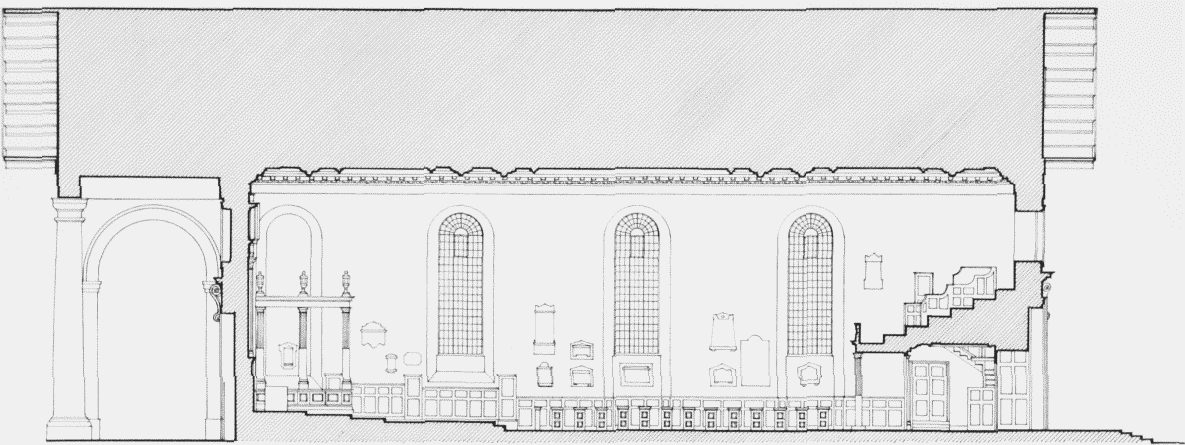
St. Paul's Church, long section looking south
The cost of the rebuilding had been increased by the wartime shortage of timber. The payment to the chief workman, the carpenter Thomas Wapshott, included a gratuity of £800 in consideration of his loss, under his contract, from the rapid rise in prices. All the bills were, however, discharged promptly, and the last had been paid by May 1799. (fn. 230)
Hardwick's interior is shown, before any important changes had been made to it, in the drawing reproduced on Plate 17b, and was described by Thomas Allen in 1828:
'The interior is very plain and has a quakerlike appearance; it produces therefore disappointment when contrasted with the simple grandeur of the outside; the ceiling is horizontal, and rests on a block cornice which forms the finish to the side walls; it is pannelled by mouldings of no very great projection, into circles and other figures; in a large circle which forms the centre is the Hebrew name of the Deity in a glory and clouds. A gallery of oak, sustained on fluted Doric columns of the same, occupies the east [sic for south], west and north walls; in the western portion is the organ, which is more properly ornamented than any other part of the church. The altar screen placed against the centre of the eastern wall consists of a stylobate sustaining four pilasters of the Corinthian order surmounted by an entablature and pediment; in the intervals the usual inscriptions, with the sacramental cup, and other subjects in relief. On the raking cornice of the pediment, an urn and pedestal, with an angel reclining on each side; the sculptor was the late Thomas Banks, R.A.
'The pulpit and desks are placed in one group in front of the altar rails. The font is situated in a pew on the south side of the church; it is a small basin of white marble on a shaft of red.' (fn. 231)
The attribution of the carved work on the reredos to the 'classic chisel' of Hardwick's friend, Banks, was also made by Britton and Pugin in 1825, (fn. 232) but the only payment for carving the reredos of which there is record was some £255 to James Tayler. (fn. 217)
In 1804 Hardwick was officially appointed surveyor to the parish at a salary of 10 guineas a year, and so continued until his death in 1829. (fn. 233) He was succeeded, at the same salary, by T. Stead, until the post was discontinued in 1833. (fn. 234)
For seventy years or so after the rebuilding there is little record of important changes. (fn. 47) There were, however, repairs or embellishments in 1814, 1824, 1831 and at other times. (fn. 235) The lighting of the church by gas was considered in 1818, and adopted in 1824. (fn. 236) In 1817 a clock had once more been placed in the eastern pediment of the church, by Thomas Grignon the younger, (fn. 237) and in 1835 this was illuminated at the expense of the sixth Duke of Bedford, to whose tenants in the market it was chiefly beneficial. (fn. 238)
In 1851–2 some repairs costing about £614 were carried out by the builders Mansfield and Sons under the direction of the architect William Grellier, (fn. 239) and in 1858 the seventh Duke contributed £10 towards the restoration of the altar. (fn. 240)
By 1861 the organist could 'get through' the Sunday services only with difficulty owing to the 'tottering state of the Mechanism'. In that year the Duke paid for a three-manual instrument by Henry Bevington, which incorporated part of the case, and possibly other pieces, of the Gray organ. (fn. 241)
Important alterations, authorized by a bishop's faculty of 20 September 1871, were carried out to the designs of William Butterfield in 1871–2. (fn. 242) By that time the exterior gave an impression of neglect, but the alterations were almost all to the interior. The church was reopened on 23 June 1872. The changes were described by The Guardian, which noted that 'in accordance with the requirements of the feelings of our day' a 'really church-like appearance' had been given to an interior which had been 'gloomy and unattractive'. The Guardian praised the special provision of seating for children, and the increased frequency of divine service that marked the reopening.
Butterfield converted the old pews into open (and uncomfortable) seats, and removed the side galleries: the accommodation was thus reduced from 832 to 528. The west gallery had perforce to remain, for want of funds to demolish it, but the organ was moved to the north-east corner of the church. The pulpit was also moved, a new reader's desk provided, and the present font installed at the west end. (fn. 243) The walls were partly decorated with pilasters and arches in colour, 'suggestive of a marble and stone treatment, whenever it can be afforded', but this decoration had to be left incomplete. Most of the wall monuments were removed. The ceiling was painted 'in bright tints'. The present flooring, with a decorative treatment in tile and marble, was laid down at the east end, where the level of the chancel was raised to its present height and in consequence the two east doors into the church from the portico were bricked up. Among the old fittings re-used were some of the gallerycolumns, which were placed north and south of the communion table, to give the effect of a sanctuary. Hardwick's reredos was altered and raised so that (like that of c. 1704) it embraced the circular east window, which was reopened and filled with 'bright and effective' stained glass. The creed, commandments and Lord's prayer in the reredos were replaced by 'large outline cartoons, slightly tinted, representing the Ascension of our Lord'. It was probably during these alterations that the easternmost side windows were blocked internally. (fn. 242)
The removal of the galleries made the interior (despite the retention of Hardwick's western screen) much closer to what it had been in 1638. In other respects, however, Butterfield's changes were inevitably very unsympathetic to Jones's style, and the raising of the east end was itself harmful to the original proportions.
The eighth Duke of Bedford had declined to contribute to the cost of these alterations, which were paid for by private subscriptions. (fn. 244) Only three years after the reopening the Duke's successor, the ninth Duke, effected the strongest silent criticism of the work by beginning a long and expensive series of further renovations, paid for by him and his successors and designed (initially) by his architect, Henry Clutton. The changes were evidently not based on a complete knowledge of the history of the building, and were much influenced by considerations of convenience and practicability, but the restoration of Jones's supposed original design was now very consciously a motive of the work.
Clutton's first report on his proposals was made to the Duke in September 1875, and they are illustrated in drawings of May 1876. (fn. 245) The interior he regarded, rightly, as having virtually nothing of Jones in it. Hardwick's work he thought 'the feeble expression of Italian art as practiced at that period', which the 'very recent modifications have not improved'. He proposed to supply a Palladian ceiling, new wainscot, and a new altarpiece, pulpit and other fittings. The organ was to be moved back to a 'Tribune' at the west end. Externally, Clutton proposed to restore the church to the simple temple form which he believed Jones had intended it to have. He thought the wings were not Jones's work, and his most important proposal was that they should be removed entirely. He also judged the lateral openings in the portico, whether Jones's work or not, to be 'innovations on an ancient Tuscan Portico', and felt free to propose that they should be widened (but not heightened or otherwise changed) to permit the diversion through the portico of the footpath on the west side of the market place. The easternmost side windows, already blocked internally, were to be entirely obliterated externally. No doubts seem to have been felt about the propriety of the masonry facing, and this was to be repaired. The west front was to be improved by removing Hardwick's bell-turret from the apex of the pediment and hanging the bells in two small square apertures formed in the pediment's tympanum. The churchyard was to be lowered and the great west doorway, furnished with handsome new doors, was to be approached by a semi-circular flight of steps in two stages each of four risers: Clutton accepted, however, the impracticability of lowering the ground at the east end to restore the original height of the church in relation to the Piazza (Plates 18b, 19a). These changes would have brought the church, especially the side elevation, to resemble very closely the 'Temple at Covent garden' delineated by Hawksmoor (fig. 3 on page 66).
The eastern gateways into the churchyard, which Clutton did not regard as of Jones's designing, were at first meant to be retained, but without their pediments. Clutton's drawings of May 1876 show, however, that by then he intended that the ground level of the churchyard should be lowered some five feet, and the difference between this and the existing level of the Piazza reconciled by interposing two semi-basement wings, each 20 feet wide, extending north and south from the east end of the church. The north range was to comprise a heating chamber and fuel store, and the south was to contain a men's lavatory, most handsomely designed with two cross-vaulted aisles divided by a range of Tuscan columns. Both wings were to have terrace roofs, and to be lit and ventilated by a series of lunette openings in the wall of rusticated stonework facing the churchyard. The terraces were to be enclosed by high iron railings on the Piazza side, and by stone balustrades on the churchyard side. The public urinal which had adjoined the south churchyard gateway since 1851 (fn. 246) would thus have been made less offensively obtrusive. Great importance was also attached to plans for making the churchyard more sanitary.
During the deliberations on the intended work a suggestion emanated from the Bedford Office for more drastic alterations, perhaps involving the removal of the portico. Clutton's rebuttal of this, in March 1877, contains an appraisal of Jones's work:
'I believe, that Inigo Jones did, literally build a Barn, but also did what his great Master Palladio did before him—He constructed an imposing Facade to screen a mean building in the rear. A simple prolongation of the roof of this Barn, and the insertion of two stone Columns and two anti to support it, evolved the noble Tuscan portico of St. Paul, Covent Garden. This was true genius. To the Earl, however, it must be remembered a portico could be of no use to the Church—but Jones had another object for a portico besides a screen, he wanted a central feature for the buildings & Piazza surrounding the great Square, and the portico best typified the Temple in the Forum of old.
'True to the principles of Vitruvius, Jones constructed the trabii or lintols, over the Columns, of wood. He possibly could not procure the large oaken timbers recommended by that author, so had recourse to what is called false construction, that is, Jones used artificial means to produce the effect he wanted. Surely if what he did has lasted two centuries, critics of the present day may reserve their censure. To me it is evident that Jones throughout the work of this Church had very scanty means at his disposal. To quote a sage of antiquity—"He is the best Cobbler who can make the strongest pair of Shoes out of the least quantity of leather." I find this principle strikingly exemplified in the Church in Covent Garden.' (fn. 247)
Attached to Clutton's plea is a note (by the Duke?): 'Let ye Portico bide where it is.'
A faculty for the work on the portico, churchyard and 'latrines' was obtained in July 1877, (fn. 248) and between 1878 and 1882 part of Clutton's programme was realized. (fn. 249) The work on the churchyard was executed, although its level was reduced less than had been intended in 1876, and the latrines made. In the course of these alterations the eastern churchyard gateways were removed. (fn. 48) Most of the proposed work affecting the external appearance of the church was carried out. The side arches into the portico were enlarged more than had at first been intended, to their present form (as is adumbrated in pencil on Clutton's elevation of 1876). While the men's lavatory on the south side was constructed, the heating chamber on the north side was omitted, much to the detriment of Clutton's original scheme. At the west end four instead of eight semi-circular steps were constructed. It proved impossible to provide the vestry with acceptable accommodation to replace that in the north and south wings of the church, and these were therefore retained, although lowered. (fn. 250) It is uncertain whether any of the intended work on the interior was executed.
Figures in the records of the Bedford estate suggest that by 1882 some £6,239 had been spent on the churchyard, some £4,954 on the latrines and some £2,790 on the church itself. (fn. 251) The builders were Messrs. Cubitt. (fn. 252)
In 1887 and the following year further important work was carried out by Holloway Brothers, under the direction of the architect, A. J. Pilkington, (fn. 253) evidently in substantial continuation of Clutton's work (fn. 254) (fn. 49) (Plates 18c, 19b). A bishop's faculty was obtained in March 1888. (fn. 256) The most striking change was the replacement of the exterior ashlar by the present bright red brick. Pilkington's comments on the poor quality of the previous stone facing have already been noted (see page III). Butterfield's seats (which were 'horizontal and the backs of them perpendicular') had been found 'most inconvenient and uncomfortable', and new were provided. The traditional altar inscriptions removed by Butterfield were replaced. Clutton's intention to restore the organ to the west end was carried out. Pilkington also provided the present ceiling, although it may be that he utilized the design known to have been previously submitted by Clutton. It was perhaps at this time that the reredos was again altered and the round east window once more concealed, although evidence of this is wanting. The church was reopened on 27 May 1888. (fn. 257)
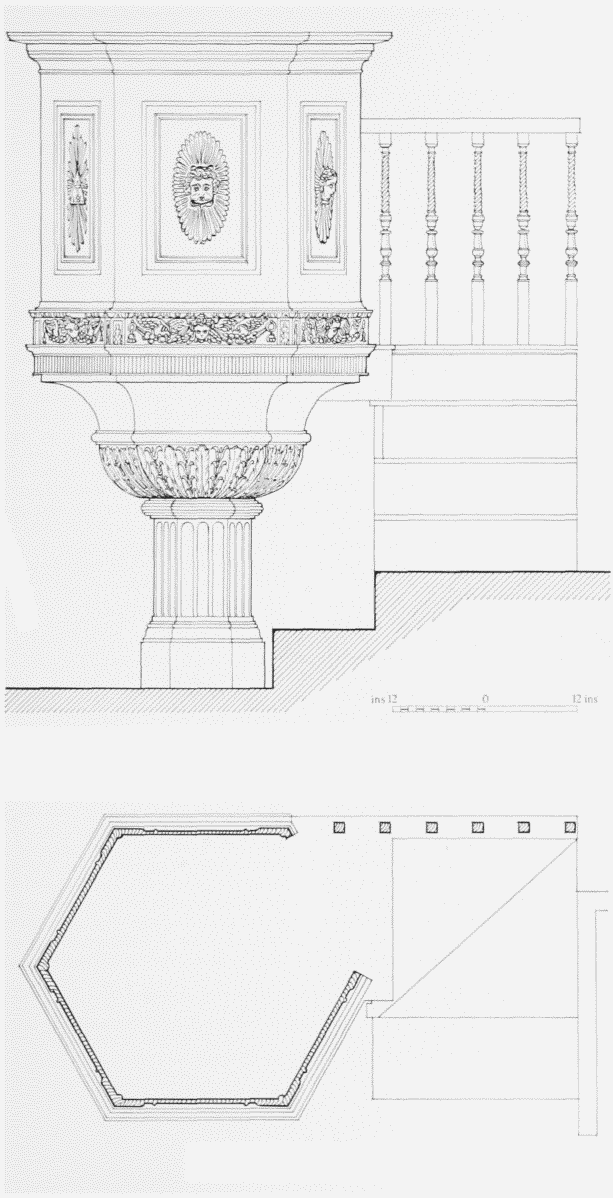
St. Paul's Church, pulpit
The total cost of Pilkington's work seems to have been some £4,224. The figure for the total expenditure on the church and churchyard by the ninth Duke (that is, mainly since 1875) was given in an estate report in 1888 as £16,572. (fn. 258)
Few subsequent alterations have been made.
In 1895 gas-lighting was replaced by electricity. (fn. 259)
In 1904 C. Fitzroy Doll, architect of the Russell and Imperial hotels in Russell Square, and of other buildings on the Bedford estate in Bloomsbury, prepared a scheme of interior decoration, comprising 'the windows and mural paintings'. (fn. 50) The eleventh Duke was, however, unwilling to pay the estimated cost of upward of £1,875, and the scheme was not executed. The rector did, however, obtain sufficient subscriptions to have a stained-glass window of St. Paul inserted in c. 1910. (fn. 259)
The rectory of St. Paul was united with the vicarage of St. Michael, Burleigh Street, in 1905, when the latter church was demolished (fn. 260) (see page 224).
After the 1914–18 war a memorial was made on the east front of the north vestry wing, incorporating a stone doorcase removed from the south front of the south wing. (fn. 261)
In 1965 a limewood wreath carved by Grinling Gibbons, a parishioner of Covent Garden who was buried here in 1721, was placed on the screen as a memorial to him (fig. 14 on page 124). It was presented by the Dean and Chapter of St. Paul's cathedral. (fn. 262)
The Bevington organ was completely dismantled and restored, but not modernized, by N. P. Mander, Limited, in 1967. (fn. 263)
The present Fabric of the Church (fn. 51)
The most noteworthy changes made to the exterior by Clutton were the enlargement of the side arches into the portico, the removal of Hardwick's bell-turret, and the reduction in height of the vestry wings. Whereas the original portico arches were treated like the windows with unbroken moulded architraves, the new arches have very simply moulded archivolts rising from architrave-profiled imposts above plain piers. Each vestry wing was reduced in height by about 2 feet and finished with a plain frieze, moulded cornice, and a plain blocking-course, partly concealing the low ogee-capped square lantern-light rising from the flat roof. Pilkington's work on the exterior was largely confined to replacing the defective ashlar facing with red brickwork, using a bond having three courses of stretchers alternating with one of headers (Plate 18c).
Although there is virtually nothing of Jones's work to be seen inside the church, the general effect is now probably closer to his original conception than at any time since the 1640's, when the south gallery was allowed to spoil the harmony of his finely proportioned interior (Plate 22).
Above the low dado of oak panelling, and except for some unobtrusive memorial tablets, the walls are quite plain and only a staff-bead is used to dress the splayed reveals of the tall and roundarched window embrasures. The east wall alone is now divided into three bays by pilaster-strips of channel-jointed courses, with architrave caps. Hardwick's altered reredos occupies the wide middle bay and there is a tall window in each side bay. A plain and narrow frieze-band projects slightly to finish the walls, above which is the boldly modelled cornice enriched with an eggand-dart moulding below the plain modillions supporting the corona, and a beaded fillet below the crowning cymatium. A plain margin surrounds the flat ceiling, where raised mouldings are used to frame three large compartments, the middle one almost a square and each end one an oblong. Except for an egg-and-dart ovolo on the inside, the outer frame is composed of plain mouldings on either side of a heavy and broad band of cross-ribboned oak garland, freely modelled and undercut. The mouldings of these outer frames are turned and lapped to enclose small circular ventilators breaking the margins between the three compartments. Within each compartment is an inner frame enriched with a beaded moulding.
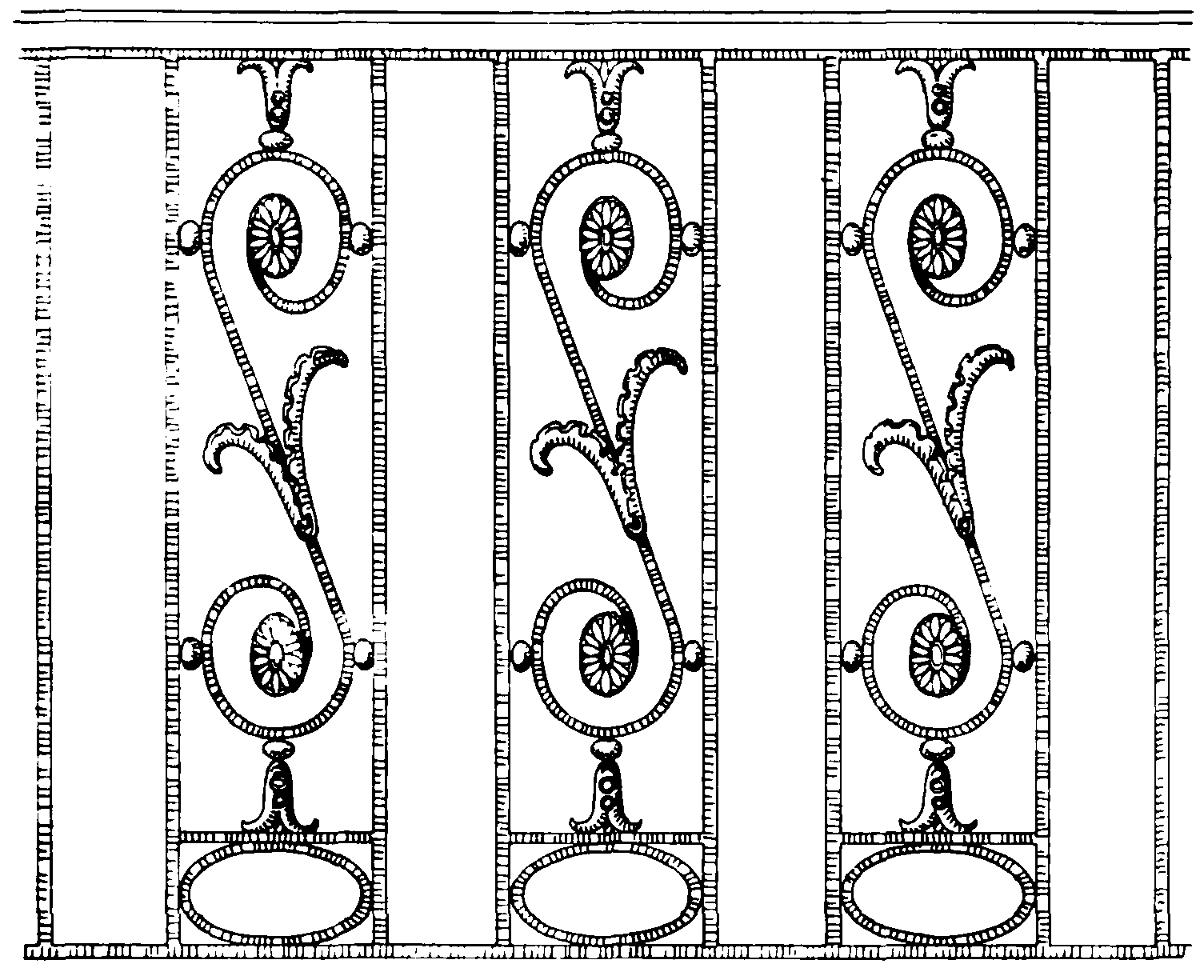
St. Paul's Church, altar rail
The important architectural furniture designed by Hardwick has been largely retained, though altered and sometimes used for purposes other than those intended. His handsome reredos was originally set at a lower level than at present, within a shallow round-arched recess. The inscribed tablets have gone from the three intercolumniations, and the urn and flanking figures no longer ornament the pediment, but the architectural framework remains (Plate 23b). Now elevated on a high plinth, the tall pedestal is divided vertically into three parts, all similarly panelled, that at each end projecting below a widely spaced pair of fluted Corinthian pilasters. These support a simple but appropriate entablature, its dentilled cornice returned to frame a triangular pediment. A copy of Botticelli's Madonna del Magnificat now hangs in the middle intercolumniation, and a gilt sunburst enriches the pediment's tympanum. Six of the partly fluted Doric columns that originally supported Hardwick's galleries have been re-used to form the two-bay screens on either side of the sanctuary. Raised on stepped bases above panelled dwarf walls, the columns now support entablatures crowned with urns. The communion-rail designed by Hardwick is of wrought iron and composed of a series of narrow vertical panels, each containing an S-scroll enriched with leaves and a small oval patera (fig. 13). The pulpit, now placed to the north-west of the sanctuary, is hexagonal in plan and rests on a short fluted column of the same form. This supports the cyma-profiled base, which is plain above a horizontal moulding and carved below with formal acanthus leaves. The front of the pulpit is treated as a pedestal, having a plinth richly carved with leaves, swagged garlands, and cherubheads, above a band of fluting. Above the plinth each face is formed with a large raised-and-fielded panel, one enriched with the symbol of the Trinity, the others with an oval motif formed of a winged cherub-head, and the top rail is formed as a cornice (fig. 12). All the woodwork is of polished oak, discreetly enriched with gilding.
On the evidence of Britton and Pugin's engraved plan (Plate 16) it must appear that the present west gallery is not that originally constructed by Hardwick, although it incorporates much of his decorative material. Four of his partly fluted Doric columns are equally spaced to support the gallery front, which is dressed with an entablature below a pedestal divided by plain dies into five bays, each with three oblong panels. In the middle panel of the central bay is a clock dial, and the middle panel of each flanking bay is decorated with the Royal Arms. In the centre of the gallery rises the fine organ case, its console set in a panelled chest below the exposed pipes which are arranged in five groups. The middle group is set in a frame with a carved valance below a triangular pediment, and each end group is treated as a 'tower'. Below the gallery is a screen formed with partly panelled and partly glazed partitions and doors extending between Doric pilasters, corresponding with the columns supporting the gallery front. This screen divides the west end of the church to form a lobby, having a gallery staircase on either side of the great west door, and at each end a door leading to a vestry. The church is now furnished with panelled oak benches arranged in four blocks, served by three aisles, and there are two ranges of choir stalls flanking the space in front of the sanctuary.
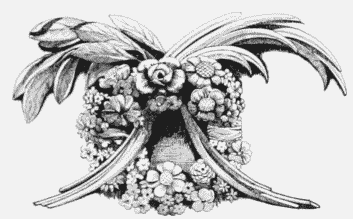
St. Paul's Church, carved wreath by Grinling Gibbons, until recently in St. Paul's Cathedral
Churchyard
In the fourth Earl of Bedford's act of donation on the day before the consecration of the church, 26 September 1638, the area of the churchyard and of the three entrance passages from Bedford Street, Henrietta Street and King Street were stated approximately as they have subsequently remained. (fn. 264)
The building accounts say little of the churchyard, beyond its planting with hayseed. The pair of much admired eastern gateways out of the Piazza are mentioned, set in brick walls. (fn. 265) It is not known when this wall, which seems to survive in Sutton Nicholls's view of c. 1717–28, was replaced by the dwarf wall and iron railings shown in mid eighteenth-century views of the Piazza. Possibly the good decorative ironwork gates of early eighteenth-century character were provided for these gateways in 1714–15 (see page 107, n.): originally, like the other gateways into the churchyard, the eastern entrances were furnished with wooden doors. (fn. 266) Iron gates of the same character still survive in the southern and northern entrances out of Henrietta Street and King Street (Plates24, 25). In c. 1730 these southern and northern entrances were rebuilt. (fn. 267)
In Bedford Street Kip's view of c. 1718–22 seems to show gates of iron rails, hung between ball-topped piers set in a wall. New iron gates were provided in 1788 (fn. 268) and again in 1880. (fn. 269)
Within the churchyard, wooden posts and rails were provided in 1677–9, two of the posts being surmounted by carved figures. (fn. 136) The wooden rails were renewed in 1714 (fn. 270) and 1740 (at the latter date at least, in oak). (fn. 271) In 1770 they were replaced by iron railings. (fn. 272) (fn. 52)
Hollar's mid seventeenth-century view (Plate 1) shows no trees in the churchyard. By 1680 a vine required pruning, (fn. 136) and by 1690 trees had been planted. (fn. 274) Strype describes the churchyard in 1720: 'Coming out of Bedford street is a very handsome Walk, with a Freestone Pavement, and Pallisado Pales on each side, leading into the Church, through the Midst of the Church-yard. The like Walk is out of Henrietta-street, and King's-street, with Rows of Trees; which, when grown to Maturity, will be very ornamental.' (fn. 169) In 1732 limes were planted, and other limes and elms in 1740 and 1759. (fn. 136)
From an early period the vestry was concerned at the nuisance and insecurity threatened by the proximity of the churchyard to the backs of the houses in the surrounding streets (Plate 17a). In 1685 all doors made without leave were ordered to be shut up. (fn. 275) Subsequently, licences were sometimes sold for making windows on to the churchyard, (fn. 276) but the first recorded licence for a house-door to be made was in 1732. (fn. 277)
By 1755 the vestry was becoming concerned also at the rise in level of the churchyard, which it was inclined to attribute to the burial of large numbers of non-parishioners. (fn. 278) Until the consecration of a burial-ground at the workhouse in St. Pancras in 1790 (fn. 279) the churchyard was also filled 'with the remains of multitudes of Paupers'. (fn. 280)
In 1853 the churchyard was closed to burials, (fn. 281) and in 1855 the tombstones were removed or laid flat. (fn. 282)
Between 1878 and 1882, as part of the general renovation of the church by Henry Clutton, alterations were made to the churchyard by Messrs. Cubitt, (fn. 252) under his direction. A bishop's faculty was obtained in July 1877. (fn. 248) The frontage to the Piazza south of the church was set back, and the two Jonesian entrance gates from the Piazza removed, to permit the construction of men's lavatories south of the church, and cellars. (fn. 283) (fn. 53) (A proposal to re-erect the gates at the King Street and Henrietta Street entrances came to nothing.) (fn. 285) The ground west of the church was lowered and levelled, (fn. 286) and for purposes both of security and sanitation the churchyard was set back from the adjacent houses. (fn. 287) An area was excavated on the north, west and south sides, to prevent the adjoining occupants' getting into the churchyard 'and using the same for various and improper purposes', (fn. 248) and to remedy a 'soakage' from the graves into the houses. (fn. 288) Some displaced bodies were put in a vault under the church and the rest reinterred at Brookwood. (fn. 288) In 1877 it was intended to plant poplars in the churchyard (fn. 285) but evidently this was not done. The present iron gates into Bedford Street probably date from this period. (fn. 289)
In the early twentieth century the churchyard was evidently being cared for by gardeners employed by the Bedford estate, as in 1918 the rector was informed they would no longer do so, the estate being sold. (fn. 290)
In the same year plans were prepared by P. Morley Horder for a war memorial hall north of the church, but this was not built, perhaps partly because it was found that burials had been made there. (fn. 291)
The statue of Charles I
The equestrian statue of Charles I in brass which now looks down Whitehall from Trafalgar Square was during the Commonwealth to be found in Covent Garden churchyard. Why this was so is not entirely clear, although the early history of the statue seems well established. It had been made in 1633 for the Lord Treasurer, Lord Weston (created in that year Earl of Portland) by Hubert Le Sueur, who was to be paid £600 for it. (fn. 292) Doubt has been expressed whether it ever stood, as was intended, in the garden of Portland's house at Roehampton, but it is evident that it did.
Portland died in 1635 and the next that is known of the statue is in November 1644, when the Roehampton estate was owned by Sir Thomas Dawes, a 'delinquent'. His property had been sequestrated and the House of Commons was concerning itself with the sale of the statue. The Commons' Journal does not say what was intended, (fn. 293) but in the following month the statue was taken from Roehampton to Covent Garden. Sir Thomas notes in his diary that this was done 'by order of the House of Commons' in the person of 'Captaine Withers', who had come to Roehampton in November to value it. (fn. 294) He was Anthony Wither, a prominent resident in Covent Garden, who paid about £150 for it, and is said, convincingly enough, to have been acting for two other Covent Garden residents, Edward Carter (who was Surveyor in the Office of Works) and Richard Harris, chapelwarden. All three were among those nominated 'governors' of the new parish in January 1645/6, and the purchase had evidently been made on behalf of the chapelry. (fn. 295) Why the statue was bought at such a time is not known. (fn. 54)
In the course of 1645 Wither himself fell under the suspicion of the Commons and in January 1645/6 his estate was sequestrated. (fn. 297) Perhaps in consequence of this, the vestry of Covent Garden ordered in April that the statue should be 'speedily sold' by Carter. (fn. 298) If anything was done, it was evidently no more than the transference of the ownership to Carter personally. Thus in 1650 the statue was still within the parish; in fact, in the churchyard. In July of that year the Council of State had ordered royal statues at St. Paul's cathedral and the Exchange to be thrown down or mutilated. (fn. 299) This, and the fact of Wither's appeal against the sequestration of his estate as a delinquent, seem to have drawn the Council's attention to the statue in Covent Garden. In October the Council ordered an enquiry into its ownership (and that of Charles's statue at Greenwich) (fn. 300) and in February 1650/1 the Commissioners for Sequestrations in Middlesex were required to investigate whether it belonged to Wither. (fn. 301) Carter interposed his claim to its ownership and in March the Commissioners decided in his favour. (fn. 302) No more is known of any connexion of Carter with the statue.
The only other (presumed) reference to the statue before the Restoration is in 1655 when the Council for an unknown reason again ordered an investigation into 'the matter of Fact touching a Statue in the Churchyard of Covent Garden'. (fn. 302)
In 1660 the second Earl of Portland discovered the whereabouts of the statue, which by then was in the possession of a brazier, John Rivett, and the House of Lords interested itself in securing the surrender of the statue to Portland. Between 1672 and 1675 Charles II bought it, for £1,600, from the Countess of Portland, and it was set up at Charing Cross. (fn. 292)
As early as 1684 Chamberlayne was writing that during the Interregnum 'the Rebels' had sold the statue for the price of the brass to an unnamed brazier (said to be of Holborn), 'who preserved it intire till his Majestie's happy Restauration'. (fn. 303) In Vertue the story is given in more detail. After noting that in Covent Garden churchyard the statue was 'boarded up or enclosed', Vertue says that on acquiring it the brazier, of Snow Hill, took pains to seem to have broken it up, but actually concealed it 'under ground' until the Restoration. (fn. 304) This version was published by Walpole, who gives the brazier's name as Rivet. (fn. 305) (fn. 55)
Vertue adds that the statue had been 'cast and wrought in a peice of ground near the Church of Covent Garden'. (fn. 307) There appears to be no other evidence of this, and some doubt is cast on it by the fact that Vertue associates this statement with another that is known to be erroneous, that it had never been removed from Covent Garden until it was sold to the brazier, whereas it certainly came to Covent Garden from Roehampton. (fn. 56)
Round-House
Hollar's mid seventeenth-century aerial view (Plate 1) shows a building in the south-east corner of the churchyard, which is represented in more detail in the undated drawing reproduced on Plate 12b and in Sutton Nicholls's view of c. 1717–28 (Plate 26). These depict a small, and small-scaled, structure, in a very un-Jonesian style. It was the parish round-house or watchhouse, and was probably built soon after the creation of the parish in 1646: the first certain reference to it in surviving records is in 1655. (fn. 308) In 1733 the vestry decided to rebuild it, (fn. 309) and mid eighteenth-century views show a very unpretentious building set back a little from the Piazza frontage. The Act of 1788 for raising funds to repair the church also empowered trustees to demolish the watch-house and hire another site, but this was not done. In 1829 the Commissioners of Metropolitan Police announced their intention to take over the use of the building, (fn. 310) but relinquished it in 1832 for the new police station in Bow Street. (fn. 311) The watch-house was demolished in the following year. (fn. 312)
School
A few weeks after St. Paul's was consecrated, in November 1638, one Alexander Alexander was admitted by the bishop's vicar-general to teach in a grammar school within the chapelry. (fn. 313) Nothing is known of this school, although in 1650 Anthony Wither, one of the 'governors' of the parish, was claiming to have been instrumental in obtaining a benefaction of £20 or £30 per annum in land 'for a free schoole' for Covent Garden. (fn. 132)
In the 1670's the parish benefited from the will, proved in August 1672, of William Shelton, which provided, inter alia, for the education of five children from St. Paul's at the school he had established in Parker Street, St. Giles in the Fields. Each scholar had a green coat provided by the charity, and in 1679 the churchwardens of St. Paul's were providing each with green breeches. The parish seems to have continued to benefit intermittently from this educational charity until the mid nineteenth century. (fn. 314)
The St. Paul's charity school for boys was established in 1702, (fn. 315) and that for girls in 1712. (fn. 316) In 1701 the belfry-wing at the south-west end of the church had been converted into a schoolroom, (fn. 161) and so remained for some three quarters of a century: thirty boys were educated here. The girls (twenty in number) seem to have had no permanent schoolroom, accommodation being provided by the schoolmistress. (fn. 317) In 1729–30 a burial vault was made under the boys' schoolroom. (fn. 318) In 1775–8 the parish built a workhouse in Cleveland Street, St. Pancras, and thither were transferred the boys' school and the girls' school (which had latterly been in Hart Street). (fn. 105) In 1779 the south-west wing of the church was fitted up as the vestry clerk's office (fn. 319) and this or similar use has continued thereafter. (For the subsequent history of the schools see pages 61– 63).
The Rectory House
In 1637, before the church was consecrated, a house on the west side of James Street (later No. 27) had already been assigned by the fourth Earl of Bedford for use as the minister's house. (fn. 320) This arrangement was confirmed by the Privy Council in April 1638, although in the absence of legislation to make the precinct parochial the house was not then permanently attached to the living. (fn. 121) In 1637 the house was occupied by a Mr. Robert Russell, (fn. 320) and from 1637 to 1641 the rates were paid by a William Russell, esquire. In 1643 and 1644 no rates seem to have been assessed on the house. (fn. 105) Probably this indicates that in the two latter years the house was being occupied by the minister, rate-free. Conceivably this had been so from the time of the consecration of the church in 1638, with the Russell family making itself responsible for the rates.
The Parliamentary ordinance of 1646 by which the precinct was made parochial designated another house for the rector's residence. This was on the north side of King Street (later No. 42). It was to be occupied by the rector for the remaining twenty-five and a half years of a lease granted by the fourth Earl to the previous occupant, Maurice Aubert, Queen Henrietta Maria's 'chief chirurgion', whose estate had been sequestrated. Thereafter the rector was to revert to the James Street house. In the meantime the latter house was vested in the 'governors' of the new parish, who were to let it and apply the rent to parochial purposes. (fn. 321)
Thenceforward until the Restoration the King Street house disappears from the ratebooks, presumably because of its occupation rate-free by the rector, and the James Street house was let by the parish successively to Sir Henry Herbert, sometime master of the revels (c. 1647–56), and Edward Bleyden, a tailor (1657–65). (fn. 322)
The Parliamentary ordinance was invalidated by the Restoration, and the Act of 1660 which gave authority to the parochial status of Covent Garden designated the James Street house as the rectory house. (fn. 149) The part of James Street in which the house was situated was no longer possessed by the head of the Russell family, and it was 1665 before the house was conveyed to the fifth Earl, in trust for its use as the rectory house, by John and Edward Russell. (fn. 323) From 1666 onwards the ratebooks indicate that it was held by the rector rate-free until 1782 (with the exception of periods of lay occupation in 1673–88 and 1724–32).
From 1784 onwards the rector (or his curate) paid the parochial rates (except for a period of lay occupation from 1790 to 1803). (fn. 105) By the early nineteenth century, however, the growing business of the market was rendering James Street unattractive and in 1813 the removal of the rectory house to No. 7 Henrietta Street was being envisaged. (fn. 324) The rector was not resident in James Street after 1822, and the move to Henrietta Street was effected in 1832. (fn. 325) The deed of exchange, between the rector and the sixth Duke of Bedford, was made in the following year, with the consent of the Bishop of London. (fn. 326)
Nothing is known of the appearance of No. 27 James Street during the period of its use as the rectory house. It has since been rebuilt.
No. 7 Henrietta Street remained in use as the rectory house until c. 1934. (fn. 327) It still survives (see pages 233–5).
In 1905 the former vicarage house of St. Michael's, Burleigh Street, at No. 14 in that street, was taken over as the clergy house of St. Paul's when St. Michael's was united with it (see page 224). It is now the rectory house of St. Paul's.