Survey of London: Volume 37, Northern Kensington. Originally published by London County Council, London, 1973.
This free content was digitised by double rekeying. All rights reserved.
'Bedford Gardens to Uxbridge Street: The Racks', in Survey of London: Volume 37, Northern Kensington, ed. F H W Sheppard (London, 1973), British History Online https://www.british-history.ac.uk/survey-london/vol37/pp77-86 [accessed 9 May 2025].
'Bedford Gardens to Uxbridge Street: The Racks', in Survey of London: Volume 37, Northern Kensington. Edited by F H W Sheppard (London, 1973), British History Online, accessed May 9, 2025, https://www.british-history.ac.uk/survey-london/vol37/pp77-86.
"Bedford Gardens to Uxbridge Street: The Racks". Survey of London: Volume 37, Northern Kensington. Ed. F H W Sheppard (London, 1973), British History Online. Web. 9 May 2025. https://www.british-history.ac.uk/survey-london/vol37/pp77-86.
In this section
CHAPTER V - Bedford Gardens to Uxbridge Street: The Racks
The area covered by this chapter (fig. 9), which was known by the ancient name of The Racks, was formerly part of the Campden House estate and came into the possession of the Phillimore family during the eighteenth century (see page 58). In 1774 Robert Phillimore appointed the reversion of The Racks to his younger son, Joseph Phillimore, as part of a settlement on the latter's marriage, and confirmed the transaction by his will. (fn. 8)
Joseph Phillimore, who became vicar of Orton-on-the-Hill, Leicestershire, sold The Racks, consisting of slightly over twenty-five acres, by auction in 1808 for £6,790 (equivalent to approximately £270 per acre). (fn. 9) There were two purchasers. Alexander Ramsay Robinson, who owned other land in Kensington and had at one time been a tenant of The Racks, purchased approximately 14½ acres, while John Jones of Harley Street, esquire, bought the remaining 10½ acres. (fn. 10) The dividing line between their respective purchases is shown on fig. 9. In 1810 Jones sold his portion to John Johnson of Horseferry Road, Westminster, a paviour, for £2,660 (approximately £253 per acre). (fn. 11)
Robinson also disposed of part of his newly acquired land within a short time when he sold 3½ acres to the West Middlesex Water Works Company (see below). In 1822 he agreed to sell most of the remainder, (fn. 12) or 10¾ acres, for £6,000 (approximately £560 per acre) to Henry Gore Chandless of St. Marylebone. Chandless was the son of a prosperous property owner and brother of a barrister, (fn. 13) and, according to the deed of conveyance, he had secured purchasers for part of the land that Robinson had contracted to sell to him before the documents could be drawn up. The new parties to the transaction were two builders from St. Marylebone, John Punter and William Ward, who agreed to pay Chandless £4,300 for 5¾ acres (approximately £750 per acre). (fn. 14) Within a few months Chandless had found a buyer for the remaining 5 acres in another builder from St. Marylebone, William Hall; (fn. 15) the price paid by Hall is not known, but if it was at a comparable rate to that paid by Punter and Ward, Chandless would have secured a considerable profit on the transactions. He was later found to be under twenty-one years of age at the time of these dealings and had to sign confirmatory deeds when he achieved his majority, but he (or perhaps his father or brother) seems to have shown considerable business acumen.
In 1823 Punter and Ward divided the land which they had jointly purchased, after having agreed to lay out two east-west streets (Campden Street and Peel Street). With minor exceptions, Punter's share consisted of Peel Street and Ward's of Campden Street. (fn. 16) Hall also planned to develop his land by constructing an east-west road (Bedford Place, now Bedford Gardens), but he was able to provide house plots of much greater depth (generally about a hundred feet) than those of Punter and Ward. As a result of their decision to make two roads across an area which was of basically the same width as Hall's land, the house plots in Peel Street and Campden Street were in most cases less than fifty feet in depth, and the houses built there were of a different type and catered for a different social group from those in Bedford Gardens.
Bedford Gardens
In 1823 William Hall, who was also building on the Eyre estate in St. Marylebone, secured £9,000 by mortgaging his property in St. Marylebone and Kensington. (fn. 17) One of his mortgagees was William Hussey, a solicitor, who had helped to arrange the sale of Robinson's land in 1822. Of the total amount borrowed, £5,500 was apportioned to Bedford Gardens, and shortly afterwards Hall obtained a further £1,800 on the security of this land. Before the end of the year his mortgagees may have become concerned about Hall's solvency—perhaps because an action was brought against him for the recovery of £5,000 in debts (fn. 18) and Bedford Gardens was put up for sale by auction in ninety-seven lots, providing house plots with seventeen-foot frontages. A number of these plots on the south side of the road towards the western end were bought by various individuals at approximately £70 each, (fn. 19) but the whole of the north side and most of the south side became the property of William Bromley, a solicitor of the firm of W. and J. W. Bromley of Gray's Inn. (fn. 20) As in the case of Hussey, Bromley's firm had been involved in the transactions which took place in 1822.
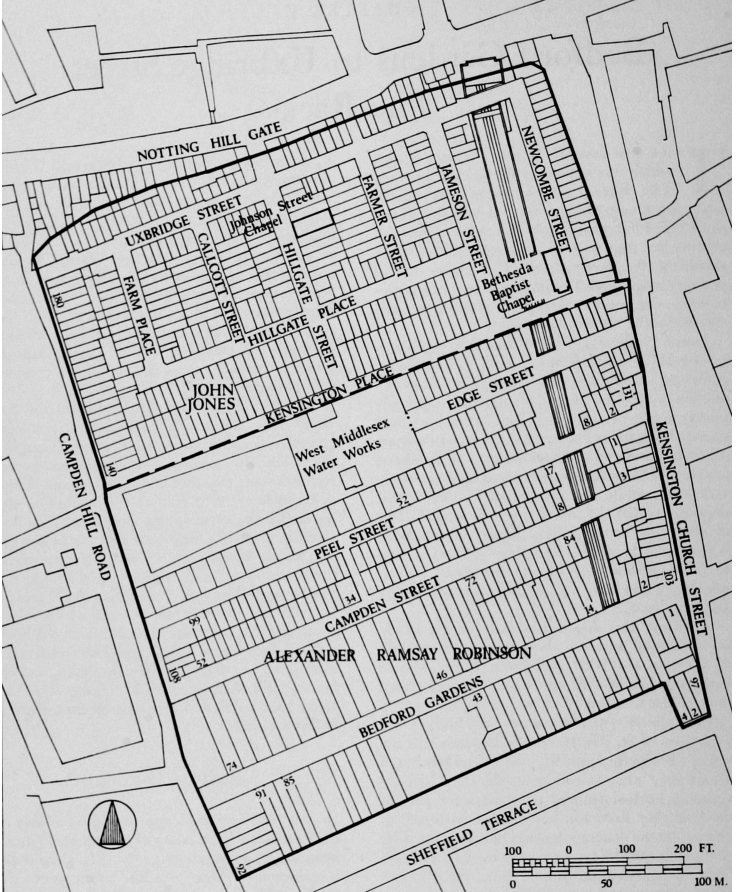
The Racks area, showing the lands bought by John Jones and Alexander Ramsay Robinson in 1808. Based on the Ordnance Survey of 1862–72
Owing to lack of documentary evidence, it is not possible to determine exactly how Bromley came to acquire the freehold of most of Bedford Gardens, but he may have been acting in Hall's interest. In 1824 the two entered into an agreement whereby Hall, by now referred to as William Hall the elder, was to build a terrace consisting of fifty-one houses with seventeen-foot frontages on the north side of the road. The houses were to be built to the satisfaction of William Bromley's surveyor (who was not named) and Bromley agreed to grant ninety-nine-year leases from 1824 to Hall or his nominees. (fn. 21) The frontage on the south side of Bedford Gardens, mostly at the eastern end, of which Bromley also owned the freehold, was developed by William Hall the younger, Charles Hall and Caleb Hall, all of St. Marylebone, builders, and probably the sons of William Hall the elder. (fn. 22)
The Halls built two late-Georgian terraces of basically identical design at the eastern end of Bedford Gardens, consisting of twenty-three houses on the north side of the street and twenty-two on the south side (fig. 10). Of these Nos. 2–4 (even), 14–46 (even), 3–9 (odd) and 19–43 (odd) survive virtually intact and No. 1 considerably altered. Most of the leases of houses on the north side were granted directly to William Hall the elder, and of those on the south side to William Hall the younger, Charles Hall and Caleb Hall jointly. Sometimes the Halls nominated other lessees, who were presumably concerned with the development. (fn. 2) The yearly ground rent for each house varied between £8 and £10, and if sold leasehold a house could command a price of approximately £600. (fn. 24)

No. 22 Bedford Gardens, elevation
The abrupt termination of the two terraces halfway along Bedford Gardens may be explained by the death of William Hall the younger in 1829 or 1830 (fn. 25), and by the fact that William Hall the elder appears to have encountered financial difficulties. By 1830 only five houses were occupied on the north side of the street (fn. 26) although leases had been granted for seventeen, and in 1831 Nos. 36–46 (even) were leased to another builder, Robert Paten of Paddington, by the direction of two trustees of the estate and effects of William Hall the elder. (fn. 27) That a new hand was at work in finishing these houses can be seen by differences in their appearance from other houses in the terrace.
Bromley quickly sold the freeholds of completed houses; in 1827, for instance, he disposed of his interest in twenty houses on the south side of Bedford Gardens and two in Kensington Church Street for £4,580 (a sum equivalent to slightly over twenty years' purchase of the ground rents). (fn. 28) In 1831 he sold the remaining ground on the north side of Bedford Gardens, as yet unbuilt on, to Walter Alexander Urquhart, a City merchant. Shortly afterwards Urquhart purchased land on the south side of Campden Street so that he could provide house plots which would extend for the whole distance between the two streets. (fn. 29)
Urquhart's solicitors were the firm of Blunt, Roy, Blunt and Duncan, and the developers chosen by Urquhart, probably through his solicitors, were Robert William Jearrad, Charles Jearrad and Charles Stewart Duncan of Oxford Street, architects and surveyors. Charles Stewart Duncan may have been related to John Duncan, a partner in the firm of solicitors, and both were later concerned with developments on the Ladbroke estate. A further connexion is that between Richard Roy, another partner and later a major speculator on the Ladbroke estate, and the Jearrad brothers. All three had considerable interests in Cheltenham, and the Jearrads not only designed several buildings there, but also established a warehouse in London to deal in Cheltenham salt. (fn. 30)
The Jearrads and Duncan built seven pairs of semi-detached houses in Bedford Gardens and one detached house facing Campden Hill Road. In 1835 Urquhart granted them ninety-nine-year leases from 1834 at annual ground rents of £12 10s. after a two-year peppercorn term for the semi-detached houses, and £25 for the detached house. Urquhart himself provided £6,000 by way of a mortgage to finance the development. (fn. 31) The houses were completed by 1836 and the lessees had no difficulty in finding tenants. (fn. 26) Shortly afterwards the semi-detached villas were advertised for sale by auction and were described as follows: 'The property is creditable to the achitectural pretensions of the builder and presents a most refreshing contrast to all the modern school. Substantiality and elegance is combined with an infinity of good taste, and Mr. Jarard (fn. 3) had thus acquired a new wreath to his well-earned previous fame. The villas are formed on a petite scale, but uniformity prevails throughout. The plan of placing two villas under one roof is here exemplified most successfully. The portico entrée to each gives them a consequence at which their neighbours do not aspire . . . They contain four bedchambers, handsome dining room leading to the drawing-room, dining parlour, small library, cook's room, lots of closets, and a cammodité [sic]; a kitchen, larder, scullery, wine cellars, coal-shed, &c. To each is a large walled garden behind, with plenty of fruit-trees, and a small garden in front. The present low rental is only £50 for each villa, but the time is fast arriving when a considerable addition will be willingly given.' (fn. 33) These two-storey brick-faced houses, Nos. 48–74 (even) Bedford Gardens, have since been considerably altered, but sufficient survives to give an indication of their pleasing quality as a group, now enhanced by a number of trees and shrubs.
No. 76 Bedford Gardens, the detached house built by the Jearrads and Duncan, has been demolished and its place taken by The Mount, a block of flats built in 1962–4 to the designs of Douglas Stephen and Partners. (fn. 34)
On the south side of the street some of the plots purchased at the auction in 1823 remained unbuilt upon for many years and often changed hands several times before houses were erected. Of the earliest surviving houses, Nos. 85–91 (odd) were built shortly before 1830. (fn. 26) Of the later houses, the most interesting is No. 77, which was built in 1882–3 by Perry and Company of Bow to the designs of R. Stark Wilkinson to contain ten studios, some with living quarters attached. (fn. 35)
The extension of the Metropolitan Railway (now the Circle Line) to Kensington in the mid-1860's led to the demolition of several houses in the terraces built by the Halls. After the construction of the railway some houses were rebuilt in 1871 by the ubiquitous Campden Hill builder, Jeremiah Little. (fn. 36) Of his houses, Nos. 6, 12 and 17 survive.
Campden Street
Campden Street comprised the main part of William Ward's share of the land which he had originally purchased jointly with John Punter in 1822. Little development took place there initially, and by 1844 only twenty houses were listed in the ratebooks, probably mostly built by Ward himself. The rack-rental value of each house was estimated to be approximately £14 and in almost all cases the rates were paid by Ward. (fn. 26)
Shortly before 1850 a more concerted attempt to complete building in the street took place. For this Ward relied on other builders, principally Henry Gilbert, who built the Campden Arms public house (now No. 34 Campden Street) and is variously described as a builder and a victualler, and William Wheeler of Portobello Terrace, builder. Gilbert was also responsible for Nos. 72–84 (consec.) on the south side. (fn. 37) William Ward died in 1850. In his will (fn. 38) he directed his trustees to grant leases of his 'Building Ground' for any term not exceeding seventy-two years, and this became the standard term for the leases granted to Gilbert and Wheeler.
The buildings on the south side of the street to the west of No. 72 were erected piecemeal over several years on land which had been sold by Ward to Walter Alexander Urquhart in 1832 to provide extensive gardens to houses in Bedford Gardens (see above).
The Byam Shaw School of Drawing and Painting Limited (No. 70) was founded by John Byam Shaw and Rex Vicat Cole and opened in 1910. The architect of the building was T. Phillips Figgis. (fn. 39)
Peel Street
After John Punter and William Ward had purchased the land on which Peel Street and Campden Street were later laid out, they borrowed £4,800 from Nathaniel Robarts of Covent Garden, a woollen-draper. (fn. 40) The firm of solicitors, W. and J. W. Bromley, were probably instrumental in arranging this loan, and when Punter and Ward decided to partition their land, Joseph Warner Bromley acted as their trustee. (fn. 16) As in the case of the land purchased by William Hall, for whom the Bromleys also acted, a part of Punter's and Ward's land was put up for auction in 1823. In this instance Peel Street, which Punter had acquired in the division of the land, was sold in lots corresponding to building plots.
In Peel Street the freeholds were much more widely dispersed than in Bedford Gardens. Most of the purchasers were individuals who were not connected directly with the building trades and their occupations were remarkably diverse, including those of bootmaker, coachman, cow-keeper, grocer, potato salesman, schoolmaster, tailor, victualler and well-digger. (fn. 41) Among the gentlemen and esquires was Joshua Flesher Hanson, who was concerned in other developments in Kensington. He bought four plots, only to sell them again almost immediately before houses had been erected on them. (fn. 42)
The largest number of plots to be bought by one person was secured by William Humphrey Pilcher, a solicitor, who paid £967 for twenty-one building plots. (fn. 43) The amount paid by Pilcher corresponds with the average price of just under £50 for each plot realized at the auction. Punter paid back £3,000 of the £4,800 which he and Ward had owed to Robarts, and the remainder appears to have been charged on Ward's share of the Kensington Church Street frontage. (fn. 44)
Punter retained or bought in several plots, principally on the north side of the street to the west of the present No. 52. There he built eight pairs of semi-detached cottages called Claremont Place, which were among the first houses to be erected in the street and were completed by 1826. (fn. 26) He also built some houses on the south side of Peel Street and on his share of the frontage to Kensington Church Street, which had not been auctioned. In 1824 he borrowed £2,000 on his own account from Robarts on the security of this property and by 1826 had increased his mortgage debt to £4,000. (fn. 45) In 1829 he sold all of his remaining property in The Racks area to John Herapath, the railway journalist. Besides taking over the mortgage debt of £4,000, Herapath paid Punter £2,225. (fn. 46)
By 1834 few plots in Peel Street remained undeveloped. (fn. 47) Some houses were erected under long-term building leases at annual ground rents of about £5, (fn. 4) but most appear to have been built under contract. Punter and Ward, who was a party to several deeds relating to houses in Peel Street, appear to have been involved in the building operations, and other persons connected with the building trades either bought plots directly or were parties in conveyances to others. (fn. 5) Most of the original houses in Peel Street have sixteen-foot frontages, although No. 41 (which had been built by 1834) has a frontage of less than ten feet. The houses are brick-faced and consist in the main of two storeys without basements (Plate 38c). Their rack-rental value was originally as low as £12 per annum. (fn. 49) In many cases the parish rate collector only noted the names of house owners, who paid rates for their tenants, (fn. 26) and it is possible that some of these small houses were multi-occupied from the time of their erection. In only a few instances did the purchasers of house plots live in the houses built on them. It was not until John Herapath bought Punter's remaining interest in the street that sewers were provided, (fn. 50) and in 1856 reports were made to the Vestry that pigs were being kept in a filthy condition at one house in the street, while there were 'foul and offensive' privies at seven other houses. (fn. 51)
Several houses at the east end of the street were demolished or rebuilt between 1865 and 1875 as a result of the construction of the Metropolitan Railway, but the most extensive rebuilding took place in 1877–8 when Campden Houses, No. 80 Peel Street and No. 118 Campden Hill Road were built in place of the sixteen semi-detached houses which Punter had sold to John Herapath in 1829. The seven blocks of flats called Campden Houses (Plate 112a) were built as labourers' dwellings for the National Dwellings Society Limited by D. Laing and Company of Westminster, whose tender was for £17,600. The Society's architect was E. Evans Cronk. (fn. 52) No. 80 Peel Street was built for Matthew Ridley Corbett, the portrait and landscape painter, who had purchased the site in 1876. (fn. 53)
Nos. 92–118 (even) Campden Hill Road
When the building plots in Bedford Gardens were auctioned in 1823 the westernmost plot on the south side, which included a frontage to Campden Hill Road, was bought by Joseph Gardner of St. Marylebone, a butcher. Within a short time he resold it to the solicitor William Bromley, and the terrace comprising Nos. 92–100 (even) Campden Hill Road and No. 95 Bedford Gardens (originally known as Campden Hill Terrace) was built under ninety-nine-year leases granted by Bromley in 1826 to William Jones the elder and William Jones the younger of High Street, Kensington, builders. (fn. 54)
Nos. 108–116 (even) Campden Hill Road, including the Windsor Castle public house, stood on land which was allocated to William Ward in the division of his and John Punter's joint purchase in 1823. In 1826 Ward entered into an agreement to grant a ninety-nine-year lease of the site of the Windsor Castle to Douglas and Henry Thompson of Chiswick, brewers, at an annual ground rent of £10, and the public house was built shortly afterwards. (fn. 55)
No. 118 Campden Hill Road: West House
Plate 79
In 1876 George Henry Boughton, the artist, purchased a site on the north side of Peel Street at its junction with Campden Hill Road, on which the westernmost pair of the semi-detached cottages built by Punter then stood. (fn. 56) These were demolished and Boughton engaged Richard Norman Shaw to design him a house. The builders were Braid and Company of Chelsea. (fn. 57)
Although West House, which was named after Benjamin West, (fn. 58) has been much altered, several interesting features of Shaw's design can still be discerned. The house is built of stock brick with dressings in both stone and cut and rubbed brickwork, and several of the windows have stone mullions and transoms. There is an extensive use of tile-hanging in the upper of the two main storeys. The smaller of the two gables on the Campden Hill Road façade, now straight-sided, was originally stepped.
The studio was on the first floor at the back. It had a north-south axis, with a gallery at the south end and a large window to let in north light with a small balcony outside at the opposite end.
Nos. 99–135 (odd) Kensington Church Street
The range of houses and shops punctuated by street openings which is now numbered 103–135 (odd) Kensington Church Street was originally called Peel Place. It was built along the valuable frontage to Kensington Church Street (then called Silver Street at this point) which had formed part of the joint purchase of John Punter and William Ward in 1822. The terrace was begun in 1823 and although Punter and Ward divided the frontage between them in the partition of their land in that year, there is evidence that they continued to co-operate in their building work. Among the earliest buildings erected was the original public house on the site of the site of the present Churchill Arms, for which a lease was granted in October 1823. (fn. 59) The public house was originally known as the Bedford Arms, but the present name was adopted shortly afterwards and may have been a contraction of 'Church Hill'.
In 1824 Ward sold the freehold of the part of the frontage to the south of Bedford Gardens to William Bromley. Nos. 99 and 101 Kensington Church Street were built under ninety-nine-year leases granted by Bromley in 1826 to William Hall the younger, Charles Hall and Caleb Hall, builders (No. 101), and to Jonathan Turner and Jeremiah White of Soho, timber merchants, by the direction of the Halls (No. 99). (fn. 60)
West Middlesex Water Works Company Site
The land bounded on the south by the backs of houses in Peel Street, on the west by Campden Hill Road, on the north by Kensington Place, and on the east by Kensington Church Street was sold in 1809–10 by Alexander Ramsay Robinson to the West Middlesex Water Works Company. Within a month of purchasing a substantial part of The Racks in July 1808 Robinson had offered land to the company. The directors informed the shareholders that the construction of a reservoir on Campden Hill would give the company, which had been incorporated as recently as 1806, a considerable advantage in competing with the older established companies for the supply of water both to Kensington and the parts of St. Marylebone which were becoming increasingly populated. Robinson, whose price was 1,500 guineas for approximately 3½ acres of land (i.e. £450 per acre), was described as a 'Public Spirited Individual'. The sale was concluded, and the reservoir was built in 1809. (fn. 61)
Robinson had, however, retained a twenty-foot wide strip of land fronting on to Campden Hill Road, which was then only a footpath at this point, intending to make it into a roadway. After a few months the directors of the company found that they needed this extra land, which adjoined the highest point of their property, in order to construct the works required to enable them to supply water to the upper floors of their customers' houses. In 1810 Robinson sold this strip to the company, but the fact that he had by this time been elected a director did not prevent him from again charging 1,500 guineas, this time for a very much smaller piece of land. He resigned from the board shortly afterwards. (fn. 62)
By the 1920's the reservoir was no longer needed by the Metropolitan Water Board, which had taken over the operations of the West Middle-sex Water Works Company in 1904. The site of the reservoir itself, which was at the western, or higher, end of the Board's property, was let in 1923 and shortly afterwards sold for use as a garage. (fn. 63)
The site of the Board's premises to the east of the reservoir was sold to the London County Council in 1924 and is at present occupied by the buildings of the Fox School and Kensington Institute. The school is named after Caroline Fox, the sister of the third Lord Holland, who had established a charity school on the north side of St. Mary Abbots Mews (now Holland Park Road) in 1842. In 1876 the school was transferred to the School Board for London, which built new premises in Silver Street (now Kensington Church Street). In 1920 the London County Council decided to widen Kensington Church Street where the school buildings stood, and for this reason purchased the present site from the Metropolitan Water Board. The road widening proposals were postponed, however, and it was not until 1935 that work began on the present school buildings. (fn. 64)
Edge Street
The eastern, or lowest, part of the land purchased by the water works company in 1809 was not needed for the reservoir or its associated buildings and was let to tenants. In 1825, however, after building developments had begun immediately to the south, the company built a road and sewer and sold the land by auction as building ground. The road, which was originally known as Sheffield Street (the subsidiary names of Edge Terrace, Cousins' Cottages and Reservoir Cottages were used later), is now called Edge Street after one of the purchasers of land fronting it, Andrew Edge of St. Clement Danes, esquire. The other purchasers were William Bartlett of St. George's, Hanover Square, victualler, Samuel and William Cousins of Kensington, builders, and Richard Dartnell of Kensington, gentleman. (fn. 65)
Edge Street forms a cul-de-sac and was generally built up with small houses of a similar kind to those in Peel Street. Some of these survive, particularly on the north side, but at the eastern end of the south side there were also groups of tiny cottages arranged around courtyards. These were demolished as a result of the construction of the Metropolitan Railway in c. 1865 and the erection of Campden Hill Mansions by the builders E. and H. Harris of Kensington in c. 1907. (fn. 66) The architect of Campden Hill Mansions was William G. Hunt. (fn. 67)
The westernmost building on the south side of Edge Street is the much-altered school established in 1839 as the Kensington Infant National School on land purchased by the Vestry and charity school trustees. In 1865 the school was assigned to the newly established district of St. George's, Campden Hill, and became known as St. George's School. It was closed in 1963 as a result of the reorganization and enlargement of the nearby Fox School, and the building is now used by the Kensington Institute. (fn. 68)
Kensington Place to Uxbridge Street
John Johnson, who purchased the northern part of The Racks from John Jones in 1810, was described as a paviour, but this hardly does justice to the extent of his business activities. He quarried stone on Dartmoor and became the contractor for several major projects involving stonework, including the construction of the breakwater at Plymouth. He amassed a considerable fortune and, besides The Racks area, he also owned property in Earl's Court, Westminster, St. Pancras, Ealing and other places outside Middlesex. (fn. 69)
Shortly after purchasing the land, Johnson encouraged speculative building around the periphery of the area, while using most of it as a brickfield. The first houses (now demolished) were erected on the north side of Uxbridge Street under eighty-year leases granted in 1814, (fn. 70) but relatively little building took place during these early years. The building boom of the early 1820's stimulated development, however, and William Inwood submitted a plan to the Westminster Commissioners of Sewers showing a proposed layout for Johnson's estate. (fn. 71) There is no evidence that Inwood acted in any other capacity for Johnson than as a surveyor, and his street pattern was not adhered to. Stephen Bird constructed sewers in Uxbridge Street and New Street (now Newcombe Street), (fn. 72) but in the event building was chiefly confined to these streets and parts of the frontage to Plough Lane (now Campden Hill Road). By the late 1820's the pace of activity had slowed considerably—a general trend reflected elsewhere in Kensington and other parts of London.
In 1829 John Johnson transferred the bulk of his property, including his land in Kensington, to his sons, John Johnson the younger and William Johnson, who carried on their father's business. (fn. 73) The younger John Johnson became an alderman of the City of London and was Lord Mayor in 1845–6. (fn. 74)
In 1839 the Johnsons leased their brickfield, which still occupied by far the largest part of the area, to Benjamin and Joseph Clutterbuck, brickmakers, for fourteen years at an annual rent of £150 plus an extra 2s. 6d. for every 1,000 bricks made above 1,200,000. Benjamin Clutterbuck, who was working a brickfield on the Holland estate (see page 105), shortly afterwards assigned his interest to Joseph Clutterbuck, who became the sole lessee. (fn. 75)
John Johnson the younger died in 1848. In his will (fn. 76) he left his estates to his brother on trust to sell them to settle his share of their joint debts. The mortgage debts on The Racks and other property amounted to £50,000, and William Johnson immediately began to sell the freeholds of the houses that were then standing in the area. These did not command very high prices, however; for instance, Edward Baker of Stamford Hill, esquire, paid only £1,570 for the freeholds of at least twenty-six houses. (fn. 77)
In 1850 Joseph Clutterbuck was granted ninety-nine-year building leases by Johnson of four houses at the east end of Kensington Place. (fn. 78) Clutterbuck's lease of the brickfield was shortly due to expire and by 1851 he had entered into an agreement with Johnson to undertake building developments on the land. The agreement itself has not survived, and it is not known who was responsible for determining the layout or for the basic design of the houses themselves, which are markedly similar although erected by a miscellany of builders. Most of the houses consist of two storeys above semi-basements with narrow frontages of approximately sixteen feet, and are brickfaced with stucco dressings in a uniform style (Plate 41e). Clutterbuck himself applied to the Metropolitan Commissioners of Sewers for permission to build over four thousand feet of sewers, partly in continuation of the drainage system begun by Stephen Bird and partly in the new streets about to be laid out, viz: Ernest Street (now Farm Place), William Street (now Callcott Street), Johnson Street (now Hillgate Street), Farm Street (now Farmer Street), St. James or James Street (now Jameson Street) and Dartmoor Street (now Hillgate Place). (fn. 79)
Clutterbuck died in 1851 or 1852 and although several leases were granted to builders by the direction of his widow, another developer became involved. He was William Millwood of High Row (Kensington Church Street), who was described variously as a licensed victualler and a builder. (fn. 80) The development proceeded with great rapidity and over two hundred houses were erected in a decade. A considerable number of builders were employed, most of them building only a few houses each. (fn. 6) Johnson granted leases at terms equivalent to ninety-nine years from 1850 at very low ground rents, but he disposed of the freeholds shortly after the houses had been completed. In 1855 Edward Baker, who had already purchased several of the older houses, bought the freeholds of over one hundred of the newly erected houses for £8,200. (fn. 82)
The evidence of the census of 1861 suggests that the majority of houses were multi-occupied as soon as they were finished. (fn. 7) Several houses contained over twenty people, and in one house in St. James Street thirty-two people seem to have lived, spread among six households. In 1865 Henry Mayhew interviewed several workmen who lived in the vicinity of Silver Street, possibly in these houses, and they extolled the virtues of living in 'the suburbs', where they could enjoy the luxury of two rooms. (fn. 83) An observer commented in the 1870's, however, that 'Johnsonstreet is a dingy, ill-favoured slum', (fn. 84) and in 1900 the vicar of St. George's, Campden Hill, made an appeal for the relief of the poverty of the inhabitants of the area, in which he compared their conditions of living to those in the East End of London. (fn. 85) The upward social transformation which has taken place in recent years, however, has been remarkable, its most obvious outward manifestation being the liberal application of paint in various pastel shades to the brickwork of the houses.
The most extensive redevelopment has occurred at the eastern end of the area. As a result of the construction of Notting Hill Gate railway station, which was opened in 1868, most of the houses on the east side of St. James Street and the west side of New Street had to be demolished. After the station was completed new houses were erected in 1871–4, the builder responsible being Walter William Wheeler of Victoria Gardens, Notting Hill. (fn. 86) The range consisting of Nos. 11–37 (odd) Jameson Street survives as an example of his work.
The whole of New Street (now Newcombe Street), with the exception of the chapel at the corner of Kensington Place, has since been demolished.
No. 23 Kensington Place, built in 1966–7, maintains the scale and frontage line of its neighbouring Victorian houses, although it provides a sharp contrast in design and appearance. The house, which consists of three storeys and has a prominent circular staircase tower on the Hillgate Street front, is faced with blue Staffordshire bricks of a very dark colour. The architect was Tom Kay. (fn. 87)
Bethesda Baptist Chapel, Kensington Place
Plate 28a
This chapel was built under a ninety-eight-year lease granted in 1824 by John Johnson the elder to Thomas Worger of Kensington Gravel Pits, a coachmaker. For most of its history, and possibly, indeed, from its establishment, it has been used by various Baptist sects. For several years during the nineteenth century it was known as the Silver Street Baptist Chapel on account of its proximity to the northern part of Kensington Church Street which was then called Silver Street, and on the Ordnance Survey map of 1863–73 it is called The Labourers' Church. (fn. 88)
Johnson Street Baptist Chapel
This building, which is now in commercial use, is situated on the east side of Hillgate Street (formerly Johnson Street) and is now known as Hillgate House. It was built in 1851–2 under a lease granted by William Johnson to Peter William Williamson, its first pastor. The builder was James Betts of St. Pancras. The chapel was used by a congregation of Particular Baptists and was described in 1872 as 'one of the plainest of buildings for religious worship, low and uncommanding, . . . a simple meeting-house with a stuccoed front'. A less sympathetic observer commented that it was 'a low, beetle-browed edifice, bearing on its front the outward and visible signs of the strictest sect of Calvinism, as though one should have written thereupon the stern motto, "All hope abandon, ye who enter here".' By 1882 the chapel had ceased to be used for worship, and the building appears to have been refronted shortly afterwards. (fn. 89)