A Topographical Dictionary of England. Originally published by S Lewis, London, 1848.
This free content was digitised by double rekeying. All rights reserved.
'Barnard Castle - Barnshaw', in A Topographical Dictionary of England, ed. Samuel Lewis (London, 1848), British History Online https://www.british-history.ac.uk/topographical-dict/england/pp148-153 [accessed 2 May 2025].
'Barnard Castle - Barnshaw', in A Topographical Dictionary of England. Edited by Samuel Lewis (London, 1848), British History Online, accessed May 2, 2025, https://www.british-history.ac.uk/topographical-dict/england/pp148-153.
"Barnard Castle - Barnshaw". A Topographical Dictionary of England. Ed. Samuel Lewis (London, 1848), British History Online. Web. 2 May 2025. https://www.british-history.ac.uk/topographical-dict/england/pp148-153.
In this section
Barnard-Castle
BARNARD-CASTLE, a market-town and chapelry, in the parish of Gainford, union of Teesdale, S. W. division of Darlington ward, S. division of the county of Durham, 25 miles (S. W. by W.) from Durham, and 244 (N. N. W.) from London; containing 4452 inhabitants. This place is supposed to have originated soon after the Conquest, from the decay of a more ancient town called Marwood. About the year 1093, the crown having bestowed extensive possessions in the vicinity upon Guido Balliol, a Norman nobleman, who had accompanied the Conqueror to England, and was ancestor of the kings of Scotland, his eldest son Bernard, about 1178, built a castle here, and, by a grant of privileges, encouraged the erection of houses near it, thus laying the foundation of the present town, to which he imparted his own name. It was formerly a member of the ancient wapentake of Sadberge, and for a certain period was exempt from the jurisdiction of the palatinate; the illustrious family of Balliol, who held it for five successions, exercising jura regalia within the franchise. Bernard Balliol, son of the founder, having espoused the cause of Galfrid, elect Bishop of Durham, the usurper Comyn despatched hither a party of soldiers, who committed great devastation.
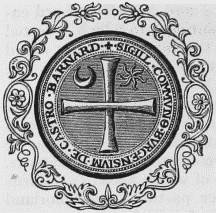
Seal.
Being forfeited to the crown, the barony, with its members, was granted to Guy Beauchamp, Earl of Warwick, and continued in the possession of his descendants until 1398. It was then given by Richard II. to Scroope, Earl of Wiltshire, but was restored in the following year to Thomas Beauchamp, Earl of Warwick, and subsequently passed by marriage with Anna, daughter and coheiress of Richard Neville, Earl of Warwick, to Richard, Duke of Gloucester, afterwards Richard III., who, before ascending the throne, resided here, and whose badge (the boar) may still be seen on the walls of the castle. In 1477, he obtained a license to found a college in the castle, for a dean and twelve secular priests, ten clerks, and six choristers; but it does not appear that the design was carried into effect. During the rebellion of the Earls of Northumberland and Westmorland, in the reign of Elizabeth, the castle, which was then the property of the crown, was garrisoned by Sir George Bowes, of Streatlam, who defended it against the insurgents, but was obliged to surrender on honourable terms. In the great civil war it was held for the king, and was besieged by Cromwell, to whom, after a severe cannonading, the garrison surrendered. Subsequently to the battle of Newburn, in 1642, part of the Scottish army was quartered here. After frequent grants and reversions, the castle, lands, and appurtenances, were purchased by an ancestor of the Duke of Cleveland, to whom they now belong. The ruins of this important baronial edifice occupy an area of nearly seven acres, on an elevated rock near the margin of the river Tees, and indicate the strength and extent of the original structure: one of the towers was some years since fitted up as a shotmanufactory, and the inner area has been converted into a garden.
The town is situated on an eminence rising abruptly from the southern bank of the Tees, the bridge over which at this place was repaired in 1771, after the injury it had sustained in that year by the memorable flood that swept away most of the bridges on the Tees and Tyne. It has undergone considerable improvement of late years, by the formation of new streets, and the removal of unsightly objects. The houses are built of white freestone, and have a very handsome appearance: the streets are well paved; they were lighted with gas in 1834, and the inhabitants are amply supplied with water from springs in the neighbourhood. The environs are remarkably pleasant, and the Vale of Tees abounds with romantic scenery. There are two book societies, one in conjunction with Staindrop; also a mechanics' institution founded in 1832, under the auspices of H. T. M. Witham, Esq., of Lartington Hall. On the banks of the river are the extensive flax, tow, and spinning mills of Messrs. Ullathorne and Longstaff, established in 1798, and whose manufacture of shoe-makers' thread gives employment to between 400 and 500 hands: there are also four carpet manufactories, employing a large number of persons; and two iron-foundries. The market is on Wednesday: there is a cattle-market every fortnight; and fairs are held on the Wednesday in Easter and Whitsun weeks. A fair on St. Mary Magdalene's day has nearly fallen into disuse. The magistrates hold a petty-session once in every month; and a baronial court for the recovery of debts under 40s. is held quarterly: the powers of the county debt-court of Barnard-Castle extend over the registration-district of Teesdale. The town-hall, situated in the market-place, is an octagonal structure, erected in 1747, by Thomas Breaks, a native of the place; the upper part is used for the transaction of business, and the lower for the market.
The township comprises 3860a. 32p., exclusively of waste, water, and the site of the town: the land is generally good, and is divided in equal portions of arable, and meadow and pasture; the moorlands abound in game. The living is a perpetual curacy, in the patronage of the Vicar of Gainford, with a net income of £224; impropriator, as lessee under Trinity College, Cambridge, John Bowes, Esq.: the great tithes have been commuted for £211. 8. 10., and those of the vicar for £292. 14. 10. The chapel, dedicated to St. Mary, is an ancient and spacious cruciform structure, in the decorated and later English styles, with a square embattled tower at the south-west angle: the bells were recast about twenty-five years since, by subscription. There are places of worship for Independents, Primitive Methodists, and Wesleyans. An hospital, for the residence and maintenance of three aged widows, was founded by John Balliol, about the 14th of Henry III., and dedicated to St. John the Baptist; the income is nearly £200 per annum. About two miles north-west of the town is a chalybeate spring, which is approached by walks through highly varied scenery of the most pleasing description. A Roman coin of the Emperor Trajan was dug up in the churchyard, in the year 1824. Sir John Hullock, one of the late barons of the exchequer; William Hutchinson, Esq., author of the History and Antiquities of the County of Durham, and who resided at the Grove, and died in the year 1814; and George Edwards, Esq., M.D., a political writer of distinction, were natives of the chapelry. It gives the titles of Viscount and Baron Barnard to the Duke of Cleveland.
Barnardiston (All Saints)
BARNARDISTON (All Saints), a parish, in the union and hundred of Risbridge, W. division of Suffolk, 3 miles (N. E.) from Haverhill; containing, with the extra-parochial liberty of Monks' Risbridge, 217 inhabitants. This parish, which comprises by computation 1500 acres, was originally the seat of, and gave name to, the family of Barnardiston, long resident in the adjoining parish of Kedington. The living is a discharged rectory, valued in the king's books at £7. 10. 5.; net income, £191; patron and incumbent, the Rev. Valentine Ellis.
Barnbrough, or Barmbrough (St. Peter)
BARNBROUGH, or BARMBROUGH (St. Peter), a parish, in the union of Doncaster, N. division of the wapentake of Strafforth and Tickhill, W. riding of York, 6¼ miles (W.) from Doncaster; containing, with Harlington, 508 inhabitants. This place has long been in the possession of the family of More; John More, only son and heir of Sir Thomas, the celebrated chancellor of England, having obtained it by marriage with Ann Cresacre, whose family had settled here in the reign of Edward I. The parish is on the north side of the river Dearne, and comprises about 1947 acres, of which 273 acres are common or waste; the soil is mostly a strong fertile clay, resting on a substratum of excellent lime and freestone. Barmbrough Hall, the former seat of the Cresacres and Mores, is in a retired situation near the church; and the Grange, which once belonged to the religious house of Nostel, and has, since the Dissolution, been in succession the residence of various families, stands in the meadows near the Dearne, not far from the hamlet of Harlington. The village is situated in the vale. The living is a rectory, valued in the king's books at £23, and in the patronage of the Chapter of the Collegiate Church of Southwell: the tithes have been commuted for £534, and there are 100 acres of glebe. The church, built in the fourteenth century, is a neat structure with a tower, and contains a highlywrought tomb to a member of the Cresacre family. There is a place of worship for Wesleyans.
Barnby (St. John the Baptist)
BARNBY (St. John the Baptist), a parish, in the incorporation and hundred of Mutford and Lothingland, E. division of Suffolk, 4 miles (E. by S.) from Beccles; containing 296 inhabitants. It comprises by measurement 1010 acres; and is situated on the road from Lowestoft to Beccles, and bounded on the north by the navigable river Waveney, which separates it from the county of Norfolk. The living is a discharged rectory, annexed to the vicarage of Mutford, and to the rectory of Wheatacre, All Saints, in Norfolk; it is rated in the king's books at £6: the tithes have been commuted for £170, and there are nearly 4 acres of glebe.
Barnby
BARNBY, a township, consisting of the villages of East and West Barnby, in the parish of Lythe, union of Whitby, E. division of the liberty of Langbaurgh, N. riding of York, 5¼ miles (W. by N.) from Whitby; containing 262 inhabitants. These two villages lie about a couple of miles to the south-west of that of Lythe, not far from the road between Whitby and Guisborough. The township anciently belonged to a family of the same name; mention occurring of Robert de Barneby, who held the lands under Peter de Mauley, lord of Mulgrave.
Barnby-In-The-Willows (All Saints)
BARNBY-IN-THE-WILLOWS (All Saints), a parish, in the union of Newark, S. division of the wapentake of Newark and of the county of Nottingham, 4¼ miles (E. by S.) from Newark; containing 266 inhabitants, and comprising by measurement 1400 acres. The living is a discharged vicarage, valued in the king's books at £5. 9. 9½., and in the patronage of the Chapter of the Collegiate Church of Southwell: the incumbent's tithes have been commuted for £219. 10., with a glebe of 29 acres, and those of the impropriators for £140, with a glebe of 42 acres. There is a place of worship for Wesleyans. Flawford, a farm of 250 acres, anciently belonged to the Knights Templars.
Barnby-Moor
BARNBY-MOOR, with Bilby, a township, in the parish of Blyth, union of East Retford, Hatfield division of the wapentake of Bassetlaw, N. division of the county of Nottingham, 3½ miles (N. W.) from East Retford; containing 221 inhabitants. It comprises by measurement 1918 acres, chiefly arable: the soil is of a sandy nature, and the chief crops are wheat, barley, and oats. The scenery is pleasingly diversified, and in some parts picturesque. The great north road, and the Trent and Chesterfield canal, pass through the township. The tithes were commuted for land in 1807.
Barnby-Upon-Don (St. Peter)
BARNBY-UPON-DON (St. Peter), a parish, in the union of Doncaster, S. division of the wapentake of Strafforth and Tickhill, W. riding of York; containing 629 inhabitants, of whom 510 are in the township of Barnby, 5¾ miles (N. E. by N.) from Doncaster. The parish comprises the townships of Barnby and Thorp-in-Balne. The village of Barnby, the "residence of Beorn," is pleasantly situated close to the river Don, on the road between Doncaster and Thorne, and consists of somewhat picturesque houses, among gardens and orchards, in a flat country; the rest of the township is for the most part inclosed and cultivated land, with scarcely a house erected upon it. The living is a discharged vicarage, valued in the king's books at £9. 12. 6., with a net income of £105; the patronage and impropriation belong to Thomas Gresham, Esq., who is chief landowner: the tithes were commuted for land and annual money payments in 1803. The church is a well-built structure of very ancient date, with a chancel the property of the Gresham family, which contains some handsome monuments to their ancestors and others. There are places of worship for Primitive and Wesleyan Methodists.
Barnes (St. Mary)
BARNES (St. Mary), a parish, in the union of Richmond, W. division of the hundred of Brixton, E. division of Surrey, 5 miles (W. S. W.) from London; containing 1461 inhabitants. This parish comprises 936 acres of land, of which 176 are common or waste; the soil is for the most part gravelly, and the surface flat. The village is pleasantly situated on the southern bank of the river Thames, and contains several wellbuilt houses, particularly on the terrace facing the river, which commands an extensive view of the opposite bank, and forms a peculiarly interesting promenade, from the constant traffic on the Thames, and the continued succession of pleasure-boats passing between London and Richmond, and in other aquatic excursions. The Barnes station of the Richmond railway is 5½ miles distant from Nine Elms, London. At BarnElms, in the vicinity, so called from a row of stately elm-trees, is an ancient mansion called Queen Elizabeth's Dairy, which was the residence of Jacob Tonson, the eminent bookseller, who built a room for the meetings of the members of the "Kit-Kat Club," portraits of some of whom adorn the walls; these have been engraved and published, and among them are several of the most distinguished English literati of the early part of the last century. Elizabeth granted the manorhouse to Sir Francis Walsingham, who, in 1589, entertained that sovereign and her court here: it was afterwards the residence of the Earl of Essex, who had espoused the daughter of Sir Francis, the widow of Sir Philip Sidney; and is now that of the Rt. Hon. Sir Launcelot Shadwell, Vice-Chancellor. A court leet is held at Putney, by the lord of the manor, at which constables and other officers are appointed for Barnes.
The living is a rectory, valued in the king's books at £9. 3. 4., and in the patronage of the Dean and Chapter of St. Paul's, London: the tithes have been commuted for £315, and there are 8 acres of glebe. The church is an ancient edifice in the early English style, built of flint and freestone, with a square tower of brick, having an octagonal turret at one angle, which appears to have been added in 1500: it was enlarged in 1838, by subscription, on the north side of the chancel. Mrs. Mary Wright, in 1804, bequeathed £500, which were invested in the purchase of £824. 11. three per cent. consols.; and Mr. John Biggs, in 1837, left £500: the interest of both sums is applied in keeping their tombs in repair, and for the benefit of the poor. Robert Beale, who was employed by Elizabeth to communicate to Mary, Queen of Scots, the sentence which had been passed upon her, and who was afterwards sent to Fotheringay Castle to see it carried into effect, died here in 1601. Cowley, the poet, resided here for some time.
Barnesley, county of York.—See Barnsley.
BARNESLEY, county of York.—See Barnsley.
Barnet-By-The-Wold (St. Mary)
BARNET-BY-THE-WOLD (St. Mary), a parish, in the union of Glandford-Brigg, S. division of the wapentake of Yarborough, parts of Lindsey, county of Lincoln, 5 miles (E. N. E.) from Glandford-Brigg; containing 679 inhabitants. This parish, which is on the road from Brigg to Caistor, comprises by survey 2600 acres: the soil, partly chalk and sand, is rich and fertile, and the chief produce barley and turnips; a considerable portion of the land is in pasture. The living is a discharged vicarage, valued in the king's books at £6. 4. 2.; net income, £305; patron and appropriator, the Bishop of Lincoln. The tithes were commuted for land in 1766. There are places of worship for Independents, Primitive Methodists, and Wesleyans.
Barnet, Chipping (St. John the Baptist)
BARNET, CHIPPING (St. John the Baptist), a parish, town, and the head of a union, in the hundred of Cashio, or liberty of St. Alban's, county of Hertford, 14 miles (S. W. by S.) from Hertford, and 11 (N.) from London, on the great north road; containing 2485 inhabitants. This place, called also High Barnet, from its situation on the summit of a hill, derives its distinguishing name from the privilege granted to the monks of St. Alban's, of holding a market here. On April 5th, 1471, the decisive battle which terminated in the defeat and death of the Earl of Warwick, and established Edward IV. on the throne, took place on Gladmore Heath, a mile north-west of the town; in commemoration of which, an obelisk was erected by Sir Jeremy Sambrook, at the junction of the roads from Hatfield and St. Alban's, near Hadley Common. The town, which is pleasantly situated, consists principally of one street, more than a mile in length; the houses, though interspersed occasionally with a few of more respectable appearance, are in general mean, and the inhabitants scantily supplied with water. A new road, entering from London, was made in 1826, by means of an embankment across the valley, at an expense of £15,000. The great railway from London to York will pass near. The races, held on Barnet Common, and for some time discontinued, have lately been revived; and a hall has recently been erected, by shareholders, for public meetings, concerts, lectures, &c. The market was on Monday, and was chiefly noted for the sale of pigs, but has been discontinued. A fair is held on April 8th and 9th, for cattle and horses, and on the 10th there is a pleasure-fair; another, considered the largest in England for horned-cattle, commences on Sept. 4th, and continues the three following days, on the last of which the races are held. The magistrates for the liberty hold a meeting here on the first Thursday in every month; and two constables and two headboroughs are appointed at the court leet of the lord of the manor, held at Easter. The powers of the county debt-court of Barnet, established in 1847, extend over the registration-district of Barnet and the parish of Hendon.
The living is united to the rectory of East Barnet: the church was built by one of the abbots of St. Alban's, in the fifteenth century, and is a venerable structure in the style of that period, but has undergone several alterations. There is a place of worship for Independents. A free school was established in 1573 by Queen Elizabeth, and was further endowed, in 1676, by Alderman Owen, and in 1734 by the Rev. Humphrey Hall; the income amounts to about £35. There is also a national school, supported partly by a bequest from Mrs. Allen in 1725, since invested in land let for £57 per annum. Jesus' hospital, for six elderly women, was founded in 1679, by James Ravenscroft, and was further endowed with the residue of the produce of £500 left by Mrs. Barcock, in 1731, after distributing £10 annually to the poor; and with a moiety of the dividends of £800 reduced Bank annuities, bequeathed by Ann Mills, in 1784: the income is £273. In 1728, Mr. John Garret founded six almshouses for aged widows, the income of which has been augmented by bequests, and now amounts to £50; and six others, for married couples, were erected a few years ago, at an expense of £1022, by the trustees of a charity founded by Eleanor Palmer, and producing £153 per annum, two-thirds for the parish of Chipping-Barnet, and the remainder for that of St. Pancras. The Leather-sellers' Company likewise erected almshouses, the first stone of which was laid in July, 1837, by the master of the company, Mr. R. Thornton, who presented the amount of the contract, £1208. There are other charities for the relief of the poor, the principal of which are, Valentine Poole's, producing £51 per annum; an inclosure of Barnet Common, amounting to 135 acres, let for £167; and the dividends on £898 three per cent. reduced annuities, under the will of Keene Fitzgerald, Esq., in 1829. A rental of £41, arising from a plot of ground in the parish of Stepney, assigned by deed of James Ravenscroft, Esq., in 1679, is applied to repairing the church. On Barnet Common has been built the workhouse for the poor law union of Barnet, which comprises nine parishes and places, under the care of fourteen guardians. On this common is a mineral spring, the water of which contains a considerable portion of calcareous glauber, with a small portion of sea-salt.
Barnet, East (The Virgin Mary)
BARNET, EAST (The Virgin Mary), a parish, in the union of Barnet, hundred of Cashio, county of Hertford, 10¼ miles (N.) from London; containing 598 inhabitants. It comprises 1702a. 20p., and the village is pleasantly situated near the town of ChippingBarnet; the houses are neatly built, and the general appearance of the place is pleasingly picturesque. The air is salubrious, but the supply of water is scanty, and the quality not very good. The living is a rectory, with the living of Chipping-Barnet annexed, valued in the king's books at £22. 2. 8½., and in the patronage of the Crown: the tithes, with those of Chipping-Barnet, have been commuted for £860. 5. 8., and there are 31½ acres of glebe, with an allotment. The church formerly belonged to the monastery of St. Alban's: in the churchyard is a handsome monument to the memory of Sir Simon Houghton Clarke, Bart. A building was erected on Barnet Common in 1839, by Enos Durant, Esq., of High Canons, which has been licensed by the bishop for the performance of service. On a hill opposite to the church, called Monk's Frith Garden, the abbots of St. Alban's anciently had a villa. In the neighbourhood are several mineral springs.
Barnet, Fryern (St. James)
BARNET, FRYERN (St. James), a parish, in the union of Barnet, Finsbury division of the hundred of Ossulstone, county of Middlesex, 8¾ miles (N. by W.) from London; containing, with the hamlet of Colney-Hatch and a portion of that of Whetstone, 849 inhabitants. It is supposed that an abbey anciently existed here from which the place obtained the prefix to its name, and that the old manor-house, now taken down, was the summer residence of the abbots. The land is tithe-free, if cultivated by resident proprietors, but if let to tenants the exemption ceases. Courts leet and baron are held on the Friday in Whitsunweek. The living is a rectory not in charge, in the patronage of the Dean and Chapter of St. Paul's, London; net income, £255. The church is a small and very ancient structure, in the Norman style; the chancel was rebuilt some years since. Almshouses for twelve aged persons were founded, and endowed with £10 a year, in 1612, by Lawrence Kemp, Esq., of London. John Walker, author of the "English Pronouncing Dictionary," was born here in 1732.
Barney (St. Mary)
BARNEY (St. Mary), a parish, in the union of Walsingham, hundred of North Greenhoe, W. division of Norfolk, 5 miles (E. N. E.) from Fakenham; containing 276 inhabitants. It comprises 1389a. 3r. 31p., of which the greater portion is arable land. The living is a discharged vicarage, valued in the king's books at £6. 13. 4.; patron and impropriator, Lord Hastings. The great tithes have been commuted for £168, and the vicarial for £104; there is a glebe of 38½ acres. The church is in the early and later English styles, and consists of a nave, chancel, and south chapel, with a square embattled tower. The Wesleyans and Baptists have places of worship.
Barnham (St. Gregory and St. Martin)
BARNHAM (St. Gregory and St. Martin), a consolidated parish, in the union of Thetford, hundred of Blackbourn, W. division of Suffolk, 3 miles (S.) from Thetford; containing 412 inhabitants, and comprising 5184a. 3r. 32p. The living of St. Gregory's, valued in the king's books at £7. 11. 10½., and that of St. Martin's, at £8. 5. 5., now form one rectory, united to that of Euston: the tithes have been commuted for £423. 2., and there are about 95 acres of glebe. The church of St. Gregory is the parochial church; St. Martin's is in ruins, but the steeple is standing.
Barnham (St. Mary)
BARNHAM (St. Mary), a parish, in the union of West Hampnett, hundred of Avisford, rape of Arundel, W. division of Sussex, 6 miles (S. W. by W.) from Arundel; containing 125 inhabitants. It comprises about 700 acres, and is intersected by the Arundel and Portsmouth canal. The living is a discharged vicarage, valued in the king's books at £7. 15.; net income, £67; patron, the Bishop of Chichester; impropriators, the family of Postlethwayte. The church is in the early English style; the north isle was a chantry, founded by John Le Taverner in 1409, and was taken down at the Dissolution.
Barnham-Broom (St. Peter and St. Paul)
BARNHAM-BROOM (St. Peter and St. Paul), a parish, in the incorporation and hundred of Forehoe, E. division of Norfolk, 4¾ miles (N. N. W.) from Wymondham; containing 494 inhabitants. This parish comprises by measurement 1760 acres: at the western boundary is a small stream, on which is a flour-mill: the common was inclosed in 1811, when 19 acres were allotted to the poor for fuel. The living is a rectory, with that of Bixton and the vicarage of Kimberly united, valued in the king's books at £12. 8. 1½.; net income, £524, with 19 acres of glebe, and a house; patron, Lord Wodehouse. The church is a handsome structure in the later English style, with a square embattled tower. There was formerly a church dedicated to St. Michael in the same churchyard.
Barnhill
BARNHILL, a hamlet, in the parish of Malpas, Higher division of the hundred of Broxton, S. division of the county of Chester, 10 miles (S. E. by S.) from Chester. The petty-sessions for the hundred are held here.
Barningham (St. Andrew)
BARNINGHAM (St. Andrew), a parish, in the union of Thetford, hundred of Blackbourn, W. division of Suffolk, 4 miles (N. N. E.) from Ixworth; comprising by measurement 1556 acres, and containing 508 inhabitants. The living is a discharged rectory, with that of Coney-Weston annexed, valued in the king's books at £13. 9. 2.; net income, £770; patron, R. Hunt, Esq. The glebe consists of about 25 acres. The church is in the decorated style, with an embattled tower. There is a place of worship for Wesleyans. Land and tenements called the Town estate are let for about £35 per annum, applied to the repairs of the church and general parochial purposes; and the sum of £21, the rental of an allotment of 20 acres, is laid out in coal for poor families.
Barningham (St. Michael)
BARNINGHAM (St. Michael), a parish, in the union of Teesdale, wapentake of Gilling-West, N. riding of York; containing 600 inhabitants, of whom 337 are in the township of Barningham, 2 miles (S. S. W.) from Greta-Bridge. The parish includes the townships of Barningham, Hope, Scargill, and part of Newsham, and comprises 10,771 acres, of which 3255 are common or waste: in the township of Barningham are 3620 acres. On the west are high moors and fells, but on the east is a fine and fertile champaign country, in the most open part of the dale of Greta: in his poem of Rokeby, Sir Walter Scott alludes in eulogistic terms to the scenery of this place. The river Tees flows on the north at a distance of about two miles from the village. The living is a rectory, valued in the king's books at £19. 17. 1., and in the patronage of the Crown, with a net income of £553: the tithes have been commuted for £356. 10., and the glebe consists of 101½ acres. The church was rebuilt about 25 years since. There is a place of worship for Wesleyans; and a school, conducted on the national plan, is endowed with about £25 per annum.
Barningham, Little (St. Andrew)
BARNINGHAM, LITTLE (St. Andrew), a parish, in the union of Aylsham, hundred of South Erpingham, E. division of Norfolk, 6 miles (N. W. by N.) from Aylsham; containing 229 inhabitants. This parish, which is intersected by the road from Aylsham to Holt, comprises 1224a. 3r. 14p.; 917 acres are arable, 49 meadow, 49 wood and plantations, and 209 heath. A charter for a market and a fair was granted by Edward I. to Walter de Berningham, who at that time possessed the manor. The living is a discharged rectory, valued in the king's books at £5. 15. 2½., and in the gift of the families of Graver and Knight: the tithes have been commuted for £260. The church, which is situated on an eminence above the village, is chiefly in the later English style.
Barningham-Northwood (St. Mary)
BARNINGHAM-NORTHWOOD (St. Mary), a parish, in the union of Erpingham, hundred of North Erpingham, E. division of Norfolk, 4½ miles (E. S. E.) from Holt; containing 54 inhabitants, and comprising 825a. 3r. 30p. The living is a discharged rectory, valued in the king's books at £6. 13. 4.; net income, £156; patron, W. H. Windham, Esq., lord of the manor: the glebe consists of 11 acres. The church is chiefly in the decorated and later English styles, and contains several handsome monuments to the Palgrave family.
Barningham-Winter, or Barningham Town (St. Peter)
BARNINGHAM-WINTER, or Barningham Town (St. Peter), a parish, in the union of Erpingham, hundred of North Erpingham, E. division of Norfolk, 8 miles (N. N. W.) from Aylsham; containing 86 inhabitants. It comprises 824 acres, of which 444 are arable, 212 pasture, 144 wood and water, and 7 common. A grant of a market and a fair was obtained by Roger le Curzain, in the reign of Edward II. The living is a discharged rectory, valued in the king's books at £6. 13. 4.; patron, J. T. Mott, Esq., lord of the manor: the tithes have been commuted for £137, and there are 40½ acres of glebe. The church stands in the park, a short distance from the Hall, and is in ivymantled ruins, except the chancel, which has been fitted up for divine service.
Barnoldby-Le-Beck (St. Helen)
BARNOLDBY-LE-BECK (St. Helen), a parish, in the union of Caistor, wapentake of BradleyHaverstoe, parts of Lindsey, county of Lincoln, 5 miles (S. W. by S.) from Grimsby; containing 292 inhabitants, and comprising by measurement 1190 acres, of which 800 are arable, and the rest pasture. The living is a rectory, valued in the king's books at £14. 13. 4., and in the patronage of the Chapter of the Collegiate Church of Southwell: the tithes were commuted for land in 1769, and the income is £140.
Barnoldswick (St. Mary)
BARNOLDSWICK (St. Mary), a parish, in the union of Skipton, E. division of the wapentake of Staincliffe and Ewcross, W. riding of York, 9 miles (W. S. W.) from Skipton; containing 2844 inhabitants, of whom 1849 are in the township of Barnoldswick. This place was the original seat of the monks of Kirkstall, who were settled here from 1147 until 1153, and of whose abode there are still some remains. The parish includes the townships of Brogden, Coates, and Salterforth, and comprises 6073a. 2r. 8½p.; the surface is boldly diversified, rising into hills of lofty elevation, and in some parts intersected with deep and narrow glens. In the vicinity are extensive and valuable limestone-quarries. The Leeds and Liverpool canal passes through the parish in a direction nearly north and south. The village, which is spacious, is situated in a secluded part of a valley, and sheltered by lofty hills; the inhabitants are chiefly employed in the cotton manufacture, for which there are three mills, and many are engaged in hand-loom weaving. The living is a perpetual curacy, in the patronage of Richard Hodgson, Esq., with a net income of £162; impropriators, the landowners. The original church was built probably as early as 1080, and the existing structure bears marks of a date not long subsequent to the removal of the monks, who built it after having levelled the first edifice to the ground in consequence of the opposition made by the rector and inhabitants to their intrusive entry among them; it is seated on the brink of a deep glen, from which it obtained the name of Gill church. A chapel of ease, dedicated to St. James, was erected in the centre of the village in 1837, at an expense of £1700, raised by subscription, aided by a grant of £200 from the Ripon Diocesan Society, and the same sum from the Incorporated Society; it is a neat structure in the early English style. There are places of worship for Baptists and Wesleyans.
Barnshaw, with Goostrey.—See Goostrey.
BARNSHAW, with Goostrey.—See Goostrey.