A Topographical Dictionary of England. Originally published by S Lewis, London, 1848.
This free content was digitised by double rekeying. All rights reserved.
'Bolingbroke - Bonby', in A Topographical Dictionary of England, ed. Samuel Lewis (London, 1848), British History Online https://www.british-history.ac.uk/topographical-dict/england/pp295-302 [accessed 30 April 2025].
'Bolingbroke - Bonby', in A Topographical Dictionary of England. Edited by Samuel Lewis (London, 1848), British History Online, accessed April 30, 2025, https://www.british-history.ac.uk/topographical-dict/england/pp295-302.
"Bolingbroke - Bonby". A Topographical Dictionary of England. Ed. Samuel Lewis (London, 1848), British History Online. Web. 30 April 2025. https://www.british-history.ac.uk/topographical-dict/england/pp295-302.
In this section
Bolingbroke (St. Peter and St. Paul)
BOLINGBROKE (St. Peter and St. Paul), a parish, in the union of Spilsby, W. division of the soke of Bolingbroke, parts of Lindsey, county of Lincoln, 30 miles (E. S. E.) from Lincoln, and 129 (N.) from London; containing 919 inhabitants. A castle was built by William de Romara, Earl of Lincoln, of which his descendant, Alicia de Lacey, was dispossessed by Edward II. Henry IV. was born in this fortress, and from it took the name of Henry of Bolingbroke: it was nearly demolished in the civil wars, the south-west tower being all that remains. At this period also the church suffered so considerably, that it was almost reduced to a ruin; one aisle of it only has been rebuilt, at the corner of which is a low tower. Bolingbroke is situated in a wide and pleasant valley, near the source of a small river which runs into the Witham: the public road passing through the town to Spilsby, has been superseded by a new line about two miles distant, which ascends Keal Hill. There is a manufactory for earthenware. The market formerly held on Tuesday has been discontinued, but a fair is still held on St. Peter's day. The living is a discharged rectory, to which that of Hareby was united in 1739, valued in the king's books at £9. 19. 2., and in the gift of the family of Bosanquet: the glebe consists of 345 acres, the income of which amounts to £456; and an excellent parsonage-house has lately been built, at a cost of £2000. There is a place of worship for Wesleyans; also a free school, with a trifling endowment in land. The village and district of New Bolingbroke have lately risen up on lands in the fen belonging to Bolingbroke; a curate has been appointed by the rector.
Bollin-Fee
BOLLIN-FEE, a township, in the parish of Wilmslow, union of Altrincham, hundred of Macclesfield, N. division of the county of Chester, 6 miles (S. W.) from Stockport; containing 2212 inhabitants. The township comprises 2484 acres, of which 89 are common or waste; the soil is principally clay. The tithes have been commuted for £378, and there is a glebe of 71 acres.
Bollington
BOLLINGTON, a township, partly in the parish of Rosthern, but chiefly in that of Bowdon, union of Altrincham, hundred of Bucklow, N. division of the county of Chester, 5½ miles (N. by W.) from Nether Knutsford; containing 316 inhabitants. The manor was anciently parcel of the barony of Dunham-Massey. Hamo, one of the barons, gave a moiety of it with his daughter to Geffery Dutton, from whose descendants the portion passed by a female heir to the Radcliffes, earls of Sussex, and by sale to the Carringtons, from whom it came, through the Booths, to the earls of Stamford and Warrington, afterwards possessors of the whole estate. The township consists of 585 acres. The tithes of that part in the parish of Bowdon have been commuted for £30 payable to the Bishop of Chester, and £15 to the vicar of Bowdon. At a place called Pump hill is a tumulus, in which human bones have been found.
Bollington
BOLLINGTON, a township, in the parish of Prestbury, union and hundred of Macclesfield, N. division of the county of Chester, 2½ miles (N. by E.) from Macclesfield; containing 4350 inhabitants. In this township are 1120 acres, of a sandy and a clayey soil. The village lies on the banks of a small stream called the Bolling, from which its name is derived. For more than twenty years it has been exceedingly prosperous: there are cotton and silk factories, and collieries; and at Kerridge Hill, which is partly in this township and partly in that of Rainow, are quarries of freestone and slate, worked to a considerable extent, the produce being chiefly sent to the neighbouring towns. The Macclesfield canal passes through the township. A district church dedicated to St. John, erected by grant from the Parliamentary Commissioners, was consecrated July 7th, 1834: the living is a perpetual curacy, in the gift of the Vicar, with a net income of £174. The Wesleyans have a meeting-house.
Bollom
BOLLOM, a hamlet, in the parish of Clareborough, union of Retford, North-Clay division of the wapentake of Bassetlaw, N. division of the county of Nottingham, 1 mile (N.) from Retford; containing 103 inhabitants. This is a romantic place, on the east side of the river Idle; and comprises 223 acres of land. Half a mile eastward are some cottages called Bollomlane Houses. There was anciently a chapel, the site of which is still called Chapel yard.
Bolney (St. Mary Magdalene)
BOLNEY (St. Mary Magdalene), a parish, in the union of Cuckfield, partly in the hundred of Buttinghill, but chiefly in the half-hundred of Wyndham, rape of Lewes, E. division of Sussex, 3¼ miles (W. S. W.) from Cuckfield; containing 713 inhabitants. It comprises 3482 acres, of which 42 are common or waste. The London and Brighton road by way of Hixted passes through the parish, within half a mile of the village. The land is chiefly arable and pasture, with a tract of wood forming part of the forest of St. Leonard; it is generally poor, being a thin soil over sandstone, but in some places there is a good stiff clay. Sandstone abounds, and iron-ore is found. The living is a discharged vicarage, valued in the king's books at £5. 5. 2½.; patron, the Prebendary of Hove in the Cathedral of Chichester; impropriators, W. and C. Marshall, Esqrs.; net income, £162.
Bolnhurst (St. Dunstan)
BOLNHURST (St. Dunstan), a parish, in the hundred of Stodden, union and county of Bedford, 7 miles (N. by E.) from Bedford, on the road to Kimbolton; containing 344 inhabitants. It comprises 2166a. 3r. 13p., of which the surface is undulated, and the soil a stiff cold clay. The living is a rectory, endowed with only one-third of the tithes, and valued in the king's books at £9; net income, £159; patron, the Rev. H. W. Gery; impropriators of the remaining two-thirds of the tithes, Capt. Duberly and others.
Bolsover (St. Mary)
BOLSOVER (St. Mary), a parish, and formerly a market-town, in the union of Chesterfield, hundred of Scarsdale, N. division of the county of Derby, 6 miles (E. by S.) from Chesterfield, 28½ (N. N. E.) from Derby, and 145½ (N. by W.) from London; containing, with the hamlets of Glapwell, Ockley, Whaley, Oxcroft, Stanfree, Shuttlewood, Woodside, and Woodhouse, 1512 inhabitants. This place, called Belesoure prior to the Conquest, was noted for a castle erected immediately after by William Peveril, who had obtained the grant of several manors in England. The castle, which was remarkably strong, on the extinction of the Peveril family became a royal fortress, and sustained a siege in the war of the barons, by whom, together with the Castle of the Peak, it was garrisoned against King John. In 1215, William, Earl of Ferrers, retook both these castles from the barons, and was made governor of them, as a reward for his fidelity. In the reign of Henry VII. the castle became the property of the Earl of Shrewsbury, and in that of Elizabeth was given to his step-son, Sir Charles Cavendish, who rebuilt the greater portion of it, and erected a magnificent suite of state apartments on the site of the original Norman structure, which had become ruinous. His eldest son, William, afterwards Duke of Newcastle, erected the spacious riding-house, and the long range of buildings, now in ruins, which crown the beautiful terrace. In these stately and splendid halls he thrice entertained Charles I. and his court, and upon one occasion, when the queen was present, expended £15,000. During the civil war, while the duke was abroad, the castle sustained a siege, and, after being defended for some time by the Marquess of Newcastle, surrendered to the parliamentarians, from whom it was purchased by Sir Charles, the duke's younger brother. The Duke of Portland, who is proprietor of the castle, and lord of the manor of Bolsover, inherits from the Cavendish family. The keep is in an excellent state of preservation, and is at present the residence of the Rev. J. H. Gray, vicar of Bolsover; it occupies a lofty eminence commanding an extensive prospect.
The town is large and well built, and is pleasantly situated on rising ground, environed on every side, except where the ground forms a natural rampart, with a deep intrenchment. The chief pursuit of the inhabitants is agriculture; at present no manufacture is carried on, but formerly the place was celebrated for buckles and tobacco-pipes. Facility of conveyance is afforded by the Midland railway, which has a station at Chesterfield; and to the east of the town is the road from Mansfield to Rotherham. It is within the jurisdiction of the court for the honour of Peveril, held at Lenton, near Nottingham: a court leet belonging to the lord of the manor is held every third week, for the recovery of debts under 40s.; and there is a fair on Midsummerday. The parish comprises 4590 acres of land, whereof 82 are wood. South-west of the town the surface declines to a fine open valley, and on the east approaches to a level undulating country; the scenery of the valley is exceedingly beautiful, and in the distance is seen hill rising over hill for more than twenty miles. The soil is calcareous, and the substratum consists of thick beds of limestone of two or three varieties. The quarries here supply excellent building-stone, which is extensively used in the town and neighbourhood, and has been raised for the erection of parts of the new houses of parliament; the material is of a durable nature, but more suitable for exterior than inner work. Coal-mines, also, are wrought, on a limited scale. The chief proprietor of land, after the Duke of Portland, is the Duke of Devonshire; and there are a great number of other owners, the farms being generally small.
The living is a discharged vicarage, valued in the king's books at £5. 19. 4.; net income, about £110; patron and impropriator, the Duke of Portland, who receives about £800 per annum as tithe rent: the glebe consists of 28 acres of arable land. The church, situated in the town, is a spacious structure, and consists of a nave, chancel, and south aisle: it is said to be partly Norman, but is probably of later construction; with the exception of an arch, the general style is early English, of which the spire is a good specimen. In the chancel is a mutilated piece of sculpture, of very ancient workmanship, representing the Virgin and the Infant Jesus, and, perhaps, the Magi; with camels looking over the manger. The Cavendish family have a sepulchral chapel, terminating the aisle; it was built in 1618, and contains some very splendid monuments: in one corner of the chancel, also, is a flat stone, with an inscription round it in square letters, and a number of figures in outline, evidently of great age. The Wesleyans and Independents have places of worship; that belonging to the latter was formerly a Presbyterian chapel, in which Archbishop Secker officiated for some time. An endowed school was built in 1755 by the Countess of Oxford and Mortimer: it had dwindled into insignificance, and become almost useless; but in 1844 was placed under the National Society, and opened on an improved system. Mrs. Isabella Smithson, in 1761, bequeathed £2000 to the poor of Bolsover; the payment being resisted by her executors, a suit was instituted, and in 1770 the full amount, with £956 interest, was recovered. The annual proceeds are chiefly paid as marriage portions, of £25 each, to five young women of the parish; and in default of that number of young women in any year, the portions unclaimed, and the residue, are appropriated in sums not exceeding three guineas annually, to poor persons upwards of 55 years of age. The Duke of Portland lately set apart some land as allotments for the poor, and about 135 families have already been assigned plots of ground. In the parish is a ferruginous spring; and partly inclosing the town wall is a circular mound supposed to have been a Danish camp.
Bolsterstone
BOLSTERSTONE, a chapelry, in the parish of Ecclesfield, union of Wortley, N. division of the wapentake of Strafforth and Tickhill, W. riding of York, 8½ miles (N. W. by N.) from Sheffield. This place is in the district of Hallamshire, and is bounded on the south-south-west by the river Euden, on the north-north-west by the Porter, and on the east by the Don; the land is chiefly arable, and the soil of various qualities. A thin seam of coal is wrought, employing about 100 hands; as is also a quarry of firestone of a peculiar kind, which employs a few hands more. The living is a perpetual curacy, in the patronage of the Trustees of J. Remington, Esq., with a net income of £119: the chapel is a plain square edifice, rebuilt in 1791, at a cost of nearly £600, raised by subscription. There is a place of worship for dissenters. A national school has an endowment of about £50 per annum, and a house for the master, bequeathed by John Hodgkinson in 1780.
Bolstone
BOLSTONE, a parish, in the Upper division of the hundred of Wormelow, union and county of Hereford, 6 miles (S. S. E.) from Hereford; containing 83 inhabitants. On the east the parish is partly bounded by the river Wye; it consists of 540 acres, with a soil of average fertility, and the surface is extremely well wooded. The living is annexed to the vicarage of HolmLacy: the tithes have been commuted for £85.
Boltby
BOLTBY, a chapelry, in the parish of Felix-Kirk, union of Thirsk, wapentake of Birdforth, N. riding of York, 4¾ miles (N. E.) from Thirsk; containing 320 inhabitants. This township, which forms the manor of Ravensthorpe, comprises by computation 3600 acres of land; the village is situated in a picturesque vale at the foot of the Hamilton hills. The chapel is dedicated to the Holy Trinity.
Bolton (All Saints)
BOLTON (All Saints), a parish, in the union of Wigton, Allerdale ward below Derwent, W. division of Cumberland, 1½ mile (N. by W.) from Ireby; containing 1211 inhabitants, of whom 312 are in HighSide, and 899 in Low-Side. This place was anciently called Bothilton. It has four districts or constablewicks, namely, Bolton-Wood, which was at one time mostly woodland; Bolton-Row; Newlands; and BoltonGate. The prevailing soil is a dry loam, well adapted for turnip husbandry, but there is also a large portion of this loam on a clayey bottom, which, when drained, yields abundant crops of wheat and oats: coal, limestone, and red sandstone are worked to a considerable extent. The timber of Bolton-Wood has been greatly cleared away, except near the residence of William Coulthart, Esq., at Bolton-Wood House. The living is a rectory, valued in the king's books at £19. 18. 4.; net income, £512; patron, the Earl of Lonsdale. The church is a very ancient edifice roofed with stone. There is a place of worship for Wesleyans. A copper battle-axe was lately found in the moss at Bolton-Wood.
Bolton
BOLTON, a chapelry, in the parish of Edlingham, union of Alnwick, N. division of Coquetdale ward and of Northumberland, 6½ miles (W.) from Alnwick; containing 128 inhabitants. It is memorable as the scene of a meeting in 1209, between John, King of England, and William, King of Scotland, who proceeded in company from this village to Norham, where they conferred upon matters affecting their respective interests; and on the 5th of Sept., in the 5th of Henry VIII., a short time previously to the battle of Branxton, a congress was held here, at which several noblemen and other distinguished persons, with a train of about 26,000 troops, were present. An hospital for a master, three chaplains, thirteen lepers, and other lay brethren, was founded and endowed prior to 1225, by Robert de Roos, Baron of Wark, in honour of St. Thomas the Martyr, or the Holy Trinity, and made subordinate to the abbey of Rivaulx, and the priory of Kirkham, in Yorkshire. Several stone chests, and urns containing ashes, charcoal, and fragments of human bones, together with a celt, have been discovered at a short distance from the place. The tithes here of the Dean and Chapter of Durham have been commuted for £196.
Bolton
BOLTON, a chapelry, in the parish of Morland, West ward and union, county of Westmorland, 4 miles (N. W. by W.) from Appleby; containing 383 inhabitants. About a mile north of the village, an iron bridge, thirty yards in length, was constructed across the Eden, at the expense of the landowners on both sides of the river, in 1816. The living is a perpetual curacy; net income, £80; patron, the Vicar of Morland: the tithes were commuted for land in 1808. The chapel is dedicated to All Saints. A meeting-house for Methodists was built in 1818; and there is a free school endowed with £13 per annum.
Bolton
BOLTON, a township, in the parish of BishopWilton, union of Pocklington, Wilton-Beacon division of the wapentake of Harthill, E. riding of York, 2¾ miles (N. W.) from Pocklington; containing 98 inhabitants. It comprises 960 acres by computation; and has a neat and pleasant village seated on a gentle acclivity. The vicarial tithes have been commuted for £41. 4. 6., and the impropriate for £6. 2. There is a place of worship for Wesleyans.
Bolton
BOLTON, a township, in the parish of Calverley, union of Bradford, wapentake of Morley, W. riding of York, 1½ mile (N. N. E.) from Bradford; containing 683 inhabitants. This township, including the hamlets of Hodgsonfold, Lowfold, and Outlanes, with part of the hamlet of Undercliffe, comprises by measurement 699 acres; the surface is varied, and the scenery of pleasing character. There are quarries of slate and flagstone in full operation; and the Bradford canal passes through the township. The Wesleyans have a place of worship.
Bolton-Abbey
BOLTON-ABBEY, a chapelry and township, in the parish and union of Skipton, E. division of the wapentake of Staincliffe and Ewcross, W. riding of York, 6 miles (E. N. E.) from Skipton; the township containing 127 inhabitants. This place derives its name from its magnificent abbey of canons regular of the order of St. Augustiue, founded originally at Embsay, and dedicated to the Virgin Mary and St. Cuthbert, by William de Meschines and Cecilia his wife, in 1121, and removed to this place, about the year 1151, by their daughter and heiress Adeliza, who had married William FitzDuncan, nephew of the King of Scotland. The establishment continued to flourish till the Dissolution, when its revenues were estimated at £302. 9. 3. Of this once stately and magnificent structure the nave is perfect, and appropriated as a parochial chapel; the north and south transepts and the choir are in ruins. The choir, which is the most ancient part of the church, is in the Norman style of architecture, with later insertions; the windows, apparently altered from the original openings, are in the decorated English style. The township comprises by computation 3000 acres, situated in the vale of the river Wharfe, which pursues its varied course through a district abounding with scenery of romantic character, combining features of intense interest, among which the venerable remains of the abbey are conspicuous. The acclivities that inclose the vale are in some parts richly wooded; and in others, masses of rugged rock rise precipitously from the margin of the river, which flows almost under the east window of the abbey. Towards the north of the ruins is a verdant expanse of level lawn, studded at intervals with clusters of elm and ash of stately growth, and skirted by a thick wood of oak, interspersed with protruding rocks of barren aspect. In the distance are the venerable groves of Bolton Park, beyond which are seen the craggy heights of Simonseat and Bardon Fell, finely contrasting with the softer beauties of the luxuriant vale, which, gradually contracting its limits, scarcely affords a passage for the Wharfe between the densely wooded banks which overhang its stream. In this part of the vale is a beautifully picturesque cascade, formed by a tributary of the Wharfe descending from a rocky glen into the river, near its disappearance in the deep cleft of a rock which obstructs its course. The road leading from Skipton to Harrogate passes at the distance of about half a mile from the abbey. The living is a perpetual curacy; net income, £111; patron, the Duke of Devonshire. A free grammar school was founded in 1697, by the Hon. Robert Boyle. who endowed it with a rent-charge of £20, and other property, making in the aggregate an income of £100; the master has a good house and garden.
Bolton-By-Bowland (St. Peter)
BOLTON-BY-BOWLAND (St. Peter), a parish, in the union of Clitheroe, wapentake of Staincliffe and Ewcross, W. riding of York, 3½ miles (W.) from Gisburn, and 15 (W. by S.) from Skipton; containing 993 inhabitants. This place was anciently owned by the Pudsey family of Bolton Hall, of whom Sir Ralph Pudsey afforded to Henry VI. an asylum in his mansion after the battle of Hexham. The parish comprises by computation 4940 acres; the lands are mostly in good cultivation, and the prevailing scenery is pleasingly diversified. Bolton Hall is an ancient mansion, beautifully situated in an extensive and tastefully embellished demesne; in one of the apartments, a pair of boots, a pair of gloves, and a spoon, left here by Henry VI., are carefully preserved. The village stands on one of the streams flowing into the river Ribble; a large fair, chiefly for cattle, is held in it on the 28th of June and two following days. The living is a rectory, valued in the king's books at £11. 13. 4., and in the patronage of Mrs. Littledale: the tithes have been commuted for £335, and the glebe comprises 100 acres, with a good house. The church is a venerable structure, in the later English style, having a square embattled tower; and contains a monument to Sir Ralph Pudsey, with a slab of grey Craven limestone, on which are sculptured in bold relief the effigies of himself, his three wives, and twenty-five children. The Independents have a place of worship. There is a spring at Fooden, strongly impregnated with sulphur; and at Holden is a picturesque cascade.
Bolton-Castle
BOLTON-CASTLE, a chapelry, in the parish of Wensley, union of Leyburn, wapentake of HangWest, N. riding of York, 7¼ miles (N. W. by W.) from Middleham; containing 230 inhabitants. On the brow of a hill are the ruins of a castle built by Richard, Lord Scrope, chancellor of England in the reign of Richard II., and endowed with £106. 15. 4. per annum, for a chantry of six chaplains. Mary, Queen of Scots, was kept a prisoner here for about two years, and was removed hence to Tutbury in 1569; she inscribed her name on a pane of glass, which was removed to Bolton Hall a few years since. During the parliamentary war, the castle was defended for the king by Colonel Scrope and a party of the Richmondshire militia, and sustained a pressing siege, which terminated in its surrender to the insurgents in 1645. The north-eastern tower fell down in 1761, and the eastern and northern sides are entirely in ruins; the west front is in good repair. The living is a perpetual curacy, with that of Redmire annexed; net income, £115; patron, the Rector of Wensley. The chapel is dedicated to St. Oswald.
Bolton-Le-Moors (St. Peter)
BOLTON-LE-MOORS (St. Peter), a parish, and the head of a union, in the hundred of Salford, S. division of the county of Lancaster; comprising the borough and market-town of Bolton, the chapelries of Blackrod, Bradshaw, Harwood, Little Lever, and Turton, and the townships of Anglezarke, Breightmet, Edgeworth, Entwistle, DarcyLever, Longworth, Lostock, Quarlton, Rivington, Sharples, and Tonge with Haulgh; and containing 73,905 inhabitants, of whom 33,610 are in Great, and 16,153 in Little, Bolton, 43 miles (S. S. E.) from Lancaster, and 197 (N. W. by N.) from London. This place, which derives the adjunct to its name from its situation on the moors, was of little importance prior to 1337, when the emigrant Flemings, who fixed their residence here, introduced the manufacture of woollen-cloth, and laid the foundation of its future increase as a manufacturing town. After the revocation of the edict of Nantz, also, many of the French refugees, attracted by the means of employment which its trade at that time afforded, took up their abode in the town. At the commencement of the civil war in the reign of Charles I., the inhabitants espoused the cause of the parliament, by whom the town was garrisoned, and in whose possession it remained till 1644, when Prince Rupert, advancing with 10,000 men to the relief of Lathom House, which was besieged by a body of 2000 parliamentary troops, compelled them to raise the siege and retire into this town. Being joined by the Earl of Derby from the Isle of Man, the prince assembled his forces on the moor to the south-west of the town, and there held a council of war, at which it was resolved to carry the place by storm. Pursuant to this, an assault was made with great spirit and bravery, which, however was met by equal intrepidity from the garrison, now consisting of 3000 men; and the assailants, after performing numerous acts of valour, were compelled to retreat, with the loss of 200 of their force. A second council of war was then convened, and a second attack determined upon, which, at his earnest request, was entrusted to the Earl of Derby: this loyal nobleman, placing himself at the head of a gallant band of only 200 Lancashire men, principally his own tenantry and their sons, led on the van, by marching directly to the walls, where the conflict was for some time carried on with desperate valour on both sides; but the earl, bearing down all opposition, entered the town, and put the whole garrison into the utmost consternation. The royalists pursued the enemy in every direction, killing all whom they encountered; and at last plundered the town, which remained for some time in their possession, but was ultimately given up to the parliament. After the disastrous battle of Worcester, the gallant earl, who had come from the Isle of Man to the assistance of Charles II., being taken prisoner, was condemned by a military tribunal at Chester, and sent under an escort to this place, where he was beheaded.
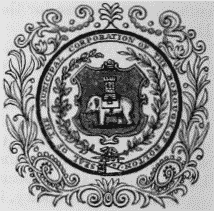
Borough Seal.
The manor of Bolton, which is of considerable antiquity, was alienated by Roger de Maresey, with his other lands between the rivers Ribble and Mersey, to Ranulph de Blundeville, Earl of Chester, for 240 marks of silver, and a pair of white gloves, to be presented annually at Easter. It afterwards passed through the families of Ferrers and Pilkington, and was confiscated to the crown on the attainder of Sir Thomas Pilkington, in the 1st of Henry VII., for his adherence to the cause of Richard III. at the battle of Bosworth-Field. Henry granted it to his relation, Thomas, Lord Stanley, then created Earl of Derby; but a considerable portion of the property having been confiscated by parliament, during the period of the Commonwealth, the manor of Bolton is at present held, in unequal proportions, by five lords.
The town, comprising the townships of Great and Little Bolton, which are separated by the rivulet Croal, was greatly enlarged under an act of parliament obtained in 1792, for inclosing Bolton Moor, of which more than 250 acres were divided into allotments, now partly occupied with buildings. The powers of the commissioners appointed under that act were extended by an act in 1817, since which time three spacious squares, several ranges of buildings, and a few public edifices, have been erected; 428 houses in Great Bolton, and 196 in Little Bolton, were built during one year, and considerable improvement has been made in the roads leading to the town. It is lighted with gas by a company incorporated in 1820, whose powers were extended by an act passed in 1843; and the inhabitants are supplied with excellent water, brought from the high lands in Sharples, five miles north of Bolton, by pipes, and conveyed by an iron main of eighteen inches diameter to the various parts of the town. This undertaking was first established at an expense of £40,000, subscribed in shares of £50 each, by a company formed in 1824, for whose use a handsome stone building was erected, in front of which is an emblematical tablet representing a Naïad seated by a fountain, pouring water from a ewer to a thirsty child. The company obtained a new act in 1843, extending its powers to the adjacent townships; and in 1847 an act was passed, enabling the municipal corporation to purchase or take a lease of the water-works, and to improve the town generally. The theatre is regularly open during the season; a town-hall was erected a few years since, in which concerts occasionally take place, and there are three public libraries. Splendid baths, with public rooms for assemblies, concerts, and lectures, were erected in 1846, at a cost exceeding £4000. The Exchange Buildings, erected in 1825, form a neat edifice of stone, with two Ionic columns at the entrance: the lower room, which is of ample dimensions, is appropriated to the transaction of general business, and fitted up as a news-room; the upper part contains a library and reading-rooms. A mechanics' institute was established in 1825. Temporary barracks have been provided for the accommodation of two companies of infantry.
The principal branch of manufacture, and to the introduction of which Bolton owes its present extent and importance, is that of cotton, in the improvement of which many ingenious and valuable discoveries originated in this town. Sir Richard Arkwright, a resident here, after he had established his works at Derby and Nottingham, brought the spinning-jenny and the waterframe machines to perfection; and Samuel Crompton, who was also an inhabitant of Bolton, invented a machine called the mule, combining the properties of both, for which, after receiving two several donations of £105 and £400, subscribed as acknowledgments of his merit, he was ultimately remunerated by parliament with a grant of £5000. Previously to the introduction of the cotton-trade, some weavers who arrived in this country from the palatinate of the Rhine, had added to the manufacture of woollen-cloth that of a fabric, partly composed of linen-yarn chiefly imported from Germany, and partly of cotton. The chief articles were fustian, jean, and thickset: velvet, entirely of cotton, was first made here in 1756, and muslin, quilting, and dimity succeeded. After the introduction of the improved machinery, several factories were established, but, being chiefly worked by water, they were on a small scale; the subsequent employment of steam enabled the proprietors to enlarge their works, and the adoption of power-looms contributed greatly to improve and extend the trade.
There are at present in Bolton sixty-one cotton-factories. At fifty-six of these are engines of the aggregate power of 1685 horses, and 793,800 throstle spindles; the number of power-looms is 2131, and the weight of raw cotton annually used 13,705,636 lb.: in fifty-five of the factories are consumed 69,278 tons of common coal and 888 tons of cannel coal. The bleaching-grounds are also very extensive, and more than 10,000,000 pieces of cloth are annually bleached. Among them are three large establishments, in each of which from 130,000 to 150,000 pieces are, on the average, finished every month, in two of them is used engine-power equal to 120 horses, and in one alone are annually consumed 16,000 tons of coal. There are twenty-one ironfounders and machine-makers, of whom thirteen have engines of the aggregate power of 433 horses, and employ 2793 hands; use 18,390 tons of metal, and consume 28,150 tons of coal and 3231 tons of coke: machinery of all kinds, and mills of every description, are made. A paper-mill manufactures annually 470 tons of paper, and consumes 3640 tons of coal. The neighbourhood abounds with coal; and veins of leadore and of calamine have been worked at Rivington, but they have not been found productive. The total amount of horse-power in the various works carried on in the borough, in 1846, was 3816; of this aggregate, steam-engines supplied the power of 3654 horses, and water-wheels of 162. The Bolton and Leigh and the Kenyon and Leigh Junction railways connect the town with the Liverpool and Manchester railway at Kenyon; the whole line is nine miles and three-quarters in length. A direct railway to Manchester, 10 miles long, was opened in May 1838; a railway to Euxton, a few miles south of Preston, in June 1843; and a railway to Darwen and Blackburn, 14½ miles long, in 1847. An act, also, was passed in 1845 for the construction of a railway from Liverpool, by Wigan and Bolton, to Bury, there to join a branch of the Manchester and Leeds line. The canal to Manchester was constructed in 1791; a branch to Bury diverges from it at Little Lever, in this parish. The market-days are Monday and Saturday: there are fairs on July 30th and 31st, and Oct. 13th and 14th, for horned-cattle, horses, pigs, and pedlery; and a fair for lean-cattle every alternate Wednesday, from Jan. 5th to May 12th. The market is held in the area of the new square, in the centre of which is a handsome cast-iron column, 30 feet high, rising from a pedestal in the form of a vase, and supporting a lantern which is lighted with gas.
The town was formerly within the jurisdiction of the county magistrates, and its internal government was under the regulation of officers appointed at the court leet of the lord of the manor; but on the 11th Oct. 1838, a charter of incorporation was granted under the Municipal act, and it is now governed by a mayor, 12 aldermen, and 36 councillors. On May 9th, 1839, the queen decreed that a court of quarter-sessions should be held here. The number of magistrates is 17. It was made a parliamentary borough by the act of the 2nd of William IV., cap. 45, with the privilege of returning two members to parliament, the right of election being vested in the £10 householders; the limits of the borough comprise 1748 acres. The county debt-court of Bolton, established in 1847, has jurisdiction over the registration-district of Bolton. The town-hall, already mentioned, at Little Bolton, was built at an expense of £2000; and it is in contemplation to erect a similar structure in Great Bolton, more suited to the importance of the town than the present rooms in which the business is transacted.
The parish comprises by computation 31,000 acres. The living is a discharged vicarage, valued in the king's books at £10. 3. 1½.; net income, £464; patron and appropriator, the Bishop of Chester. The church is a spacious structure, of the style of architecture termed Perpendicular or later English: it has a splendid east window by Wailes, of Newcastle, one of his best productions, and forming an obituary window, erected by the vicar, the Rev. James Slade, M.A., and his relatives, at the cost of £300; a beautiful font of Caen stone was recently erected by Matthew Dawes, Esq., F.G.S., in memory of his parents, and among some interesting monuments is one by Chantrey in the Chetham chapel to John Taylor, Esq., and his family. A district church dedicated to the Holy Trinity was erected in 1825, at an expense of £13,412, defrayed by a grant from the Parliamentary Commissioners; it is a handsome edifice in the later English style, with a tower. The living is a perpetual curacy, in the gift of the Vicar of Bolton, on whose voidance the district will become a separate parish in the gift of the Bishop: the net income, previously £120, was augmented in 1842 with £30 per annum by the Ecclesiastical Commissioners. The district church dedicated to St. George, in Little Bolton, was erected by subscription in 1796: the living is a perpetual curacy, in the patronage of the Vicar; net income, £168. Emmanuel church, built in 1838, at a cost of £2200, originated in a desire on the part of the parishioners to present a service of plate to the vicar, who requested the fund might be applied rather to the building of a church in the most destitute part of the town; it is a handsome structure in the early English style, with a tower and spire. The living is a perpetual curacy, augmented in 1841 by the Ecclesiastical Commissioners to £150, and in the presentation of the Vicar. Christ church, built as a meeting-house in 1818, for Methodists of the New Connexion, was purchased from the trustees in 1841, and licensed for divine worship according to the rites of the Church of England, the minister and greater part of the congregation having conformed thereto: it was consecrated as the church of one of the new parishes under the 6th and 7th Victoria, cap. 37, in 1844; and is of brick, with a handsome Norman porch, and windows of the same style of terra cotta. The living is a perpetual curacy, with an endowment of £150 per annum from the Ecclesiastical Commissioners; patrons, the Crown and the Bishop alternately. A church district, called St. John's, was formed in Little Bolton, in May, 1846, under the same act, and the erection of a church was commenced in 1847; the edifice is in the decorated style, will seat 1000 persons, and was built at a cost of £3500. The district became an ecclesiastical parish on the consecration of the church: the living is a perpetual curacy; net income, £150; patrons, the Crown and Bishop alternately. A chapel dedicated to All Saints, also in Little Bolton, has been restored, and made a district church: the living is a perpetual curacy; net income, £128; patron, T. Tipping, Esq. A Scottish church, in the early English style, was erected by subscription, in 1846. There are also places of worship for Baptists, Independents, Unitarians, the Society of Friends, Swedenborgians, Methodists, and Roman Catholics; and, besides these, ten churches in chapelries and rural townships within the parish. Connected with the parish church is a lectureship, endowed by the Rev. James Gosnell in 1622, and considerably augmented by a grant of land from the Earl of Derby.
The free grammar school, containing 60 boys, was founded by Robert Lever, citizen of London, who, in 1641, bequeathed estates now producing about £350 per annum, with which the revenue of a school previously existing has been united, amounting in the whole to £485: there is a small exhibition to either of the Universities. Robert Ainsworth, compiler of the Latin Dictionary, and Dr. Lempriere, compiler of the Classical Dictionary, were masters of the school; and the former had been educated here. A charity school was founded and endowed in 1693, by Nathaniel Hulton, for the instruction of 30 boys and 30 girls; the income is £277. The "Churchgate Charity School" was founded in 1714, by Thomas Marsden, who endowed it with a house, &c., now producing £14. 10. per annum; in addition, £10 per annum are allowed to the master from Brook's charity, accruing from pews in the parish church. Other schools are supported by subscription; and there are various Sunday schools, of which that in connexion with the parish church, is a large and handsome building of freestone, in the later English style, erected in 1819 at an expense of £1800. A dispensary was established in 1814: a clothing society is supported chiefly by ladies; and there is a society for the relief of poor women during child-birth, formed in 1798. In 1829, John Popplewell, Esq., a gentleman of the medical profession, and a native of the parish, bequeathed £4500, the interest to be applied in providing clothing and bread for the poor of Great and Little Bolton, and the township of Turton; the interest of £2000, to found scholarships for the grammar school; of £400, to repair All Saints' chapel; and of £3500, to the township of Blackrod, for various uses. The bequests of this benefactor altogether amounted to £15,099, vested in the three per cent. consols.; to which his sisters, Anne and Rebecca, added in 1831 the interest of £12,600 in the same stock, for similar benevolent purposes. Elizabeth Lum, in 1840, built six almshouses at the Tealds, in Little Bolton, for twelve widows or spinsters above sixty years of age, who each receive a weekly allowance. The union of Bolton comprises the entire parish with the exception of Anglezarke, Blackrod, and Rivington, and, in addition, eleven other chapelries and townships; and contains a population of 97,519. There are several strong chalybeate springs in the parish. John Bradshaw, president of the court which sentenced Charles I. to the scaffold, is said to have been born near the town.
Bolton-Le-Sands (St. Michael)
BOLTON-LE-SANDS (St. Michael), a parish, in the hundred of Lonsdale south of the Sands, N. division of the county of Lancaster; containing 1774 inhabitants, of whom 671 are in the township of Bolton, 4 miles (N.) from Lancaster, on the road to Kendal. On the foundation of the priory at Lancaster, Roger de Poictou gave to it the church of "Boelton," with the tithes of the lordship, and half a carucate of land; and in the Testa de Nevill, several transactions are mentioned of a family of the local name, as occurring in the registry of the priory. The manor of Bolton, on the suppression of religious communities, seems to have passed to the crown. The parish comprises the townships of Bolton, Slyne with Hest, and Nether Kellet, and the chapelry of Over Kellet. Bolton township comprises 1574a. 3r., chiefly arable land; the surface is undulated, and the soil principally loam, with a gravelly subsoil. It is beautifully situated on Morecambe bay, having views of the Lake mountains and the opposite shore of Furness.
The living is a discharged vicarage, valued in the king's books at £4. 15., and in the patronage of the Bishop of Chester, who is appropriator. The church has a noble square tower: the body was rebuilt in 1816; as was the chancel in 1846, in the early English style, at a cost of £600, by John Holden, Esq., of Woodlands, Gateacre, near Liverpool, as a memorial of his late wife, the daughter of John Walmsley, Esq., of Richmond House, Lancaster. The windows of the chancel are of stained glass, by Wailes, of Newcastle; the eastern window depicts the Crucifixion and Ascension, and the rest contain family arms. The chapel at Over Kellet forms a distinct incumbency. The free school was founded in 1619, by Thomas Assheton, and has an income of £27, arising from the original endowment and subsequent benefactions. The interest of £250, left in 1838 by Richard Sparling Berry, Esq., is given in rewards to parents who educate their children without parochial relief, in the township of Bolton. The arm of a Saxon stone cross, and the remains of the cross from the churchyard, are preserved.
Bolton-Percy (All Saints)
BOLTON-PERCY (All Saints), a parish, in the Ainsty wapentake, W. riding of York; containing 1040 inhabitants, of whom 241 are in the township of Bolton-Percy, 4 miles (E. by S.) from Tadcaster. This parish, which is bounded on the south-west by the river Wharfe, comprises the four townships of Bolton-Percy, Appleton-Roebuck, Colton, and Steeton; and contains about 7320 acres. The soil is generally a strong clay, with portions of a lighter kind; the surface is level, and interspersed with small plantations and woods. Bricks and tiles are manufactured. The York and NorthMidland railway passes through the parish, in which is a station. The living is a rectory, valued in the king's books at £39. 15. 2½.; net income, £1540; patron, the Archbishop of York. The church, built in 1423, by Thomas Parker, rector, is a neat structure with a square tower; it is decorated with a quantity of stained glass, and contains several monuments to the Fairfax family.
Bolton-upon-Dearne (St. Andrew)
BOLTON-upon-Dearne (St. Andrew), a parish, in the union of Doncaster, N. division of the wapentake of Strafforth and Tickhill, W. riding of York, 7¼ miles (N. by E.) from Rotherham, and upon the road from Doncaster to Barnsley; containing 671 inhabitants. At the time of the Conquest here was a church, with its attendant priest; also a mill; and the country appears to have been in a higher state of cultivation than the lands around. The place became the residence of several families of some consideration, and seems to have been from early times a rich and flourishing spot. It lies on the line of road traced by those who consider that a Roman road existed from Templeborough to Castleford; and it is certain there was a bridge over the Dearne here at a remote period, the pontage of which was early a subject of dispute, as is recorded in the Hundred rolls. The parish comprises by measurement 2400 acres, of which about one-third is grass, and the remainder arable: the soil is various, in some parts a strong clay, in others a light sand; and the substratum abounds with excellent sandstone, which is extensively quarried. The village is beautifully situated on the northern acclivities of the vale of Dearne, having a good bridge over the river, said to occupy the site of a Roman ford; and about a mile northward is the pleasant hamlet of Goldthorpe. A statute-fair for hiring servants is held on the second Thursday in November. The living is a perpetual curacy, valued in the king's books at £6. 15. 5.; net income, £88; patrons, the Executors of the late W. H. Marsden, Esq., in whom are vested the impropriate tithes, which have been commuted for £580. The church is an ancient edifice, chiefly in the Norman style, with a tower at the west end. There is a place of worship for Wesleyans.
Bolton-upon-Swale
BOLTON-upon-Swale, a chapelry, in the parish of Catterick, union of Richmond, wapentake of Gilling-East, N. riding of York, 1¾ mile (N. E.) from Catterick; containing 960 inhabitants, of whom 96 are in Bolton township. It comprises the townships of Bolton, Whitwell, Kiplin, Ellerton, Scorton, and Uckerby; and is separated from that of Catterick by the river Swale. The living is a perpetual curacy, in the gift of the Vicar of Catterick, with a net income of £100; the chapel, dedicated to St. Mary, is ornamented with a lofty tower, and its burial-ground contains a neat pyramidal monument, erected by subscription, in 1743, over the grave of Henry Jenkins, a native of this place, who died in the year 1670, at the age of 169, and is the oldest Englishman on record. A free school was founded in the beginning of the last century by Leonard Robinson; and there is a large nunnery, with a ladies' boarding school attached.
Bonby (St. Andrew)
BONBY (St. Andrew), a parish, in the union of Glandford-Brigg, N. division of the wapentake of Yarborough, parts of Lindsey, county of Lincoln, 5½ miles (S. S. W.) from Barton-on-Humber; containing 386 inhabitants. This parish, in ancient records called Bondeby, is on the road from Barton to London, and comprises by survey 2427 acres, equally divided between arable and pasture: the eastern half is high land, part of the Wolds, and the western half part of the Ancholme level; the soil is a peat moor, upon a stratum of clay. There are some quarries of chalkstone, which is raised for manure. The Ancholme river and Ancholme canal pass through the parish. The living is a discharged vicarage, valued in the king's books at £6. 4. 4.; net income, £233; patron and impropriator, Lord Yarborough. The church is an ancient edifice, with a square tower. There are places of worship for Primitive Methodists and Wesleyans. In the reign of John, a priory was established here.