A Topographical Dictionary of England. Originally published by S Lewis, London, 1848.
This free content was digitised by double rekeying. All rights reserved.
'Calne - Camborne', in A Topographical Dictionary of England, ed. Samuel Lewis (London, 1848), British History Online https://www.british-history.ac.uk/topographical-dict/england/pp474-479 [accessed 30 April 2025].
'Calne - Camborne', in A Topographical Dictionary of England. Edited by Samuel Lewis (London, 1848), British History Online, accessed April 30, 2025, https://www.british-history.ac.uk/topographical-dict/england/pp474-479.
"Calne - Camborne". A Topographical Dictionary of England. Ed. Samuel Lewis (London, 1848), British History Online. Web. 30 April 2025. https://www.british-history.ac.uk/topographical-dict/england/pp474-479.
In this section
Calne (St. Mary)
CALNE (St. Mary), a borough, market-town, and parish, and the head of a union, in the hundred of Calne, Chippenham and Calne, and N. divisions of Wilts, 30 miles (N. N. W.) from Salisbury, and 87 (W. by S.) from London, on the road to Bath and Bristol; comprising the tythings of Blackland, Calstone, Eastmead-Street, Quemerford, Stock, Stockley, Studley, Whetham, and Whitley; and containing 5128 inhabitants, of whom 2483 are in the borough. This place is of very remote origin, and is supposed to have risen from the ruins of a Roman station on the opposite side of the river, near Studley, where numerous Roman antiquities have been discovered. It is said by tradition to have been the residence of the West Saxon monarchs; but no vestiges exist of their palace or castle, the remembrance of which is preserved only in the name of a field thought to have been its site, and of a street which probably led to it. A synod was assembled here in 977, for adjusting the differences then prevailing between the monks and the secular clergy, at which Dunstan, Archbishop of Canterbury, presided. During the controversy the floor of the chamber gave way, and several of the secular priests were killed; but Dunstan, and the monks whose cause he advocated, escaped unhurt; their preservation was regarded as a miraculous interposition of Heaven, and they were allowed to take immediate possession of the religious houses throughout the kingdom, to the exclusion of the secular clergy.
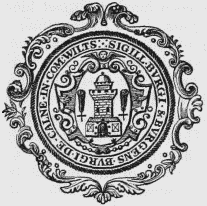
Corporation Seal.
The town consists principally of one long street, lighted with gas; the houses are in general well built of stone, and the inhabitants are amply supplied with water from springs, and from the river Marden, which, after passing through the town, falls into the Avon. It has been much improved under the auspices of the Marquess of Lansdowne, whose extensive and stately mansion is in the adjoining liberty of Bowood; and the environs abound with pleasing scenery. The woollen-manufacture, formerly carried on to a great extent, is now conducted on a very limited scale; the articles are principally broad-cloth, kerseymere, and serge. A branch of the Wilts and Berks canal comes up to the town, and, uniting with the Kennet and Avon canal, and with the Thames at Abingdon, affords a facility of communication with London, Bristol, and the intermediate places. The market is on Wednesday; and fairs are held on May 6th and September 29th, for cattle and sheep. The corporation formerly consisted of two guild stewards, and an indefinite number of free burgesses, who annually appointed two constables; but the government is now vested in a mayor, four aldermen, and twelve councillors, under the act of the 5th and 6th of William IV., cap. 76. The borough first sent members to parliament in the 23rd of Edward I.; from that time it made irregular returns until the reign of Richard II., after which it uninterruptedly returned two members; but, by the act of the 2nd of William IV., cap. 45, the number was reduced to one. The right of election, formerly in the members of the corporation, was, by the above act, extended to the £10 householders of the borough, the limits of which were increased from 800 to 8080 acres: the mayor is returning officer. The powers of the county debt-court of Calne, established in 1847, extend over the registration-district of Calne. The town-hall is a neat and commodious building, erected by the lord of the manor, and has been repaired, and an upper story added, by the Marquess of Lansdowne; the lower part is used as a market-place.
The living is a vicarage, with the living of BerwickBasset annexed, valued in the king's books at £8. 5.; net income, £769; patron, the Bishop of Salisbury. A portion of the vicarial tithes was commuted for land in 1813. The church is a venerable structure in the early English style, with a square embattled tower. A district church, of which the first stone was laid in 1839, by the Marquess of Lansdowne, attended by a large concourse of the nobility and gentry, was completed at Derry Hill in 1840; it is an elegant edifice in the later English style, with a spire, and contains 500 sittings, of which 400 are free, for the benefit of the inhabitants of Derry Hill, Studley, and Pewsham, many of whom are four miles distant from the mother church. The living was augmented in 1842 to £120 per annum, by the Ecclesiastical Commissioners; patron, the Vicar. There are places of worship for Baptists, the Society of Friends, Methodists, and Unitarians. A free school was founded in 1660, by John Bentley, who endowed it with property, afterwards sold, and the produce vested in the purchase of annuities amounting to £50. Sir Francis Bridgman, Knt., in 1730 founded six scholarships, of the value of £50 per annum each, in Queen's College, Oxford; two of which are for natives of this town. The poor law union of Calne comprises 11 parishes or places, and contains a population of 9324. An hospital dedicated to St. John existed here in the reign of Henry III., the revenue of which, at the Dissolution, was £2. 2. 8. At the distance of three miles to the east of the town is the figure of a horse, cut in the chalk hill, 157 feet long.
Calow
CALOW, a township, in the parish and union of Chesterfield, hundred of Scarsdale, N. division of the county of Derby, 2 miles (E. by S.) from Chesterfield; containing 536 inhabitants. The township comprises 1280 acres of land: the village is pleasantly situated on the Clown road, at its junction with the Sutton road. There are extensive collieries in the neighbourhood, and a furnace for smelting iron-ore. The Earl Manvers occasionally holds a manor court at Billmore House.
Calstock (St. Andrew)
CALSTOCK (St. Andrew), a parish, in the union of Liskeard, Middle division of the hundred of East, E. division of Cornwall, 5¼ miles (E.) from Callington; containing 2553 inhabitants. This place anciently belonged to the Coteheles, of whom the last heiress, more than three centuries since, conveyed it by marriage to the Edgcumbe family, whose descendant, the Earl of Mount-Edgcumbe, is the present proprietor. In the reign of Richard III., Sir Richard Edgcumbe, a zealous adherent to the Earl of Richmond, erected a chapel in the grounds of his baronial mansion of Cotehele, in commemoration of his escape from the partisans of Richard III., by whom he had been pursued. Charles II. passed several nights in this residence; and, in 1789, it was visited by the Princess Royal, and the Princesses Augusta and Elizabeth. The house is a spacious and highly interesting quadrangular structure, having on the north side a lofty square tower, containing the state apartments, with all their ancient furniture, which has been carefully preserved. The chapel erected by Sir Richard Edgcumbe has been much defaced by modern alterations, and externally retains but little of its original character.
The parish is separated from Tavistock and BeerAlston, in Devon, by the navigable river Tamar, which forms its boundary on the east and south, and over which are a ferry and a bridge: the scenery is diversified, and near Cotehele House is singularly beautiful. The tide flows nearly to the centre of the parish, where is a weir; and a very productive fishery is carried on, of salmon and trout of excellent quality, with which the Tamar abounds. A steamer runs three times a week to Plymouth, distant upwards of twenty miles. The parish comprises 6133 acres, of which 1397 are common or waste: the surface in the hilly parts is shelfy, and the soil light; the remainder is tolerably good corn-land. Mines of copper and tin are in operation; and a lead-mine, the ore of which is richly intermixed with silver, has been opened: the mineral Uranium is likewise procured, and there is a quarry of fine granite, of which considerable quantities were used in the erection of Waterloo Bridge. The living is a rectory, valued in the king's books at £26. 7. 8½., and in the patronage of the Crown, in right of the duchy of Cornwall; net income, £510. The church is an ancient structure, with a lofty embattled tower crowned by pinnacles; it stands upon a hill, and commands fine prospects. The parsonage-house was built in 1710, by Launcelot Blackburn, Archbishop of York, then rector. There are several places of worship for dissenters. On Hengist Down are several tumuli: here was fought a great battle between the Saxons and ancient Britons.
Calstone
CALSTONE, a tything, in the parish, union, and hundred of Calne, Chippenham and Calne, and N. divisions of Wilts; containing 219 inhabitants.
Calstone-Wellington (St. Mary)
CALSTONE-WELLINGTON (St. Mary), a parish, in the parliamentary borough, union, and hundred of Calne, Chippenham and Calne, and N. divisions of Wilts, 3 miles (S. E. by E.) from Calne; containing 31 inhabitants. It comprises 183 acres; the surface is hilly, and the soil various, in some parts chalk, and in others a fertile loam. The living is a discharged rectory, valued in the king's books at £4. 13. 4.; net income, £192; patron, the Marquess of Lansdowne. A portion of the vicarial tithes was commuted for land in the year 1813.
Calthorpe, Leicester.—See Cathorpe.
CALTHORPE, Leicester.—See Cathorpe.
Calthorpe (St. Margaret)
CALTHORPE (St. Margaret), a parish, in the union of Aylsham, hundred of South Erpingham, E. division of Norfolk, 4 miles (N. by W.) from Aylsham; containing 214 inhabitants. It comprises 1048 acres, of which 40 are common or waste; the soil is in general rich and loamy: a small tributary of the river Bure forms the boundary of the greater part. The living is a discharged vicarage, in the patronage of the Corporation of Norwich; impropriator, the Earl of Orford. The great tithes have been commuted for £195, and the vicarial for £138; the impropriate glebe consists of 34 acres, and the vicar's comprises 23 acres.
Calthwaite
CALTHWAITE, a township, in the parish of Hesket-in-the-Forest, union of Penrith, Leath ward, E. division of Cumberland, 7 miles (N. N. W.) from Penrith; containing 206 inhabitants. The river Petterill, over which a bridge of one arch was built by subscription in 1793, flows on the eastern side of the village, and the Lancaster railway runs through the township.
Calton
CALTON, a chapelry, partly in the parish of Blore, N. division, and partly in the parishes of Croxden, Mayfield, and Waterfall, S. division, of the hundred of Totmonslow, N. division of the county of Stafford, 5¾ miles (W. N. W.) from Ashbourn, on the road to Leek; containing 244 inhabitants. It comprises about 1400 acres, of which the surface is hilly, and the soil in general rich and productive; the substratum is limestone, which abounds with fossil shells. This is a dairyfarming country, and mostly laid out in grass-land and sheep-walks. The river Hamps, which separates the chapelry from Waterfall, is said to disappear at Waterhouses, and, after running underground for upwards of five miles, again to make its appearance near Ilam. The living is a donative, in the patronage of the Inhabitants; net income, £86, with a parsonage-house. The chapel, a small edifice, is dedicated to St. Mary.
Calton
CALTON, a township, in the parish of Kirkby-inMalham-Dale, union of Skipton, E. division of the wapentake of Staincliffe and Ewcross, W. riding of York, 7 miles (N. W.) from Skipton; containing 79 inhabitants. It comprises by computation 1730 acres, of which the surface is varied, and chiefly in pasture. Calton Hall, now a farmhouse, was the residence of the Lambert family, of whom General Lambert was one of the principal leaders of the parliamentarians in the reign of Charles I.
Calveley
CALVELEY, a township, in the parish of Bunbury, union of Nantwich, First division of the hundred of Eddisbury, S. division of the county of Chester, 6 miles (N. W. by N.) from Nantwich; containing 190 inhabitants. The township lies on the road from Nantwich to Tarporley, and comprises 1416 acres, of a clayey soil. The Chester canal and the Chester and Crewe railway pass in the vicinity of the village; and the railway has a station here, 8 miles distant from the great station at Crewe. This was the birthplace and residence of the famous Sir Hugh Calveley, whose niece in 1360 married Arthur, sixth son of Sir John Davenport, of Merton, whose descendants have resided here up to the present time. A school is supported by Mrs. Davenport.
Calver
CALVER, a township, in the parish and union of Bakewell, hundred of High Peak, N. division of the county of Derby, 1 mile (E. S. E.) from Stoney-Middleton; containing 573 inhabitants. There are extensive lime-works; also some cotton-mills, in which from 200 to 300 persons are employed. The village is situated on the river Derwent,
Calverhall
CALVERHALL, a chapelry, in the parish of Prees, union of Wem, Whitchurch division of the hundred of North Bradford, N. division of Salop; containing, with Willaston and Millenheath, 262 inhabitants. The living is a perpetual curacy; net income, £65; patron and impropriator, John W. Dodd, Esq. The chapel is dedicated to St. Bartholomew.
Calverleigh (St. Mary)
CALVERLEIGH (St. Mary), a parish, in the union and hundred of Tiverton, Cullompton and N. divisions of Devon, 2 miles (N. W.) from Tiverton; containing 81 inhabitants. It comprises by measurement 500 acres, about 50 of which are woodland, and the rest arable and pasture in nearly equal portions. The living is a rectory, valued in the king's books at £12, and in the patronage of G. W. Owen, Esq.: the tithes have been commuted for £85. 13., and the glebe comprises 72 acres. In the church is a curious monument to a former proprietor named Southcot, dated 1638. There is a Roman Catholic chapel.
Calverley (St. Wilfrid)
CALVERLEY (St. Wilfrid), a parish, in the union of Bradford, wapentake of Morley, W. riding of York, 5 miles (N. E.) from Bradford; containing, with the township of Bolton and the chapelries of Idle and Pudsey, 21,039 inhabitants, of whom 4142 are in the township of Calverley cum Farsley. This extensive parish, which is within the honour of Pontefract, belonged at the time of the Conquest to the Lacys, by whom the manor was given to Gospatrick, Earl of Northumberland, one of whose daughters and co-heiresses conveyed it by marriage, in the reign of Stephen, to the family of Scot, whose descendants assumed the name of Calverley. In 1754, Sir Walter Calverley, who took the surname of Blackett, sold it, with the whole of the estates, to the great-uncle of Thomas Thornhill, Esq., the present lord. The parish comprises 8644a. 3r. 14p.; the soil is fertile, the surface is pleasingly varied, and the higher grounds command extensive and interesting views of the country adjacent. The village is beautifully situated, partly on the brow of an acclivity on the south side of Airedale, and partly on the bank of the river, and near the Leeds and Liverpool canal. The population is principally employed in the woollen-manufacture, for which there are extensive establishments; and within the parish are also some stone-quarries and coal-mines. The living is a vicarage, valued in the king's books at £9. 11.10.; net income,£150, with a good glebe-house; patron, the Crown. The church is a venerable structure in the later English style, with a square embattled tower crowned by pinnacles, and contains several handsome monuments. Other churches have been erected at Farsley, Idle, and Pudsey; and there are some places of worship for dissenters.
Calverton (All Saints)
CALVERTON (All Saints), a parish, in the union of Potter's-Pury, hundred of Newport, county of Buckingham, 1 mile (S.) from Stony-Stratford; containing 493 inhabitants. This parish once included the western portion of Stony-Stratford, which was separated from it by act of parliament: the manor belonged to Simon Bennet, Esq., who, during the commonwealth, built the manor-house on the site of a more ancient structure. The parish comprises about 2000 acres, whereof two-thirds are arable and the rest pasture; both the surface and the soil are considerably varied: the river Ouse skirts it on the north. The substrata are chiefly limestone and sandstone; the former, which abounds with numerous fossil shells, is quarried for burning into lime and for building purposes. The living is a rectory, valued in the king's books at £26. 2. 11.; net income, £346; patron, the Earl of Egmont: the tithes were commuted for land and a money payment in 1782. The church is a neat plain edifice, erected in 1818, by Lord Arden and the Rev. George Butler, D.D., then rector; it has been embellished with stained glass by the Rev. C. G. Perceval, the present incumbent, and the interior has a neat and pleasing appearance. The rectory-house, built by Lord Arden in 1820, occupies the site of a small Roman camp, and numerous fragments of Roman pottery, with arrow-heads, and a spear, have been discovered. Six small almshouses were built in 1830. A chalybeate spring, called the Bloody Hawk, was formerly much resorted to by persons who, on those occasions, formed groups for dancing to the violin.
Calverton (St. Wilfrid)
CALVERTON (St. Wilfrid), a parish, in the union of Basford, S. division of the wapentake of Thurgarton and of the county of Nottingham, 7 miles (N. N. E.) from Nottingham; containing 1339 inhabitants. The parish is separated from that of Oxton by a small stream called Dover beck, which rises in the forest of Sherwood, and runs in a south-eastern direction into the Trent; it comprises by measurement 3300 acres, whereof twothirds are arable, and the rest pasture and woodland. The chief manufactures are those of stockings and lace, which afford employment to about 600 persons. The village is of considerable extent, and situated in a picturesque valley. The living is a discharged vicarage, valued in the king's books at £4, and in the alternate patronage of the Archbishop of York and the Prebendary of Oxton in the Collegiate Church of Southwell; net income, £127: the tithes were commuted for 203 acres of land, under an inclosure act passed in 1779. The church, erected in 1774, is a neat and substantial edifice with a tower. There are places of worship for Baptists and Wesleyans, and for a sect peculiar to the parish, founded in the latter part of the last century, by John Roe. A school is endowed with £6 per annum; and £40 per annum, a house and garden, and four tons of coal, are also allowed by the trustees of Mr. Jonathan Labray's hospital.
Calwich
CALWICH, a township, in the parish of Ellastone, S. division of the hundred of Totmonslow, N. division of the county of Stafford, 3½ miles (S. W. by W.) from Ashbourn; containing 131 inhabitants. A hermitage was established here, which was given to the priory of Kenilworth before the year 1148, by Nicholas de Greselei Fitz-Nigell, and a small number of Black canons placed therein. The house was assigned by Henry VIII. to the monastery of Merton, in Surrey, in exchange for the manor of East Moulsey, and as parcel of the monastery was again granted by that monarch to John Fleetwood. The township is on the western side of Dovedale, and comprises 655 acres, including the hamlet of Northwood. Calwich Abbey is the seat of the Hon. and Rev. Augustus Duncombe, by whom it was purchased of Court Granville, Esq., in 1842. Attached to the mansion are a beautiful lawn and pleasure-grounds, and a fine sheet of water supplies excellent fishing. Handel, the composer, was a frequent guest here.
Cam (St. George)
CAM (St. George), a parish, in the union of Dursley, Upper division of the hundred of Berkeley, W. division of the county of Gloucester, 1 mile (N.) from Dursley; containing 1851 inhabitants. This place is distinguished as the scene of a battle fought between the Saxons and the Danes, in the reign of Edward the Elder. The parish takes its name from a rivulet that divides it into Upper and Lower, and falls into the Severn at Frampton: it comprises 2531a. 1r. 26p., of which 2025 acres are pasture, 263 arable, and 242 common land; the soil is in general a strong clay. There are several quarries of white and of brown freestone, which, when kept dry, is of good quality for building; and facility of communication is afforded by the Gloucester and Bristol railway, which crosses the lower part of the parish. A considerable portion of the land lies low, but the meadows afford excellent pasture, and the district is noted for the superiority of its cheese. The majority of the inhabitants are employed in the finer branches of the clothing-trade, and the weavers of the place are among the best workmen of this part of the kingdom. The living is a vicarage, valued in the king's books at £6. 13. 4.; net income, £150; patron and impropriator, the Bishop of Gloucester and Bristol. The great tithes have been commuted for £500, and the bishop's glebe consists of 23a. 2r. The church, which has been improved and newly pewed at a considerable expense, is an ancient structure in the later English style: in the porch was a figure of the patron saint carved in wood, which, in the reign of Edward VI., was taken down and removed to Colnbrook, from which circumstance the George inn in that town received its name. There are places of worship for Independents and Wesleyans. In 1730, Mrs. Frances Hopton bequeathed an estate for a school, now producing nearly £200 per annum.
Camberwell (St. Giles)
CAMBERWELL (St. Giles), a parish and union, in the E. division of the hundred of Brixton and of the county of Surrey, 3¼ miles (S.) from London; containing, with the hamlets of Dulwich and Peckham, 39,868 inhabitants. This place, in the Norman survey called Cambrewell, and in other ancient records Camerwell, appears to have been known to the Romans, whose legions are by some antiquaries supposed to have here forded the Thames, and to have constructed the causeway leading from the river through the marshes in this parish, of which a considerable part, consisting of square chalk-stones, and secured with oak piles, was discovered fifteen feet below the surface of the ground, in digging the bed of the Grand Surrey canal, in 1809. In Domesday book mention is made of a church; and in the register of Bishop Edington at Winchester, a commission dated 1346, for "reconciling Camberwell church, which had been polluted by bloodshed," is still in existence. The village or town is pleasantly situated, and the beauty of its environs has made it the residence of many wealthy merchants of the metropolis: it is paved, and lighted with gas; and the inhabitants are amply supplied with water from springs, and from the works of the South London Company. The ancient part of the village contains several spacious mansions in detached situations; the more modern is built on rising ground to the south-east, and comprises the Grove, and Champion, Denmark, and Herne Hills, which are occupied by elegant villas in a pleasing style. A literary and scientific institution was founded in 1846. There are several coal and coke wharfs, and a limekiln on the banks of the Surrey canal, which terminates in the parish, through which the London and Croydon railway also passes. By the act to "amend the representation," the whole parish, except Dulwich, was included within the limits of the borough of Lambeth. The magistrates for the district hold a meeting every alternate week.
The parish comprises 4342 acres, of which 55 are common or waste. The living is a vicarage, valued in the king's books at £20, and in the gift of the Rev. J. Williams: the great tithes have been commuted for £80, and the vicarial for £1100; the glebe comprises 21 acres, with a good glebe-house. The church, an ancient structure in the later English style, with a low embattled tower surmounted by an open lantern-turret rising from the centre, was destroyed by an accidental fire on the morning of Monday, the 8th of February, 1841, and only the roofless walls left standing: a meeting of the parishioners was held on the 13th for the appointment of a committee, who, at a subsequent meeting, were empowered to raise £12,000 for the erection of a new edifice. The new church, which is the most magnificent ecclesiastical structure recently completed in the neighbourhood of London, is of cruciform design, with a central tower and spire, and in the style of the latter half of the 13th century. The mass of the walls is built of rubble-work of Kentish ragstone, mixed with the materials of the old church; the exterior is faced with hammer-dressed stone from Yorkshire, with dressings of Caen stone. The general character of the building is bold and massive, rather than highly ornamented. The nave is supported on each side by five arches, resting on alternately round and octagonal pillars with carved capitals: the pulpit and some other portions of the interior are of oak, the communion-table is of stone; there is a fine organ, and the west window contains some stained glass, chiefly ancient.
The district church dedicated to St. George is situated on the bank of the Surrey canal, and is a handsome structure in the Grecian style, erected in 1824, at an expense of £17,000, of which £5000 was a grant from the Commissioners for Building New Churches; it is adapted for a congregation of 1700 persons. The living is a perpetual curacy; net value, £500. Emmanuel district church, situated in the High-street, near the old mansion-house, and of which the first stone was laid in 1841, was completed at an expense of £6000, of which £2000 were contributed by the Metropolitan ChurchBuilding Society, £1000 by the Incorporated Society, and £1900 by Sir Edward Bowyer Smith, who also gave the site and a house for the minister, and presented the organ. It is a handsome structure of white brick, in the Norman style, with two towers surmounted by small spires at the east end, where is the principal entrance; the interior is well arranged, and contains 1000 sittings, of which 500 are free. The first stone of St. Paul's church, Herne-Hill, was laid in June, 1843. It is a brick building faced with Sneaton stone, in the English style, with a tower and spire 115 feet in height: the extent of the plan is 115 feet from east to west, and the internal length of the nave 80 feet, and its breadth, including the aisles, 50; the windows are of stained glass. The edifice affords accommodation to 700 persons; the cost was £4958, independently of numerous gifts of fittings-up. The living is in the gift of the Rev. J. G. Storie; income, £500. Two churches have been erected at Peckham, where are also two proprietary episcopal chapels. Camden chapel, built in 1795, and subsequently enlarged, is a handsome edifice of brick, with a campanile turret; it was under proprietary management previously to November, 1844, when it was consecrated. Besides these, is a chapel dedicated to St. Matthew, on Denmark Hill, and which, though locally in this parish, is dependent on that of Lambeth. There are places of worship for Baptists, Independents, and Wesleyans.
The free grammar school, originally intended for 12 boys, was founded in 1618, by the Rev. Edward Wilson, vicar of the parish, who built the premises, and gave seven acres of land for its endowment, which are let on lease for £60 per annum, paid to the master, who has also a house rent-free, and the privilege of taking boarders. The school is under the management of governors, who are a body corporate, and have a common seal. The Camberwell collegiate school, founded in 1834, is a proprietary establishment, on the principles of King's College, London, and under the patronage of the Bishop of Winchester; the buildings, to which are attached two acres of garden and play ground, are situated in the Grove, and are in the collegiate style, with a cloister in the centre of the front, forming the principal entrance. On the south of the village is Ladland's Hill, on which are the remains of a Roman camp, defended on the south side by a double intrenchment; and in a field in the neighbourhood, called Well Hill, three large wells, 36 feet in circumference, and lined with cement, have been discovered, from which the place probably derived its name. A head of Janus, 18 inches high, was found about a century since, at a place designated St. Thomas' Watering, where pilgrims used to stop on their way to Becket's shrine; and near it is a hill, called Oak-ofHonour Hill, from an oak under which Queen Elizabeth is said to have dined. Dr. Lettsom, an eminent physician, lived for many years in a beautiful cottage in the Grove, where he had an extensive library and philosophical apparatus. The uncle of George Barnwell, the hero of Lillo's tragedy, resided in an ancient house of which there are still some vestiges remaining.
Camblesforth
CAMBLESFORTH, a township, in the parish of Drax, union of Selby, Lower division of the wapentake of Barkstone-Ash, W. riding of York, 2¾ miles (N.) from Snaith; containing 321 inhabitants. There is a charity school, with an endowment of £6 per annum; likewise almshouses for six people, endowed with £100 per annum. The poor children also participate in the advantages of the grammar school at Drax.
Cambo
CAMBO, a township, in the parish of Hartburn, union of Morpeth, N. E. division of Tindale ward, S. division of Northumberland, 11½ miles (W.) from Morpeth; containing 99 inhabitants. The township comprises 630 acres, of which the greater part is rich pasture-land. The village is on the road from Hexham to Alnwick: there is a small subscription library. The tithes have been commuted for £17. 10. payable to the impropriator, and £19 to the vicar of Hartburn. A district chapel has been built, the living of which is in the gift of the Vicar. Launcelot Brown, the landscape gardener, received his early education here. In the village are the ruins of a peel-house, or fortalice.
Cambois
CAMBOIS, a township, in the parish and division of Bedlington, union of Morpeth, N. division of Northumberland, 7½ miles (E. by S.) from Morpeth; containing 109 inhabitants. The lands extend along the sea-shore, between the rivers Blyth and Wansbeck; and the village is situated among rich pastures on a dry green knoll, formed by the banks of the sea and the Wansbeck, which has here a ferry over it. There is a small harbour, where corn, timber, and grindstones are shipped. Some spacious granaries were built during the war with France, at which period a great quantity of grain was exported. About half a mile south-east of the Wansbeck is a cluster of rocks, named Cambois ridge, the tops of which are dry at low water; but as this part of the coast is little frequented, except by small vessels, accidents seldom occur.
Camborne (St. Martin)
CAMBORNE (St. Martin), a market-town and parish, in the union of Redruth, E. division of the hundred of Penwith, W. division of Cornwall, 4 miles (W. S. W.) from Redruth, and 267 (S. W.) from London, on the road from Truro to Penzance; containing 10,061 inhabitants. This town, which is situated in the centre of an extensive district abounding with copper, tin, and lead mines, consists of several streets, uniformly built, but indifferently supplied with water: two book-clubs have been established. The Dolcoath copper-mine has been sunk to the depth of 1000 feet, and extends laterally for more than a mile, in a direction from east to west; the number of persons employed exceeds 1500, and the annual expenditure of the proprietors is more than £50,000. There are several other mines, on a smaller scale: the neighbourhood abounds with granite; and an iron-foundry, and a manufactory for safety-fuzes used by miners in blasting, together employ about sixty persons. Here is a station on the Hayle and Redruth railway. The market is on Saturday: the markethouse, a shed supported on pillars of granite, was erected at the expense of Lord de Dunstanville. The fairs are on March 7th, June 5th and 29th, and November 12th, and are principally for cattle. The county magistrates hold a petty-session for the district every alternate Tuesday; and a court leet is held in November, at which constables are appointed.
The parish comprises by computation 6000 acres, of which 1120 are common or waste. The living is a rectory, valued in the king's books at £39. 16. 10½., and in the patronage of Lady Bassett: the tithes have been commuted for £900, and the glebe comprises 40 acres. The church is an ancient structure, principally in the later English style, and contains several monuments to the family of Pendarves; the altar-piece is of marble handsomely sculptured, and the pulpit of oak curiously carved. A church district, called All Saints, Tuckingmill, and including part of the parish of Illogan, was formed in 1844, and endowed by the Ecclesiastical Commissioners: another district, named Penponds, was formed in 1846. At Treslothan is a district church dedicated to St. John, the living of which is in the gift of E. W. Pendarves, Esq. There are places of worship for the Society of Friends, Wesleyans, and Bryanites. Mr. Arthur Woolf, an eminent civil engineer, who died in 1837, was born here about the year 1765; he made considerable improvements in the construction of steamengines, and took out a patent for the application of two cylinders. Mr. Richard Trevithic, who was born at Camborne in 1775, and died in 1835, in conjunction with Captain Andrew Vivian, now residing here, constructed the first locomotive engine, for which they took out a patent, in 1802; they also constructed a highpressure steam-engine, and invented the cylindrical boiler with a single tube, which is very economical in the use of fuel. Mr. Bickford, resident here, invented, with Mr. Thomas D'Arcy, the patent safety-fuze used by miners for blasting. John Stackhouse, Esq., of Pendarves, who was born in the parish in 1748, and died in 1819, was author of the Nereis Britannica, and editor of the Theophrasti Plantarum Historia.