A Topographical Dictionary of England. Originally published by S Lewis, London, 1848.
This free content was digitised by double rekeying. All rights reserved.
'Ives, St. - Ixworth-Thorpe', in A Topographical Dictionary of England, ed. Samuel Lewis (London, 1848), British History Online https://www.british-history.ac.uk/topographical-dict/england/pp628-631 [accessed 30 April 2025].
'Ives, St. - Ixworth-Thorpe', in A Topographical Dictionary of England. Edited by Samuel Lewis (London, 1848), British History Online, accessed April 30, 2025, https://www.british-history.ac.uk/topographical-dict/england/pp628-631.
"Ives, St. - Ixworth-Thorpe". A Topographical Dictionary of England. Ed. Samuel Lewis (London, 1848), British History Online. Web. 30 April 2025. https://www.british-history.ac.uk/topographical-dict/england/pp628-631.
In this section
Ive, St.
IVE, ST., a parish, in the union of Liskeard, Middle division of the hundred of East, E. division of Cornwall, 4¼ miles (W. S. W.) from Callington; containing 768 inhabitants. The parish comprises 4553 acres, of which 804 are common or waste. Its substratum abounds in minerals, but no mines are in operation; there is a quarry of slate, which is extensively worked. A fair is held on the second Thursday in April, for cattle. The living is a rectory, valued in the king's books at £26, and in the patronage of the Crown: the tithes have been commuted for £430, and the glebe comprises 60 acres of very inferior land. The church is a handsome structure in the later English style; in the chancel is a monument to Sir Boucher Wray, who was interred here. There is a place of worship for Wesleyans. Several bequests, amounting to £10 per annum, have been left for educating children.
Ivegill, Cumberland.—See Highead.
IVEGILL, Cumberland.—See Highead.
Iver (St. Peter)
IVER (St. Peter), a parish, in the union of Eton, hundred of Stoke, county of Buckingham, 2½ miles (S. S. W.) from Uxbridge; containing 1948 inhabitants. This place had formerly a market, granted to Lord Neville in 1351, and confirmed in 1461, together with an additional grant of two fairs, to the Dean and Canons of Windsor; the market has been long discontinued, and only a small pleasure-fair is now held, on the 10th of July. The parish comprises 6269a. 2r. 12p.; the surface is varied, and the lower grounds are watered by the river Colne, on which is an extensive flour-mill. A considerable traffic in grain is carried on by the Grand Junction canal, which passes to the east of the village; and the Great Western railway intersects the parish. The living is a perpetual curacy, valued in the king's books at £13. 16. 8.; net income, £115; patrons and impropriators, the family of Sullivan. The church is much admired for the simplicity and beauty of its architecture, and is evidently of great antiquity; it contains several interesting monuments. There is a place of worship for Independents. A free school, supposed to have been founded about 1688, by Robert Bowyer, who endowed it with a fee-farm rent of £21. 11. 9½., was enlarged by donations from Lord Gambier and others, in 1823, and is now conducted on the national plan: there is also a girls' school, and the two establishments are carried on in a building erected by subscription in memory of the late Rev. E. Ward, thirty-one years minister of Iver. Bequests amounting to £108 per annum are distributed in coal, bread, and blankets. Queen Elizabeth occasionally resided at Rycots, now a farmhouse surrounded by a moat. There is also a house at Richings, in the parish, formerly in the possession of the Duchess of Somerset, and the resort of Pope and the wits of that age: an adjoining walk is known by the name of Pope's Walk. Oliver Cromwell resided at Thorney.
Ives, St. (St. Andrew)
IVES, ST. (St. Andrew), a sea-port, borough, and parish, in the union of Penzance, hundred of Penwith, W. division of the county of Cornwall, 9 miles (N. E. by N.) from Penzance, and 278 (W. S. W.) from London; containing 5666 inhabitants. This town derived its ancient appellation, Porth Ia, from its situation on the coast, and the dedication of its original church to St. Hya or Ia, daughter of an Irish chieftain, who, devoting herself to a religious life, visited Cornwall with some Christian missionaries about the middle of the fifth century, and took up her residence at this place, where she was interred. St. Ives appears from its very origin to have been governed by portreeves; and in the reign of Edward VI., Payne, who at that time held the office, having engaged in the rebellion under Humphrey Arundel, governor of St. Michael's Mount, was hanged here by order of the provost-marshal, Sir Anthony Kingston.
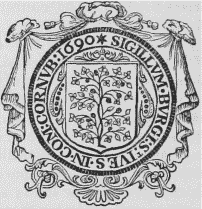
Seal and Arms.
The Town is situated on the western shore of the bay of the same name, and consists of several streets, which, towards the entrance from Redruth, contain some wellbuilt houses, but which in the lower part of the town are narrow and uneven; the inhabitants are amply supplied with water. When viewed from the surrounding heights, its appearance is tolerably picturesque; and the scenery is enriched with some pleasing valleys in the vicinity, watered by small streams. Though still rather difficult of approach, from the steepness of the hills in the neighbourhood, the access has been greatly improved by the formation of a new road, of a good width, round the hill which formerly led into St. Ives; it affords an agreeable view of the bay. The town would make an excellent bathing-place, the water being perfectly clear, and the bottom a hard sand: provisions of all kinds are cheap; there is an abundance of fish, particularly turbot; and the place is remarkably healthy. Within two miles, is a neat village of about eighty houses, with a good inn, in a district abounding with tin and copper mines; it was erected some years since, by J. Halse, Esq., for the accommodation of the miners. On a promontory extending northward from the town is a building, formerly a lighthouse, which is now used as a depôt for government stores; and near it is a battery for the defence of the harbour. A good pier was erected at an expense of £10,000, in 1770, by Smeaton, the builder of the Eddystone lighthouse, and several subsequent efforts have been made for the improvement of the harbour. The entrance is rendered incommodious by the constant accumulation of sand driven in by the north-west winds, to prevent which it was proposed to extend the pier and construct a breakwater: the latter of these was commenced a few years since, but, after an expenditure of nearly £5000, was discontinued. A harbour light, for facilitating the access to the port, was erected in 1832.
The chief trade arises from the extensive fisheries carried on off the coast, and from the mines in the neighbourhood; and consists of the importation of articles necessary for their use, and the exportation of their produce. The number of vessels of above fifty tons' burthen registered here is 101, and their aggregate tonnage 8676. Within the jurisdiction of the port are comprehended the ports of Portreath, Hayle, and St. Agnes. The Drift and Sean pilchard-fisheries are conducted on a very large scale, and during the season, which lasts from July till the end of October, the quantity of fish taken and cured has in some years amounted to 20,000 hogsheads: the fish are exported principally to Italy and other ports in the Mediterranean. An act was obtained in 1841, to repeal an act passed in the 16th year of George III. for the encouragement and improvement of the pilchard-fishery within the bay, and to make other provisions in lieu thereof. A steam-packet sails to Bristol every week. Ship-building and the making of ropes and sails are carried on, and the produce of the mines in the neighbourhood is consigned to Wales and to Bristol. The market-days are Wednesday and Saturday, the latter being the principal: there were formerly four annual fairs, of which only those on May 29th and the Saturday before Advent-Sunday are at present observed.
The borough was incorporated by charter of the 16th of Charles I., confirmed and extended by James II., in 1685, and under which the government was vested in a mayor, recorder, ten aldermen, and an unlimited number of common-councilmen, assisted by a town-clerk and other officers. By the act of the 5th and 6th of William IV., cap. 76, the corporation now consists of a mayor, four aldermen, and twelve councillors, the number of magistrates being three. The town received the elective franchise in the 5th of Philip and Mary, from which time it sent two members to parliament till 1832, when it was deprived of one by the act of the 2nd of William IV., and the parishes of Uny-Lelant and Towednack were, for parliamentary purposes, incorporated with the borough, which now comprises an area of 4803 acres: for municipal purposes the borough is co-extensive with the parish. The mayor is returning officer. The corporation hold quarterly courts of session for the trial of misdemeanors; courts baron for the manor are held annually, and petty-sessions weekly. A town-hall, with a commodious market-house, was erected in 1832, at an expense of £1000. The parish comprises 1206 acres, of which 75 are common or waste. The living is a perpetual curacy, in the gift of the Vicar of Uny-Lelant, with a net income of £150: the tithes have been commuted for £430, and there are 63 acres of glebe. The church, commenced in 1416, and finished in 1432, is a large handsome edifice, chiefly in the later English style, with rich Norman details: the tower is admired for its fine proportions; the stone of the interior of the church was brought from Caen, and the ancient carved work, which is of black oak, still remains in excellent preservation. A church district named Halsetown was endowed in 1846 by the Ecclesiastical Commission: the living is in the gift of the Crown and the Bishop of Exeter, alternately. There are places of worship for the Countess of Huntingdon's Connexion, Primitive Methodists, and Wesleyans, which last have also a meeting-house in the village of Halsetown. The Rev. Jonathan Toup, a celebrated critic, who published an edition of Longinus, and other learned works, was born here in 1713.
Ives, St. (St. Ivo)
IVES, ST. (St. Ivo), a market-town and parish, and the head of a union, in the hundred of Hurstingstone, county of Huntingdon, 6 miles (E.) from Huntingdon, and 59 (N. by W.) from London; containing 3514 inhabitants. The Saxon name of this town was Slepe, by which it is also distinguished in Domesday book. It belonged to the abbot of Ramsey, who, in the beginning of the eleventh century, founded a church here in honour of St. Ivo, or Ives, a Persian archbishop, who travelled in England as a Christian missionary, and died about 660, and from whom the place derived its present appellation. The town is situated on the north side of the navigable river Ouse, over which is a good stone bridge; and the approach to it from the London road has been greatly improved by the construction of a causeway on arches, affording a free passage for the water during the overflowings of the river. The streets are well paved and lighted, and the inhabitants are amply supplied with water. The trade is considerable, especially in corn and coal; and by means of the Ouse, an intercourse is carried on with Bedford, Lynn, and other places. Railway communication, also, was opened in 1847 with Huntingdon on the west, with Ely on the north-east, and Cambridge on the south-east; in 1846 an act was passed for a railway to Wisbech. A market is held on Monday for corn and cattle, which is one of the largest cattle-markets in the kingdom; and there are fairs on Whit-Monday and Michaelmas-day, the former chiefly for cattle and horses, and the latter for horses, cheese, &c. A meeting of the magistrates occurs every Monday. The living is a vicarage, with the livings of Oldhurst and Woodhurst united, valued in the king's books at £6. 15., and in the gift of John Ansley, Esq., and the Trustees under the will of Henry Grace, Esq.: the tithes were commuted for land and a money payment in 1801. The church is a handsome edifice, with a tower supporting a lofty spire; various parts of the building appear to be of ancient construction. There are places of worship for Baptists and Wesleyans. The union of St. Ives comprises 24 parishes or places, of which 18 are in the county of Huntingdon, and 6 in that of Cambridge; the population amounting to 19,107. Some remains exist of a Benedictine priory, a cell to the abbey of Ramsey. Slepe Hall, in the parish, now a boarding-school, was for some time the residence of Oliver Cromwell.
Ivestone
IVESTONE, a township, in the parish and union of Lanchester, W. division of Chester ward, N. division of the county of Durham, 10½ miles (N. W. by W.) from Durham; containing 448 inhabitants. This place is of somewhat more ancient note than most of the neighbouring hamlets, being mentioned in Boldon book. At the Dissolution it was the property of the hospital of Kepier; and it was granted subsequently (by Edward VI.) to Cockburn, lord of Black Ormiston, for his services in conducting the regent Somerset's army through the borders, into Scotland. Crook Hall, in the township, was the seat of the Bakers, of whom Thomas, a celebrated scholar and antiquary, was born here in 1656: his grandfather, Sir George Baker, Knt., the first of the name who owned the estate, was recorder of Newcastle, which he assisted gallantly to defend when beleagured by the Scots. The township comprises about 1590 acres: the village, which is considerable, is situated on a cold hill side, on the Watling-street; many of the inhabitants are employed in the neighbouring collieries.
Ivinghoe (St. Mary)
IVINGHOE (St. Mary), a market-town and parish, in the union of Leighton-Buzzard, hundred of Cottesloe, county of Buckingham; comprising the hamlets of Aston-Ivinghoe, St. Margaret, Ringshall with Incomb and Wards, part of the hamlets of Horton and Seabrook, the village of Cheddington, and part of the chapelry of Nettleden; and containing 1843 inhabitants, of whom 740 are in the town, 9 miles (E. by N.) from Aylesbury, and 33 (N. W.) from London. This small town is situated on the side of a chalk hill, near the ancient British and Roman road called Ikeneld-street, and consists principally of two streets; it contains a few good houses, and is abundantly supplied with water from wells. The London and Birmingham railway runs within a mile south-west of the church; and the Grand Junction canal, also passing within the distance of a mile, affords another means of communication. The manufacture of straw-plat furnishes employment for the females. A small market is held on Thursday for the sale of straw-plat, butchers' meat, and vegetables; and there are fairs, chiefly for cattle, pigs, and sheep, on May 6th and October 17th. The parish comprises by measurement 5017 acres, of which 2820 are arable, 1836 meadow, pasture, and homesteads, and 310 woodland. The living is a discharged vicarage, valued in the king's books at £12. 16. 1., and in the patronage of the Trustees of the Earl of Bridgewater; net income, £220. The tithes were chiefly commuted for land and a money payment in 1821; the remainder of the impropriate tithes have been commuted for a rent-charge of £9. 9. 6., and of the vicarial for £14. 12. The church is an ancient building, with a square tower and a small spire; in the chancel is an altar-tomb with a recumbent figure. There are places of worship for Baptists and Wesleyans. In the hamlet of St. Margaret are some remains of a convent of Benedictine nuns, founded about 1160, by Bishop de Blois, and the revenue of which, at the Dissolution, was estimated at £22. 6. 7.
Ivington
IVINGTON, a chapelry, in the parish and union of Leominster, hundred of Wolphy, county of Hereford, 3 miles (S. W. by W.) from Leominster; containing, with the hamlets of Cholstrey, Hide with Wintercott, Newtown, and Stagbatch, 645 inhabitants, of whom 177 are in the township of Ivington. Here is a district church, built at a cost of about £700, and consecrated in 1844; it is dedicated to St. John. The living is a perpetual curacy in the gift of the Vicar, with a net income of £100.
Ivonbrook-Grange
IVONBROOK-GRANGE, a hamlet, in the parish of Wirksworth, union of Bakewell, hundred of High Peak, N. division of the county of Derby; containing 30 inhabitants.
Ivy-Bridge
IVY-BRIDGE, a village, in the parishes of Cornwood, Ermington, Harford, and Ugborough, union of Plympton St. Mary, hundred of Ermington, Ermington and Plympton, and S. divisions of Devon, 6 miles (E.) from Earl's-Plympton. This place is remarkable for its mild temperature, and the beauty of the surrounding scenery, which is richly diversified with wood and water; it is much visited by tourists, for whose accommodation there is a good hotel. Paper is manufactured, and here is a factory for serges. A chapel, now a district church, was built by subscription, in 1799; an aisle was subsequently added to it by Sir John Leman Rogers, Bart., who has still more recently made considerable improvements in the edifice, and in whom the patronage is vested. There is a place of worship for Wesleyans. The priory here, dedicated to the Virgin Mary, was founded by Henry II., for four canons of the order of St. Augustine, and by the favour of succeeding sovereigns, rose to considerable opulence and distinction.
Ivy-Church (St. George)
IVY-CHURCH (St. George), a parish, in the hundred of Martin-Pountney, union and liberty of Romney-Marsh, lathe of Shepway, E. division of Kent, 3 miles (N. W.) from New Romney; containing 180 inhabitants. It comprises 4450 acres, of which 4000 are pasture, and 450 arable. The living is a rectory, valued in the king's books at £44. 16. 8.; net income, £405; patron, the Archbishop of Canterbury.
Ivy-Church
IVY-CHURCH, a chapelry, in the parish and hundred of Alderbury, Salisbury and Amesbury, and S. divisions of Wilts, 2¾ miles (E. S. E.) from Salisbury. Here was a monastery, the remains of which have been converted into a private residence.
Iwade (All Saints)
IWADE (All Saints), a parish, in the union and hundred of Milton, Upper division of the lathe of Scray, E. division of Kent, 2 miles (N. by W.) from Milton; containing 165 inhabitants. The parish comprises 3372 acres, of which 28 are in wood. It is bounded on the north-west by Stangate-creek, and on the north-eastern side is King's Ferry, to the Isle of Sheppy; the ferry is crossed by means of a cable 140 fathoms long reaching from shore to shore, and by which the ferrymen pull the boat over. The living is a perpetual curacy; net income, £70; patron, the Archdeacon of Canterbury: the tithes have been commuted for a yearly rent-charge of £533. 16.; the glebe comprises nearly 4 acres of land. The church has a low steeple. There are vestiges of ancient military earthworks on Swaines down.
Iwerne-Courtney, or Shroton (St. Mary)
IWERNE-COURTNEY, or Shroton (St. Mary), a parish, in the union of Blandford, hundred of Redlane, Sturminster division of Dorset, 7 miles (S.) from the town of Shaftesbury; containing, with the chapelry of Farringdon and the tything of Ranston, 605 inhabitants. This place derives its name from the river Ewern, or Iwern, and its adjunct from the family of Courtney, who were its ancient proprietors. The living is a rectory, valued in the king's books at £25. 8. 1½. and in the gift of Lord Rivers: the tithes have been commuted for £260, and the glebe comprises 71 acres. The church has a tower with battlements and pinnacles. There is a chapel of ease at Farringdon. Lady Elizabeth Freke, in 1640, endowed a school with a rent-charge of £20.
Iwerne-Minster (Virgin Mary)
IWERNE-MINSTER (Virgin Mary), a parish, in the union of Shaftesbury, hundred of Sixpenny-Handley, Shaston division of Dorset, 5 miles (S.) from Shaftesbury; containing 683 inhabitants. This place derives the adjunct to its name from a religious establishment to which its church belonged. The parish comprises 2948a. 3. 19p., of which 550 acres are common or waste: the river Ewern has its source here. The living is a discharged vicarage, with the livings of Hinton St. Mary, Margaret-Marsh, and East Orchard, and the chapelry of Hartgrove, annexed, valued in the king's books at £10. 1. 0½.; net income, £306; patrons and appropriators, the Dean and Canons of Windsor. The church is a large and handsome structure, partly Norman, and partly in the early English style, having a tower and spire.
Ixworth (St. Mary)
IXWORTH (St. Mary), a parish, and formerly a market-town, in the union of Thingoe, hundred of Blackbourne, W. division of Suffolk, 7 miles (N. E.) from Bury St. Edmund's, and 79 (N. E. by N.) from London; containing 1064 inhabitants. This town, anciently called Gisworth, at the time of the Norman survey belonged to the family of Le Blund; and about the year 1100 a priory of Augustine canons, dedicated to the Virgin Mary, was founded here by Gilbert le Blund, the revenue of which, at the Dissolution, was £204. 9. 5¼. The place derived its principal importance, if not its origin, from this convent, on whose site was erected the manor-house, in which some beautiful arches and other parts of the priory crypt may be still seen in excellent preservation. The town is pleasantly situated on the road from Bury to Norwich and Yarmouth, and is a considerable thoroughfare. The market was held on Friday: a small fair still takes place on May 13th. The magistrates hold petty-sessions monthly; and courts leet and baron are held occasionally for the manor. The parish comprises by computation 2200 acres. The living is a perpetual curacy; net income, £101; patron and impropriator, R. Norton Cartwright, Esq. The church is a handsome structure, chiefly in the decorated English style, with a lofty embattled tower; the nave is lighted by handsome clerestory windows, and within the rails of the altar is a tomb under an arch, with sculptured brasses and an inscription to the memory of Richard and Elizabeth Codyngton, the former of whom was the first temporal lord of the abbey, which was granted to him at the Dissolution. A national school is supported by subscription; and Sunday schools for boys and girls are endowed with the moiety of a benefaction of £1000 three per cent. consols., by William Varey, Esq., who appropriated the other moiety of the benefaction to the relief of the poor.
Ixworth-Thorpe, county of Suffolk.—SeeThorpe-By-Ixworth.
IXWORTH-THORPE, county of Suffolk.—See Thorpe-by-Ixworth.