A Topographical Dictionary of England. Originally published by S Lewis, London, 1848.
This free content was digitised by double rekeying. All rights reserved.
'Normicott - North-Holme', in A Topographical Dictionary of England, ed. Samuel Lewis (London, 1848), British History Online https://www.british-history.ac.uk/topographical-dict/england/pp423-433 [accessed 30 April 2025].
'Normicott - North-Holme', in A Topographical Dictionary of England. Edited by Samuel Lewis (London, 1848), British History Online, accessed April 30, 2025, https://www.british-history.ac.uk/topographical-dict/england/pp423-433.
"Normicott - North-Holme". A Topographical Dictionary of England. Ed. Samuel Lewis (London, 1848), British History Online. Web. 30 April 2025. https://www.british-history.ac.uk/topographical-dict/england/pp423-433.
In this section
Normicott
NORMICOTT, a liberty, in the parish and union of Stone, S. division of the hundred of Pirehill, N. division of the county of Stafford; containing 905 inhabitants. It forms a constablewick in the Hilderstone quarter of the parish, and adjoins Lane-End.
North Anston.—See Anston, North.
NORTH ANSTON.—See Anston, North.—And other places having a similar prefix will also be found under the proper name.
Northales, or Cove-Hithe (St. Andrew)
NORTHALES, or Cove-Hithe (St. Andrew), a parish, in the union and hundred of Blything, E. division of Suffolk, 3½ miles (E. N. E.) from Wangford; containing 186 inhabitants. This was formerly a considerable fishing-place. The parish comprises 1453 acres, of which 1270 are arable and pasture with marsh, and 130 woodland. The living is a discharged vicarage, consolidated, together with the rectory of Easton-Bavents, with the rectory of Benacre, and valued in the king's books at £5. 6. 8.; impropriator, Sir Thomas S. Gooch, Bart. The vicarial tithes of Northales have been commuted for £95, and there is a glebe of 6 acres. The south aisle only of the church is now appropriated for divine service; the other parts are in ruins, and present a beautiful specimen of architecture. An allotment of about forty acres of land, set out for the benefit of the poor under an inclosure act, produces £25 per annum. John Bale, Bishop of Ossory, is supposed to have been a native of this place, in 1495.
Northall
NORTHALL, a hamlet, in the parish of Eddlesborough, union of Leighton-Buzzard, hundred of Cottesloe, county of Buckingham, 3½ miles (N. by E.) from Ivinghoe; containing 540 inhabitants.
Northallerton (All Saints)
NORTHALLERTON (All Saints), a borough, market-town, and parish, and the head of a union, in the wapentake and liberty of Allertonshire, N. riding of York; comprising the chapelries of Brompton, Deighton, and High Worsall, and the townships of Romanby and Northallerton; and containing 5273 inhabitants, of whom 3092 are in the town, 32 miles (N. W. by N.) from York, and 224 (N. N. W.) from London. This place, which was a Roman station, and subsequently a Saxon borough, is in Domesday book called Alvertune and Alreton, the prefix North being applied to distinguish it from Allerton-Mauleverer. It was greatly injured, if not destroyed, by Beornredus or Earnredus, who in 769, having invaded the kingdom of Northumbria with a view to usurp the throne, burnt the town of Catterick, about eight miles distant. William Rufus gave the town, with the lands adjacent, to the see of Durham, and, under the patronage of the bishops of that diocese, it grew into importance, and became an episcopal residence. At Cowton Moor, about three miles from the town, and within the parish, the celebrated battle of the Standard was fought, in 1138, between the English commanded by Ralph, Bishop of the Orkney Islands, Walter l'Espee, and William d'Albemarle, and the Scots led on by their king, David, who had ravaged the country as far as York: the latter were defeated, with the loss of 11,000 men. The spot on which the standard was erected is still called Standard Hill, and the holes into which the dead were thrown, the Scots' Pits. About 1174, Henry II. ordered the episcopal palace, supposed to have been built by Geoffrey, Bishop of Durham, and which had been strongly fortified by Bishop Pudsey, to be demolished; it was afterwards rebuilt, and again destroyed. Traces of the foundation are still visible on the western side of the town. In 1318, the Scots plundered and burnt Northallerton. During the civil war, Charles I., in one of his journeys to Scotland, lodged here in an old mansion called the Porch-house; and in 1745, the English army under the Duke of Cumberland encamped on the Castle hills.
The town is pleasantly situated, and consists chiefly of one spacious street, half a mile in length, partially paved, and containing some good houses; it has long given name to a district called Allertonshire, now constituting the wapentake and liberty. The principal branches of manufacture are tanning and the currying of leather; hand-loom linen weaving is carried on at Brompton. The market is on Wednesday; and fairs are held on Feb. 14th, Sept. 5th and 6th, Oct. 3rd and 4th, and the second Wednesday in the latter month. The York and Newcastle railway has a station here; and in 1846 acts were passed for making lines to Bedale and Stockton, the former seven miles long, and the latter 20½. The borough, which exists by prescription, first exercised the elective franchise in the 26th of Edward I., but made no subsequent return till 1640; from which time it regularly sent two members to parliament till the 2nd William IV., when it was destined to return only one. The right of election was formerly vested in the proprietors of ancient burgage houses, in number about two hundred and ten, but is now extended to the £10 householders of the townships of Northallerton and Romanby, and the chapelry of Brompton, which, by the act of the 2nd and 3rd of William IV., cap. 64, were made to constitute the new borough, comprising 8693 acres, of which 3150 are in Northallerton township: the returning officer is a bailiff, appointed by the Bishop of Ripon, who is high-bailiff of the whole shire or liberty, and lord of the manor of Northallerton. The general quarter-sessions for the North riding are held here, as directed by the act of the 1st of William IV., cap. 70; and there is a weekly meeting of the county magistrates. The powers of the county debt-court of Northallerton, established in 1847, extend over the registration-district of Northallerton. The sessions-house is an elegant building, erected about 1790; annexed to it is a house of correction, on the plan of Mr. Howard, containing thirty cells. To the west of the sessions-house is the registrar's office for the riding, where the bishop holds his courts.
The parish comprises an extensive and fertile district stretching for sixteen miles from north to south, and between three and four from east to west; it is bounded on the west by the river Wiske, and intersected by the Sunbeck and the Northbeck: the surface is flat, except on the west, where it is hilly, and the soil near the town is a good loam. The living is a vicarage, valued in the king's books at £17; net income, £697; patrons, the Dean and Chapter of Durham; impropriators, Miss Pierse and others. The impropriate tithes of Northallerton township have been commuted for £340. 7., and the vicarial for £273. 11.; the glebe attached to the benefice comprises about 200 acres. The church is a spacious cruciform structure, in the Norman and later English styles, with a square tower rising from the centre, and crowned with pinnacles at the angles. There are chapels at High Worsall, Brompton, and Deighton; also places of worship for Independents and Wesleyans. The free grammar (now the parochial) school is of royal foundation: it has a small endowment, arising from a bequest by Elizabeth Raine in 1737; also an interest in five scholarships founded by Bishop Cosin at Peter House, Cambridge, in a failure of applicants from the school at Durham; and has likewise a contingent interest in twelve exhibitions to Lincoln College, Oxford, founded by Lord Crewe. The school-house was rebuilt in 1777. Dr. W. Palliser, Archbishop of Cashel; Dr. George Hickes, Dean of Worcester, and author of the "Thesaurus Septentrionalium Linguarum;" Dr. Thomas Burnet, master of the Charter-House, London; Rymer, editor of the Fædera; Dr. Radcliffe; and the Rev. John Kettlewell, were educated here. An hospital, or Maison de Dieu, was founded in 1476, by Richard de Moore, a draper in the town, for thirteen poor people: it has been rebuilt at the expense of the inhabitants, but the number of inmates is reduced to four. The Rev. John Kettlewell, of St. Andrew's, Holborn, bequeathed in 1694 an estate in the township of Brompton, called Low-Moor Farm, comprising eighty-three acres, and yielding a rental of £70, of which £40 are applied in support of the national schools here and at Brompton, and the residue is laid out in clothing and medicine for the poor of those places. The union of Northallerton comprises 44 parishes and places, and contains a population of 12,575. Some remains exist of a monastery of Carmelites, founded by Thomas Hatfield, Bishop of Durham, about the year 1354, and dedicated to St. Mary; and the site of St. James's hospital, about a mile from the town, the revenue of which at the Dissolution was £58. 10. 10., is still pointed out. It is also on record that, in the 14th of Edward III., William de Alverton gave the Augustine friars eight acres of ground in the town, on which to erect a church and habitation. Vestiges of a military road leading from Alby, the Derventio of the Romans, through the town, to Catterick, may be traced. Edmund Guest, Bishop of Salisbury, almoner to Queen Elizabeth, was born here. Northallerton, in the reign of Anne, gave the title of Viscount to the Elector of Hanover, afterwards George I.
Northam (St. Margaret)
NORTHAM (St. Margaret), a parish, in the union of Bideford, hundred of Shebbear, Great Torrington and N. divisions of Devon, 1½ mile (N. by W.) from Bideford; containing 3578 inhabitants. This parish, which is bounded by the Bristol Channel on the west, and by the navigable river Torridge on the east, includes the small sea-port of Appledore (which see), and comprises by admeasurement 2500 acres; the soil is good, and the substratum contains stone for building and for the roads. The manor of Northam was given by William the Conqueror to the church of St. Stephen's, in Caen, and confirmed in 1252 to the priory of Frampton, in Dorsetshire, which was a cell to St. Stephen's: on the suppression of alien monasteries, it was granted by the crown to the college of Ottery St. Mary. Queen Elizabeth bestowed it in the year 1564 upon the Dean and Canons of Windsor, to whom the fee still belongs. The living is a discharged vicarage, valued in the king's books at £10. 10.; net income, £280; patrons and appropriators, the Dean and Canons of Windsor. The appropriate tithes have been commuted for £525, and the glebe comprises 60 acres. A chapel has been erected at Appledore. The Baptists, Independents, and Wesleyans have places of worship. Here is an estate called Tomouth and Stoopehill, consisting of four small houses, an orchard, and four fields, purchased with £200 bequeathed by James Cocke in 1700, and £100 given by Elizabeth Langdon about the year 1702; it produces about £50 per annum, which are distributed by the minister and churchwardens to widows and children.
Northampton
NORTHAMPTON, a borough and market-town, having separate jurisdiction, and the head of a union, locally in the hundred of Spelhoe, S. division of the county of Northampton, of which it is the chief town, 66 miles (N. W. by N.) from London, on the road to Leicester; containing 21,242 inhabitants. This place, from its situation to the north of the river Nene (termed by Camden the Avon, and more anciently known as the Aufona), is by some antiquaries supposed to have been called North Aufonton, of which they consider its present name to be a contraction; by others it is said to have been known to the Saxons as Hamtune, and to have received the prefix North to distinguish it from other towns of the same name. It is unquestionably a place of antiquity, and must have attained a considerable degree of importance prior to the division of the kingdom into shires, from its having given name to that in which it is situated. In the reign of Edward the Elder it was in the possession of the Danes, who in 921 made it the principal station of their forces, and marched hence to the siege of Towcester. In 1010, it was again attacked by the Danes, who burnt the town and laid waste the adjacent country. During the insurrection of the Northumbrians against Tosti, son of Earl Godwin, in 1064, the insurgents, under Earl Morcar, whom they had chosen for their leader, marched to this place, where they committed excessive outrages, burning the houses of the inhabitants, many of whom they massacred, and carrying off great quantities of cattle, and several hundred prisoners. Harold, afterwards king, being sent against the insurgents, encountered them near the town; but listening to their just representations of the tyranny and oppression of Tosti, he entered into an accommodation with them, and procured for Morcar a confirmation of his assumed authority.
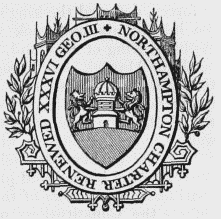
Seal and Arms.
The town, which had scarcely recovered from the depredation it suffered upon this occasion, was given at the time of the Conquest to Earl Waltheof, who had married the Countess Judith, niece of the Conqueror; but the earl having entered into a conspiracy against the king, was executed as a traitor, and his confiscated possessions were bestowed on Simon de St. Liz, Earl of Huntingdon and Northampton, who repaired and beautified the town, erected a strong castle for its defence, and surrounded it with massive walls in which were four gates. From this period it rapidly improved; and from its central situation and the security of its fortifications, it became the occasional residence of several of our kings. Henry I., in the 23rd year of his reign, celebrated the festival of Easter here with great pomp, and in 1131 assembled a parliament at Northampton, in which the barons swore homage to his daughter, the Empress Matilda, whom he appointed his successor. In the 11th of Henry II., a council was convened here, at which Archbishop Becket was summoned to appear, for his refusal to submit to the Constitutions of Clarendon. On the rebellion of Prince Henry, Anketil Mallore, one of his partisans, advancing to Northampton with a body of forces, defeated the king's troops aided by a party of the inhabitants, and took 200 of the latter prisoners. William, King of Scotland, being taken prisoner at the battle of Alnwick, was brought to Northampton, where Henry was then residing; and the Bishop of Durham, Roger de Mowbray, Earl Ferrers, with Anketil Mallore and William de Dive, constables of the Earl of Leicester, waited upon the English king to surrender the several castles which they had held against him. In 1180, a convention of barons and prelates met here, to take into consideration the laws of the realm, and to amend and enforce the Constitutions of Clarendon, by which the kingdom was divided into six circuits, and three itinerant justices were assigned to each, for the administration of the laws and the punishment of offenders; and in the following year the king held a council previously to visiting his dominions on the continent.
Richard I., soon after his return from captivity, kept the festival of Easter in the town, where he entertained William of Scotland, who came to solicit a grant of the county of Northumberland: during this reign a mint existed here. On the death of Richard, the barons assembled in council at the place, and took the oath of allegiance to his brother, John, at that time in Normandy. John, in the tenth year of his reign, being displeased with the citizens of London, removed his court of exchequer to Northampton, and three years afterwards assembled a council of temporal lords, at which Pandulph and Durand, legates from the pope, attended on behalf of the exiled clergy: these exiles the king allowed to return to their country; but refusing to restore their confiscated property, he was excommunicated by the legates. Previous to the commencement of the war between the king and the barons, the latter transmitted to him their memorial of grievances, which the king having indignantly refused to redress, they laid siege to the castle of Northampton; but being unable to reduce it, they withdrew their forces, after remaining before it fourteen days. On the signing of Magna Charta, this, among other castles, was placed in their custody, as security for the fulfilment of the conditions; but on the renewal of the war, it was intrusted to Fulke de Brente, a determined royalist. In 1216, the townsmen attacked and killed many of the garrison under the command of that officer, in retaliation for which the soldiers burnt a considerable portion of the town.
Henry III., attended by his court, celebrated the festival of Christmas at the castle, where he was splendidly entertained by the governor; and in the 30th year of his reign, the king gave the inhabitants ten marks to purchase books for a public library, a sacramental chalice for the church of All Saints, and smaller vessels of silver for the other churches. The castle was occupied in 1264 by the insurgent barons under the Earl of Leicester, from whose son, Simon de Montfort, it was taken by stratagem, after many fruitless attempts to reduce it; but the following year it was retaken by the Montforts, who celebrated a tournament here, which was numerously and brilliantly attended: soon after, the elder Montfort was defeated and slain at the battle of Evesham. In 1268, a parliament was held here, in which the rebellious barons were deprived of their estates, and Simon de Montfort was banished from the realm; and a council of prelates was assembled at the same time, at which the pope's legate excommunicated those bishops who had joined their party. During this reign, repeated attempts were made to establish a university in the town, in consequence of dissensions between the students and the citizens of Oxford; in 1258, a large party of students removed to this place, and a royal licence was obtained for erecting public schools for teaching the arts and sciences. But though subsequent disputes between the students and the townsmen, both of Oxford and Cambridge, occasioned fresh accessions to Northampton, the establishments were dissolved in 1265, by order of the king, and the professors returned with their pupils to their ancient seats. In the reign of Edward II., John Poydras, the son of a tanner of Exeter, who pretended to be the son and heir of Edward I., was convicted and executed in the town as an impostor. In the second year of the reign of Edward III., a treaty was concluded here with the Scots, by which the king resigned his pretensions to the sovereignty of Scotland, in consideration of 30,000 marks paid by Robert Bruce, whose infant son, David, was affianced to Jane, the king's sister, also an infant. In the same parliament which effected this treaty, was enacted the Statute of Northampton, specifying in what cases pardon should be granted for felony, and regulating the appointment of judges of assize. The last parliament held here was summoned in the fourth year of the reign of Richard II., to grant supplies for the troops destined to serve in a war against France, when a poll-tax was ordered, the levying of which excited the rebellion headed by Wat Tyler: this parliament, together with the convocation of Canterbury, sat in the chancel of All Hallows' church, now All Saints', the castle having fallen into a ruinous state.
During the war between the houses of York and Lancaster, a sanguinary and decisive battle took place at Northampton on the 9th of July, 1460, in which Henry VI. was defeated and taken prisoner. The treacherous desertion of Lord Grey of Ruthin, who commanded the vanguard of the king's army, contributed to the defeat of the royal forces, on whose side fell the Duke of Buckingham, the Earl of Shrewsbury, Viscount Beaumont, Lord Egremont, and other nobles, who were buried in the town; the duke was interred in the church of the Grey friars, and several of the others in St. John's hospital, where their bones have been recently discovered. In the 9th of Edward IV., Earl Rivers and his son, who had been taken by the rebels under Sir Henry Nevil and Sir John Coniers, who headed the insurrection in Yorkshire, were beheaded in the town. Queen Elizabeth, in her progress through the county, visited Northampton, where she was hospitably received, and presented by the magistrates with a valuable purse, containing £20: a similar mark of respect was paid to Charles I. and his consort, who, on passing through the town, received from the mayor and corporation two bowls of silver gilt, containing 100 marks. In 1637, the court of Eyre for the forests was held here, under the Earl of Holland, chief justice, as head of the commission, assisted by five of the judges and many of the nobility and gentry. During the parliamentary war, Lord Brooke took possession of the town, which he fortified for the parliament. In Sept. 1675, it was nearly destroyed by a fire, which consumed 600 houses chiefly built of wood and roofed with thatch; but from this severe calamity, of which the damage was estimated at £150,000, it recovered under the auspices of the Earl of Northampton. Few events of importance have occurred of late years: in Nov. 1844 the town was visited by Her Majesty the Queen and her royal consort.
The town is pleasantly situated on the acclivity of an eminence rising gradually from the north bank of the river Nene, over which are two bridges of stone, that to the south being a good structure of three elliptic arches. It consists principally of two spacious and regular streets, nearly a mile in length, which, intersecting each other at right angles, divide it into four nearly equal parts; the houses are handsomely built of stone, and the whole town, which is paved, and lighted with gas, has a clean, respectable, and cheerful appearance. An act was passed in 1843 for better paving, lighting, and otherwise improving the borough. A building has been erected and fitted up with swimming and other baths, supplied with warm, tepid, and cold water. The theatre was opened in 1806. Races take place annually: the race-course comprises about 117 acres, and is at a short distance from the town. At the end of Derngate is a fine promenade, shaded by a row of lofty trees, and commanding a view of the adjoining meadows; the environs generally are pleasant, and abound with agreeable villas and thriving plantations. At the northern extremity of the town are some barracks, erected in 1796, and forming a handsome range consisting of a centre and two wings. The principal articles of manufacture are, boots and shoes, of which great quantities are made for the supply of the army; and stockings and lace, the latter of which, since the introduction of machinery, has been less extensively made. A considerable trade is carried on in the currying of leather. There is a branch canal, constructed in 1815, from the river Nene to the Grand Junction canal, by means of which facility of communication is obtained with almost every part of the kingdom. Here also is a station of the Peterborough branch of the London and Birmingham railway: the branch quits the main line at Blisworth, a few miles south of Northampton. In 1846 an act was passed for a line of railway, six miles long, from Northampton to the Weedon station on the London and Birmingham line. The market-days are Wednesday, Friday, and Saturday, the last a very large cattle-market. The fairs are on the second Tuesday in January, Feb. 20th, the third Monday in March, April 5th, May 4th, June 19th, Aug. 5th and 26th, Sept. 19th (for cheese), the first Thursday in November, the 28th of the same month, and Dec. 19th, principally for horses, cattle, sheep, and pigs: the fairs for horses and cattle are numerously attended by dealers. The market-place is a spacious area, in the centre of which is a column with a powerful gaslight, and on the south side a conduit from which the town is supplied with water.
Northampton is a borough by prescription. Richard I. granted a charter to the burgesses, which was extended by four subsequent kings; but the first charter of incorporation is that of the 23rd of Henry VI. The mode of governing the borough was afterwards changed by statute of the 4th of Henry VII., which was confirmed with slight alterations by Elizabeth, James I., Charles II., and lastly by George III. in 1796. The control, however, is now vested in a mayor, six aldermen, and eighteen councillors, under the act of the 5th and 6th of William IV., cap. 76. The borough is divided into three wards, and the municipal boundaries are coextensive with those for parliamentary purposes; the mayor and late mayor are justices of the peace, and the total number of magistrates is twelve. The freedom is inherited by birth or acquired by servitude. The town has returned two members to parliament from the early part of the reign of Edward I.: the mayor is returning officer. The recorder holds quarterly courts of session, and, every third week, a court of record for the recovery of debts and determining of pleas to any amount; pettysessions take place every Tuesday and Friday, and the assizes for the county, and the election of knights for the southern division of the shire, are held here. The powers of the county debt-court of Northampton, established in 1847, extend over the registration-districts of Northampton, Brixworth, and Hardingstone. The town-hall is an ancient edifice, commodiously arranged, and decorated with portraits of Sir Thomas White, founder of St. John's College, Oxford, and a munificent benefactor to Northampton and other towns, and of the Right Hon. Spencer Perceval. The borough gaol was recently erected, at an expense exceeding £15,000, and is admirably adapted to the classification of prisoners. The county-hall is a spacious and elegant structure in the Grecian style, of the Corinthian order, containing courts for the assizes and quarter-sessions, and a suite of rooms well adapted to the transaction of the general business of the county: in the hall, the ceiling of which is splendidly decorated, are portraits of William III. and Queen Mary, Queen Anne, George I. and II. Adjoining the shire-hall is the common gaol and house of correction for the county, a large building, erected in 1794, at an expense of £16,000, and to which considerable additions have just been made.
The borough comprises the parishes of All Saints, containing 7898; St. Giles, 3898; St. Peter, 1029; and St. Sepulchre, 6124 inhabitants: in the extra-parochial part of the town are 2293 inhabitants. There were formerly seven parochial churches within the walls and two without, of which only four are remaining. The living of All Saints' is a vicarage, valued in the king's books at £22; net income, £350; patron, Lewis Loyd, Esq. The church, rebuilt soon after the fire in 1675, from designs by Sir Christopher Wren, is a spacious edifice in the Grecian style, having in the centre a cupola supported on columns of the Ionic order, and at the west end the original square embattled tower, which escaped the conflagration, and in which is a dial illumined with gas. There is also a portico of twelve lofty Ionic columns sustaining a cornice and balustrade, in the centre of which is a statue of Charles II.; on the pedestal is recorded his donation of 1000 tons of timber for the rebuilding of the church. The interior is appropriately ornamented: the altar-piece is decorated with paintings of Moses and Aaron, by Sir Godfrey Kneller; the chancel is separated by a richly-carved oak screen, and among the monuments are, one to the memory of the learned Dr. Conant, prebendary of Norwich, and vicar of the parish, and a handsome one by Chantrey to Spencer Perceval, many years member for the borough. St. Catherine's church, in the parish of All Saints, built by subscription, aided by the Trustees of Hyndman's bounty, was consecrated October 10th, 1839: the living is in the gift of the Trustees.
The parish of St. Giles comprises about 800 acres, of which 100 consist of meadow watered by the river Nene on the south. The living is a discharged vicarage, valued in the king's books at £7. 19.; net income, £111; patrons, Simeon's Trustees. The church is a large cruciform structure, with a lofty square embattled tower rising from the intersection; it displays good portions in various styles of English architecture, with a fine western Norman entrance: in a chapel in the south aisle is a beautiful altar-tomb of alabaster, and the font is richly panelled in the later English style. A church district named St. Edmund's was formed out of St. Giles' parish in 1846 by the Ecclesiastical Commission: the living is in the gift of the Crown and the Bishop of Peterborough, alternately. The living of St. Peter's is a rectory, with the livings of Kingsthorpe and Upton annexed, valued in the king's books at £34. 2. 11.; net income, £860; patrons, the Governors of St. Katherine's Hospital, London. The church, supposed to have been erected about the same time as the castle, is a beautiful and perfect specimen of the enriched Norman style, with a highly ornamented tower communicating with the church by a finely-moulded arch; the details are exquisitely wrought, and exhibit some of the finest models in that style: east of the chancel is a vaulted crypt. The roof of the church is supported on circular arches, and alternately clustered and single-shafted columns; the font is richly ornamented in the later English style, and there are various monuments, among which is one to the memory of John Smith, an eminent mezzotinto engraver, who died in 1742. The living of St. Sepulchre's is a discharged vicarage, valued in the king's books at £6. 1.; net income, £149; patrons, J. Mercer, and C. Markham, Esqrs. The church is thought to have been built by the Knights Templars, after the model of the church of the Holy Sepulchre at Jerusalem, and is one of four buildings of that kind remaining in the kingdom: it is of circular form, with a cupola in the centre of the roof, which is supported on eight round Norman columns and plain pointed arches; there is also a western tower surmounted by a spire. A handsome church, called St. Andrew's, has lately been consecrated in the parish, of which the cost, including the endowment, was £8000: the living is a perpetual curacy, in the gift of Hyndman's Trustees. There are places of worship in the town for Baptists, the Society of Friends, Huntingtonians, Independents, and Wesleyans. At the northern extremity of St. Sepulchre's parish, stands the Roman Catholic collegiate chapel of St. Felix, named after the apostle of the East Angles in the 7th century, a small and unpretending but correct specimen of the early English style, erected in 1844, almost at the sole expense of the Right Rev. Dr. Wareing, mentioned hereafter: its architectural correctness, and the beauty of the stained glass, are greatly admired. A public cemetery of about two acres was formed in 1847, by a company.
The Free Grammar school was founded in 1542, by Thomas Chipsey, who endowed it with lands which, together with subsequent benefactions, produce an income of about £120: in 1557, Cardinal Pole granted for its use the remains of the dilapidated church of St. Gregory. The Corporation charity school was established by the corporation, who appropriated to that purpose an unrestricted gift of £1000 by the Earl of Northampton, with which sum and other benefactions an estate was purchased, now yielding £310 per annum: part of the income is applied to the clothing of 20 aged freemen. The Blue-coat school was instituted in 1710, by Mr. John Dryden, of Chesterton, who endowed it with a house, to which Mr. Zachariah Herbert added a farm. The Green school was founded in 1761, by Mr. Gabriel Newton, of Leicester, who endowed it with a rent-charge of £26. The Seminary of St. Felix, a strictly clerical establishment, was founded by the Right Rev. Dr. William Wareing, Vicar Apostolic of the Eastern District, and is designed as a nursery for ecclesiastics, and to aid in the extension of the Roman Catholic religion in the district: the bishop has fixed his residence at Northampton, and the seminary is conducted under his superintendence. St. John's Hospital, said to have been founded in 1090 by William, Archdeacon of Northampton, for the reception of aged and infirm persons, is governed by a master and two brothers who officiate as chaplains: there are eight aged women, who receive a small weekly allowance in money, and a supply of coal. The Hospital of St. Thomas à Becket was instituted by the burgesses, about the year 1450, for the support of twelve aged widows; the endowment was augmented in 1654, by Sir John Langham, for six additional widows, and has been increased by subsequent benefactions: the income is about £850 per annum, and a commodious new building has been erected in the parish of St. Giles. The Infirmary, to the east of the town, erected and fitted up by subscription, in 1793, at an expense of nearly £25,000, is a handsome building of white stone. A county lunatic asylum has been built at a short distance from the infirmary. There are numerous and extensive bequests for benevolent purposes, among which may be noticed Sir Thomas White's fund, amounting to upwards of £15,000, for loans, in sums of £100 each, for nine years without interest, to young tradesmen on their commencing business. The poor-law union of Northampton consists of 17 parishes or places, containing a population of 28,103.
Among the Monastic institutions that existed here, were, the priory of St. Andrew, founded about 1076, for Cluniac monks, and the revenue of which at the Dissolution was £344. 13. 7.; an abbey of Black canons, established about 1112 by William Peverill, natural son of William the Conqueror, and dedicated to St. James, the revenue of which was £213. 17. 2.; the abbey de la Pré or de Pratis, for nuns of the Cluniac order, instituted in the reign of Stephen, by Simon de St. Liz, second earl of Northampton, and dedicated to St. Mary, the revenue of which was £119. 9. 7¼.; a house of Friars minors, built about the year 1217, on ground to the north of the market-place, given to them by the inhabitants, who were consequently regarded as the founders, the revenue of which was £6. 13. 4.; an hospital on the south side of the town, for a master and leprous brethren, established in 1240 by Henry III., and dedicated to St. Leonard, of which the revenue was £12. 4. 8., and which is now consolidated with the hospital of St. Thomas à Becket; a Carmelite priory, instituted in 1271 by Simon de Montfort, the revenue of which was £10. 10.; a priory and chapel for Augustine friars, built in 1322 by John Longville, near the south gate; and the college of All Saints, erected in 1459, for a master and two fellows, whose revenue was £2. 13. 4. Of the ancient Castle only a few vestiges, consisting of mounds of earth, are to be traced; and of the embattled walls and the four gates of the town, which were demolished by order of the king in 1662, there are no remains. Robert Brown, founder of the religious sect called Brownists, was a native of the town. Dr. Samuel Parker, Bishop of Oxford in the reign of James II., and author of some curious historical memoirs, was also born here, in 1640; and Dr. Philip Doddridge, author of the Family Expositor, was tutor in a dissenting academy at Northampton, until a short time previous to his death in 1749. The town gives the titles of Earl and Marquess to the family of Compton.
Northamptonshire
NORTHAMPTONSHIRE, an inland county, bounded on the north by the counties of Leicester, Rutland, and Lincoln; on the east by those of Cambridge, Huntingdon, and Bedford; on the south, by Buckinghamshire and Oxfordshire; and on the west, by Oxfordshire and Warwickshire. It extends obliquely from 51° 59' to 52° 42' (N. Lat.), and from 0° 9' to 1° 19' (W. Lon.); and includes an area of 1017 square miles, or 650,880 statute acres. There are 40,841 houses inhabited, 1677 uninhabited, and 291 in progress of erection; and the population amounts to 199,228, of whom 98,977 are males.
In the time of the ancient Britons, the county formed the most southern part of the territory of the Coritani; by the Romans it was included in the division of Flavia Cæsariensis, and by the Saxons in the kingdom of Mercia. It is in the diocese of Peterborough, and province of Canterbury; comprising the deaneries of Brackley, Daventry, Haddon, Higham-Ferrers, Northampton, Oundle, Peterborough, Preston, Rothwell, and Weldon, in the archdeaconry of Northampton, with 293 parishes. For purposes of civil government it is divided into the hundreds of Corby, Hamfordshoe, Higham-Ferrers, Huxloe, Navisford, Orlingbury, Polebrooke, Rothwell, and Willybrooke, and the liberty of Nassaburgh or soke of Peterborough, in the eastern division of the county; and the hundreds of Chipping-Warden, Cleley, Fawsley, Greens-Norton, Guilsborough, King's Sutton, NewbottleGrove, Spelhoe, Towcester, and Wymmersley, in the western division. It contains the city of Peterborough; the borough of Northampton; and the market-towns of Brackley, Daventry, Kettering, Oundle, Thrapston, Towcester, and Wellingborough. Under the act of the 2nd of William IV., cap. 45, it was divided into the Northern and Southern divisions, each to send two representatives to parliament; two members are returned for the city of Peterborough, and two for the borough of Northampton. The county is included in the Midland circuit; the assizes are held at Northampton, where stands the county gaol; and the quarter-sessions take place at Northampton, and at Peterborough.
The surface of the county exhibits much beauty and variety; the greater part is agreeably diversified by gentle undulations, the valleys being watered by numerous rivulets, and the whole forming an interesting scene of vale and upland, in many parts adorned with woods and ornamented grounds. The fertility of the soil renders it well adapted either for corn or pasturage; and although many instances of light soils occur, yet much the larger portion is a strong heavy staple, which is applied to the culture of beans and wheat while in an open state, but when inclosed is generally laid down for permanent grass, the higher inclosed lands being kept more in tillage. The soils comprise the black or darkcoloured soils, commonly a deep strong loam, on a strong gravelly or clay loam substratum; the red land, as it is called, which includes the brown and snuffcoloured loams; the white or grey loams, which are inferior in fertility to the above; the miscellaneous upland district, including the light thin soils near Stamford, and those dispersed in other parts of the county; and the soil of the natural meadows and pasture lands of the vales, and of the fen land north of Peterborough, consisting of the decomposed matter of decayed grasses and aquatic vegetables, combined with the sediment of the streams, which being drained and consolidated, forms the basis of meadow soil. Of the superficies of the county, about 150,000 acres are in common fields, by much the greater part being under tillage; and about the same extent consists of modern inclosures, in alternate grass and tillage, besides occasional, though rare instances of tillage in the ancient inclosures. Wheat is cultivated in both the open and inclosed fields, on the red friable soils, and is computed annually to occupy 60,000 acres; barley, which is the favourite crop on the red and light sand soils, about 33,000; oats, about 24,000; rape, about 3000; beans, 30,000, much being exported; peas and vetches, about 15,000; and green crops, 30,000; about 30,000 more remaining in fallow. Hemp is grown to a considerable extent in the fenny district on the borders of Lincolnshire and Cambridgeshire. Woad is cultivated and prepared for the dyers. The grass-land, including not only all pleasure-grounds, but also clover and other artificial and temporary grasses, is computed to amount to 375,000 acres. The extent of meadow is not less than 40,000 acres, the largest tract being that on the sides of the Nene, which river, commencing in different branches many miles above Northampton, extends down to Peterborough, and, in consequence of its winding course, is upwards of sixty miles in length. From Northampton westward, a great quantity of cheese is made; and in that part of the county south of the Coventry and London road are numerous dairies, the produce of which is chiefly butter. Many sheep and cattle are fattened on the pastures; and it is computed, that, besides what are consumed in the county or sold in the neighbouring districts, 15,000 head of fat-cattle, and about 100,000 sheep and lambs, are annually sent to London. The beef and mutton produced annually are thought to be nearly equal in weight, amounting each to about 27,000,000lb.; the number of sheep is estimated at 250,000, and that of cattle at about 33,750.
A considerable portion of the county, supposed to be about one-fourth, remains uninclosed; yet the waste tracts are of comparatively trifling extent. Some of the hilly land near Daventry is confined to sheep-walks, and of the same description are the common of StokeBruerne, and a few others: the whole amount of unproductive land, with the exception of Peterborough fen, is less than 1000 acres. The great Peterborough fen is a perfectly level tract, originally formed, like the adjoining fen lands of the counties of Cambridge and Lincoln, by the deposits of the neighbouring rivers, Ouse, Nene, and Welland; containing between 6000 and 7000 acres; and having a fine soil susceptible of the highest cultivation. The woodlands are very extensive, and may be classed under the four distinct heads of forests, chases, purlieu woods, and plantations on freehold property. The most considerable forest is that of Rockingham, which was anciently one of the largest in the kingdom, extending about thirty miles in length, from Northampton to Stamford, and about eight in breadth, from the river Nene to the Welland and the Maidwell. It now reaches from the vicinity of Wansford, on the great north road, towards Weldon and Rockingham, and still further to the south-west, forming an almost continued chain of woodland for a distance of nearly twenty miles; its boundaries are not exactly defined, but it is supposed to contain from 8000 to 10,000 acres. The next in extent is Whittlebury or Whittlewood Forest, which stretches along the southern border of the county, to the south of Towcester, for a distance of upwards of eleven miles, and contains about 7000 acres. A third is Salcey Forest, between Northampton and Newport-Pagnell. The entire extent of these three forests is about 20,000 acres. Geddington Chase, said to contain about 14,000 acres, of which 12,000 are woodland, the remainder consisting of lawns, ridings, and vistas, was formerly included in Rockingham Forest; but permission was given by the crown to the ancestors of the Montague family to disafforest it. Yardley Chase was a portion of Salcey Forest, but has likewise been disafforested. The purlieu woods in the county are numerous, and cover large breadths of land: they are situated immediately in the vicinity of the forests, and at one time formed part of them; but the respective owners having obtained grants and permissions from the crown to disafforest them, and appropriate them to their own use, they are not now subject to the laws and regulations that regard the forest woods. These, together with the extensive woods and plantations that abound on freehold property, amount to about 20,000 acres.
The Mineral productions include neither coal nor any of the metals. Limestone is found in various parts; and freestone, often of a calcareous nature, is raised at Brackley, Kingsthorpe (near Northampton), and various other places. A whitish kind of slate, used for roofing, is obtained in considerable quantities at Collyweston, near Stamford, and most of the buildings in that and the adjacent townships are covered with it; the laminæ are generally of good size, but rather thick and heavy. Good clay for making bricks and tiles is found in different parts of the county. The principal articles of Manufacture are, shoes, bone-lace, and woollen-stuffs, consisting chiefly of moreens, tammies, and calimancoes. In Northampton, Wellingborough, and other towns, many persons are engaged in making shoes for supplying the army and navy, and the shops in London, and for exportation to foreign countries; about 7000 or 8000 pairs being made weekly. In Wellingborough and its neighbourhood, and towards the south-western corner of the county, lace-making affords employment to a great portion of the population, chiefly young women and boys. The manufacture of silk stockings is carried on at Towcester and Kettering. At Towcester woolstapling constitutes the main branch of trade; and at Daventry is a manufactory for whips. The principal Rivers are, the Nene or Nen, the Welland, the Ouse, the Charwell, the Avon, and the Leam, all of which rise within the limits of the county: the Nene becomes navigable at Northampton, and quits the county at Peterborough; the Welland becomes navigable at Stamford. The Oxford canal runs for a considerable distance along the western confines of the county, and passes through two small projecting parts of it. The Grand Junction canal commences at the Oxford canal at Braunston, and, pursuing a south-eastern course across the county, quits it at Cosgrove for Buckinghamshire: a collateral cut from this canal at Gayton to the river Nene, at Northampton, has been formed within the last few years. The London and Birmingham railway, which runs through nearly the same districts as the Junction canal, enters the county near Ashton, and, passing about midway between the towns of Northampton and Towcester, leaves Daventry about four miles to the left, and quits the shire a little beyond Kilsby. At Blisworth, a branch of the Birmingham railway commences; it runs by Northampton, and following the valley of the Nene, touches or passes near the towns of Wellingborough, Higham-Ferrers, Thrapston, and Oundle, and terminates at Peterborough. That part of the Syston and Peterborough railway which connects the towns of Peterborough and Stamford, is also within the limits of Northamptonshire.
Of the four consular or military ways made by the Romans in Britain, two are still visible in different parts of the county, namely, the Watling-street and the Ermin-street, the latter of which, soon after its entrance from Cambridgeshire at Caistor, divides into two branches, passing into Lincolnshire by two different points on the Welland: the Watling-street enters at Old Stratford, and crosses the Lesser Avon at Dow bridge in its course into Leicestershire. Most of the Roman fortresses and garrisons were erected either upon these ways or in their vicinity. Stations and forts are also thought to have been constructed on the south side of the Nene, to guard the passages and fords, and to check the inroads of the Britons who inhabited the woods on the other side, which extended from the Nene to the Welland. On the line of the Watling-street are supposed to have been three principal stations within the limits of the county, namely, Lactodorum, which is placed at Towcester; Benaventa, or Bennavennum, variously placed at Weedon-Beck, Castle Dykes, and near Daventry, which last position seems to be the most probable; and Tripontium, usually placed at Lilbourn, though Horsley supposes it to have been at Rugby, in Warwickshire. The only station situated on the Erminstreet was Durobrivæ, at or near Caistor. Remains of tessellated pavements, coins, &c., have been found in various places, especially at Weldon, and at Cotterstock near Oundle. Besides the intrenchments already mentioned as either decidedly Roman, or supposed to be such, are the ancient encampments of Arbury Banks, Raynsbury Camp, "the Boroughs" at Guilsborough, and others.
The number of religious houses of all denominations, including colleges, hospitals, &c., was about 55: the remains are inconsiderable, excepting Peterborough cathedral (which was the church of the ancient abbey of Medeshampstead or Peterborough) and the churches, anciently collegiate, of Fotheringay, Higham-Ferrers, and Irthlingborough. Of ancient mansion-houses the county affords a few interesting specimens, particularly those of Burleigh, Kirkby, Castle-Ashby, Fawsley, Rushton, and Drayton. Burleigh House, the seat of the Marquess of Exeter, is the most magnificent of the numerous mansions that adorn the county, among which, also, Althorp, the property and residence of Earl Spencer, is one of the most distinguished. There are mineral springs at Astrop, Northampton, and Wellingborough; and at Rothwell a petrifying well.
Northaw (St. Thomas à Becket)
NORTHAW (St. Thomas à Becket), a parish, in the union of Hatfield, hundred of Cashio, or liberty of St. Alban's, county of Hertford, 4½ miles (N. E. by N.) from the town of Barnet; containing 609 inhabitants. The living is a donative; net income, £150; patron and impropriator, the Rev. A. Trenchard, D.D. The church was rebuilt in 1810, at an expense of £1600, defrayed by W. Strode, Esq., the late patron. A free school is endowed with £20 per annum. There is a fine saline spring, formerly much resorted to.
Northborough (St. Andrew)
NORTHBOROUGH (St. Andrew), a parish, in the union and soke of Peterborough, N. division of the county of Northampton, 1¾ mile (S. E. by S.) from Market-Deeping; containing 272 inhabitants. It comprises about 735 acres of inclosed land in good cultivation; the soil is chiefly clay, interspersed with sand and gravel, and part of the parish borders on the fenny district. The river Welland, within a mile of the village, is navigable for corn and coal boats. The living is a rectory, valued in the king's books at £10. 19. 7.; net income, £373; patrons, the Dean and Chapter of Peterborough. The tithes have been commuted for land under acts of inclosure, the last of which was in 1812. The church has a fine admixture of the Norman and the various later styles, and contains a monument to the family of Claypole, of whom John married Elizabeth, daughter of Oliver Cromwell, who created him a baronet in 1657, and made him master of the horse, and a lord of the bedchamber. The ancient mansion of the Claypoles, a beautiful specimen of the decorated style, has been converted into a farmhouse.
Northbourne (St. Augustine)
NORTHBOURNE (St. Augustine), a parish, in the union of Eastry, partly in the hundred of Eastry, but chiefly in the hundred of Cornilo, lathe of St. Augustine, E. division of Kent, 2¾ miles (W.) from Deal; containing 885 inhabitants. It comprises 2289 acres, of which 2038 are arable. The living is a vicarage, with that of Shoulden annexed, valued in the king's books at £12. 11. 8.; net income, £398; patron and appropriator, the Archbishop of Canterbury. The church consists of a nave, chancel, and transepts, with a large square central tower, and is in the Norman style: the south transept contains a handsome monument to the memory of Sir Edwin Sandys and his lady. In the parish are the ruins of an ancient chapel; and upon the north-north-eastern point of the open downs, near Little Betshanger, are the remains of a camp formed for the forces which lay here under the command of Capt. Pike, to oppose the landing of the Spaniards in 1558.
Northbrook
NORTHBROOK, a tything, in the parish and hundred of Mitcheldever, union of Winchester, Winchester and N. divisions of Hampshire, 5 miles (S. E.) from Whitchurch; containing 224 inhabitants.
Northchapel (St. Michael)
NORTHCHAPEL (St. Michael), a parish, in the union of Midhurst, hundred of Rotherbridge, rape of Arundel, W. division of Sussex, 5 miles (N. by W.) from Petworth; containing 843 inhabitants. This parish, which is situated on the road from London to Petworth, and bounded on the north by the county of Surrey, was formerly part of the parish of Petworth, but was separated in 1718, by act of parliament. It comprises by admeasurement 3739 acres, of which 1875 are arable, 318 meadow and pasture, and 1105 woodland. At Fisher-street, works were erected by government at a great expense, for making charcoal for gunpowder; they were sold after the peace, and are now carried on by a private individual. There are also a tanyard, and works for making pyroligneous acid. The living is a rectory not in charge, in the gift of Col. Wyndham: the tithes have been commuted for £400, and the glebe comprises 3 acres. The Rev. John Johnson, late rector, in 1831 left £100 towards rebuilding the church, in consequence of which, it was enlarged in 1833 by the erection of a north transept, and repewed, and the tower rebuilt chiefly at the expense of the Earl of Egremont, and with the bequest above mentioned. In 1835, also, the earl erected a Sunday school, which he endowed with £333. 6. 8. three per cent. consols.; and two almshouses, to which he assigned £1500 three per cent. consols.
Northchurch.—See Berkhampstead.
NORTHCHURCH.—See Berkhampstead.
Northcott
NORTHCOTT, a hamlet, in the parish of Boyton, union of Holsworthy, hundred of Black Torrington, Holsworthy and N. divisions of Devon, 5¼ miles (N. by E.) from Launceston; with 100 inhabitants.
Northcourt
NORTHCOURT, a hamlet, in the parish of St. Helen, Abingdon, union of Abingdon, hundred of Hormer, county of Berks; containing 227 inhabitants. It is near the Abingdon and Oxford road.
Northcove, Suffolk.—See Cove, North.
NORTHCOVE, Suffolk.—See Cove, North.
Northen, or Northenden (St. Wilfrid)
NORTHEN, or Northenden (St. Wilfrid), a parish, in the union of Altrincham, hundred of Macclesfield, North division of the county of Chester; containing, with the tything of Northen-Etchells, 1386 inhabitants, of whom 659 are in the township of Northen, 7 miles (S.) from Manchester. This place once belonged to the Tatton family, whose ancient Hall, during the reign of Charles I., was garrisoned for the king, and besieged and ultimately taken by the parliamentarians; the remains exhibit features of very great antiquity. The parish is situated on the river Mersey, and comprises 3386 acres, of which 1165 are in the township of Northen; the whole is in a high state of cultivation. The living is a rectory, valued in the king's books at £10. 7. 6.; net income, £406; patrons, the Dean and Chapter of Chester. The tithes of Northen township have been commuted for £177, and the glebe consists of 42 acres. The church, originally a fine specimen of Norman architecture, of which it retains many beautiful details, has been much disfigured by alterations, and is now principally in the later English style; it has an enriched wooden screen.
Northend
NORTHEND, a hamlet, in the parish of Crayford, union of Dartford, hundred of Lessness, lathe of Sutton-at-Hone, W. division of Kent; containing 191 inhabitants. This place is situated to the north of the village of Crayford, and to the south of that of Erith, about midway between those two places, and is in the immediate vicinity of the river Thames and the road from London to Dartford.
Northfield (St. Lawrence)
NORTHFIELD (St. Lawrence), a parish, in the union of King's-Norton, Upper division of the hundred of Halfshire, E. division of Worcestershire, 6 miles (S. W. by S.) from Birmingham; containing 2201 inhabitants. This parish, which is situated on the road from Birmingham to Worcester, comprises 5789 acres of land, held by various proprietors, of whom Joseph Frederick Ledsam, Esq., of Edgbaston, is lord of the manor. The surface is pleasingly undulated, and the soil generally a strong clayey loam, producing excellent crops of wheat and beans, with a due portion of good turnip soil; the substratum abounds with freestone, which is extensively quarried, and much of which has been used in the erection of the new churches in the surrounding districts. There are some elegant mansions belonging to professional gentlemen and merchants, whose business is chiefly in Birmingham. Many of the inhabitants are employed in the manufacture of nails; and some chemical-works are carried on upon the banks of the Netherton canal, which passes through the parish, as do also the small river Rea and the Birmingham and Worcester canal. The living is a rectory, with the living of Coston-Hacket annexed, valued in the king's books at £14. 15. 2½., and in the gift of Messrs. Fenwick, of Sunderland: the tithes have been commuted for £805, and the glebe comprises 44 acres. The church is an ancient structure, chiefly in the early and decorated English styles, with a Norman doorway; the interior is spacious, and consists of a nave, north and south aisles, and a splendid chancel, ornamented with beautiful representations of the Four Evangelists, several other figures, and coats of arms: of 639 sittings nearly all are free. A district church, dedicated to St. Michael, was erected at Bartley-Green in 1838. There are two places of worship for Wesleyans; and two schools, one of which is on the national system, are endowed with the dividends of £433. 6. 8. three per cents. Some remains exist of Weoley Castle, formerly belonging to the Jervoise family, and now the property of Mr. Ledsam: and vases, coins of Henry III. and Edward I., an old spur, the skeleton of a stag, and other relics of antiquity, have been found in and near the moat.
Northfleet (St. Botolph)
NORTHFLEET (St. Botolph), a parish, in the union of North Aylesford, hundred of Toltingtrough, lathe of Aylesford, W. division of Kent, 1½ mile (W.) from Gravesend, and 20 miles (E.) from London; containing 3621 inhabitants. This place is mentioned in Domesday book, and is supposed to have been more anciently a Roman and a Danish station. The parish comprises by measurement 3900 acres, of which 200 are common, and 116 wood. It is bounded on the north by the Thames, at a distance from which the face of the country is diversified with gently rising hills and small valleys. To the north-west the land lies so low as to be overflowed at high tides, and the flood would extend even beyond the London road if not prevented by a raised causeway and bridge, to which gates are affixed as a barrier against the tides, and an outlet for the fresh water. The original bridge was erected at an early period, and rebuilt of brick in 1634, but this being found inconvenient, another has been constructed in a line with the direction of the road. Large chalk and lime works extend from the north side of the village to the Thames. Lime is sent off in considerable quantities for the builders in London, and is also exported to Holland and Flanders, the refuse being used for manuring the land in Essex, Suffolk, and Norfolk. The chalk-pits are very extensive, and strata of flint stones abound, which are frequently wrought into flints for guns: imbedded in the chalk are many curious fossils, chiefly echinites and glossopetræ or sharks' teeth; and some of the flints inclose cockleshells filled with chalk, forming singular natural curiosities. Here is a large yard for ship-building, near which is a spacious dock excavated in the solid chalk, and capable of containing six or seven ships; an establishment for the manufacture of Parker's Roman cement is likewise carried on. Fairs are held on Easter and Whit Tuesdays, and on the 24th of March.
The living is a vicarage, valued in the king's books at £21, and in the patronage of the Crown; impropriator, the Earl of Aylesford: the great tithes have been commuted for £683, and the vicarial for £600. The church, which is one of the largest in the diocese, displays various styles of English architecture, with several good decorated windows; the chancel contains the remains of some ancient oak stalls. In the south wall are three stone seats, and on a slab in the pavement is a fulllength brass figure of a priest standing beneath a richlyornamented canopy, with an imperfect Latin inscription around the verge of the slab; the grave below being opened about half a century since, the body of Peter de Lucy was found enveloped in leather. Among the monuments of more modern date is a fine alabaster tomb to the memory of Dr. Edward Browne, physician to Charles II., and author of Travels in Hungary. Nursted church being close to the village of Northfleet, and Northfleet church five miles distant, Mr. W. Edmeads some years ago, at his own expense, built a gallery in the former for the accommodation of the inhabitants of Northfleet. Huggens' College, at Northfleet, was incorporated by act of parliament in 1847. There is a place of worship for Wesleyans.
North-Forty-Foot-Bank, or Fen-Corner
NORTH-FORTY-FOOT-BANK, or Fen-Corner, an extra-parochial liberty, in the union of Boston, wapentake of Kirton, parts of Holland, county of Lincoln, 9 miles (N. W. by W.) from the town of Boston; containing 343 inhabitants.
North-Hill (St. Torney)
NORTH-HILL (St. Torney), a parish, in the union of Launceston, N. division of the hundred of East, E. division of Cornwall, 6¾ miles (S. W. by S.) from Launceston; containing 1217 inhabitants. The parish is bounded for a short distance on the north by the river Inny, and is intersected by the Lynher, which discharges itself into the Hamoaze. It comprises by survey 6732 acres, of which 2333 are common or waste. There are some stream tin-works in the southern portion of it, and manganese has been found; good buildingstone is quarried in several parts, and the substratum of the southern districts is chiefly granite. Fairs are held in the beginning of September and November. The living is a rectory, valued in the king's books at £36. 6. 8., and in the gift of the Rev. Dr. Rodd: the tithes have been commuted for £538; the glebe comprises 50 acres. The church is a handsome structure of granite, in the early English style, with a lofty embattled tower crowned by pinnacles, and contains several interesting monuments, among which, in the south aisle, is a splendid one to the memory of the Spoure family, of Trebartha Hall, in the parish. At Trebartha and Landreyne were formerly chapels. There are places of worship for Wesleyans; and a national school supported by Dr. Rodd. From a lofty elevation in the grounds of Trebartha Park, a stream tributary to the Lynher descends with much picturesque beauty, forming several falls in its course for nearly a mile. On a tor near the road side are several rock basins, called "Arthur's Troughs," near which are some Druidical remains, and Arthur's Hall, an opening 60 feet long.
North-Holme
NORTH-HOLME, a parish, in the union of Spilsby, Marsh division of the wapentake of Candleshoe, parts of Lindsey, county of Lincoln, 8 miles (S. E. by E.) from Spilsby; containing 140 inhabitants. The living is a rectory, united to that of Wainfleet. The church has been destroyed, and not a trace of it now exists, but the cemetery is still used.