A Topographical Dictionary of England. Originally published by S Lewis, London, 1848.
This free content was digitised by double rekeying. All rights reserved.
'Osleston - Otley', in A Topographical Dictionary of England, ed. Samuel Lewis (London, 1848), British History Online https://www.british-history.ac.uk/topographical-dict/england/pp486-491 [accessed 30 April 2025].
'Osleston - Otley', in A Topographical Dictionary of England. Edited by Samuel Lewis (London, 1848), British History Online, accessed April 30, 2025, https://www.british-history.ac.uk/topographical-dict/england/pp486-491.
"Osleston - Otley". A Topographical Dictionary of England. Ed. Samuel Lewis (London, 1848), British History Online. Web. 30 April 2025. https://www.british-history.ac.uk/topographical-dict/england/pp486-491.
In this section
Osleston, with Thurvaston
OSLESTON, with Thurvaston, a township, in the parish of Sutton-on-the-Hill, union of Burtonupon-Trent, hundred of Appletree, S. division of the county of Derby, 7½ miles (W. by N.) from Derby; containing 405 inhabitants. The township comprises 1588 acres, of which 842 are in Orleston hamlet, and 746 in that of Thurvaston; in each is a small rural village, and the township also includes the scattered village of Cropper, where the Primitive Methodists have a place of worship. The impropriate tithes have been commuted for £112. 11. 6., and the vicarial for £125.
Osmaston (St. Martin)
OSMASTON (St. Martin), a parish, in the hundred of Appletree, S. division of the county of Derby, 3 miles (S. E. by S.) from Ashbourn; containing 271 inhabitants. This was long the chief residence of the Pegges, branches of whose family resided in Shirley, Yeldersley, and Ashbourn. Dr. Samuel Pegge, the antiquary, was of Osmaston, where his ancestors had been located in lineal succession for four generations; he died possessed of the estate. The parish comprises 1254a. 15p. of land, mostly pasture: the soil is poor, and chiefly upon gravel or sand; the general feature of the scenery is picturesque. The village, which stands high, is about half a mile from the Derby and Ashbourn road. Osmaston Manor-house, the erection of which has been recently commenced by Francis Wright, Esq., will, when completed, be one of the most splendid mansions in the county; it is in the pure Elizabethan style, 330 feet in length and 192 in breadth, and, with the terraces, will cover two acres of ground: the estimated cost is £50,000. The living is a perpetual curacy, annexed to the rectory of Brailsford. In lieu of the very old and dilapidated church, a new and beautiful structure in the style of the 14th century was opened for divine service in June 1845; it was erected by Mr. Wright, at a cost exceeding £9000, including some schoolrooms. The tithes have been commuted for £104, and the incumbent's glebe comprises about 27 acres. The Wesleyan Methodists have a place of worship. The parish is celebrated for its springs of clear water, and there is a chalybeate spring.
Osmaston (All Saints)
OSMASTON (All Saints), a parish, in the union of Shardlow, hundred of Repton and Gresley, S. division of the county of Derby, 1¼ mile (S. S. E.) from Derby; containing 178 inhabitants. It lies on the Loughborough and Ashby-de-la-Zouch roads from Derby, and comprises 929a. 27p., consisting of arable, pasture, and woodland, but chiefly occupied as milk-farms; the soil is a sandy and loamy earth, resting upon a deep bed of gravel. The river Derwent skirts the parish on the north-east, the Derby and Birmingham railway on the west, and the Derby canal runs through. The Hall, the seat of Sir Robert Wilmot, Bart., the principal owner in the parish, is a large stone mansion in the Italian style, with wings, and an observatory at the top; it is situated in park-like grounds, has been latterly very much improved, and contains many splendid rooms, and good pictures. The village is small and scattered. The living is a perpetual curacy; income, £75, with a house near the church; patron and impropriator, Sir Robert Wilmot. The glebe comprises 25 acres within the parish, with land at Hathern and Belton, in Leicestershire. The church is a small ancient structure, much covered with ivy; in the chancel is a handsome painting of Our Saviour in the Manger, and some tablets are erected to the Wilmot and Horton families. The churchyard is retired and picturesque.
Osmington (St. Osmond)
OSMINGTON (St. Osmond), a parish, in the union of Weymouth, hundred of Culliford-Tree, Dorchester division of Dorset, 4 miles (N. E.) from Weymouth; containing, with the hamlets of Ringstead and Upton, 467 inhabitants. This parish, which is said to derive its name from the patron saint, comprises 2135a. 3r. 37p. Building-stone is plentiful, and a peculiar kind is found, called "Horse-flesh," remarkable for its long fibres and perpendicular grain. The parish is bounded on the south by the English Channel, and intersected by the Weymouth and Wareham road. The living is a vicarage, endowed with a portion of the rectorial tithes, and valued in the king's books at £11. 0. 2½.; patron the Bishop of Salisbury; impropriators of the remainder of the rectorial tithes, the landowners. The tithes have been commuted for a rent-charge of £250, and the glebe comprises 6½ acres.
Osmondiston, Norfolk.—See Scole.
OSMONDISTON, Norfolk.—See Scole.
Osmotherley
OSMOTHERLEY, a township, in the parish and union of Ulverston, hundred of Lonsdale north of the Sands, N. division of Lancashire, 3 miles (N. by W.) from Ulverston; containing 298 inhabitants. This place appears to be the Asmunderlaw of the 13th and 14th centuries. William de Asmunderlaw was a witness to the charter of John de Lancaster to the burgesses of Ulverston, in the reign of Edward I.; and by an escheat of the 18th of Edward III., it seems that Laurence de Asmondrelawe held a messuage here. This race has long been extinct. The surface of the land is hilly, and there is a considerable tract of peat-moss on the elevated grounds. A school is endowed with about £16 per annum.
Osmotherley (St. Peter)
OSMOTHERLEY (St. Peter), a parish, in the union of Northallerton, wapentake of Allertonshire, N. riding of York, 7 miles (E. N. E.) from Northallerton; containing, with the townships of Ellerbeck, West Harsley, and Thimbleby, 1354 inhabitants, of whom 1029 are in Osmotherley township. The parish comprises by admeasurement 7740 acres, and is watered by the Wiske and Cod-beck. There are some flax-mills and a manufactory of linen drills, &c., carried on by Messrs. Yeoman and Company for thirty years, and employing about three hundred hands; also some quarries of freestone, extensive bleach-works, and cornmills. The village is romantically situated about half a mile from the road between Stokesley and Thirsk; the scenery of the neighbourhood presents a beautiful combination of hill and dale, and commands a fine view of the vale of Mowbray. The living is a discharged vicarage, valued in the king's books at £8. 10., and in the patronage of the Bishop of Ripon, with a net income of £120; impropriators, the mortgagees of Benjamin John Wetherell, Esq.: a vicarage-house was built in 1841. The church is a small neat structure, built about 50 years since, and incorporating the porch and tower of the original edifice. Here are places of worship for Quakers, Wesleyans, and Roman Catholics.
Ospringe-Liberty (St. Peter and St. Paul)
OSPRINGE-LIBERTY (St. Peter and St. Paul), a parish, in the union and hundred of Faversham, Upper division of the lathe of Scray, E. division of Kent, ¾ of a mile (W. S. W.) from Faversham; containing 1015 inhabitants. This parish consists of 2798 acres, of which 465 are in wood. It is an independent franchise, governed by its own constable; and has a fair on May 25th. Here is a neat range of infantry barracks, erected during the late war; and the workhouse for the union of Faversham is situated in the parish. On a stream which flows through the village are extensive gunpowder-mills. The living is a vicarage, valued in the king's books at £10; patrons and impropriators, the Master and Fellows of St. John's College, Cambridge. The great tithes have been commuted for £832, and the vicarial for £305; the glebe comprises 32 acres. The church is principally in the early English style. This was doubtless the site of the ancient Durolevum, though some have fixed that station at Newington; and a Roman fortification and burial-place have been discovered, besides numerous minor Roman antiquities of various kinds. Some remains exist of a Maison-Dieu, founded by Henry III. about 1235, and dedicated to the Blessed Virgin Mary: it was originally of great repute, and consisted of a master and three brethren of the order of the Holy Cross, and two secular clerks; but falling into decay, at the close of the reign of Edward IV., it escheated to the crown.
Ossett, with Gawthorpe
OSSETT, with Gawthorpe, a chapelry, in the parish and union of Dewsbury, Lower division of the wapentake of Agbrigg, W. riding of York, 3½ miles (W.) from Wakefield; containing 6078 inhabitants. This chapelry, which comprises by admeasurement 2990 acres, is situated on the south side of the road between Dewsbury and Wakefield, and intersected by the Manchester and Leeds railway. The village is large and populous; the inhabitants are partly employed in the manufacture of cloth, blankets, and worsteds, and in some works for preparing the various ingredients for dyeing. On Ossett Common are the Cheltenham Baths, the water of which contains iron and hydrogen gas, and is esteemed by invalids. The living is a perpetual curacy; net income, £162, with a glebe-house; patron, the Vicar of Dewsbury, whose tithes here (those on mills excepted) were commuted for land in 1807. The chapel, dedicated to the Holy Trinity, and originally erected about 200 years since, is an unsightly edifice, built in 1806, partly by a grant of £300 from the Incorporated Society, and contains 1000 sittings, 300 of which are free. A church district named South Ossett was endowed in 1846 by the Ecclesiastical Commissioners: the living is in the gift of the Crown and the Bishop of Ripon, alternately. There are places of worship for Independents and Wesleyans. A free school, established in 1745, and rebuilt in 1834, is endowed with cottages and land producing about £12 per annum, to which sum Joshua Haigh, Esq., of Long Lands Hall, added in 1836 £12 per annum.
Ossington (Holy Rood)
OSSINGTON (Holy Rood), a parish, in the union of Southwell, N. division of the wapentake of Thurgarton, S. division of the county of Nottingham, 4 miles (S. S. E.) from Tuxford; containing 228 inhabitants. It comprises 2355a. 1r. 3p., about 500 acres of which are woodland, and by far the larger part of the rest arable; the soil is a productive clay. The Hall is a handsome modern mansion, with an extensive park and pleasure-grounds. The living is a donative, in the patronage of J. E. Denison, Esq. The church is a neat structure, and has several beautiful monuments.
Ostenhanger.—See Westenhanger.
OSTENHANGER.—See Westenhanger.
Oswaldkirk (St. Oswald)
OSWALDKIRK (St. Oswald), a parish, in the union of Helmsley, wapentake of Ryedale, N. riding of York, 3½ miles (S.) from Helmsley; containing 449 inhabitants, of whom 290 are in the township of Oswaldkirk, and the remainder in the township of Oswaldkirk-Quarter. The surface of the parish is varied by hill and dale; the road from Helmsley to York passes through the village. The living is a rectory, valued in the king's books at £10. 1. 8., and in the gift of the Rev. H. G. W. Comber: the tithes have been commuted for £409. 10., and the glebe comprises 300 acres (100 of which are not in cultivation), with a house attached, the whole valued at £265 per annum. The church is principally in the Norman style. Here are the remains of a monastic edifice, commenced in the ninth century, but never finished, the monks removing to Old Byland. Roger Dodsworth, the antiquary, was born at NewtonGrange, in the parish, in 1585.—See Ampleforth.
Oswaldtwistle
OSWALDTWISTLE, a township, in the parochial chapelry of Church, parish of Whalley, union, and Lower division of the hundred, of Blackburn, N. division of the county of Lancaster, 3¾ miles (E. by S.) from Blackburn; containing 6655 inhabitants. This place was held by lords of the same name, before the general use of dates in charters. The Radcliffes were early proprietors, and of this family was Robert Radcliffe, Baron Fitzwalter, afterwards Earl of Sussex, who, dying in 1542, was succeeded by Henry Radcliffe, by whom the reversion of the manor was disposed of to Andrew Barton, of Smithills. It passed from the Bartons by marriage to the son and heir of Thomas, Viscount Falconberg, and was sold about 1722 to the Whalleys and Barons. The Whalleys' moiety became afterwards the property of the late Sir Robert Peel, who was born at Peel-Fold, in Oswaldtwistle, in the old family residence; it is now vested in his son, the present baronet. In the township are several ancient mansions. There are print-works on a large scale, and other establishments connected with the cotton manufacture: coal, also, is obtained. A church, dedicated to Emmanuel, was built in 1837: the living is a perpetual curacy, in the patronage of five Trustees. The dissenters have several places of worship; and there are various schools. Mr. William Sadler, the distinguished aeronaut, in his aerial voyage from Bolton, was thrown from his balloon at this place, and killed, 29th September, 1824.
Oswestry (St. Oswald)
OSWESTRY (St. Oswald), an incorporated market-town, a parish, and the head of a union, in the hundred of Oswestry, N. division of Salop; containing 8843 inhabitants, of whom 4566 are in the town, 18 miles (N. W.) from Shrewsbury, and 172 (N. W.) from London. This town is of ancient British origin, and was at one time called Maserfield. Its present appellation is a corruption of the Saxon Oswaldstre, "Oswald's tree or town," and originated in a battle fought here, August 5th, 642, between Oswald, the Christian King of Northumbria, and Penda, the pagan King of Mercia, in which the former was slain, and the members of his body were severally affixed to three crosses, in token of conquest, and in derision of his religious tenets: on this account, also, the Welsh called the place Croes Oswald, which name they still retain. The esteem in which Oswald had been held by the monks led to his canonization; the scene of his death became hallowed, miraculous virtues were attributed to his relics, and a monastery was soon afterwards raised to his memory, from which institution the place was termed Blanc minster, with other names of similar import. Oswestry continued in the possession of the Britons, and constituted a portion of the kingdom termed Powysland, until the year 777, when it was annexed to Mercia, by conquest; and an earthen mound called Clawdd Offa, Offa's dyke, and vulgarly the Devil's ditch, was raised as a line of demarcation between that kingdom and the principality of Wales. The dyke extends from the river Wye along the counties of Hereford, Radnor, Montgomery, and Denbigh, and terminates near the Clwydian hills; in the neighbourhood of this town it crosses the race-course on Cyrn-y-bwch. Parallel with it, but at unequal distances, is a similar rampart, called Wat's Dyke, or perhaps originally Watch Dyke, from the number of watch forts on its course. On the line of Wat's Dyke, about a mile northward of the town, is a work of the ancient Britons, denominated by their descendants Llys Ogran or Ogyrvan, or Caer Ogran, "Ogran's palace or stronghold;" and also Hên Dinas, "old camp or city:" its present name is Old Fort, or, by corruption, Old Port; and it is occasionally termed Old Oswestry, there being a vulgar tradition that it was anciently the site of the town. It was a famous military post, being a lofty natural eminence, of an oblong shape, and surrounded by a deep triple intrenchment on the summit and sides; the area comprised nearly sixteen acres, and the fortifications, which are covered with timber and brushwood, upwards of 40 acres.
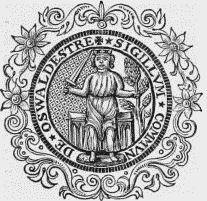
Corporation Seal.
Oswestry, according to Dugdale, was given by the Conqueror to Alan, ancestor of the Fitz-Alans, earls of Arundel, in which noble family the barony continued upwards of 500 years. Another authority states that the Fitz-Alans became owners of it by the marriage of one of the lords of Clun with Maud, widow of Madog ab Meredydd, who, on the partition of Powysland by his father, succeeded to the division termed Powys Vadog, of which Oswestry formed part. This was Madog's chief residence, and according to the Welsh records, he built the castle about 1149, though the English historians mention it to have existed before the Conquest: it stood on an artificial mound on the northwest side of the town, but there are scarcely any remains. When Henry II. attempted to subjugate the principality, in the year 1164, he assembled his army and encamped here for a considerable time, prior to the sanguinary conflict beneath Castell Crogen, now Chirk Castle, the scene of which is yet marked by a heap of stones, called Adwy'r Beddau, or the "Passage of the Graves." During the contest between John and the barons, about 1216, the castle was destroyed by fire; and in 1233, the town experienced a similar fate from Llewelyn ab Iorwerth, Prince of Wales. In 1277, Edward I., still meditating the subjugation of Wales, began to surround the place with walls, for the completion of which he imposed a murage tax upon the county for six years: they were about a mile in circumference, had four gates, and were flanked by a fosse.
Soon after the dissolution of the parliament held at Shrewsbury, in which the Duke of Hereford, afterwards Henry IV., accused the Duke of Norfolk of treasonable expressions, those illustrious persons were cited to appear at Oswestry before the king and the commissioners appointed by that parliament. During an insurrection of the Welsh, under Owain Glyndwr, in 1400, the town was again nearly destroyed by fire; and in 1403, that renowned leader, having caused himself to be proclaimed Prince of Wales, assembled a force of 12,000 men here, with a view to join Lord Percy against the king; but this union was not effected; and on the issue of the celebrated battle of Shrewsbury, Glyndwr retreated precipitately into Wales. At the commencement of the parliamentary war, Oswestry was garrisoned in support of the royal cause; but on June 22nd, 1644, the forces were compelled to surrender to a detachment of the parliamentary army, under the command of the Earl of Denbigh and General Mytton: an ineffectual attempt was made to retake the town, and a few years afterwards the castle was demolished. A great part of the place was destroyed by casual fires, in 1542, 1544, and 1567; and the southern suburb is yet called Pentre poeth, "the burnt town."
The town is situated on the road from London to Holyhead. It occupies the declivity of a range of hills which skirt it on the western side, and commands an extensive view over the fertile plain of Salop. The streets are paved and lighted, under the provisions of an act obtained in 1810: the old buildings of timber and brick have been replaced by respectable modern edifices, and the town, which long since stretched beyond its ancient boundaries, is still progressively increasing in size, and improving in appearance. An act was passed in 1845 for constructing a railway from Shrewsbury, by Oswestry, to Chester. In Willow-street is a neat theatre; and races are held in September. The chief business is in malting, and there is some trade in flannel: coal abounds in the neighbourhood. The markets are on Wednesday and Saturday, the former being the principal. A fair on the eve, day, and morrow of St. Andrew, was granted by Henry III.; and fairs are also held on the third Wednesday in January, March 15th, May 12th, the Wednesday before Midsummer-day, Aug. 15th, the Friday before Sept. 29th, and Dec. 10th. The first charter was bestowed upon the inhabitants by William Fitz-Alan, their feudal lord, in the reign of Henry II., and the first royal charter by Richard II.: that by which the borough was until lately regulated was conferred in the 25th of Charles II. The government is now vested in a mayor, six aldermen, and eighteen councillors, under the act of the 5th and 6th of William IV., cap. 76; the borough is divided into two wards, and the number of magistrates is five, the justices of the hundred having concurrent jurisdiction. Pettysessions are held on the last Thursday in every month; and one or two magistrates, as occasion requires, also attend at the town-clerk's office, where the sessions take place, once or twice every week, to dispose of offences as they arise. The powers of the county debt-court of Oswestry, established in 1847, extend over part of the registration-districts of Oswestry and Ellesmere. The guildhall is a plain stone edifice with a small turret; the town-clerk's office is a lofty edifice built with the stone which belonged to the town gates. A small prison was erected in 1825, at a cost of about £500.
The living is a discharged vicarage, valued in the king's books at £23. 15. 7½.; net income, £477; patron, the Earl of Powis. The great tithes of Oswestry township have been commuted for £211, and the small for £70: the vicar has a glebe of an acre and a half. The church, originally the church of the ancient monastery, was greatly damaged during the commotions of 1616 and 1644, at which latter period the tower was taken down by the royalists, lest, as it stood without the town walls, their opponents should annoy them from its summit. A district church, dedicated to the Holy Trinity, was erected in 1835: the living is a perpetual curacy, in the gift of the Vicar of Oswestry, with a net income of £150. At Trefonnen is a church for the accommodation of the Welsh inhabitants, and at Aston is another incumbency: the Welsh church is in the gift of the Earl of Powis. Here are places of worship for Baptists, Independents, Welsh Calvinists, and Primitive and Wesleyan Methodists. The free grammar school was founded about the time of Henry IV., by David Holbeche, and endowed with land then worth £10: the rental now arising from the original endowment is about £260, and the master's salary, including the value of the house, &c., is about £300 per annum. In 1776, the sum of £780 was raised by subscription, for the erection of a new schoolroom. Thomas Bray, D.D., a learned divine, the principal promoter of the Society for the Propagation of the Gospel in Foreign Parts, and the founder of parochial and lending libraries, received the early part of his education at the school. In Willow-street are six almshouses for men and women, founded by the widow of Sir Francis Eure, in 1626. The house of industry, a spacious edifice of brick, about a mile from the town, was erected for the poor of eleven parishes, with the township of Llwyntedman, in Llanymynech, pursuant to an act passed in 1791. A general fund of £55. 17. arising from various bequests, is distributed in bread to the poor. Sir Nathaniel Lloyd bequeathed property in the South Sea stock and Old Annuities, the dividends on which, amounting to £97. 10. 8., are paid to reduced inhabitants of Oswestry and Whittington. A little westward from the town is Oswald's well, a small basin under an arch in the recess of a stone wall, with a crowned head of Oswald, near the spot where that monarch is supposed to have fallen; a chapel formerly stood near it. On the ancient wall which surrounded the town were several towers, and the entrance was through four gates called respectively New, Beatrice, Willow or Wallia, and Black gates; the last was taken down in 1766, and the others in 1782. Oswestry confers the inferior title of Baron on the Duke of Norfolk.
Osyth, St., Chich
OSYTH, ST., CHICH, a parish, in the union and hundred of Tendring, N. division of Essex, 11 miles (S. E.) from Colchester; containing 1677 inhabitants. This place, which is remarkable for the remains of its noble monastery, derives its name from St. Osyth, daughter of Redwald, King of East Anglia, who, having made a vow of virginity, retired hither, and founded a church and a nunnery, which were afterwards plundered by the Danes, who beheaded the foundress near an adjacent fountain. Canute, the Danish king, gave St. Osyth to Godwin, Earl of Kent, who granted it to ChristChurch, Canterbury. At the time of the Domesday survey it belonged to the see of London, the bishop of which, Richard de Belmeis, about 1118 established a priory for Augustine canons on the supposed site of the nunnery, which he dedicated to St. Osyth in conjunction with St. Peter and St. Paul. At the Dissolution, a prior, an abbot, and 18 canons were on the foundation, the revenues of which were £758. 5. 8. per annum. The parish extends along the sea-shore, and comprises by admeasurement 8571 acres, of which 4402 are arable, 1949 pasture, and about 817 woodland. A creek or arm of the river Colne, dividing into two branches, leads to two wharfs in the parish, and is navigable for barges and sloops. The living is a donative; net income, £80; patron, W. F. Nassau, Esq.: the tithes have been commuted for £2503. The church is a large irregular building, of which some parts are of considerable antiquity, and others of the time of Henry VI.: in the chancel are two monuments in alabaster, to the memory of the two first lords D'Arcy, and their wives. The quadrangle of the monastery is entire, excepting part of the north side, where are some modern apartments: the entrance is by a beautiful gateway of hewn stone mixed with flints, having two towers and posterns; to the east are three towers, one larger and loftier than the rest. These remains have been partly converted into a handsome residence.
Otby
OTBY, a hamlet, in the parish of Walesby, poorlaw union of Caistor, S. division of the wapentake of Walshcroft, parts of Lindsey, county of Lincoln; containing 44 inhabitants.
Otford (St. Bartholomew)
OTFORD (St. Bartholomew), a parish, in the union of Seven-Oaks, hundred of Codsheath, lathe of Sutton-at-Hone, W. division of Kent, 3 miles (N.) from Seven-Oaks; containing 798 inhabitants. This place is memorable as the scene of an important victory obtained in 773, by Offa, King of Mercia, over Ealhmund, King of Kent; and also of a sanguinary battle in which Edmund Ironside, in 1016, defeated the Danes with great slaughter. The parish is pleasantly situated on the river Darent, and was formerly the residence of the archbishops of Canterbury, who had a palace here, the favourite abode of Thomas à Becket. In the reign of Henry VII., Archbishop Wareham expended more than £33,000 in repairing this stately structure, of which one of the square towers yet remains, in a state of ruin. Near it is a well, 30 feet deep and 15 in diameter, inclosed by a wall, and said to have been used by Becket as a bath. The parish comprises 2852 acres, of which 180 are in wood. The living is a perpetual curacy; net income, £129; patrons and appropriators, the Dean and Chapter of Westminster. The church was burnt down about two centuries since, and on its being rebuilt, wooden pillars were used to separate the aisles; the eastern window, of a very elegant design, has been renewed in strict imitation of the original, at the expense of Lord Willoughby de Broke, lessee of the great tithes. The edifice contains some handsome monuments, one of which, to the memory of Charles Polhill, Esq., by Sir William Cheer, of seven different specimens of marble, is well worthy of attention. There is a place of worship for Wesleyans. An hospital for lepers was founded here in the reign of Henry III.
Otham (St. Nicholas)
OTHAM (St. Nicholas), a parish, in the union of Maidstone, hundred of Eyhorne, lathe of Aylesford, W. division of Kent, 3 miles (S. E. by E.) from Maidstone; containing 365 inhabitants. An abbey of Præmonstratcnsian canons was founded here, and dedicated to the Blessed Virgin and St. Lawrence, about the time of Henry II.; but in the reign of John, they removed to a more convenient situation at Beaulieu, in the parish of Frant; on its site now stands Gore Court. The parish is bounded on the north by the small river Len, and situated about a mile from the London and Ashford road: it comprises 947 acres, of which 198 are in wood. There are quarries belonging to the Earl of Romney, the material of which is used for building. The living is a rectory, valued in the king's books at £9. 17. 3½., and in the patronage of Mrs. Horne: the tithes have been commuted for £400, and the glebe comprises 38 acres, with a house. Dr. Horne, Bishop of Norwich, and author of the well-known Commentary on the Psalms, was born in the parish in 1730.
Otherton
OTHERTON, a liberty, in the parish and union of Penkridge, E. division of the hundred of Cuttlestone, S. division of the county of Stafford, 1 mile (S. S. E.) from Penkridge. It forms a constablewick, and consists of several farms and a few cottages. The Staffordshire and Worcestershire canal passes through.
Othery (St. Michael)
OTHERY (St. Michael), a parish, in the union of Bridgwater, hundred of Whitley, W. division of Somerset, 4½ miles (N. W. by N.) from Langport; containing, with part of the hamlet of Boroughbridge, 704 inhabitants. This place belonged to the abbey of Glastonbury, to which it was given by Alfred, who was much in the neighbourhood. The navigable river Parret forms the western and southern boundaries of the parish, and it is traversed by the high road from Taunton to Bath, Wells, and Glastonbury, and by that from Bridgwater to Langport. It comprises 1828a. 1r. 32p., of which 568 acres are common or waste. Here is a quarry of good building-stone. The living is a discharged vicarage, valued in the king's books at £12; net income, £166; patron and appropriator, the Bishop of Bath and Wells. There is a glebe-house, with about 19 acres of land. The church is a large cruciform structure, 106 feet in length, and has a very handsome tower, 75 feet high, with an excellent peal of five bells. Here is a place of worship for Independents.
Otley (St. Mary)
OTLEY (St. Mary), a parish, in the union of Woodbridge, hundred of Carlford, E. division of Suffolk, 9 miles (N. E. by N.) from Ipswich; containing 647 inhabitants, and comprising 2157a. 2r. 8p. The living is a rectory, valued in the king's books at £16. 6. 5½., and in the gift of the Earl of Abergavenny: the tithes have been commuted for £650: the glebe comprises 70 acres. The church has been repewed. A rectory-house, and a school with a residence for the master and mistress, have been lately erected in the antique style; the school is conducted on the national plan. There is a place of worship for Baptists. The Hall, now a farmhouse, a building of the reign of Elizabeth, was the seat of the family of Gosnold.
Otley (All Saints)
OTLEY (All Saints), a market-town and parish, partly in the Upper division of the wapentake of Skyrack, and partly in the Upper division of that of Claro, W. riding of York, 28 miles (W. by S.) from York, 10 (N. W. by N.) from Leeds, 10 (N. by E.) from Bradford, and 196 (N. N. W.) from London; containing 11,143 inhabitants, of whom 3445 are in the town. This place, in the Domesday survey Othelia, is supposed to have derived the name from Othe or Otho, its Saxon proprietor. It formed the principal portion of an extensive manor or liberty, which was granted by Athelstan to the see of York. The archbishops had a residence here, and their successors to this day are lords of the manor and liberty, for which they held courts of quarter-session in the town by magistrates nominated by themselves, though appointed by the royal commission, till, by the act 6th and 7th of William IV., cap. 87, the criminal jurisdiction within the liberty was transferred from the archbishop to the lord lieutenant of the West riding. The episcopal palace was situated on the north side of the town, and the site is now occupied by the Manor House, in the erection of which the strong foundations of the ancient structure were discovered.
The town is seated in the beautifully picturesque vale of the Wharfe, and on the south bank of the river, over which is a neat bridge of seven arches; it is small, but well built, and partially lighted with gas, and, from its situation between the precipitous heights of Otley Chevin and Newall Carr, has a very romantic appearance. A new road from Leeds, avoiding the steep ascent of the Chevin, was completed in 1841, which forms a good line of approach in that direction; and the York and Lancaster, and Manchester and Harrogate roads pass through Otley. The river abounds with smelts, eels, grayling, and trout; and occasionally salmon are taken in it, near the town. In the immediate neighbourhood are several gentlemen's seats, which add much to the beauty of the scenery; the principal are Farnley Hall, Newall Hall, Denton Park, Middleton Lodge, Ashfield House, Westborn Lodge, and Weston Hall, the last the property of a descendant of the ancient family of Vavasour who came from Normandy with William I. The woollen manufacture was anciently carried on to a very considerable extent in the town; 500 of the inhabitants are now employed in two worsted-mills, one paper-mill, and other mills. The market is on Friday, and is well supplied with corn, fat calves, butter, and eggs; a large market for cattle and sheep is held every alternate Friday. A large fair for cattle takes place on the first Monday after the 3rd of August, which is also the feast fair; and there are fairs for spring cattle on the Wednesday in Easter-week, and two alternate Wednesdays following, and on the Wednesday in Whitsunweek: statute-fairs are held on the Fridays before and after Old Martinmas-day. Quarter-sessions for the liberty, which comprises thirteen townships, are regularly held; petty-sessions are held on the first Friday in every month. The powers of the county debt-court of Otley, established in 1847, extend over the registrationdistrict of Otley.
The parish comprises the chapelries of Baildon, Bramhope, Burley, Denton, and Farnley, and the townships of Esholt, Hawksworth, Lindley, Menstone, Newall with Clifton, Otley, Poole, and Little Timble. It contains by computation 23,060 acres, of which 3000 are moorland, including part of Romald's Moor, and abounding with stone. The township consists of about 2310 acres, and is principally pasturage, with 150 acres of arable, and 150 of wood. The living is a discharged vicarage, valued in the king's books at £13. 1. 8.; net income, £160; patron, the Crown; impropriators, F. H. Fawkes, Esq., Mrs. Oliver, and Mrs. Ray. The church is a spacious cruciform structure, erected in the Norman style, but has undergone so many alterations and repairs, that little of its original character remains, except the north doorway, which has a fine arch; it contains monuments to the families of Fairfax, Fawkes, Vavasour, and others. At Baildon, Bramhope, Burley, Denton, Farnley, and Poole, are separate incumbencies. There are places of worship for the Society of Friends, Independents, Wesleyans, Primitive Methodists, and Methodists of the New Connexion. The free grammar school was founded by Thos. Cave, who in 1602 bequeathed £250 for its endowment; it was established by James I., and styled in honour of the then Prince of Wales, "The Grammar School of Prince Henry." The property belonging to the school consists of twelve acres of land, producing £26. 13. per annum; the schoolroom was lately enlarged at an expense of £400, and is a neat building in the Elizabethan style, also used as a court-house. There was formerly an hospital for lepers. Lord Fairfax, the parliamentary general, was born at Denton Park.