A Topographical Dictionary of England. Originally published by S Lewis, London, 1848.
This free content was digitised by double rekeying. All rights reserved.
'Roehampton - Romsey', in A Topographical Dictionary of England, ed. Samuel Lewis (London, 1848), British History Online https://www.british-history.ac.uk/topographical-dict/england/pp690-695 [accessed 30 April 2025].
'Roehampton - Romsey', in A Topographical Dictionary of England. Edited by Samuel Lewis (London, 1848), British History Online, accessed April 30, 2025, https://www.british-history.ac.uk/topographical-dict/england/pp690-695.
"Roehampton - Romsey". A Topographical Dictionary of England. Ed. Samuel Lewis (London, 1848), British History Online. Web. 30 April 2025. https://www.british-history.ac.uk/topographical-dict/england/pp690-695.
In this section
Roehampton
ROEHAMPTON, a hamlet, in the parish of Putney, union of Wandsworth and Clapham, W. division of the hundred of Brixton, E. division of Surrey, 5½ miles (S. W. by W.) from London; containing 595 inhabitants. It is pleasantly situated at the western extremity of Putney Heath, and comprises several handsome villas of the nobility and gentry. Roehampton Grove, formerly called Putney Park, in the reign of Charles I. belonged to the Earl of Portland, and was subsequently the property of Christiana, Countess of Devonshire, a lady distinguished for her talents, and said to have had some share in the restoration of Charles II., who frequently visited her. A chapel attached to the mansion, erected by Lord Portland, was taken down in 1777, by Thomas Parker, Esq., then proprietor of Roehampton Grove, who built a new chapel at a short distance. The district church of the Holy Trinity was consecrated in February 1843; it is in the early English style, and is built of Kentish ragstone, with ornamental parts of Bath stone. The living is in the gift of the Bishop of London. This place suffered great injury from a violent hurricane which occurred October 15th, 1780, and extended from Lord Besborough's mansion to Hammersmith, tearing up trees in its course, and driving them to a considerable distance; some buildings were unroofed, and a windmill was thrown down.
Rofford
ROFFORD, a liberty, in the parish of Chalgrove, poor-law union of Thame, hundred of Ewelme, county of Oxford, 4¾ miles (W. S. W.) from Tetsworth; containing 23 inhabitants.
Rogate (St. Bartholomew)
ROGATE (St. Bartholomew), a parish, in the union of Midhurst, hundred of Dumpford, rape of Chichester, W. division of Sussex, 5½ miles (W. N. W.) from Midhurst; containing 1023 inhabitants. The parish borders on the county of Hants, and is pleasantly situated on the road from Midhurst to Petersfield. It abounds in limestone. The living is a discharged vicarage, valued in the king's books at £10. 5., and in the patronage of the Crown; net income, £212; impropriators, eight of the landowners. The church is in the early English style, and was enlarged in 1841. There is a place of worship for Independents. At Durford are some small remains of an abbey founded in 1160, by Henry Hoes, for Præmonstratensian canons, and dedicated to St. John the Baptist: the revenue, at the Dissolution, was estimated at £98. 4. 5.
Rogerstone
ROGERSTONE, a hamlet, in the parish of Bassaleg, union and division of Newport, hundred of Wentlloog, county of Monmouth, 2¾ miles (W.) from Newport; containing 949 inhabitants.
Rogiett
ROGIETT, a parish, in the union of Chepstow, division of Christchurch, hundred of Caldicot, county of Monmouth, 6½ miles (S. W.) from Chepstow; containing 31 inhabitants. The parish is bounded on the south by the Bristol Channel, and is intersected by the road from Chepstow to Newport; it consists of about 1170 acres, of a sandy and loamy soil resting upon limestone. The living is a discharged rectory, with that of Ifton united, valued in the king's books at £12. 6. 0½., and in the gift of Sir C. Morgan, Bart. The tithes have been commuted for £65. 17.; there is a glebe, with a small cottage, and 4 acres of land in the contiguous parish of Llanvihangel also belong to the benefice. The church consists of a nave and chancel, and is in the early and decorated English styles; the font exhibits marks of Saxon origin.
Rokeby (St. Mary)
ROKEBY (St. Mary), a parish, in the union of Teesdale, wapentake of Gilling-West, N. riding of York, 3 miles (S. E. by S.) from Barnard-Castle; containing 162 inhabitants. This place belonged to the Rokebys, a Saxon family, who had a fortified mansion here, which was almost wholly destroyed in the incursion made by the Scots after the battle of Bannockburn. The owner of Rokeby having become proprietor of Mortham, in the parish, by marriage with the heiress of the Manfields, built a dwelling there about the beginning of the reign of Edward III.; and the principal branch of the family made it their residence until the period of the Commonwealth, when they declined. Sir Thomas Robinson, Bart., built the present Rokeby Hall, planted the park and grounds, and added to the estate the manor and lands of Eggleston Abbey, which he purchased from the Lowthers. He afterwards disposed of the whole to John Sawrey Morritt, Esq., of Cawood, who removed hither, and died in 1791, leaving it in the possession of his son, the late J. B. Sawrey Morritt, Esq.
Rokeby is situated at the confluence of the Tees and the Greta. It has always been distinguished for the beauty of its river scenery, and has been celebrated by the poetry of Mason and Scott, both friends of the late owner, and the former of whom made it his favourite retreat. The Hall is in the Palladian style, adopted from Lord Burlington's designs, and after the model of the Italian villa; it contains some rare marbles, relics of high value, and pictures, chiefly collected by Sir Thomas Robinson. The parish comprises by measurement 1110 acres, of which 348 are arable, 705 grass-land, and 57 wood and plantations; the soil is generally a rich loam, and the majestic woods and verdant pastures on the banks of the rivers are proofs of its fertility. The living is a discharged rectory, valued in the king's books at £4. 3. 9., and in the patronage of the Crown: the tithes have been commuted for £151, and the glebe consists of 5 acres, with a good parsonage-house. The church, situated near the manor-house, was completed in 1778, by Sir Thomas Robinson, in lieu of one demolished in 1730; it is a small plain edifice, with an open belfry, and arched windows. A Roman road led through the parish; and here are vestiges of an encampment, near which various inscribed stones and other Roman relics have been found. In a close adjoining the embattled keep of Mortham, the ancient residence of the Rokebys, is a large tomb, removed thither from Eggleston Abbey, and the sides of which are ornamented with shields.
Rollesby (St. George)
ROLLESBY (St. George), a parish, in the East and West Flegg incorporation, hundred of West Flegg, E. division of Norfolk, 5¼ miles (N. E.) from Acle; containing 589 inhabitants. It comprises by measurement 1639 acres, of which 1226 are arable, 212 meadow and pasture, 25 woodland, and 156 water. The living is a discharged rectory, valued in the king's books at £17; patrons, the family of Ensor. The tithes have been commuted for £644, and the glebe comprises 7 acres. The church is chiefly in the early English style, with a circular tower. There is a place of worship for Baptists. The sum of £15, the rental of land awarded under an inclosure act, is annually expended in coal for the poor.
Rolleston
ROLLESTON, a chapelry, in the parish and union of Billesdon, hundred of Gartree, S. division of the county of Leicester, 10 miles (E. by S.) from the town of Leicester; containing 43 inhabitants. The chapel is dedicated to St. John.
Rolleston (Holy Trinity)
ROLLESTON (Holy Trinity), a parish, in the union of Southwell, partly in the N., and partly in the Southwell, division of the wapentake of Thurgarton, S. division of the county of Nottingham, 4½ miles (W. by S.) from Newark; containing, with the township of Fiskerton, 718 inhabitants, of whom 316 are in Rolleston township. The village is situated on the river Trent, which receives a smaller stream that bounds the parish on the west. The living is a vicarage, valued in the king's books at £10. 1. 3.; income, £246; patrons, the Chapter of the Collegiate Church of Southwell.
Rolleston (St. Mary)
ROLLESTON (St. Mary), a parish, in the union of Burton-upon-Trent, N. division of the hundred of Offlow and of the county of Stafford, 3½ miles (N. N. W.) from Burton; containing, with Anslow township, 797 inhabitants, of whom 519 are in the township of Rolleston. The parish is situated near the river Dove, and comprises by measurement 1196 acres, of which 199 are arable, 915 meadow and pasture, 56 wood and osierbeds, and 26 road and waste. The soil of the high lands is a marly loam, and of the lower rich pasture; the scenery is pleasingly diversified, and enriched with wood. The chief proprietor of land in the parish is Sir Oswald Mosley, Bart., whose seat Rolleston Hall has been much enlarged and beautified by him. It is built on the site of a house that belonged to William de Rolleston in the reign of Henry III.; the estate was sold by Gilbert Rolleston to Sir Edward Mosley, Knt., attorney-general of the duchy of Lancaster, in 1617, and has since continued in the Mosley family. The gardens and pleasuregrounds attached to the mansion are very extensive, and contain many choice trees and plants; in the fine park is a splendid piece of water. Petty-sessions are held every Monday. The living is a rectory, valued in the king's books at £13. 19. 7.; net income, £664; patron, Sir Oswald Mosley. The tithes of Rolleston township have been commuted for £225, and the glebe consists of 79 acres. The church has a handsome spire, and is neatly pewed, entirely with oak; it contains some ancient monuments of the Rolleston family, and one of Sir Edward Mosley, with more modern ones of his successors. There is a place of worship for Wesleyans. A free school was founded about 1520, by Robert Sherbourne, Bishop of Winchester, who endowed it with an annuity of £10, to which subsequent benefactions have been added, producing together £37 a year. A school for girls, recently erected, is supported by subscription; and there are ten almshouses called the Hospital, for aged people, endowed in 1672, by Mr. Rolleston, with rent-charges amounting to £100 per annum, since increased by bequests.
Rollright, Great (St. Andrew)
ROLLRIGHT, GREAT (St. Andrew), a parish, in the union of Chipping-Norton, hundred of Chadlington, county of Oxford, 3 miles (N. by E.) from Chipping-Norton; containing 459 inhabitants. It comprises by measurement 2400 acres, of which two-thirds are arable, and the remainder meadow and pasture; the pasture is rich, and the parish is noted for its corn and turnips, and its breed of sheep. The living is a rectory, valued in the king's books at £16. 9. 4½.; net income, £250; patrons, the Principal and Fellows of Brasenose College, Oxford. The tithes were commuted for land and a money payment in 1775. The church is a handsome structure in the early English style, with a lofty embattled tower, in the west face of which are elegant windows; on the south side of the church are a Norman doorway and porch, near which is an ancient cross. The interior is finely arranged; part of the ancient rood-loft is remaining, and a portion of the image of the Holy Rood is also preserved. There is a chapel belonging to the Rev. Mr. Bulteel; likewise a place of worship for Baptists.
Rollright, Little
ROLLRIGHT, LITTLE, a parish, in the union of Chipping-Norton, hundred of Chadlington, county of Oxford, 2¼ miles (N. W. by N.) from ChippingNorton; containing 25 inhabitants, and comprising about 600 acres. The living is a discharged rectory, valued in the king's books at £5. 6. 8.; net income, £130; patron, Sir John Reade, Bart. The church is a small edifice, with a tower built in 1617 by William Brower, Esq., lord of the manor. Within the parish, at the extreme verge of the county, are the Rollright Stones, supposed to be the remains of a Druidical temple; they are set up in the form of a circle, the diameter of which is thirty-five yards, and vary from five to seven feet in height. At the distance of about eighty yards, in Warwickshire, is a stone eight feet and a half high, seven feet broad, and twelve inches in thickness, called the King Stone; and about 300 yards from the circle are five stones called the Whispering Stones.
Rollstone, or Rowleston (St. Andrew)
ROLLSTONE, or Rowleston (St. Andrew), a parish, in the union of Amesbury, forming a detached portion of the hundred of Elstub and Everley, Salisbury and Amesbury, and S. divisions of Wilts, ½ a mile (S.) from Shrewton; containing 49 inhabitants. The parish is on the road from Salisbury to Devizes, and comprises about 900 acres. The living is a discharged rectory, valued in the king's books at £7. 19. 5½., and in the patronage of the Crown: the tithes have been commuted for £169, and the glebe contains 5 acres. The church is a plain ancient structure, There is a bequest of £10 per annum for apprenticing a boy.
Rolvenden (St. Mary)
ROLVENDEN (St. Mary), a parish, in the union of Tenterden, hundred of Rolvenden, Lower division of the lathe of Scray, W. division of Kent, 2½ miles (S. W. by W.) from Tenterden; containing 1411 inhabitants. It consists of 5622 acres. The living is a discharged vicarage, valued in the king's books at £10; patrons and appropriators, the Dean and Chapter of Rochester. The great tithes have been commuted for £558, and the vicarial for £43. 10.; the glebe comprises 8 acres, with a house. The church is principally in the later English style; galleries have been erected. There is a place of worship for Wesleyans. Major John Gibbon, in 1707, bequeathed £921 three per cent. consols., for education.
Romald-Kirk (St. Romald)
ROMALD-KIRK (St. Romald), a parish, in the union of Teesdale, wapentake of Gilling-West, N. riding of York; containing, with the townships of Cotherstone, Holwick, Hunderthwaite, Lartington, Lune, and Mickleton, 2379 inhabitants, of whom 338 are in Romald-Kirk township, 6 miles (N. W.) from BarnardCastle. This is a very extensive parish, occupying the extreme north-western portion of Yorkshire, bounded on the north-east by the county of Durham, and on the south-west by that of Westmorland. It stretches from the immediate vicinity of Barnard-Castle, along the bank of the Tees, to the source of that river; the district embraces numerous romantic features, and is diversified by lofty acclivities and pleasant streams. The township of Romald-Kirk comprises about 1470 acres of land, mostly cultivated. The village is neat, built round a verdant green, and is a polling-place for the election of the parliamentary representatives of the riding. Cattle-fairs are held on the first Thursday in April and in September. The living is a rectory, valued in the king's books at £58. 14. 2.; net income, £773, with a handsome rectory-house; patron, J. Bowes, Esq. The tithes were commuted for land, under an inclosure act, in 1811. The church is an ancient cruciform structure, with a large square tower crowned by pinnacles, and contains several monuments. There is a chapel at Laith-Kirk. John Parkin, in 1682, bequeathed £300, now producing £20 per annum, for instruction; and in 1698, an hospital for six pensioners was founded by William Hutchinson.
Romanby
ROMANBY, a township, in the parish and union of Northallerton, wapentake of Allertonshire, N. riding of York, ¾ of a mile (S. W.) from Northallerton; containing 371 inhabitants. It comprises by computation 2250 acres of land, the property of various owners: the Bishop of Ripon is lord of the manor. The village is pleasantly situated on the Roman road from Thirsk to Catterick, from which circumstance it derived its name. The impropriate tithes have been commuted for £147. 3. 10., and the vicarial for £85. 16.
Romansleigh (St. Rumon)
ROMANSLEIGH (St. Rumon), a parish, in the union of South Molton, hundred of Witheridge, South Molton and N. divisions of the county of Devon, 3¼ miles (S. by E.) from South Molton; containing 239 inhabitants. The living is a rectory, valued in the king's books at £10. 14. 9½., and in the gift of Sir T. D. Acland, Bart.: the tithes have been commuted for £190, and the glebe comprises 150 acres.
Romford (St. Edward the Confessor)
ROMFORD (St. Edward the Confessor), a market-town and parish, and the head of a union, in the liberty of Haveringatte-Bower, S. division of Essex, 17 miles (S. W.) from Chelmsford, and 12 (E. N. E.) from London; containing 5317 inhabitants. It is supposed by Dr. Stukeley to occupy the site of the Roman station Durolitum, and he considers its name to be a contraction of Romanford, in which opinion he is supported by the eminent antiquary, Smart Lethuellier: others, however, derive the name from a ford over a small stream running into the Thames, called the Rom, which intersects the town, and is crossed by a bridge. The town is situated on the road from London to Norwich, and consists chiefly of one long and wide street, which is paved, and lighted with gas; the houses are tolerably good, and the inhabitants are well supplied with water. A brewery for ale and porter has been established for nearly a century. The Eastern-Counties' railway crosses the road near the town; and in 1836, an act was passed for making a railway from Romford to Shell haven, and for constructing a tide-dock at its termination: the act was renewed in 1846. The market, granted in 1247, is on Wednesday, and is a general market for all kinds of agricultural produce, cattle, &c.; there is also one on Tuesday for calves, and one for hogs was formerly held on Monday. A fair takes place on Midsummer-day for horses and cattle, and a statute-fair for hiring servants on the market-days next before and after September 29th.
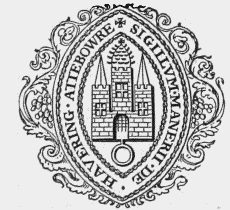
Corporation Seal.
The parish, which, with the parishes of Hornchurch and Havering, constitutes "the liberty of Havering-atteBower," was once considered a ward of Hornchurch; but by an act of parliament passed for the regulation of the poor, in 1786, it is recognised as a separate parish, although, as regards ecclesiastical affairs, it is still partly dependent on Hornchurch. The earliest charter was granted by Edward the Confessor. The government is vested in a high steward, deputy-steward, and justice, who are a corporation exercising magisterial authority, and have a patent authorising them to hear and determine, every three weeks, all actions for debt, trespasses, ejectments, and replevins, in a court of ancient demesne. The tenants of the liberty claim exemption from toll every where throughout the realm, both for goods and cattle sold, and provisions purchased; from payment towards the county expenses; and also exemption from being empanelled on juries and inquests, save within their own liberty; with various other privileges. The court-house is in the market-place, and beneath it is a small gaol for the liberty. The powers of the county debt-court of Romford, established in 1847, extend over the registration-district of Romford, and part of that of Orsett.
The living is a perpetual curacy, in the patronage of the Warden and Fellows of New College, Oxford, to whom all the tithes were given by William of Wykeham. The church was erected in 1407, and consists of a nave, north aisle, and chancel, with a tower at the west end. In the east window is the figure of the patron saint, in fine old painted glass. There are several ancient monumental tablets and effigies, of which the most remarkable are, a monument to Sir Anthony Coke, ambassador to Elizabeth, who died in 1576, and was interred here; and two others to the memory of Sir George Hervey, Knt., and his daughter. The edifice was repewed in 1841, and 680 additional sittings were obtained, of which 534 are free in consideration of a grant of £500 from the Incorporated Society. A new church has been erected at Noak Hill, in the parish; it was consecrated in Oct. 1842. There are places of worship for Independents and Wesleyans. A free school for children of both sexes was erected in 1728, and has been endowed with various benefactions, amounting to more than £1300; it is further supported by subscription, and is on the national plan. An almshouse was founded by Roger Reed, in 1483, for the support of five men and their wives, and was rebuilt in 1784; the value of the endowment is £422. 10. per annum. The union workhouse was erected at an expense of £10,000; the union comprises ten parishes or places, and contains a population of 22,216. Here were anciently a guild and a chantry, the revenue of the former of which was valued at the Dissolution at £4. 10. 2., and that of the latter at £13; also an hospital, a cell to that of Mount St. Bernard, in the Savoy, London, founded at an early period, and dedicated to St. Nicholas and St. Bernard. In the park of Gidea Hall is a mineral spring of some repute among the poor. Francis Quarles, the poet, author of The Divine Emblems, who was cup-bearer to the Queen of Bohemia, and afterwards secretary to Archbishop Ussher, was a native of Romford.
Romiley, or Chad-Kirk
ROMILEY, or Chad-Kirk, a chapelry, in the parish and union of Stockport, hundred of Macclesfield, N. division of the county of Chester, 4 miles (E.) from Stockport; containing 1465 inhabitants. It comprises 1089 acres; the surface is undulated, the soil clay, with a little sand, and the scenery beautiful. Coal is found at a great depth, but is not wrought; and there is a stone-quarry. Several large cotton-mills are in operation. The river Etherow here takes the name of Mersey; and the Peak-Forest canal, and the Sheffield and Heybridge tramway, pass through the chapelry. The living is a perpetual curacy; net income, £120; patron, the Rector of Stockport, whose tithes here have been commuted for £52. 10. The chapel, dedicated to St. Chad, was rebuilt by subscription in 1746. The manor was anciently in the Stockport family, from whom it descended to the Etons and the Warrens: in the seventeenth century it was held under the Warrens, by the Davenports.
Romney-Marsh
ROMNEY-MARSH, a liberty, and the head of a union, in the lathe of Shepway, E. division of Kent, lying on the southern coast of the county, between the uplands and the sea-shore. Although the name is usually given to the whole level between Hythe and Rye, comprehending the districts of Walland Marsh, Denge Marsh with South Brooks, and Guildford Marsh, yet Romney Marsh, properly so called, contains only about 24,000 acres, and is not more than ten miles in length from east to west, and four in breadth at the broadest part. A charter of incorporation was granted by Edward IV., incorporating a body under the style of the "Bailiff, Jurats, and Commonalty of Romney Marsh;" and the management of the drainage is vested in the lords of twenty-three manors in and adjoining the Marsh, who, with the bailiff, jurats, and commonalty, are called Lords of the Marsh. Scarcely any place in England has equal privileges with this corporation, the charter empowering them to purchase lands and tenements, to have a common seal, to hold a court every three weeks, and pleas of action, real and personal, civil and criminal; to choose yearly four justices of the peace, besides the bailiff; and to have the benefit of all writs, fines, forfeiture, and amerciaments; with exemption from many charges. These immunities were bestowed, as the letters-patent mention, to invite persons to inhabit the marsh, then much deserted on account of the danger of foreign invasion, and the unwholesomeness of the soil and situation. The Marsh is defended against the sea by an artificial wall called Dymchurch Wall, extending in length 1060 rods, and forming the sole barrier that prevents the sea from overflowing the whole of the level. The poor-law union comprises nineteen parishes or places, with a population of 5200: the workhouse is at New Romney.
Romney, New (St. Nicholas)
ROMNEY, NEW (St. Nicholas), a decayed market-town, a cinque-port, and parish, having separate jurisdiction, in the union of Romney-Marsh, E. division of Kent, 34 miles (S. E.) from Maidstone, and 68 (S. E. by E.) from London; containing 955 inhabitants. This place, the name of which is probably derived from the Saxon Rumen-ea, "a large watery expanse, or marsh," arose from the decay of Old Romney. At the time of the Conquest it was a town of considerable importance, divided into twelve wards, and containing five parochial churches, of which that of St. Nicholas is the only one now remaining. It was given by William the Conqueror to his brother Odo, Bishop of Bayeux, whom that monarch created Earl of Kent; and was subsequently made a cinque-port, to which the towns of Old Romney and Lydd were added as members, though not included within its jurisdiction. In return for such privileges, it was charged with the duty of supplying five ships of war for the service of the king. In the 15th of Edward I. an irruption of the sea inundated an extensive tract of land, destroyed the populous village of Bromhill and a considerable part of the town, diverted the course of the river Rother, and ruined its fine haven on the western shore; since which time it has shared the fate of its predecessor, and, though still respectably inhabited, has fallen into decay as a port. On several occasions, as a cinque-port, it furnished a complement of five ships duly manned and equipped for naval engagements, especially in the reigns of John, Edward III., Henry VII., and Henry VIII. The town is situated on rising ground near the centre of Romney Marsh, and consists of a broad well-paved street, with a smaller one intersecting it almost at right angles. The chief trade arises from the grazing of cattle; and there is a considerable fair for live-stock on Aug. 21st.
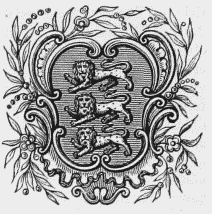
Arms.
New Romney, a borough by prescription, received its first charter of incorporation from Edward III., under the style of "Barons of the town and port of Romney:" a new charter was granted by Elizabeth, by which the corporation consists of a mayor, twelve jurats, and commoncouncilmen, with a recorder, chamberlain, town-clerk, and other officers, under the title of "Mayor, Jurats, and Commonalty." A court called a Brotherhood and Guestling, connected with the business of the various cinque-ports and their members, is held, when necessary, on the Tuesday next after St. Margaret's day; sessions occur quarterly, and by adjournment every six weeks. The powers of the county debt-court of Romney, established in 1847, extend over nearly the whole of the registration-district of RomneyMarsh. The guildhall is a neat structure of brick cemented so as to resemble stone. Two representatives, under the title of Barons, were returned to parliament until the 2nd of William IV., when the borough was disfranchised. The parish comprises 2929 acres, of which 555 are common or waste land. The living is a vicarage, valued in the king's books at £6. 16. 3., and in the patronage of All Souls College, Oxford, with a net income of £160: the vicarial tithes have been commuted for £87. 13., and the impropriate for £42. 7.: there are 20 acres of glebe. The church is a spacious edifice, consisting of three aisles and three chancels, and a square tower at the west end, with several portions of Norman architecture, and a variety of monuments and brasses. Here are places of worship for Baptists and Wesleyans. An hospital was founded in 1610, and endowed with land by John Southland, for the maintenance of a governor, who must be a scholar of Oxford or Cambridge, four poor persons, and two children.
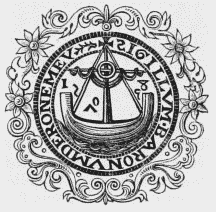
Corporation Seal.
Romney, Old (St. Clement)
ROMNEY, OLD (St. Clement), a parish, in the cinque-port liberty of Romney, union of RomneyMarsh, lathe of Shepway, E. division of Kent, 1¾ mile (W. by N.) from New Romney; containing 122 inhabitants. The town had a good and much frequented haven prior to the Conquest; but in the reign of Edward III. it sustained considerable damage from violent tempests, and its harbour became choked up and obstructed. The parish comprises 2535 acres, of which a small part is arable and the remainder pasture. The living is a rectory, in the patronage of the Archbishop of Canterbury, valued in the king's books at £15. 19. 2.; net income, £260. The church is a neat structure. An hospital for lepers, founded by Adam de Chorring, and dedicated to St. Stephen and St. Thomas à Becket, was in the fourteenth century converted into a chantry, and in 1481 was annexed to the college of St. Mary Magdalene, in Oxford. There was also a cell subordinate to the abbey of Pountney, in France.
Romsey (St. Mary)
ROMSEY (St. Mary), a market-town and parish, having separate jurisdiction, and the head of a union, locally in the hundred of King's-Sombourn, Romsey and S. divisions of the county of Southampton, 8 miles (N. W. by N.) from Southampton, and 75 (S. W. by S.) from London; containing 5347 inhabitants, of whom 1919 are in Romsey Infra, and 3428 in Romsey Extra, which includes the tythings of Capernham, Lee, Mainstone, Ranvills, Spurshot, Stanbridge, Woodbury, and Wools. This place, which derives its name from the Saxon, was selected as the site of an abbey for nuns of the Benedictine order by Edward the Elder, whose daughter Elfleda was the first abbess. The foundation was augmented in 967, by Edgar, whose son Edmund was interred in the abbey church; all the early abbesses were of royal birth, and eminent for their sanctity. About the year 992 it was plundered by the Danes, but the nuns, with the relics, and other articles of the greatest value, had been previously removed to Winchester, through the precaution of Elwina, the abbess. In 1085, Christina, cousin to Edward the Confessor, took the veil here; and to her was entrusted the education of Matilda, daughter of Malcolm, King of Scotland, and subsequently wife of Henry I. In the reign of Stephen, Mary, daughter of the king, became abbess, and was induced to quit her charge by Matthew, younger son of Theodore, Earl of Flanders, to whom she was married, which step so excited the indignation of the Papal see, that she was compelled to return to her conventual duties after having borne two children. The benefactors to the abbey were numerous, and its revenue, at the Dissolution, was valued at £528. 18. 10¼.: in the 35th of Henry VIII., the site was granted to the inhabitants of the town, and three years afterwards to John Bellew and R. Bigot.
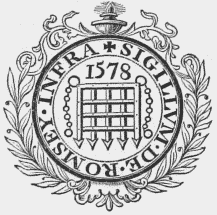
Seal and Arms.
The town is situated on the road from Southampton to Bath, and on the river Test, which falls into the Southampton Water at Redbridge, about six miles below. It is surrounded by an amphitheatre of hills, and by fertile and pleasant meadows, which are rendered more productive by the occasional overflowing of the river. There are several good streets, which are paved under the provisions of an act of parliament; the town is lighted with gas, and well supplied with water. A newsroom and some book clubs are supported, and concerts and musical festivals are sometimes held. The clothing-trade was formerly carried on to a considerable extent, but has long since declined: employment is given to nearly 300 persons in three paper-mills, a flax-mill, and three sacking-manufactories; there are also some tanneries, malting establishments, and several corn-mills upon the river. The inhabitants are supplied with coal by means of the canal from Redbridge to Andover, which passes through the town; and the Bishop's Stoke and Salisbury branch of the South-Western railway, completed in 1847, has a station here. The market, which is on Thursday, is chiefly for corn, and on alternate Thursdays is also supplied with cattle; the fairs are on Easter Monday and Tuesday, Aug. 26th, and Nov. 8th, for horses, cattle, cheese, cloth, and other articles of merchandise.
The inhabitants were first incorporated by charter of James I., which was confirmed and extended in the 10th of William III.: the corporation now consists of a mayor, four aldermen, and twelve councillors, under the act 5th and 6th of William IV., cap. 76; and the number of magistrates is four. The corporation hold a court of record every Thursday, for the recovery of debts not exceeding £40, though very little business is transacted; and petty-sessions occur weekly. The powers of the county debt-court of Romsey, established in 1847, extend over the registration-districts of Romsey and Stockbridge. The court-house, or town-hall, in which public meetings and assemblies are held, is situated in the abbey precinct, and was built by the corporation in 1820: near it is a gaol. The parish comprises 9651a. 33p., of which 5011 acres are arable, 2389 meadow and pasture, and 2249 woodland: the soil in the valleys is rich, but on the hills light and gravelly; the country is finely wooded.
The living is a discharged vicarage, valued in the king's books at £20. 18. 1½.; net income, £365; patrons, the Dean and Chapter of Winchester; impropriator, John Fleming, Esq., who is lord of the manor. The church, which belonged to the abbey, is a magnificent cruciform structure, with a low tower rising from the intersection. The principal portion was erected in the middle of the tenth century, and exhibits some fine specimens of the Norman style, consisting of various round arches, with zigzag and other ornaments; the less ancient parts of the edifice are early English. The interior contains several memorials of abbesses who were interred here; a neat tablet to the memory of Sir William Petty, a native of the town, and ancestor of the present Marquess of Lansdowne; and a remarkable monument, with effigies and a curious inscription, to the family of John St. Barbe, Esq., one of the representatives of the county in parliament in 1654. At the angle of the southern transept are the remains of a fine Norman doorway, and in its western wall is a very ancient image of Christ on the Cross, in basso-relievo. The west end is separated from that part of the building appropriated to divine service by a curious oak screen. The only vestiges of the abbey, exclusively of the church, are a few fragments of the walls. There are places of worship for Baptists, Independents, Wesleyans, and Sandemanians. A free school was endowed in 1718, from the estate of John Nowes, Esq., with an income of £30 per annum; another has a rent-charge of £25, under the will of Sir John St. Barbe. Almshouses for six widows were founded in 1692, by John Hunt, Esq.; and six others for single women, in 1809, by John Bartlett, Esq., who endowed them with £6700 three per cent. consols. The poor-law union comprises 12 parishes or places, 10 of which are in the county of Southampton, and two in that of Wilts; the whole containing a population of 10,387. Giles Jacob, author of the Law Dictionary, was born here in 1686.