A Topographical Dictionary of England. Originally published by S Lewis, London, 1848.
This free content was digitised by double rekeying. All rights reserved.
'Yeading - Yettington', in A Topographical Dictionary of England, ed. Samuel Lewis (London, 1848), British History Online https://www.british-history.ac.uk/topographical-dict/england/pp716-719 [accessed 30 April 2025].
'Yeading - Yettington', in A Topographical Dictionary of England. Edited by Samuel Lewis (London, 1848), British History Online, accessed April 30, 2025, https://www.british-history.ac.uk/topographical-dict/england/pp716-719.
"Yeading - Yettington". A Topographical Dictionary of England. Ed. Samuel Lewis (London, 1848), British History Online. Web. 30 April 2025. https://www.british-history.ac.uk/topographical-dict/england/pp716-719.
In this section
Yeading
YEADING, a hamlet, in the parish of Hayes, union of Uxbridge, hundred of Elthorne, county of Middlesex; containing 222 inhabitants.
Yeadon
YEADON, a township, in the parish of Guiseley, Upper division of the wapentake of Skyrack, W. riding of York, 6 miles (N. W.) from Leeds; containing 3379 inhabitants. This township, which includes Upper and Lower Yeadon, and Henshaw, comprises about 1730 acres, chiefly high moorland affording tolerable pasture; the surface is watered by copious springs, and the substratum abounds with good building-stone. The population is mostly employed in the manufacture of woollencloth, in three large mills. The village, which is extensive, stands on an eminence on the north side of Airedale, commanding a fine view of the vale and of the adjacent scenery, which is pleasingly diversified. A district church dedicated to St. John was erected in 1843, at an expense of £2000, by subscription, aided by grants of £300 from the Incorporated Society, a like sum from the Commissioners for Building Churches, and £400 from the Ripon Diocesan Society; it is in the early English style, with a square embattled tower, and stands on a site given by Richard Barwick, Esq. The living is in gift of the Rector of Guiseley. The tithes have been commuted for £111. There are places of worship for Wesleyans and Association Methodists.
Yealand-Conyers
YEALAND-CONYERS, a township, in the parish of Warton, union of Lancaster, hundred of Lonsdale south of the Sands, N. division of Lancashire, 2¼ miles (W. S. W.) from Burton-in-Kendal; containing 322 inhabitants. Anciently, Yealand-Conyers and Yealand-Redmayne appear to have formed one district. In the Testa de Neville it is stated, that "Mathew de Redeman and Robert de Kemyers, or Cynyers, held the eighth part of a knight's fee in Yeland, of the fee of William de Lancaster, the king's tenant in chief;" hence the origin of the additions to the name. The Conyers and Redmayne families were long connected with Yealand; and subsequently the Crofts, among others, held the manor of Yealand-Conyers. The township comprises 1464 acres; it is situated in a district abounding with interesting and varied scenery, and the immediate vicinity is enlivened with numerous handsome seats and pleasant villas. A church, dedicated to St. John, was built in 1838, and a district has been assigned to it comprising all Yealand; it is in the early English style, with a tower. The living is a perpetual curacy, in the gift of Hyndman's Trustees; net income, £57, with a house. The Society of Friends have a place of worship, with a school attached; and there is a Roman Catholic chapel, of which the priest has an endowment of £130 per annum, with a residence. A national school, built in 1841, is supported by subscription; and another school has an endowment of £9 a year, left by Thomas Widows.
Yealand-Redmayne
YEALAND-REDMAYNE, a township, in the parish of Warton, union of Lancaster, hundred of Lonsdale south of the Sands, N. division of the county of Lancaster, 3 miles (S. W.) from Burton-in-Kendal; containing 228 inhabitants. This township adjoins the preceding, and its history is interwoven with the history of Yealand-Conyers. Yealand Hall, an ancient dwelling at Yealand-Storrs in the township, seems to have been possessed in the reign of Henry VIII. by the family of Lawrence, who held the manor of "Yeland-Redmayn" as of the manor of Warton. Thomas Lathom held the manor in the same reign.
Yealmpton (St. Bartholomew)
YEALMPTON (St. Bartholomew), a parish, in the union of Plympton St. Mary, hundred of Plympton, Ermington and Plympton, and S. divisions of Devon, 3¾ miles (S. E. by S.) from Earl's-Plympton; containing 1317 inhabitants. It comprises by measurement 3132 acres; the substratum is chiefly limestone of good quality, which is quarried for burning into lime. The navigable river Yealm, which gives name to the place, flows through much pleasing scenery, and is crossed by a bridge at the village. Yealmpton was anciently denominated a borough, and though much decayed, is still of respectable appearance. A great cattle-market is held on the fourth Wednesday in every month. Kitley, the fine mansion of the family of Bastard, contains some of the most valuable productions of Sir Joshua Reynolds. The living is a vicarage, with that of Revelstoke annexed, valued in the king's books at £35. 19. 4½.; patron, the Bishop of Exeter: the vicarial tithes have been commuted for £355. The church is partly in the early and partly in the later English style, with two stone stalls enriched with trefoil arches. Near it are the ruins of a building, once, probably, a prebendal residence: according to tradition, it was a palace of the Saxon kings, and occupied by Ethelwold, whose lieutenant, Lipsius, was buried here.
Yeardsley, with Whaley
YEARDSLEY, with Whaley, a township, in the parish of Taxall, union and hundred of Macclesfield, N. division of the county of Chester, 10 miles (S. E. by E.) from Stockport; containing 663 inhabitants. It is situated on the west bank of the river Goyt, on the road from Manchester to Buxton, and comprises 1266 acres, of a stony soil. The lands appear to have been the property of the Jodrells since the time of Henry VI.: Sir Francis Jodrell, of Henbury, is the present proprietor. Some very productive collieries are worked, and one of the seams of coal is crossed by a vein of lead-ore, a circumstance of very rare occurrence; there are also quarries of flag and building stone. In the village, which is of considerable antiquity, a small manufacture of tape is carried on; and a wire-mill in the township employs about fifty persons. The Peak Forest canal commences here. An act was passed in 1846, enabling the Manchester and Sheffield Railway Company to make a branch to Whaley bridge, 12¼ miles in length; and in the same year, another act was obtained for a railway from Stockport, by Whaley, to Buxton, Bakewell, &c. There is a place of worship for Wesleyan Methodists.
Yearnor
YEARNOR, a tything, in the parish of Porlock, union of Williton, hundred of Carhampton, W. division of Somerset; containing 27 inhabitants.
Yearsley
YEARSLEY, a township, in the parish of Coxwold, union of Easingwould, wapentake of Birdforth, N. riding of York, 5½ miles (N. E. by E.) from Easingwould; containing 176 inhabitants. The township comprises 2764a. 2r. 7p., of which 496 acres are arable, 2085 meadow and pasture, and 184 woodland and common. The tithes have been commuted for £403, payable to Trinity College, Cambridge. A chapel of ease was built in 1839, by George Wombwell, Esq.
Yeaveley
YEAVELEY, a chapelry, in the parish of Shirley, hundred of Appletree, S. division of the county of Derby, 4½ miles (S.) from Ashbourn; containing 329 inhabitants. The township comprises 1065 acres, of fertile soil, and has a well-built village, seated about a mile east of the high road from Ashbourn to Sudbury: Earl Ferrers is a considerable owner, and the lord of the manor. The common laud, about fifty acres, was inclosed in 1840. The chapel, rebuilt on a new site in 1840, and dedicated to the Trinity, is a neat brick structure, of which the cost, about £800, was defrayed by subscription, aided by a grant from the Incorporated Society; it has a tower, and contains 154 sittings, whereof 74 are free. An ecclesiastical district was annexed to it in 1844. The living is a perpetual curacy, in the patronage of the Vicar. The impropriate tithes of the township have been commuted for £50, and the vicarial for £20. Here was a commandery of the Knights Hospitallers, dedicated to St. Mary and St. John the Baptist, to which Sir William Meynell was a great benefactor in 1268, and which had a revenue of £107. 3. 8. The chapel of this commandery, now called Stydd Chapel, has fallen to ruins, which present, nevertheless, some beautiful remains of early-English work.
Yeavering
YEAVERING, a township, in the parish of KirkNewton, union, and W. division of the ward, of Glendale, N. division of Northumberland, 4½ miles (W. N. W.) from Wooler; containing 68 inhabitants. It comprises by computation 1400 acres, of which about 400 are arable, and the remainder pasture and moorland. The river Glen passes on the north, at a short distance from the village. In the township is Yeavering Bell, a lofty conical mountain rising to the height of more than 2000 feet from the vale. Its summit, which is level, and 1000 yards in circuit, is encompassed by the remains of an ancient wall, eight yards in breadth, built on the very edge of the hill, with an entrance on the south; within this is another wall, defended by a ditch, and in the centre of the area is a large cairn hollowed like a bowl. There are several smaller circles on other parts of the hill, with vestiges of a grove of oaks, strongly indicating that these works were constructed by the Druids; and in the neighbourhood are an immense cairn, and a cluster of rocks, respectively called Tom Tallan's Grave and Crag. Yeavering was the residence of some of the Saxon kings of Northumbria, particularly of Edwin, after his conversion; and here Paulinus was employed in baptizing converts, in the river Glen, close by. Near the village is a rude column of stone, commemorating the victory gained in 1415, by the Earl of Westmoreland, with an English force of 440 men, over Sir Robert Umfraville at the head of a Scottish army of 4000.
Yeddingham (Blessed Virgin Mary)
YEDDINGHAM (Blessed Virgin Mary), a parish, in the union of Malton, wapentake of Buckrose, E. riding of York, 8¼ miles (N. E.) from Malton; containing 122 inhabitants. In 1163, Roger and Helwysia de Clere founded a priory here for nine nuns of the Benedictine order, dedicated to the Virgin Mary; the revenue was valued at the Dissolution at £26. 6. 8., and the site was granted to Robert Holgate, afterwards Archbishop of York. The parish lies on the road from York to Scarborough, and comprises about 700 acres, whereof two-thirds are arable, and the remainder pasture. The village is pleasautly situated on the navigable river Derwent, which forms the northern boundary of the parish, and also divides the North and East ridings of the county. The living is a vicarage, valued in the king's books at £5. 4. 2.; net income, £205; patron, Earl Fitzwilliam; impropriator, Mark Foulis, Esq. The church, a small ancient structure, with a tiled chancel, and a belfry, was dedicated in 1241; and several indulgences were granted to it by Richard de Breuse, patron of a monastery near Yeddingham. There is a place of worship for Wesleyans.
Yeldersley
YELDERSLEY, a hamlet, in the parish of Ashbourn, hundred of Appletree, S. division of the county of Derby, 3½ miles (E. S. E.) from Ashbourn; containing 211 inhabitants.
Yeldham, Great (St. Andrew)
YELDHAM, GREAT (St. Andrew), a parish, in the union of Halsted, hundred of Hinckford, N. division of Essex, 7 miles (N. W. by N.) from Halsted; containing 726 inhabitants. The village is pleasantly situated in a retired part of the parish. Many of the women and children are employed in the straw-plat manufacture. The living is a rectory, valued in the king's books at £20, and in the gift of the Cripps family: the tithes have been commuted for £500, and the glebe comprises 41 acres. The church is a small ancient edifice with a very handsome tower; the burialground is planted with avenues of fir-trees. A national school is partly supported by an endowment assigned by John Symonds, in 1691. The gravelly soils are replete with fossils.
Yeldham, Little
YELDHAM, LITTLE, a parish, in the union of Halsted, hundred of Hinckford, N. division of Essex, 9 miles (N. N. W.) from Halsted; containing 333 inhabitants. It is a pleasant and healthy district, comprising 9l6a. 3r. 18p., of which 793 acres are arable, 81 pasture, and 42 wood; the soil is strong and rather wet, but the lands generally are in profitable cultivation. The living is a rectory, valued in the king's books at £8, and in the patronage of the Crown: the tithes have been commuted for £275, and the glebe comprises 2 acres. The church is a spacious and venerable structure, with a square embattled tower: on the south side of the chancel is a small chapel belonging to the family De la Pole: the altar-piece is richly embellished.
Yelford-Hastings
YELFORD-HASTINGS, a parish, in the union of Witney, hundred of Bampton, county of Oxford, 3½ miles (S.) from Witney; containing 16 inhabitants. This parish, which originally belonged to the family of Hastings, was purchased by Mr. Speaker Lenthall, whose descendant, K. J. W. Lenthall, Esq., is the present lord of the manor. It comprises by measurement 313 acres, of which 100 are arable, 200 meadow and pasture, and 13 woodland. The living is a discharged rectory, valued in the king's books at £4. 3. 6½.; net income, £108; patron, Mr. Lenthall. The church is a handsome structure in the later English style.
Yelling (Holy Cross)
YELLING (Holy Cross), a parish, in the union of Caxton and Arrington, hundred of Toseland, county of Huntingdon, 4 miles (S. E. by S.) from Caxton; containing 333 inhabitants, and comprising by measurement 1800 acres. The living is a rectory, valued in the king's books at £14. 10. 5., and in the patronage of the Crown: the tithes have been commuted for £291, and the glebe comprises 38 acres. The church is an ancient structure. There is a place of worship for Baptists. The rent of about fourteen acres of land, amounting to £14. 14., is chiefly distributed among the poor.
Yelvertoft (All Saints)
YELVERTOFT (All Saints), a parish, in the union of Rugby, hundred of Guilsborough, S. division of the county of Northampton, 4½ miles (S. W. by S.) from Welford; containing 618 inhabitants. It comprises 2150a. 2r. 15p., of which five-sixths are pasture and meadow, and one-sixth arable; the surface is generally undulated, and the soil strong and clayey, but productive. The Grand Union canal passes through. The living is a rectory, valued in the king's books at £25. 0. 10., and in the patronage of the Earl of Craven; net income, £487, arising entirely from land allotted at the inclosure in 1770: a new glebe-house was erected by the present incumbent in 1833. The church is ancient, with a square tower of the time of Edward III., and a curious monument supposed to be in memory of a benefactor to the parish. There is a place of worship for Independents. Thirty children are instructed for £35 a year, arising from land bequeathed by Mrs. Ashby in 1719.
Yelverton (St. Mary)
YELVERTON (St. Mary), a parish, in the union of Loddon and Clavering, hundred of Henstead, E. division of Norfolk, 5¾ miles (S. E. by S.) from Norwich; containing 82 inhabitants. It comprises 538a. 1r. 26p., of which 492 acres are arable, 38 pasture and meadow, and 8 in roads. The road from Norwich to Beccles passes through the village. The living is a discharged rectory, with that of Alphington annexed, valued in the king's books at £10, and in the patronage of the Crown: the tithes have been commuted for £400, and the glebe comprises 21 acres. The church is an ancient structure in the decorated and early English styles, with a square embattled tower, and contains several handsome monuments to the families of Rant, Playter. and Day; and a Norman font. The sum of £27 per annum, arising from land purchased with a bequest by Mrs. Anne Rant in 1698, is divided between the rector and the poor, the latter of whom have also 4 acres that were allotted at the inclosure.
Yeovil (St. John the Baptist)
YEOVIL (St. John the Baptist), a market-town and parish, and the head of a union, in the hundred of Stone, W. division of Somerset, 9½ miles (S. S. E.) from Somerton, and 122 (W. S. W.) from London; containing 7043 inhabitants. This place, from the discovery of tessellated pavements and other relics of antiquity, is supposed to have been known to the Romans. It derives its name from the river Yeo, or Ivel, the Velox of Ravennas, which, having its source in seven springs near Sherborne, separates the counties of Somerset and Dorset, and passes Yeovil at a short distance to the east, beneath a stone bridge of three arches, near which it receives a small stream, turning three mills, that bounds the town on the south. The place was anciently called the town, borough, lordship, and hundred of Yeovil, including a district which soon after the Conquest fell into the possession of the crown. Part of this district was assigned by the name of the manor to the rector of St. John the Baptist's church, in the town, by one of the kings of England, who also granted him a weekly market on Friday, view of frankpledge, and several other rights and privileges. The inhabitants were likewise incorporated, under the designation of the Portreeve and Burgesses of Yeovil; and a daily court of pie-poudre was anciently held by the provost on behalf of the rector. The manor was held by the successive rectors till the year 1418, when the then rector resigned the church, together with the town and lordship, to Henry V., who gave the manor, with all its rights and privileges, and the rectory, to the convent of the Virgin Mary and St. Bridget, which that monarch had founded at Sion, in the county of Middlesex. This grant was confirmed by Edward IV., and after the dissolution of monasteries the manor was settled by Henry VIII. on his queen, Catherine, who held it till her death. In 1449, an accidental fire consumed 117 houses in the town, of which 45 belonged to different chantries; and on this occasion, an indulgence of 40 days was granted to all who contributed to repair the loss.
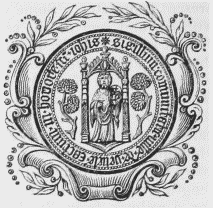
Corporation Seal.
The town is situated on the middle road leading from Exeter to London, and consists of numerous streets, many of them spacious; the houses, of which several are of stone, are in general well built. It is supplied with water from springs that rise at a short distance, and is sheltered on the north by a range of hills which, as well as the adjacent country, are in a high state of cultivation. On the south-east are three remarkable hills, from the summit of one of which, Newton Hill, the English and Bristol Channels can be discerned. The metropolis is chiefly supplied with what is called Dorset butter from the dairy-farms in the vicinity. The inhabitants were formerly engaged in the woollen manufacture; but this has been superseded by that of leather gloves, which are made here to the extent of 4000 dozen per week, affording employment to many hundred persons in the parish and neighbouring villages. An act was passed in 1845, for a railway from Yeovil to the Bristol and Exeter line near Bridgwater, 20 miles in length; and in the same year, an act for a railway from near Chippenham, by Yeovil, to Weymouth. The market-day is Friday, and on every alternate Friday is the great market: corn, cattle, pigs, bacon, butter, cheese, hemp, and flax, are sold in considerable quantities; and in the purchase and sale of the two last articles upwards of £1000 are frequently returned in one day. Fairs are held on June 28th and November 17th, for horses, cattle, and pedlery; each continuing for two days. The market-house is supported on stone pillars. The government of the town, which is a corporation by prescription, is vested in a portreeve and eleven burgesses; a macebearer and two constables are chosen for the town, and two constables for the parish, which has a distinct jurisdiction: the portreeve exercises magisterial authority while in office. A court of record formerly took place every three weeks; and a court-leet for the borough is still held annually, by the lord of the manor. The powers of the county debt-court of Yeovil, established in 1847, extend over the registration-district of Sherborne, and part of that of Yeovil. The parish comprises 4038a. 3r. 31p., of which about 900 acres are arable, 30 woodland and plantations, and the remainder meadow and pasture; the soil varies from a light sand to a strong clay, with portions of rich loam.
The living is a vicarage, with that of Preston annexed, valued in the king's books at £18; net income, £391; patron, William Phelips, Esq.; impropriators, Henry William R. W. Halsey, Esq., for one portion, and John Newman, Esq., for the residue. The church is a fine cruciform structure, near the centre of the town, in the ancient English style, with a tower surmounted by a balustrade; and, according to Leland, contained the chantries of St. John the Baptist, the Holy Cross, the Holy Trinity, and the Virgin Mary. At its western end stands a building now used as a schoolroom, of much older date than the church itself. The foundation-stone of a district church was laid at Hendford on June 23rd, 1843; it was consecrated in Oct. 1846, and the district, consisting of half the town, and containing a population of about 3000, then became an ecclesiastical parish, under the act 6th and 7th Victoria, cap. 37. The church, a cruciform structure in the early English style, cost about £3000, and is dedicated to the Trinity. The living is a perpetual curacy, with a net income of £150, and is in the gift of the Crown and the Bishop of Bath and Wells, alternately; except the next presentation, which belongs to Mr. Phelips. There are places of worship for Particular Baptists, the Society of Friends, Independents, Wesleyans, and Unitarians. A free school, originally founded in 1707, by subscription, has been endowed with sundry bequests, including that of John Noyes, who in 1718 left estates producing about £150 per annum, partly extended to Romsey and FishertonAnger. An almshouse for a custos, two wardens, and twelve other persons, was founded in 1476, by John Woburne, minor canon of St. Paul's Cathedral, and endowed to a considerable extent with landed property; a chapel is annexed to the institution. The portreeve's almshouses, in Back-street, are for four women, each of whom receives a small allowance. The poor-law union of Yeovil comprises 35 parishes or places, containing a population of 27,894. In the hamlets of Kingston, Marsh, and Hendford were ancient chapels, dependent on the mother church, in which the inhabitants of those villages had a right of sepulture; the places appropriated for that purpose are still pointed out in the parish church.
Yeovilton (St. Bartholomew)
YEOVILTON (St. Bartholomew), a parish, in the union of Yeovil, hundred of Somerton, W. division of Somerset, 1½ mile (E.) from Ilchester; containing, with the tything of Bridghampton, and the hamlets of Hainbury and Speckington, 294 inhabitants, of whom 163 are in Yeovilton township. The parish is bounded on the north by the river Yeo, and comprises 1753 acres, of which one-half are arable, and the remainder meadow, pasture, and orchard. The soil is generally a strong clay. The living is a rectory, valued in the king's books at £26. 9. 2., and in the gift of the Bishop of Bath and Wells: the tithes have been commuted for £410, and the glebe comprises 65 acres. The church is a handsome structure in the later English style of architecture.
Yetlington.—See Callaley.
YETL1NGTON.—See Callaley.
Yetminster (St. Andrew)
YETMINSTER (St. Andrew), a parish, and formerly a market-town, in the union of Sherborne, hundred of Yetminster, Sherborne division of Dorset, 5¼ miles (S. W.) from Sherborne; containing, with the chapelries of Chetnole and Leigh, 1246 inhabitants, of whom 628 are in Yetminster township. This parish, which lies on the western border of the county, and gives name to the hundred, comprises by measurement 1575 acres. There are quarries of good limestone, and of a very hard freestone for building. The village, situated near the river Ivel, consists of a long well-built street, having still the appearance of a town. In the year 1300, the Bishop of Sarum obtained from Edward I. a grant for a market and fair, which was confirmed by Richard II.; the market has long been disused, and fairs are now held on April 23rd and October 1st. The living is a discharged vicarage, in the patronage of the Bishop, valued in the king's books at £20. 14. 7.: the great tithes have been commuted for £160, and the vicarial for £250; the glebe consists of garden and orchard ground attached to the glebe-house. The church is a large ancient structure, with a lofty square embattled tower crowned by pinnacles. At Leigh and Chetnole are chapels of ease. The Hon. Robert Boyle, in 1699, bequeathed an estate now producing more than £70 per annum, for teaching 26 boys; the master has a house, with a garden and orchard.
Yettington
YETTINGTON, a hamlet, in the parish of Bicton, union of St. Thomas, hundred of East Budleigh, Woodbury and Southern divisions of Devon; containing 137 inhabitants.