A History of the County of Lancaster: Volume 5. Originally published by Victoria County History, London, 1911.
This free content was digitised by double rekeying. All rights reserved.
'Townships: Rivington', in A History of the County of Lancaster: Volume 5, ed. William Farrer, J Brownbill (London, 1911), British History Online https://www.british-history.ac.uk/vch/lancs/vol5/pp286-294 [accessed 30 April 2025].
'Townships: Rivington', in A History of the County of Lancaster: Volume 5. Edited by William Farrer, J Brownbill (London, 1911), British History Online, accessed April 30, 2025, https://www.british-history.ac.uk/vch/lancs/vol5/pp286-294.
"Townships: Rivington". A History of the County of Lancaster: Volume 5. Ed. William Farrer, J Brownbill (London, 1911), British History Online. Web. 30 April 2025. https://www.british-history.ac.uk/vch/lancs/vol5/pp286-294.
In this section
RIVINGTON
Rowinton, Rawinton, Revington, 1202; Ruhwinton, 1212; Riuiton, 1226; Rowynton, Rouynton, 1278 and common; Roynton, 1332; Rouyngton, 1400; Revyngton, Ryvington, xvi cent.
The township occupies the western and northern slopes of Winter Hill, which rises to the height of 1,498 ft. near the meeting-place of the boundaries of Rivington, Horwich, Halliwell, and Sharpies. A spur of this hill shoots out westward and then southward, terminating at the Pike or Peak, 1,158 ft. high; from this the ground slopes rapidly to the west and south, and more gently to the south-east. On the Pike is a tower built in 1733, and said to mark the position of an older beacon. (fn. 1) Fine views are obtained from this point. The western boundary is about 3 miles from north to south, and is formed by the reservoirs of the Liverpool Waterworks, begun in 1847, and completed ten years later. (fn. 2) The area of the township is 2,768 acres. (fn. 3) The population in 1901 numbered 421.
The little village of Rivington, with its church and chapel, lies near the embankment separating the upper and lower reservoirs; the hall is further to the east. A large part of the hill-side, from the village to the southern boundary, has been formed into a park, which was in 1904 presented to the corporation of Bolton by Mr. W. H. Lever, the present lord of the manor. (fn. 4)
The principal road is that along the foot of the hill from Horwich to the village, where it is crossed by a road from Anderton over the embankment and eastward to Belmont and Bolton. There are some other old roads, and new ones have been formed in connexion with the great park.
The River Douglas rises on Winter Hill and flows south-west, forming part of the southern boundary; while the Yarrow, rising on the same hill, forms the northern boundary.
There were calico-printing works at Knoll. (fn. 5) Veins of lead and calamine were formerly worked. (fn. 6) The soil is clayey, with subsoil of gravel, and grass is the chief crop.
On Noon Hill is an ancient mound.
The township is governed by a parish council.
There were 62 hearths in this township liable to the tax in 1666, but no house had as many as six hearths in it. (fn. 7)
Manor
The manor of RIHNGTON in 1212 was held of the king in thegnage by the Pilkingtons of Pilkington; it was assessed as 6 oxgangs of land, and a rent of 10s. was paid. (fn. 8) About the end of the 13th century an eighth part was acquired by the Hulton family, so that in 1324 Roger de Pilkington held seven-eighths of the manor at a rent of 8s. 9d., and Richard de Hulton held the other eighth by 1s. 3d. (fn. 9) This partition appears again in 1346 (fn. 10) and 1445. (fn. 11) From this time the descent of the manor cannot be traced satisfactorily. After the forfeiture by the Pilkingtons of Pilkington in 1485 the thegnage rents appear to have been collected directly from the tenants in possession, (fn. 12) and at the beginning of the 17th century five-eighths was held by the Pilkingtons of Rivington, (fn. 13) a fourth part by the Lathoms of Irlam, (fn. 14) and the other eighth by the Shaws of Heath Charnock. (fn. 15) Even in the 14th century a fourth part was held by the Westleigh and Birkenhead families, (fn. 16) and descended to the Birkenheads (fn. 17) and Chisnalls (fn. 18) in the 16th century, and to the Hamerton's (fn. 19) or Lathoms. (fn. 20)
The principal local family was that just named— the Pilkingtons of Rivington. (fn. 21) In 1202 Alexander de Pilkington, William his brother, and Alice his sister, secured from Thomas de Rivington a release of his right in 2½ oxgangs in Rivington and Worsthorne, all the parties claiming by descent; Thomas, however, received the oxgang in Worsthorne, the Pilkingtons retaining the land in Rivington, which was a fourth part of the manor. (fn. 22) At the same time Henry de Pilkington released to Alexander his claim to 3 oxgangs of land in the townships named. (fn. 23) In 1212 Alexander de Pilkington, the head of the family, held the manor of the king, and the sons of his uncle or stepfather held the land of him. (fn. 24) It is clear, therefore, that the land was much divided. Nothing is known of it for the greater part of a century, (fn. 25) but then another Alexander de Pilkington is found purchasing lands (fn. 26) in Rivington, apparently as an estate for his younger son Richard, (fn. 27) who settled there as the immediate lord of the place, or at least of the seven-eighths held by the Pilkingtons. Richard married Ellen, daughter of William de Anderton, who had a share of Rivington from her father; (fn. 28) she was living in 1301, (fn. 29) and Richard was living in 1310. (fn. 30) He was succeeded by his son Robert, (fn. 31) who had a son Richard married to Joan, daughter of John de Heaton, (fn. 32) and other children. Though a considerable number of the family deeds have been preserved the history of the manor is unknown for about thirty years, (fn. 33) from 1350 to 1380, and then another Robert de Pilkington is found in possession. His parentage is not stated. (fn. 34) His first wife was Alice, daughter of Adam de Hulton; and then he married Alice de Astley; but in 1379 this union was dissolved, on the allegation of kinship with his first wife; (fn. 35) and Robert soon afterwards married Katherine, daughter of John de Ainsworth, then settled near the Peak. (fn. 36)
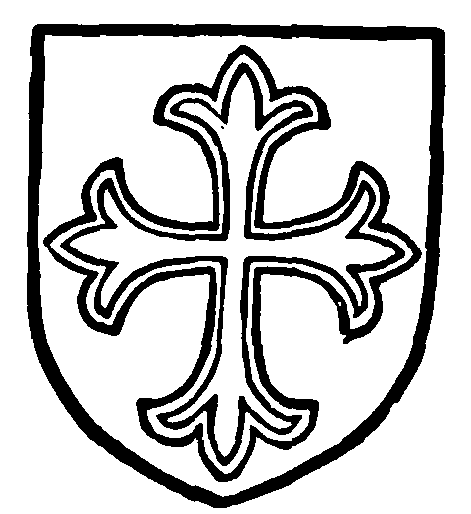
Pilkington. Argent a cross flory voided gules.
Their son Alexander succeeded to the manor about 1403, (fn. 37) and in 1420 was found to hold seven parts of Rivington of Sir John de Pilkington in socage by the service of 5s. yearly. (fn. 38) He married Katherine, daughter of Richard de Crook, and was succeeded by his son Ralph. (fn. 39) From his first wife, Margery daughter of William de Lever, Ralph was divorced in 1432, (fn. 40) and he then married Margaret, sister of William Ambrose, (fn. 41) by whom he had a son and heir Robert. Ralph Pilkington died in 1476, holding messuages and lands in Rivington of the king as of his duchy. (fn. 42) Robert the son and heir was born about 1450. Another inquisition was taken in 1507. (fn. 43)
One of Robert's first acts was to build a hall and cross-chamber at Rivington. (fn. 44) He lost the Derbyshire estates, the Ainsworths establishing their right after some violent proceedings. (fn. 45) Robert married Joan daughter of Thomas Tyldesley. (fn. 46) and died in September 1508, holding lands of the king; the service is not stated in the inquisition. (fn. 47) Richard, his son and heir, then twenty-four years of age, is said to have built or rebuilt the chapel at Rivington, and was the father of several sons, who distinguished themselves as zealous Protestants in the second half of the century; one of them, James, was Bishop of Durham from 1560 to 1575, and founded the grammar school at Rivington in 1566. (fn. 48)
An inclosure of the waste made in 1536 gives an indication of the holdings of the three lords of the manor; for, out of 20 acres, Richard Pilkington had I 3, James Shaw 3, and George Lathom 4. (fn. 49) Richard Pilkington married Alice daughter of Lawrence Asshaw, (fn. 50) and at his death in 1551 was found to hold a messuage and chapel at Rivington by a rent of 12d. and suit of court; (fn. 51) George, his son and heir, was of full age. (fn. 52) The fortunes of the family were declining, and after the death of George's son and heir Robert in 1605, (fn. 53) the estates were sold.
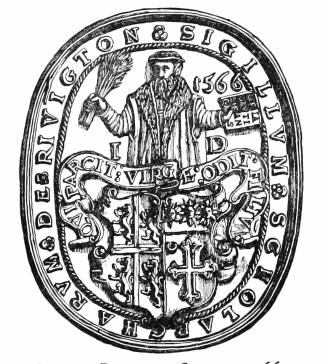
Seal of Rivington School, 1566
The arms are those of Bishop James Pilkington, who bore Argent a cross patance voided gules, on a chief vert three suns or, impaled with the cross and lions of the bishopric of Durham.
The Pilkington manor was purchased in 1611 by Robert Lever of Darcy Lever and Thomas Breres of Preston. (fn. 54) The former, who died in 1620, left his moiety of the manor and Old Hall, with appurtenances, to his younger son Robert, a great benefactor of Bolton School. (fn. 55) Dying unmarried Robert's estate went to a son of his elder brother James, a third Robert Lever. (fn. 56) The new possessor lived on till 1688, when by his will his lands, &c., in Rivington, Heath Charnock, and Walton-le-Dale went to his daughter Jane, who had married John Andrews of Little Lever in 1648. (fn. 57) Their heir was their son John, whose son and heir, also John Andrews, purchased the other moiety of the manor in 1729. (fn. 58)
This second moiety descended from Thomas Breres, who died in 1617, (fn. 59) to his son Thomas. On his death in 1673 Thomas Breres was followed by his brother John, a clergyman, sometime incumbent of Chorley. (fn. 60) The Breres family lived at Rivington, and several stones bear the initials of William Breres, the son and heir of John, and his wife Martha, showing their alterations in the hall buildings. William died in 1723, and his son John sold his moiety of the manor in 1729, as stated above. (fn. 61)
After their purchase the Andrews family seem to have removed from Little Lever to Rivington.61 John Andrews, the purchaser, died in 1743, (fn. 62) and was succeeded by his daughter Abigail, wife of Joseph Wilson of Bolton. In 1765, in default of issue, the estate reverted to the male line, the heir being Robert Andrews, grandson of Abigail's uncle Robert. The new owner pulled down the old hall and built the present house. On his death in 1793 the manor descended to his eldest son Robert, who died unmarried in 1858, then to the younger son John, who died in 1865, and afterwards to John William Crompton, grandson of their sister Hannah Maria, wife of Robert Fletcher of Liverpool, whose daughter Lucy in 1834. married Woodhouse Crompton.
In 1900 Mr. Crompton sold his interest in the manor and his estate in the township, including 2,100 acres of land, to Mr. William Hesketh Lever, of Thornton Hough in Wirral. Mr. Lever laid out about 360 acres as a park for his native town of Bolton. In 1902 the Corporation of Liverpool sought to buy all the land to preserve the purity of the Rivington water supply, and ultimately succeeded; they own the soil of the park, but have to maintain it.
RIVINGTON HALL is said to have been originally a wood and plaster building in the form of a quadrangle, inclosing in its centre a square court and approached by an open gateway. (fn. 63) No part of this timber structure, however, remains, though the quadrangular plan is still retained with an open side on the east. The house seems to have been partly rebuilt in stone at the end of the 17th, or beginning of the 18th century, though it is possible that the timber building did not extend to more than one portion of the whole. The north wing of the present building is of stone and bears on the lower parts of the wall to the courtyard, which has several built up low mullioned windows, a stone with the date 1700 and initials WBM [William Breres and his wife Martha (Gill)], while over a doorway on the west side of the court are the initials W B (William Breres) and the date 1694. The upper parts of both these wings have been rebuilt in stone in later times. The greater part of the house was pulled down in 1774 by Robert Andrews, who built the present west front, a substantial two-story structure, in red brick with a pediment. The date of erection and the initials of Robert Andrews are on the spout heads. The south wing is a later 19th-century addition also in brick. On the stable buildings to the east of the house are two door heads, one dated 1713 with the initials WBMI (William and Martha Breres and their son John), and the other 1732 with the initials IAA (John Andrews and Abigail Crookes his wife).
On the north-east of the hall is a very fine old barn 105 ft. 8 in. in length, divided into seven bays by six pairs of massive crucks standing on stone bases, varying in size from 10 in. to 15 in. by 18 in. to 20 in. The width of the main span is 25 ft. 6 in., but 'aisles' have been added in a recent restoration making the total width of the building at present 57 ft. 6 in. The timbers are now wholly exposed, new exterior stone walls having been erected during the restoration, porches added in the north and south sides, and the whole re-roofed with stone slates. The barn is now used as a place of refreshment in connexion with Lever Park.
The Hospitallers had lands in Rivington. (fn. 64)
Among the families occurring in the early deeds and pleadings are those of Rivington, (fn. 65) Broadhurst, (fn. 66) Knoll, (fn. 67) Gamelsley, (fn. 68) and Unton. (fn. 69) The only freeholder named in 1600 was Robert Pilkington, who was a justice of the peace, (fn. 70) but other names occur in the inquisitions, (fn. 71) and several are described as yeomen in the Protestation List of 1641–2. (fn. 72) From the returns of the hearth tax of 1663 it appears that the hall, the largest house, had only four hearths; there were three houses with three hearths, and seven with two. (fn. 73)
In 1796 the executors of Mr. Andrews paid nearly a third of the land tax. (fn. 74) At the appropriation of the tithe rent-charge in 1845 the estate of Robert Andrews was 1,777 acres, of which only 70 were cultivated as arable; moor and waste lands occupied a little more than half the whole, while the demesne was 200 acres.
Great House Farm is a two-story stone-built house with mullioned windows and stone-slated roof, erected probably in the middle of the 17th century. The principal front faces east, and has a small gable, and there are two dormer gables on the west side. The building was extended northward about the end of the same century or beginning of the 18th, and a further extension in the same direction but on a different axis (swung round to north-east) is probably ' the house newly erected on the Great House Farm,' leased to the master of the Grammar School in 1767. (fn. 75) North of the house are the remains of a fine old barn recently restored and used as a tea-house for excursionists, but reduced to three bays in length, carried on two sets of crucks measuring 9 in. by 20 in. on stone bases, with a span of 22 ft. The barn, which is now only 42 ft. in length, was apparently at one time of much greater size; like the Old Hall barn it is a very fine specimen of ancient timber construction and has been similarly restored, with a west porch and side aisles, which have increased its width to 48 ft. 9 in. The outer walls have been rebuilt, and the roof newly covered with stone slates. A short wing with a gable facing south was added on a date subsequent to the original building, (fn. 76) but this appears to have been removed during the restoration. In the west gable is preserved an old stone with the initials A TAR (Thomas, Alice, and Robert Anderton) and date 1702, probably the year of an extension or rebuilding of the outside wall.
'The south end of New Hall Farm, containing a fine large chimney-stack and a spiral stone staircase, is possibly as old as the beginning of the 16th century, while the interior oak and plaster partitions look even older. On the east side of the house, over a loft now used for hens, on a portion of the building which is clearly later than the south end, is the date 1642.' (fn. 77)
Church
The church of HOLT TRINITY is situated on abrupt rising ground commanding a fine view westward over the reservoirs and the country beyond. It is a plain stone building of little or no architectural interest consisting of a chancel 13 ft. 6 in. long by 15 ft. 6 in. wide, nave 55 ft. 6 in. by 27 ft. 6 in., and south porch. The latter is a modern addition built in front of the old south-west door of the nave, and a small vestry has also been added outside a corresponding door on the north side. The walls are of sandstone in uneven courses, with large quoins, many of which measure 3 ft. 6 in. in length, and some at the west end over 5 ft. The roofs are covered with modern green slates, and finished with overhanging eaves, and the coping of the stone gables has been renewed in recent times. At the west end is an octagonal stone bell-turret on a square base, with conical roof and good 18th-century cock vane, carried out partly in front of the wall on corbels.
The present structure appears to be a rebuilding, about 1666, of the 16th-century chapel of Richard Pilkington. Many repairs have been carried out, however, in recent times, and the building underwent a thorough restoration about twenty-five years ago. (fn. 78) The building externally has little architectural interest, the work being of the plainest description, with no plinth to the walls, and all the windows have chamfered jambs and mullions and plain heads without hood-moulds. The chancel has a window of five pointed lights with a transom at the east end under a segmental head, and a three-light square-headed window on the north and south with round-headed lights. The chancel arch is of two chamfered orders dying out at the springing.
The nave has three square-headed windows of three-lights on each side, the lights on the south being round-headed, while those on the north are square. Between the second and third windows from the east on each side is a doorway, and there is a door at the west end; there is no west window. The roof is divided into five bays by four original oak beams which have recently been exposed by the removal of a plaster ceiling. The roof of the chancel being lower than that of the nave there is a small window over the chancel arch.
An oak screen divides the chancel from the nave, but only a small portion is original. It appears to be of 15th-century date, and may have belonged to the former chapel. The screen has four openings with traceried heads on each side of the centre space, buttressed posts and embattled top. The pulpit, which is of oak and semi-octagonal and plain, stands on a stem against the north-east wall of the nave. It is probably of 16th-century date, and is a very good specimen of the work of the period, each side having two linen-pattern panels, and with an embattled and carved cornice. There is a good 18th-century chandelier. The rest of the fittings are modern, the old square oak pews having been taken out some years ago and modern benches substituted. The organ is at the west end above the entrance. Over the north door is a copy of a curious genealogical painting relating to the Pilkington family, (fn. 79) and there are brasses to John and George Shawe of Anglezarke (died 1627 and 1650).
To the west of the church stands a small stone building measuring 13 ft. 8 in. by 12 ft. 6 in. outside, called the bell-house. It is supposed to have been built originally to receive the great bell purchased in 1542 from the church at Wigan, which is said to have weighed '1080 poundes.' (fn. 80) The structure has been re-roofed and is now used for storage purposes. The Wigan bell has disappeared, and there is now one modern bell in the west gable turret. The oldest gravestone is dated 1616, and there are some with very good raised lettering.
The plate consists of a silver chalice of 1799, a large plated paten with inscription: 'The Rev. John Fisher, minister, William Latham, chapel warden 1788,' and a plated flagon, probably of the same date.
The original registers begin in 1730, but there are copies (made in 1834 'from a register book much decayed') of all the entries of baptisms and burials from 1702 down to 1730. The marriage registers begin in 1745.
The stone ends of the stocks are still in position in the parsonage garden, the ground having been taken in from the village green.
Advowson
A chapel of ease was built at Rivington some time before the Reformation, (fn. 81) and was rebuilt or restored by Richard Pilkington about 1540 ; (fn. 82) this was probably claimed or purchased by him, and, as above stated, was considered his property in 1551. (fn. 83) In 1566, however, it was made parochial. (fn. 84) The Pilkingtons early became Protestant, and service appears to have been maintained in the chapel. (fn. 85) By 1650 some small endowment had been secured, (fn. 86) and in 1718 the income was £28. (fn. 87) The net annual value now is £340. The incumbents are elected by the inhabitants. The following is a list:—
| oc. 1620 | Robert Worthington (fn. 88) |
| oc. 1635 | Edmund Shaw (fn. 89) |
| oc. 1641 | Robert Dewhurst (fn. 90) |
| oc. 1647 | Thomas Blackburne (fn. 91) |
| 1648 | John Walker (fn. 92) |
| 1649 | Ralph Nuttall (fn. 93) |
| ? 1654 | [Thomas] Abbott (fn. 94) |
| 1657 | Samuel Newton (fn. 95) |
| 1662 | Thomas Blackburne (restored) (fn. 96) |
| oc. 1674 | Samuel Newton (fn. 97) |
| — | ? John Walker (fn. 98) |
| 1686 | John Battersby, M.A. (fn. 99) |
| oc. 1701 | Joshua Dixon, B.A. (fn. 100) |
| oc. 1725 | Andrew Gray (fn. 101) |
| oc. 1728 | John Waddington, B.A. (fn. 102) (Trinity Coll. Camb.) |
| 1755 | William Walsh, M.A. (fn. 103) (Brasenose Coll. Oxf.) |
| 1763 | John Fisher, B.A. (fn. 104) (Peterhouse, Camb.) |
| 1813 | William Heaton, B.A. (fn. 105) (Queen's Coll. Oxf.) |
| 1823 | James Jackson (fn. 106) |
| 1856 | Thomas Sutcliffe (fn. 107) |
| 1879 | William Ritson, M.A. (fn. 108) (Pembroke Coll. Camb.) |
Nonconformity dates from the Restoration. The principal inhabitants adhered to the Presbyterian system, and though the minister was ejected from the church he is said to have returned to it after a short interval, and it seems to have remained practically in the hands of the Nonconformists for many years. Some separate meeting-place appears to have been used also, and in 1693 Thomas Anderton of Great House gave £100 or a rent-charge of £5 10s. a year for the endowment of the minister. Ten years later the present chapel was built; it contains a monument to the Willoughbys of Parham, who were concerned in its erection. Unitarian doctrine gradually prevailed in the latter part of the 18th century, and the building is now a recognized Unitarian Chapel. (fn. 109)
The grammar school was founded in 1566. (fn. 110)