A History of the County of Lancaster: Volume 7. Originally published by Victoria County History, London, 1912.
This free content was digitised by double rekeying. All rights reserved.
'The parish of St Michael-on-Wyre', in A History of the County of Lancaster: Volume 7, ed. William Farrer, J Brownbill (London, 1912), British History Online https://www.british-history.ac.uk/vch/lancs/vol7/pp260-267 [accessed 30 April 2025].
'The parish of St Michael-on-Wyre', in A History of the County of Lancaster: Volume 7. Edited by William Farrer, J Brownbill (London, 1912), British History Online, accessed April 30, 2025, https://www.british-history.ac.uk/vch/lancs/vol7/pp260-267.
"The parish of St Michael-on-Wyre". A History of the County of Lancaster: Volume 7. Ed. William Farrer, J Brownbill (London, 1912), British History Online. Web. 30 April 2025. https://www.british-history.ac.uk/vch/lancs/vol7/pp260-267.
In this section
ST. MICHAEL-ON-WYRE
Upper Rawcliffe with Tarnacre; Out Rawcliffe; Great Eccleston; Inskip with Sowerby; Elswick; Woodplumpton
The church from which the parish takes its name lies in the township of Upper Rawcliffe, on the south bank of the Wyre, which river divides the area into two unequal parts. The district is for the most part flat and lies low, except in the extreme south, where a height of about 120 ft. above sea level is attained. The acreage amounts to 18,888½, and the population in 1901 was 3,691.
The history of the parish has been extremely placid, and there is even yet no railway line within its boundary. The population is employed almost entirely in agriculture, and the land is now occupied as follows (fn. 1) :—
The plague of 1349–50 visited the parish, taking off many of the people. (fn. 2) Sir Richard Kighley of Inskip was one of those who fought at Agincourt, being killed in the battle. (fn. 3) The Reformation was long resisted by a number of the people here as elsewhere in the Fylde. (fn. 4) In the Civil War the principal squires—Butler and Kirkby—lost sons in the cause of Charles I; but men were raised also for the Parliament, (fn. 5) and around Elswick there was sufficient Puritanism to stir the people to the building of a place of worship. The Jacobite rising of 1715 brought disaster to the Butlers of Rawcliffe, but in 1745 the parish seems to have been untouched by the invasion.
To the ancient tax called the fifteenth St. Michael's contributed £6 4s. when the hundred paid £56 4s. 8d., (fn. 6) and to £100 leviable on the same district for the county lay of 1624 this parish would contribute £10 12s. 2d. (fn. 7)
The church of CHURCH ST. MICHAEL (fn. 8) standsclose to the left bank of the River Wyre, which bounds the churchyard on the north side, the west end facing on to the road immediately south of the bridge. It consists of a chancel 33 ft. 6 in. by 19 ft. 8 in. with north vestry, nave 45 ft. 6 in. by 19 ft. 8 in., south aisle 15 ft. 10 in. wide extending the full length of nave and chancel, short north aisle 8 ft. 3 in. wide, and north chapel 24 ft. 8 in. by 12 ft. 9 in., south porch and west tower 13 ft. square, all these measurements being internal.
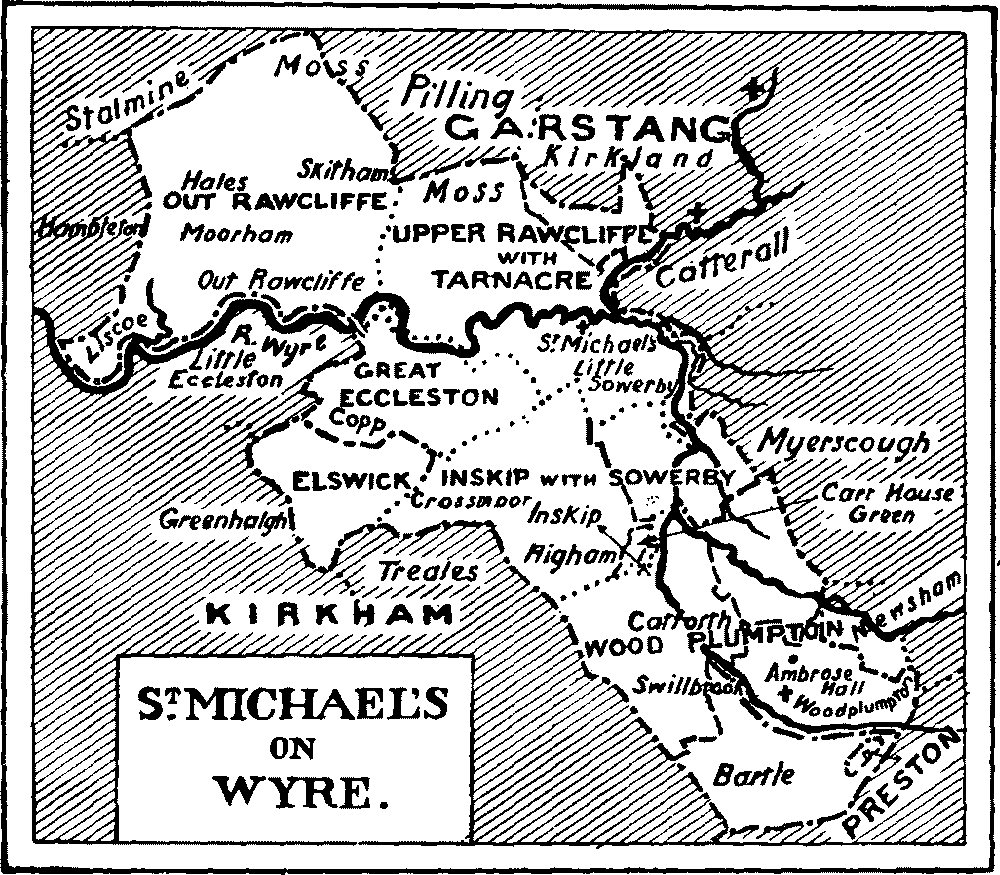
STMICHAEL'S ON WYRE.
The building is substantially of 15 th and early 16thcentury date, but there may be portions of an older structure in the north wall of the chancel and at the west end of the south aisle adjoining the tower, the masonry of which may date from the 13th century. The evidence of the building, however, is not sufficient to make it possible to trace the development of the plan or to arrive at any conclusion as to the extent and appearance of the earlier structure, except that its length must have been about the same as that of the present building. On the north chancel wall the older masonry, which is of red sandstone, includes a buttress 2 ft. 6 in. wide with a 10 in. projection, and at the west end of the south aisle the fragment of old walling, which is 3 ft. 6 in. wide and stands 6½ in. in front of the later wall, has been pierced by a pointed window 2 ft. 9 in. high and 12 in. wide, now built up. The present plan is that of the 15th-century building, but there is said to have been a restoration or partial rebuilding in 1549, (fn. 9) when the tower is said to have been erected and new bells purchased. The tower seems to have been rebuilt or refaced in 1611 by Henry Butler, whose arms and initials together with the date are carved on the north-west merlon of the parapet facing west. The north chapel, originally the chantry of St. Katharine, was repaired in 1797, and in 1854 the church was reseated and some restorations carried out, the old square pews being taken away and the whitewash removed from the arches and columns of the nave. (fn. 10)
The chancel and nave are under one continuous blue-slated roof and the south aisle has a separate gabled slated roof finishing behind an embattled parapet. The walls are generally constructed of rubble masonry with sandstone dressings, the whole of the parapet of the south aisle, together with its eastern gable, being of dressed stone.
The east wall of the chancel, however, is built of red sandstone blocks and may be a 17th-century reconstruction. The east window is of three trefoiled lights with perpendicular tracery and moulded jambs and mullions with a very slight reveal and without hood mould. On the south side the chancel is open to the aisle by two wide arches, but there is a 5 ft. 6 in. length of straight wall at the east end in which is a piscina with cinquefoiled head and chamfered jambs, now only 19 in. from the floor and without bowl, and on the east wall to the north of the window is a plain stone bracket. The north wall sets back 6 in. at a distance of 7 ft. 3 in. from the east, forming a slight recess about 9 ft. long, to the west of which is a modern two-light traceried window. Before the erection of the vestry there was a second window to the eastward, the position of which may still be seen in the plastered wall within the recess, of which part of the external hood mould remains. The arrangements of the sanctuary being altered in 1907 necessitated the vestry door being pushed further westward and a skew passageway being formed through the wall. There is no chancel arch or screen and no distinction between the chancel and the nave, except in the construction of the roof, which in the chancel is boarded and consists of three bays with plain king-post trusses, the tie-beams cutting across the top of the east window. The same roof is continued over the nave with collared principals and shaped wood brackets on stone corbels, and is of seven bays plastered between the trusses and with three modern dormer windows on the south side.
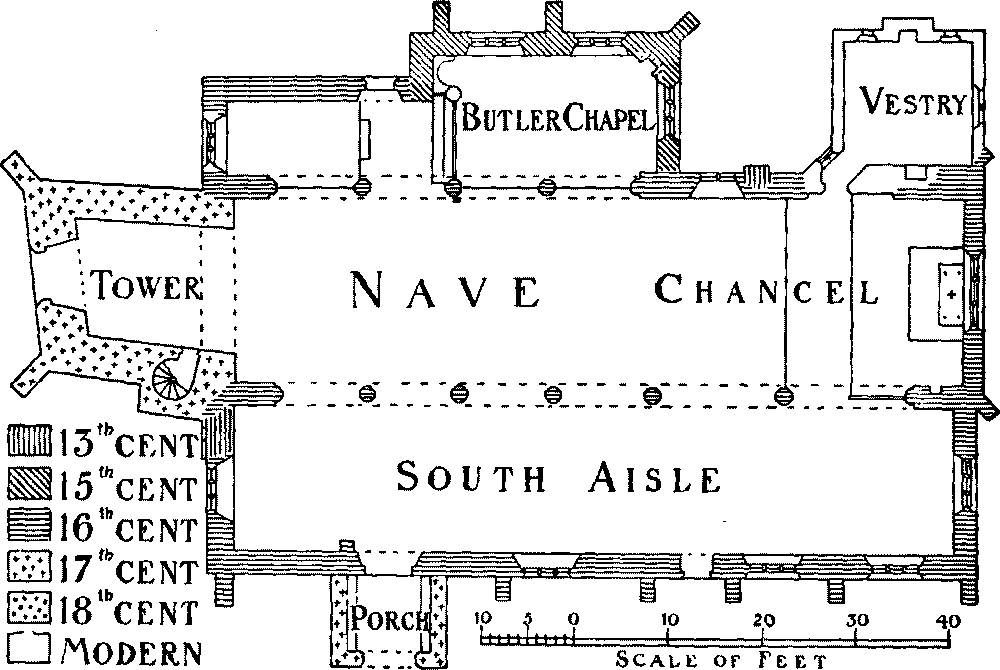
Plan Of St. Michael's Church
The south arcade consists of six pointed arches of two chamfered orders springing from octagonal piers, 1 ft. 8 in. diam., with moulded capitals and bases and from responds at ends. The two easternmost arches to the chancel are wider than those to the nave, the piers are thicker and the detail of the capitals different, but they appear to have been built at the same time. The north arcade consists of four pointed arches on octagonal piers similar to those on the south side, the capitals only slightly differing in detail. The piers are 5 ft. 6 in. in height to the top of the capitals, the height of the arches above being 10 ft. 2 in. to the crown. There is a 4 ft. length of blank wall at the west end of the nave on the north side and the whole of the interior walling is plastered. The windows of the south aisle are all square-headed, of three lights with external hood mould, (fn. 11) and are probably of 16thcentury date. There are two windows and a priest's door to the chancel aisle and a single window and doorway to the nave. The east window of the aisle has a four-centred head with three pointed lights and hollow-chamfered mullions and the west window is modern.
The porch, which is dated 1611, stands 12 ft. from the west end of the aisle, and is built of wrought stone with a blueslated overhanging roof and segmental outer arch. It is very plain in character and small in size, measuring only 8 ft. 3 in. by 8 ft. 11 in. wide, and has a seat on each side.
The north aisle proper is confined to the two western bays of the nave, beyond which, to the east, it is merged into the chantry chapel. Its west end, which now forms the baptistery, is lighted by a modern three-light segmental-headed traceried window, and has a pointed north door opposite the second bay. The wall west of the doorway is occupied by a modern Gothic memorial to members of the Swainson family, and the floor of the baptistery is raised two steps above that of the nave. The aisle roof is a continuation of that of the nave, with low overhanging eaves.
The Butler chapel, or St. Katharine's chantry, is now seated with modern pews and open to the nave, but at the west end is separated from the aisle by an ornate early 19th-century Gothic screen, said to have been made at Lancaster and bearing the arms of the France and Wilson families. (fn. 12) The floor is boarded and raised two steps above that of the nave, and the chapel is covered with a separate low-pitched gabled roof with flat plaster ceiling, the latter probably introduced in 1797. At this time, too, a fireplace was built in the north-east corner, and is still in position though bricked up. There are two segmentalheaded windows on the north side, each of three cinquefoiled lights and trefoiled tracery, and at the east end a taller three-light window of similar type with perpendicular tracery. (fn. 13) On the exterior, which is almost entirely covered with ivy and has a modern straight parapet and two square buttresses and a diagonal one at the north-east corner, is a shield with the arms of Butler. The chapel contains no monuments, but on a framed board at its west end is an escutcheon with the arms of Roe of Rawcliffe, with helm, crest, mantling and motto.
The tower is faced with large wrought sandstone blocks and is very irregular in shape, the west and south walls being at an obtuse angle. It has a projecting vice in the south-east corner and diagonal buttresses of five stages finishing below the belfry stage, which is slightly set back with a plain splay. The belfry windows are of two flat trefoiled lights without hood mould, and have slate louvres, and the tower finishes with an embattled moulded parapet, angle pinnacles and leaded roof, the height to the top of the parapet being 46 ft. 6 in. The west door has a four-centred head of two hollow-chamfered orders and hood mould, and above is a three-light segmental-headed transomed window of poor detail, with plain chamfered jambs and mullions and rounded heads to the lights. There is a clock on the east and west sides, but the north and south sides are plain except for the belfry windows and a square opening immediately below. The date 1611 on the parapet is probably that of the whole of the external walling, if not of the entire rebuilding of the tower. The tower arch is of two chamfered orders placed high up above the roof principals, obtuse and awkward in shape.
All the fittings, including the font and pulpit, are modern, but there are fragments of ancient glass in the north chancel window and westernmost window of the chapel, the former heraldic and the latter a circular piece with a picture of sheep-shearing, one of a former series representing the months or seasons. (fn. 14)
There is a ring (fn. 15) of three bells, the first dated 1652, with a long inscription in Gothic letters difficult to decipher. The second bell is dated 1663 and inscribed 'God save the King,' and with various initials, and the third is by Abel Rudhall of Gloucester, 1742.
The plate consists of two silver chalices of 1792, with the arms of Wilson impaling France, two silverplated patens and a plated flagon. (fn. 16)
The register of baptisms begins in 1659 and those of marriages and burials in 1662. From 1659 to 1707 the registers have been printed. (fn. 17)
The churchwardens' accounts begin in 1667.
In the churchyard is a sundial, the plate dated 1796 and bearing the names of the Rev. Hugh Hornby, vicar, and of five churchwardens. The oldest dated gravestone is 1667.
Advowson
At the Conquest the church was no doubt in the gift of Earl Tostig as lord of Amounderness. No change seems to have been made afterwards, so that Theobald Walter, when lord of the wapentake, 1190 to 1200, had this advowson also, for he gave the church of St. Michael with all its appurtenances to the Abbot and monks of Wyresdale in alms; they were to appoint a vicar with a portion sufficient for his maintenance. (fn. 18) The monks accordingly appointed one H. to the charge, allowing him the land to the east of the church with the fishery there and half a mark yearly. They also undertook to provide a clerk to assist him. (fn. 19)
The monastery was transferred to Ireland, and the gift of the church appears to have lapsed, for when in 1203–4 lt: was alleged that Garstang was a chapel pertaining to St. Michael's the patron was the king. (fn. 20) From that time the advowson remained with the honour of Lancaster (fn. 21) until 1409, when Henry IV gave it to the newly-founded college of St. Mary Magdalen at Battlefield near Shrewsbury. (fn. 22) A vicar was appointed in 1411, on the death of the last rector. (fn. 23) When the college was suppressed with other chantries in 1546–8, the rectory and advowson were taken by the Crown, and after minor grants (fn. 24) the rectory was in 1611 sold to Francis Morrice and Francis Phillips of London, but the advowson was reserved. (fn. 25) This, however, with the rectory soon afterwards became the property of William Johnson. (fn. 26) After various sales the advowson came into the possession of the Rev. Hugh Hornby, vicar from 1789 to 1847, and it has descended to his grandson the present patron, Mr. Hugh Phipps Hornby. (fn. 27)
In 1216–26 the rectory, then in the king's gift, was valued at 30 marks yearly, (fn. 28) but not long afterwards, in 1246, it was said to be worth 70 marks. (fn. 29) The value continued to increase, and in 1291 was recorded as £66 13s. 4d., (fn. 30) but this after the raid of the Scots in 1322 was reduced to little more than a third, viz. £23 6s. 8d. (fn. 31) This valuation was confirmed in 1341. (fn. 32) In 1527 the rectory, appropriated to Battlefield College, was valued at £20 a year and the vicarage at £8. (fn. 33) Some eight years later, however, the farmers of the rectory paid £31 1s. 4d. to the college, (fn. 34) while the vicarage was worth £10 17s. 6d. clear. (fn. 35) By 1650 the value of the vicarage had increased to £50 a year, (fn. 36) but about 1717 was certified as £44 10s. (fn. 37) The vicar and patron in 1816 obtained an Act of Parliament to commute the vicarial tithes, &c., for a corn rent, securing a dear annual income of £700, (fn. 38) and the net value is now given as £584 a year. (fn. 39)
The following have been rectors and vicars:—
| Rectors | |||
|---|---|---|---|
| Instituted | Name | Patron | Cause of Vacancy |
| c. 1196 | H. (fn. 40) | Wyresdale Abbey | — |
| oc. 1204 | Mr. Matthew the Physician (fn. 41) | — | — |
| c. 1216 | Mr. Macy (fn. 42) | King John | — |
| c. 1224 | William of Savoy (fn. 43) | Henry III | — |
| 15 Oct. 1227 | Mr. William de Avignon (fn. 44) | " | prom. — of Savoy |
| 15 Nov. 1227 | Mr. Henry de Bishopston (fn. 45) | " | " |
| 6 Mar. 1237–8 | Mr. Peter de Aqua Blanca (fn. 46) | " | ? " |
| oc. 1246 | James de Monasteriis (fn. 47) | — | — |
| 19 Feb. 1264–5 | Richard le Rus (fn. 48) | Henry III | — |
| oc. 1289–95 | Walter de Langton (fn. 49) | — | — |
| oc. 1294 | Thomas son of Alan (fn. 50) | — | — |
| oc. 1312 | Simon de Balderston (fn. 51) | — | — |
| oc. 1322–60. | William de Balderston (fn. 52) | — | — |
| oc. 1367–88 | William de Hornby (fn. 53) | — | — |
| 1 Mar. 1390 | Thomas de Herdwick (fn. 54) | — | — |
| Vicars | |||
| oc. 1428 | Richard Raby (fn. 55) | — | — |
| 5 June 1444 | Thomas Wainwright (fn. 56) | Battlefield Coll | d. R. Raby |
| oc. 1451–2 | Peter (fn. 57) — | — | — |
| 18 June 1463 | William Houghton (fn. 58) | Battlefield Coll | — |
| oc. 1504–8 | Robert Richardson (fn. 59) | — | — |
| oc. 1509–30 | John Preesall (fn. 60) | Battlefield Coll. | — |
| [1532 | Robert Hill | " ] | — |
| 1535 | Christopher Gradell (fn. 61) | Exors. Bp. Blythe. | d. J. Preesall |
| 23 Sept. 1537 | Michael Thornborow (fn. 62) | Battlefield Coll. | d. C. Gradell |
| 16 July 1549 | Thomas Cross (fn. 63) | G. Kirkby, &c. | d. M. Thornborow |
| 27 June 1577 | Adam Wolfenden (fn. 64) | The Queen | d. T. Cross |
| 31 Dec. 1628 | Nicholas Bray (fn. 65) | William Johnson | res. A. Wolfenden |
| 8 May 1629 | The King | ||
| oc. 1651–2 | Henry Jenny, M.A. (fn. 66) | — | — |
| 16 Feb. 1658–9 | Nathaniel Baxter, M.A. (fn. 67) | Alex. Johnson | — |
| 5 Mar. 1663–4 | John Greenwood (fn. 68) | — | exp. N. Baxter |
| 25 Feb. 1668–9 | Thomas Robinson, B.A. (fn. 69) | William Johnson | — |
| 29 Feb. 1715–16 | Richard Crombleholme (fn. 70) | Thomas Clitherall | d. T. Robinson |
| 14 June 1729 | William Crombleholme (fn. 71) | Edw. Crombleholme. | d. R. Crombleholme |
| 24 Sept. 1765 | Robert Oliver, M.A. (fn. 72) | Richard Whitehead | d. W. Crombleholme |
| 2 Aug. 1768 | Anthony Swainson, M.A (fn. 73) | " | res. R. Oliver |
| 14 July 1784 | Charles Buck, M.A. (fn. 74) | John Swainson | d. A. Swainson |
| 19 Oct. 1789 | Hugh Hornby, M.A. (fn. 75) | Joseph Hornby | res. C. Buck |
| Mar. 1847 | William Hornby, M.A. (fn. 76) | William Hornby | d. H. Hornby |
| 15 Sept. 1885 | Phipps John Hornby, M.A. (fn. 77) | " | res. W. Hornby |
This list of clergy does not call for any comment, though one or two of the early rectors were men of eminence. The service of the parish church, chantries and chapelries before the Reformation would require a staff of at least five priests. The list of 1548 does not seem to have been preserved, (fn. 78) but in 1554, and again in 1562, three names are entered in the Bishop of Chester's visitation list. (fn. 79) Afterwards there were apparently only the vicar at the parish church and the curate at Woodplumpton. (fn. 80) Copp chapel was added in 1723. A religious census was made in 1755, when the vicar and churchwardens recorded the 367 families in the parish (apart from Woodplumpton) thus: Church of England, 297; Protestant Dissenters or Presbyterians, 26; Quakers, 3; Papists, 41. (fn. 81)
There were two endowed chantries. One was founded by John Boteler of Out Rawcliffe (d. 1534) at the altar of St. Katharine in the north aisle of the church. (fn. 82) The priest was to celebrate for the souls of the founder and others and to teach a grammar school. The clear revenue at the confiscation in 1547–8 was £5 10s. 8d., derived from lands in Great and Little Eccleston, Esprick and Staynall Mill. (fn. 83) The other chantry, of the B.V. Mary, was founded by William Kirkby of Upper Rawcliffe, and had an endowment of £4 13s. 10d. (fn. 84) A gift of land in Great Sowerby, made by Thomas Urswick in 1423 for the support of a chaplain in the parish church, (fn. 85) may have become merged in the general endowment.
The old grammar school was destroyed with the chantry, and the next schools were not founded till the beginning of the 18th century.
Charities
Official inquiries as to the endowed charities of the parish were made in 1824 and 1898, and the report of the latter (fn. 86) contains also a reprint of the former report. It appears that the gross income is £303 a year, but £104 is devoted to the schools and £67 to ecclesiastical purposes. It is singular that there are no funds for apprenticing children and no almshouses. For the whole parish there is an ancient bread charity of £2 yearly, distributed after morning service at the parish church on the second Sunday of the month in 'cobs' of bread.
For the poor of Great Eccleston there are sums of £3 17s. 6d. from the benefactions of William Gualter, (fn. 87) Jonathan Dobson (fn. 88) and William Fyld, (fn. 89) distributed in money doles, (fn. 90) and £1 from Ellen Longworth for bread for the poor attending Copp Church. (fn. 91) Elizabeth Hoole or Hull gave about 2 acres of meadow in Elswick to the Roman Catholic chapel in Great Eccleston, charging it with the payment of £3 a year to the poor of Elswick. (fn. 92) This sum is distributed by the parish council in money gifts at Christmas.
Thomas Knowles of Sowerby in 1686 gave his estate at Loudscales in Goosnargh for the benefit of the poor of Great and Little Sowerby, Inskip, Tarnacre and Goosnargh, in equal shares. The gross rental is £90. Three-fourths of the net income, about £82, is divided equally between Inskip with (Great) Sowerby and Upper Rawcliffe with Tarnacre (which includes Little Sowerby). The money is given by the trustees in doles averaging about 14s. in December. (fn. 93) For Inskip with Sowerby there is a further money dole of £16 18s., due to the gift of John Jolly in 1750, (fn. 94) and for Upper Rawcliffe with Tarnacre other doles of £2 10s. from Ralph Longworth (fn. 95) and £2 from John Hudson. (fn. 96) In Out Rawcliffe £1 1s. a year used to be given, but had ceased by 1824. (fn. 97)
The township of Woodplumpton has £23 18s. 4d. a year from the benefactions of Thomas Houghton (fn. 98) and George Nicholson, (fn. 99) applicable in kind, or in medical relief, money gifts or education. It has also £8 15s. a year, given in money, from the bequest of Richard Edward Waterworth in 1850. (fn. 100)