A History of the County of Hampshire: Volume 4. Originally published by Victoria County History, London, 1911.
This free content was digitised by double rekeying. All rights reserved.
'Parishes: Liss', in A History of the County of Hampshire: Volume 4, ed. William Page (London, 1911), British History Online https://www.british-history.ac.uk/vch/hants/vol4/pp84-86 [accessed 30 April 2025].
'Parishes: Liss', in A History of the County of Hampshire: Volume 4. Edited by William Page (London, 1911), British History Online, accessed April 30, 2025, https://www.british-history.ac.uk/vch/hants/vol4/pp84-86.
"Parishes: Liss". A History of the County of Hampshire: Volume 4. Ed. William Page (London, 1911), British History Online. Web. 30 April 2025. https://www.british-history.ac.uk/vch/hants/vol4/pp84-86.
In this section
LISS
Lysse (xii cent.); Lys, Leys (xiii cent.); Lyss, Lyshe, Lisse (xiv cent.).
The parish of Liss lies on the borders of Sussex 4 miles north of Petersfield. It is intersected by the London and South Western Railway which has a station in the parish. The River Rother entering the parish at Greatham Bridge flows for some distance east, and then directs its course centrally through Liss, dividing it into East Liss on the one side and West Liss on the other. Further south it is met by Batt's Brook flowing from the west. By the Rother the average height above the ordnance datum is 200 ft., but both towards the east and west the ground rises, heights of 500 ft. and 463 ft. respectively being attained at Hill Brow in the east and at Wheatham Farm in the west. West Liss with the ancient church of St. Peter and the rectory lies on the main road from Farnham to Petersfield which runs through the west of the parish. The modern church of St. Mary and the Sunday school built on land given by Mr. W. Nicholson of Basing Park are situated in the centre of the parish to the west of Station Road which leaves the main road at Upper Green, and then runs southeast to the station, East Liss and Lower Green. Liss Place, situated about a quarter of a mile west of West Liss, is the residence of Mr. H. P. Papillon. Stodham House in the south of the parish, the seat of Mr. Hugh Money-Coutts, is a modern mansion built of stone with grounds of 65 acres bounded by the Rother. The Wylds in the north is the residence of Mr. Robert Henderson, and there are many other modern houses scattered through the parish, particularly at Hill Side and Hill Brow in the east on the Sussex border. Woolmer Forest extends into the north-east of the parish. The area of the parish is 3,595 acres of land and 24 acres of land covered by water, the soil being a good sandy loam with a subsoil of gravel and sand. The chief crop is wheat, and the farmers send large quantities of milk to the London market. According to the Agricultural Returns of 1905 the parish contains 784½ acres of arable land, 2,079 acres of permanent grass, and 385½ acres of woods and plantations. Some of the place-names occurring in records of Liss are:—La Lamputte (fn. 1) (xiii cent.); Rihullemersche, Cuttelane, Crockerislond (fn. 2) (xiv cent.); Newemylle Brygge, Whetehamyslond (fn. 3) (xv cent.); Kyppynges, Holmelond, Pancraslane, Colmannysmore, (fn. 4) Barne Place, (fn. 5) Twyll Acre, Olde Hall, (fn. 6) Combers, Hyllond, Chesterland, Hodyslond, Cydyhalefyld, Verny Hill, Pupeholemeade, Shafterlond, (fn. 7) Harleys Close, The Well House, (fn. 8) Le Hurst, Middlewood and Wolches (fn. 9) (xvi cent.).
Manors
The manor of LISS, afterwards known as the manor of LISS ABBAS or LISS ABBESS, was reckoned in the hundred of Meonstoke at the time of the Domesday Survey, and probably formed part of the original endowment of the abbey of St. Mary, Winchester. (fn. 10) The abbess and nuns continued in possession of the manor until the Dissolution, (fn. 11) when it was taken into the hands of the king, being then of the annual value of £7 8s. 9d. (fn. 12) From this time it apparently remained Crown property until 1610, (fn. 13) when James I granted it to George and Thomas Whitmore, together with the manor of Liss Turney, which had belonged to the Earl of Hertford. (fn. 14) After this grant to the Whitmores, Liss Abbess and Liss Turney appear to have followed the same descent (q.v. infra).
The manor of LISS, afterwards known as LISS TURNEY, (fn. 15) apparently formed part of the great royal manor of Odiham until the reign of Henry II, who granted it as twelve pounds worth of land to William de Bendeng. (fn. 16) On William's death he was succeeded by Adam de Bendeng, (fn. 17) who died seised in 1229. (fn. 18) His heir was his son Walter, who died three years later, leaving a son William under age, who was committed to the guardianship of Walter de Faukenberge; (fn. 19) William, however, died while still under age in 1234, and his lands then passed to his paternal aunt Maud, who had married Geoffrey Stunny. (fn. 20) From this date the manor continued in the Sturmy family (fn. 21) until 1426–7, (fn. 22) when William Sturmy died, leaving as his heirs a daughter Agnes, married to John Holcombe, and a grandson John Seymour, son of a deceased daughter Maud. (fn. 23) The estate of Liss was thereupon divided into two portions. Agnes, who at this time had a son of a previous marriage, William Ryngebourne, still living, held with her husband John Holcombe the one moiety, (fn. 24) which reverted to Robert Ryngebourne, her grandson, on the death of John Holcombe in 1455. (fn. 25) William Ryngebourne, brother of Robert, was the next to hold, (fn. 26) and as he had no sons alive in 1511, his grandson Thomas Bruyn inherited from him. (fn. 27) The estate next appears in the possession of the Harley family, but in what way this family acquired it is unknown. John Harley dealt with it by fine in 1541, (fn. 28) and was succeeded by his son of the same name, who sold it as the manor of Liss or Liss Harley to Nicholas Dering in 1546. (fn. 29) The Dering family held for the next sixtysix years consecutively, (fn. 30) and probably acquired the second moiety of the manor of Liss Turney (q.v. infra) and the manor of Liss Abbess meantime, since the next record is a sale in 1612 by Henry Dering to his nephew Thomas Cole of the manor of Liss alias Liss Harley alias Liss Sturmy, with all its rights, members, and appurtenances in the parish of Liss. (fn. 31)
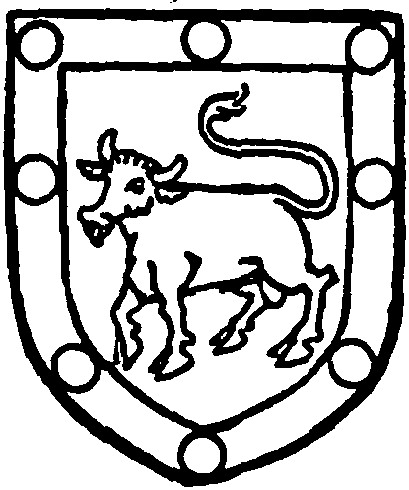
Cole of Liss. Argent a bull passant sable in a border sable bezanty.
The history of the second moiety during the same period is as follows:— It passed, as has been stated, to John Seymour, and from that date the descent in the male line of the Seymour family was probably unbroken till the time of Sir Edward Seymour, who became Duke of Somerset and Lord Protector. In 1541 Henry VIII granted him the monastery of Amesbury (co. Wilts.) and various other possessions in exchange for several of his Middlesex and Hampshire manors, among which was the manor of 'Listurmy.' (fn. 32) From this date this moiety continued in the possession of the Crown until 1610, (fn. 33) when James I granted it with Liss Abbess to George and Thomas Whitmore. (fn. 34)
So much for the moieties singly. Henceforth the manor is dealt with as a whole. In 1726 Charles Cole dealt with it by fine, (fn. 35) and by his will of 1752 he devised the manor of Liss with its rights, members, and appurtenances, (fn. 36) to Mary his wife for her life, with remainder to his cousin Herbert Aubrey for life, with remainder to the four daughters of Herbert Aubrey, Elizabeth, Judith, Arabella and Anne for their lives, with remainder in fee-tail to Harcourt Aubrey. (fn. 37) The manor was settled upon Richard Aubrey Cole, the only son and heir of Harcourt Aubrey, in 1783, (fn. 38) and continued in the possession of his family until 1807, when it was purchased by Thomas Fitzpatrick. Sir Charles William Taylor, who became the owner in 1809, held it until about 1866, when he sold it to Sir John Hawkshaw, whose trustees are now lords of the manor. (fn. 39)
Henry Sturmy obtained a grant of free warren in Liss in 1359. (fn. 40) A mill in Liss was the subject of a fine between Nicholas Braunche and Reginald de Pavely in 1304, (fn. 41) and between John Hill and John Irlond and Alice his wife in 1445. (fn. 42) A water-mill was included in the sale of the manor of Liss Harley to Nicholas Dering in 1546, (fn. 43) and its site is probably marked at the present day by the mill worked by the stream which flows into the Rother, a short distance north of the station.
The abbot and convent of Dureford (co. Sussex) had from an early date an estate in this parish. They acquired 20 acres of land, 2 acres of meadow, 80 acres of heath, and 12d. rent in Mapledurham and Liss Turney from Roger de Petersfield in 1339, (fn. 44) and in 1341 it was stated that they had 100 acres of arable land in Liss worth 25s. yearly. (fn. 45) At the Dissolution these lands were taken into the hands of the king, (fn. 46) who granted them in 1537 to Sir William Fitz William, (fn. 47) afterwards created Earl of Southampton. At the death of the earl without issue in 1542, the estate reverted to Henry VIII, and was granted by him in 1545 to George Rithe and others. (fn. 48) In 1586 Robert Rithe sold his mansion house in Liss, a messuage called the Well House, and lands in Liss, to Sir Richard Norton, (fn. 49) who the following year conveyed them to Richard Kingswell. (fn. 50) There is no further record of these lands.
Churches
The church of ST. PETER consists of a chancel 18 ft. 3 in. by 13 ft. 1 o in. with a recess on the north side for the organ, a nave 34 ft. by 18 ft. 9 in. with a south aisle 12 ft. 4 in. wide, and a west tower 10 ft.square; all the measurements being internal.
The west tower dates from the first half of the 13th century, and was no doubt set centrally with the nave then existing. An aisle was added on the south side of the nave late in the same century, and in the 15 th century the nave was widened by pulling down its north wall and rebuilding it some feet further to the north. In 1639 the south porch was built, and the south aisle was probably widened at the same time. The east and south walls of the chancel have been rebuilt, and the greater part of the north wall, in modern times, and the south wall of the aisle was rebuilt in 1869. Only the lower part of the south porch is of 17th-century work, the rest being of considerably later date.
The east window of the chancel is modern, and has three lancet lights, the centre one being higher than the others. There is only one north chancel window, and that is a small plain pointed light, perhaps of 13th-century date, but much restored. The wall in which it is set is thicker than the east and south walls of the chancel, and is probably old, in which case it must date from the 15 th century, when the church was widened northwards, and the window must have been reset in it. The organ recess is entirely modern, and takes up the greater part of the north side of the chancel.
The two windows in the south wall of the chancel are modern single-pointed lights in 13th-century style.
The chancel arch must date from the 15th-century widening of the church, and has square jambs, the southern one having been cut back just below the springing, in corbel fashion; the arch is two-centred, and has two chamfered orders which die into the jambs.
The eastern window in the north wall of the nave has three lights under a two-centred head, and is 15th-century work, a good deal altered. The middle light is trefoiled, but in the two side lights the cusping is destroyed.
The second window, also of 15th-century date, is better preserved, and has three cinquefoiled lights and a traceried head, and between the two windows is a 15th-century blocked doorway which has moulded jambs and a two-centred head with a label.
The arcade between the nave and the aisle is of three bays with octagonal columns which have splayed bases and moulded capitals of late 13th-century date, and arches of two chamfered orders.
The east window of the aisle has three lights with moulded jambs and mullions, with four-centred uncusped heads under a square lintel; the west window is similar to this, but has square-headed lights and a transom, which is a modern restoration. Both are of 17th-century date, while the two south windows are single trefoiled lights, and date from 1869. Between them is a late 13th-century south doorway, which has filleted engaged shafts and wave-moulded jambs with a two-centred arch. The shafts have moulded capitals and modern bases, the arch-mouldings dying out on a vertical face above the capitals.
The tower opens to the nave by a small doorway having chamfered jambs and drop arch, and has in its north wall a small, square-headed 13th-century light, and above it a small pointed light of the same date. In the west wall is a modern doorway with a wooden frame, the head of which cuts into another small 13th-century lancet window.
The tower walls are mostly built of a dark-brown ironstone, and the modern top stage is of timber with a low shingled octagonal spire, and makes a very pretty finish to the tower.
The chancel walls and the west wall of the aisle are faced with the same ironstone as the tower, while the east wall of the aisle is faced with chalk. The north wall of the nave is of plastered flint-work, and all the modern walling is of local stone. The roofs are tiled and their timbers for the most part modern, but midway in the centre of the nave is an old tie-beam, which projects right through the wall above the arcade. The internal fittings are modern except the octagonal font, which is of 15th-century date, with quatrefoils in each face of the bowl, and an octagonal stem and moulded base.
At one time there were galleries at the west ends of the nave and aisle, but they have been removed.
In the churchyard are a number of mediaeval coffin slabs, most of them having double hollow-moulded edges, and all of them have crosses with foliate ends to the arms, and stepped bases. The churchyard is inclosed with oak palings, and is entered on the east and south sides. Besides a very large yew tree on the north side, there are many small fir, cypress, and yew trees.
The tower contains six bells, the treble of which was added in commemoration of the 1897 Jubilee, and was cast by Mears & Stainbank; the others are by Lester & Pack, 1753.
The plate consists of a silver chalice of 1876; a paten of 1875, another of 1828 the gift of the Bishop of Carlisle, another of 1761 given with a flagon of the same date by Mary Cole widow of Charles Cole of Liss in 1762; a chalice, paten and flagon of 1892, and two glass cruets.
The first book of the registers contains all entries between 1599 and 1737; the second contains baptisms from 1737 to 1786; the third burials from 1681 to 1785; the fourth marriages from 1754 to 1812: and the fifth baptisms and burials from 1785 to 1813.
Liss also possesses another church, or chapel of ease, of ST. MARY, which was built in 1892 from the designs of Sir A. Blomfield. It consists of a chancel with a north transept for the organ and a vestry, and a nave with north and south aisles and a north porch. The west end of the nave is temporary, and its extension is intended at some future date.
The building is in plain 13th-century style, built of local stone with dressed quoins, &c, and lined inside with brick. The arcades have circular brick columns, and the roofs are tiled.
The bells are hung over the west gable.
Advowson
Liss Church was probably one of the two churches held by two priests of the manor of Odiham at the time of the Domesday Survey. (fn. 51) It was granted by King Stephen, with the churches of Bentworth and Odiham, to the use of the master of the Choristers' School of Salisbury and the chancellor of the cathedral, whose duty it was to superintend the schools of the chapter. (fn. 52) At a subsequent date Liss was attached to the church of Odiham, and although so far distant was served from there until 1867, (fn. 53) when the benefice was declared a rectory in the gift of the Bishop of Winchester. (fn. 54) The living is now of the net yearly value of £230, with 6¾ acres of glebe and residence.
There is an iron mission hall at Hill Brow. The Wesleyans have a chapel at East Liss, and the Plymouth Brethren a meeting-house at West Liss.
The Board Schools were erected in 1872, and enlarged in 1878 and again in 1888.