A History of the County of Hampshire: Volume 4. Originally published by Victoria County History, London, 1911.
This free content was digitised by double rekeying. All rights reserved.
'Parishes: Boldre', in A History of the County of Hampshire: Volume 4, ed. William Page (London, 1911), British History Online https://www.british-history.ac.uk/vch/hants/vol4/pp616-623 [accessed 30 April 2025].
'Parishes: Boldre', in A History of the County of Hampshire: Volume 4. Edited by William Page (London, 1911), British History Online, accessed April 30, 2025, https://www.british-history.ac.uk/vch/hants/vol4/pp616-623.
"Parishes: Boldre". A History of the County of Hampshire: Volume 4. Ed. William Page (London, 1911), British History Online. Web. 30 April 2025. https://www.british-history.ac.uk/vch/hants/vol4/pp616-623.
In this section
BOLDRE
Boore (xi cent.); Bolre (xiii cent.).
Boldre is a large parish in the New Forest extending inland 3 miles north of the Solent, containing 10,370 acres of land, of which 63 are covered with water. (fn. 1)
The Beaulieu River forms the eastern boundary of the parish, while the western boundary is formed for some distance by the Boldre or Lymington River, which is tidal as high as Vicars Hill. This river flows through the centre of the village, rendering it at times liable to floods. The Lymington branch of the London and South Western Railway crosses the parish in the extreme west, but the nearest station is Brockenhurst, 2½ miles distant.
The church, in which Southey married his second wife, Catherine Bowles, is a picturesque old building situated in an isolated spot a mile from the village. John Kempe, one of the members of the Long Parliament, is buried in the church. The Rev. William Gilpin, ancestor of William Sawney Gilpin, the first president of the Water Colour Society, was vicar at Boldre from 1771 to 1804. He established schools in Boldre for twenty boys and twenty girls and endowed them with the proceeds of the sale of his drawings and sketches. Dr. William Arnold Bromfield, the botanist, was a native of Boldre. The Rev. Charles Kingsley, father of Charles Kingsley, the author, lived at Battramsley House.
Among houses to be noticed in the parish are Boldre Grange, the residence of Mr. John Lane Shrubb, from which views of the Solent may be obtained; Warborne House, belonging to Mr. David Jones, J.P., with 300 acres attached; Vicars Hill, occupied by Mr. Edward Henry Pember, K.C., J.P.; and St. Austins, the residence of Mr. Keppel Pulteney. Walhampton House is the property and residence of Miss Morrison. George III visited Walhampton in 1804 and dined with Sir Harry Burrard Neale. One of the old houses in the village, the date of which, 1692, is cut in a stone tablet in one of the rooms, has been described by a modern writer as 'a small old picturesque red brick house with high pitched roof and tall chimneys, a great part of it overrun with ivy and creepers, the walls and tiled roof stained by time and many coloured lichen to a richly variegated red. . . . In the front there is no lawn, but a walled plot of ground with old ornamental trees and bushes symmetrically placed— yews, both spreading and cypress shaped, Irish yew and tall tapering juniper and arbor vitæ . . . . a sort of formal garden which has thrown off its formality.' (fn. 2)
Crops of wheat, barley and oats are grown on the 1,893 acres of arable land, 1,647 acres consist of pasture land, and there are 2,257 of woodland. (fn. 3) The soil is clay and loam, the subsoil gravel.
East Boldre, 5 miles east from Lymington, is an ecclesiastical parish formed in 1840 from the civil parish of Boldre. It contains 84½ acres of arable land and 59¾ acres of permanent grass. (fn. 4)
South Baddesley is an ecclesiastical parish, consisting of 3,000 acres, formed in 1859 from the civil parish of Boldre, and it includes the hamlets of East End Norley, Pitts Deep and Lisle Court. From Pylewell Park, consisting of 228 acres, the residence of Mr. William Ingham Whitaker, the lord of the manor, good views of the Solent may be obtained. Newton Park is the seat of Mr. Jules Duplessis.
Sway, consisting of 2,208 acres, was formed in 1839 from the civil parish of Boldre, and in 1879 was made a separate parish for all purposes. There is a station on the London and South Western Railway. There are 635 acres of arable land, 527¼ acres of permanent grass and 27 acres of woods and plantations. (fn. 5) Sway House is the residence of Mrs. Hagen, The Mount of Lord Arthur Cecil, and Shirley Holmes of Col. William Henry Burton, R.E.
Manors
At the Conquest two manors called BOLDRE were held by a certain Pagen, as they had been held by two allodial owners in the time of the Confessor. (fn. 6) This land, with the exception of 6 acres of meadow held by Hugh de Quintin, was taken by the Conqueror into the New Forest, and no further mention of a manor is found.
In 1236 Henry III granted 50 acres of heath round Boldre to the monastery of Breamore in compensation for the loss they had suffered by the foundation of the abbey of Beaulieu. With the grant went the right to inclose the same and hold it 'free of view of foresters saving the king's venison.' (fn. 7)
Before the Conquest 1 hide in Boldreford, assessed at £10, was held by Wislac of the king. It was taken into the forest, except 2 acres of meadow which Hugh de Quintin held. This has been identified by Mr. Moens as The Shallows, south of Boldre Bridge and about a mile above Lymington. There is still a ' Boldreford Bridge' two or three miles up-stream beyond Brockenhurst. (fn. 8)
In 1086 SOUTH BADDESLEY was held as 1 hide by Durand of Earl Roger of Shrewsbury, as it had been held by Suarting in the time of the Confessor. (fn. 9) It no doubt escheated to the Crown on the forfeiture of the estates of Robert of Bellesme, son of Earl Roger, in the reign of Henry I, and from this date the overlordship followed the descent of the manor of Lyndhurst until the end of the 14th century.
The first record of Baddesley after the Survey is early in the reign of Henry III, when Geoffrey de Baddesley was stated to be holding half a carucate of land in Baddesley and Fritham by a rent of 60s. (fn. 10) This probably included the manor of Baddesley. Some time during the next century, however, it passed to the family of Welles, and in 1316 Henry de Welles rendered feudal service for the vill of Baddesley. (fn. 11) He died seised of the manor in 1353, and the same year John his heir, son of Thomas de Welles, probably brother of Henry, and Cicely his wife granted it to William Edendon, Bishop of Winchester. (fn. 12) In 1383 John de Edendon brought a suit against Ralph Cheyne and Joan his wife for the recovery of the manor of Baddesley in possession of which he alleged he had been confirmed by royal writ. (fn. 13) The suit was postponed and the result does not appear.
The next recorded owner of the manor is John Lisle, who died seised of it in 1429, leaving a son and heir John. (fn. 14) John Lisle was followed by a son and grandson named respectively Nicholas and John. The latter died without children at the end of the 15th century, when his sister Eleanor, who had married John Kingston, became his heir, and in 1539, after her, her daughter Mary, who had married a Sir Thomas Lisle, died seised of the manor. (fn. 15) On the death of her husband three years later one moiety of the property was divided between the descendants of Margery (Rogers), (fn. 16) sister of Sir Nicholas Lisle, Thomas Dennys her great-grandson, Joan her granddaughter, who had married Christopher Morgan, and John Samborne, her other great-grandson. (fn. 17) By the failure of issue in this branch of the family this moiety before 1556 passed to Thomas Philpott, who had inherited the other moiety as the great-grandson of Anne (Philpott) younger sister of Margery (fn. 18) (Rogers). Thomas died possessed of the manor in 1586, (fn. 19) and was succeeded by a son George, whose son John, owing to pecuniary difficulties, leased his manor of South Baddesley in 1625 to John Lord St. John of Basing for sixteen years. (fn. 20)
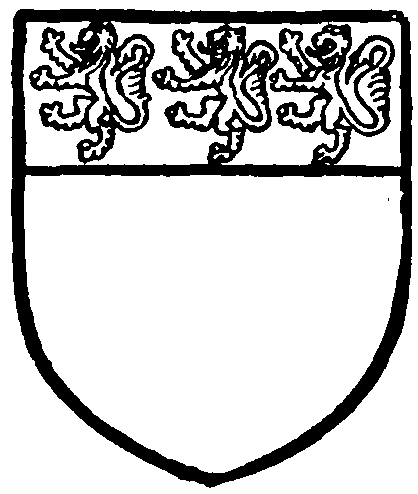
Lisle. Or a chief azure with three lions or therein.
John Philpott was convicted of recusancy in 1628, but appears to have been allowed to retain his estates, as on his death in 1637 South Baddesley passed to his son and heir Henry, (fn. 21) whose property was, however, shortly afterwards forfeited for delinquency, though he obtained his discharge in 1646. (fn. 22) Henry was holding the manor jointly with his wife in 1650, (fn. 23) and it apparently remained in this family (fn. 24) until it passed, probably by purchase, to Henry (Arundell), Baron Arundell at the beginning of the 18th century. (fn. 25) He died in 1746, and was succeeded by his eldest son Henry, who was followed in 1756 by Henry eighth Baron Arundell, who sold the manor in 1781 to Ascanius Williams, (fn. 26) by whom it was conveyed in 1787 to Thomas Robins. (fn. 27) In 1802 it was bought by Thomas Weld of Lulworth, who settled it in that year on the Hon. Charlotte Stourton, fourth daughter of Charles Philip sixteenth Lord Stourton, on her marriage with his second son Joseph. (fn. 28) From the Weld family it passed about the middle of the century for a few years to that of Peacocke, from whom it was purchased by Mr. Williams Freeman in 1853. He sold it in 1875 to Mr. Whitaker, whose son Mr. J. Ingham Whitaker, J.P., is the present owner. (fn. 29)

Arundell of Wardour. Sable six hirondelles argent.
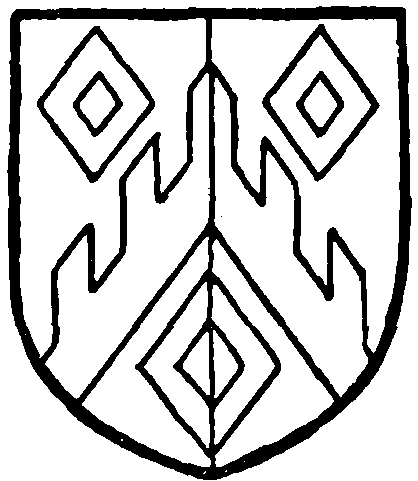
Whitaker. Party argent and azure a chevcron battled between three voided lozenges countercoloured.
At the Conquest BATTRAMSLEY, consisting of 2 hides assessed at £3, was held jointly by Saulf and Alfric. This land was taken into the forest with the exception of 4 acres which Saulf was allowed to retain. (fn. 30)
After the Survey no further mention is found of Battramsley until 1296, when one messuage and 1 carucate of land and 25s. 4d. rent in Battramsley were held by Alice Foucher, (fn. 31) from whom they passed to her daughter Margery before 1325 . (fn. 32) In this year the latter obtained permission to grant the property, which was held by the payment of 20s. yearly at the court of the king at Lyndhurst and suit every three weeks, to John Blakedon and Alice his wife and their issue with contingent remainder to Margery and her heirs. (fn. 33) Before 1345 the estate had passed to Walter de Russington and Joan his wife, (fn. 34) who appear to have conveyed it to Walter Patricke, who was in possession in 1363. (fn. 35) The history of the next two centuries is obscure. Record is found of small estates in Battramsley held by various families, but the first actual mention of manorial rights is in 1542, when the manor of Battramsley was conveyed by John Arney to John Mill, (fn. 36) purchaser and grantee of other estates in the parish. It remained in this family until the death of Richard Mill without issue in 1613. (fn. 37) His wife Mary, who survived him, married as her second husband Thomas Wroughton, and they jointly conveyed the manor in 1622 to George Wroughton, (fn. 38) probably brother or son. This is the last actual mention of manorial rights, and it is obvious that the manor was split up into many small holdings. In 1670 William Burrard appeared before the justice seat held at Lyndhurst in 1670 to assert his claim to an ancient messuage and 60 acres of land in Battramsley. (fn. 39) In 1765 the site of the manor was in the possession of William Buckler, (fn. 40) who held it certainly till 1771. (fn. 41) It passed in 1779 (fn. 42) to Sir Andrew Snape Hamond, captain in the navy, who was created a baronet in 1783 for his services in the American war.
After this no further record of the manorial existence of Battramsley is found, but Battramsley House and property undoubtedly mark the site of the capital messuage.
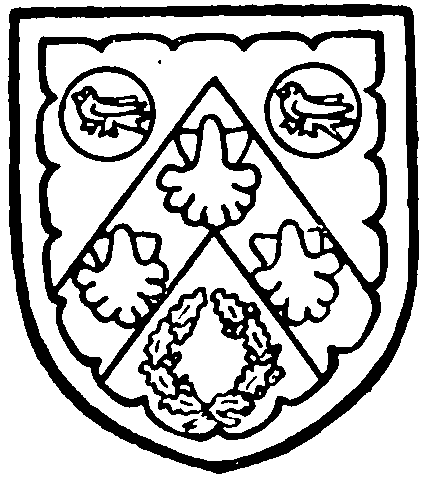
Hamond, baronet. Argent a cheveron sable between two roundels sable in the chief, each charged with a martlet argent and a wreath of oak vert in the foot with three scallops argent on the cheveron and all within a border engrailed vert.
A mill in Battramsley is mentioned in 1296, (fn. 43) in 1324, (fn. 44) and again in 1348, (fn. 45) probably the water-mill which passed with the manor to John Mill in 1542, (fn. 46) but no later record of it is found.
There is no mention of HEYWOOD in the Domesday Survey, but in December 1361 Nicholas de Pershute died seised of lands in Heywood, 22 acres of pasture land with appurtenances which passed to his son Nicholas, (fn. 47) and ten years later Edmund de Kendal, kt., died seised of four messuages and 6 acres of land in Heywood. (fn. 48)
At the Dissolution the manor of Heywood appears among the lands of the dissolved priory of Breamore, (fn. 49) though there is no evidence to show how it came into the possession of this house. The priory, including the manor of Heywood, was granted to Henry Marquess of Winchester and Gertrude his wife in 1536, (fn. 50) but reverted to the Crown on the execution of the former in 1538, followed by the attainder of his wife in 1539. It was then allotted to Anne of Cleves as part of her dower, but again came into the king's hands on the dissolution of her marriage in 1540, (fn. 51) and was granted in 1544 to Thomas Hobson, (fn. 52) who the same year obtained licence to alienate it to John Mill and Richard his son. (fn. 53) It remained in the latter family (vide Pilley) until the death of Richard Mill without issue in 1613. His wife Mary, who survived him, married as her second husband Thomas Wroughton, and in 1617 they jointly conveyed the manor to George Wroughton. (fn. 54) In 1630 it passed by fine to John Kempe, (fn. 55) and was carried by the marriage of Frances daughter and co-heir of Thomas Kempe (possibly brother of John) to Henry Bromfield of Chawcroft, verderer of the New Forest, bow-bearer to Charles II, who died seised of it in 1682. From him it passed in succession to his son and grandson, both named Henry. (fn. 56) The estate remained in this family until 1773, when it was sold by the Rev. John Trenchard Bromfield to Mr. Edward Morant, (fn. 57) whose son John was owner in 1869. (fn. 58) Mr. Edward J. H. E. Morant, J.P., is the present lord of the manor.
Mention is made in 1558 of a corn-mill adjoining Heywood Farm, (fn. 59) probably the one still existing in 1809, (fn. 60) and there is also record of a windmill in 1601. (fn. 61) Heywood mill still exists in the parish.
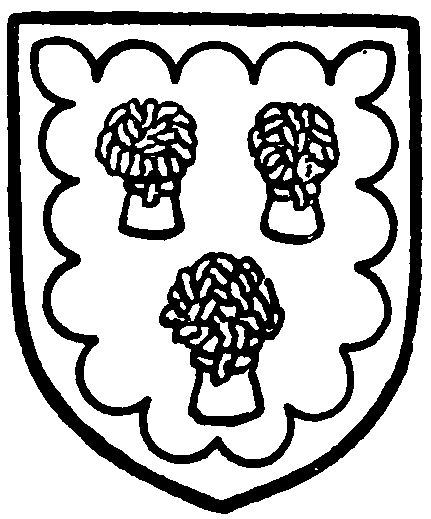
Kempe. Gules three sheaves in a border engrailed or.
There was an estate in Baddesley known as NORTHLEGH (Norley, xvii cent.), the first notice of which is found in 1306, when Edward I granted 100 acres of waste land in 'Northlegh by Baddesley' to Hugh de Ristone, to hold by a rent of 16s. 8d. (fn. 62) This land reverted to the king, presumably on the death of Hugh, and was then granted to John de Leith to hold on the same condition. (fn. 63) Before 1353, however, it had passed to Henry de Welles, lord of the manor of South Baddesley, who died seised of it in that year, (fn. 64) and its further descent is identical with that manor (q.v.).
Record is found in the Domesday Survey of three holdings in PILLEY (Pistelei, xi cent.; Pylele, xiv cent.). Of these the largest, consisting of 1 hide and assessed at 30s., was held by Edric of the king, half a hide, assessed at 15s., was held by Alric, and Hugh de Quintin held 1½ virgates, assessed at 10s., of Hugh de Port. The whole of this land was taken into the New Forest except 6 acres of meadow which Hugh de Quintin was allowed to retain. (fn. 65)
It is impossible to say with certainty which of these estates developed later into the manor of Pilley, which was held of the king's manor of Kingwood, (fn. 66) but it may fairly be assumed that it was the largest, that held by Edric.
Pilley probably gave its name to the first owners of the land, though no mention is made of a family of this name before 1316, when Roger de Pilley appears as joint owner with John de Wereburn of the vill of Pilley. (fn. 67) The former died in 1337, (fn. 68) and in 1376 Richard Pilley, presumably his son, enfeoffed John de Pulto of one messuage and 50 acres of land worth 6s. 8d. in Pilley held by the service of guarding nineteen cows and one bull in the New Forest. (fn. 69) During the 15 th century record is found of small estates held by various families, (fn. 70) but the first actual mention of a manor in Pilley is in 1505, when it was in the possession of Roger Filey, who left as heir a niece Joan, aged nine years, daughter of his elder brother John. (fn. 71) In 1547 John Filey sold the manor to John Mill. (fn. 72) It remained in this family (vide Nursling) until the death of Richard Mill in 1613. (fn. 73) His wife Mary, who survived him, married as her second husband Thomas Wroughton, and in 1617 they jointly conveyed the manor to George Wroughton, (fn. 74) who may have been a brother of Thomas, from whom it seems to have passed to William Goldwyer, who died seised of the site of the manor of Pilley, leaving a son and heir William. (fn. 75) After this no further mention is found of the manor until 1726, when it was conveyed by John Chetwynd and Hester his wife, Arthur Hyde and Lawrence Hyde to Sir James Worsley. (fn. 76) Before 1787 it had passed to Ascanius Williams, who in that year conveyed it to Thomas Robins. (fn. 77) This is the last recorded owner of the manor, and it is probable that the manorial rights afterwards lapsed.
No mention apparently occurs of the manor of SHARPRICKS (Shepprix, xiv cent.) until the 14th century, when it was in the possession of the Countess of Salisbury, (fn. 78) having probably passed to her on the death of her husband, William de Montagu first Earl of Salisbury, in 1344. It remained with this family certainly until 1415, (fn. 79) after which all trace of the overlordship is lost.
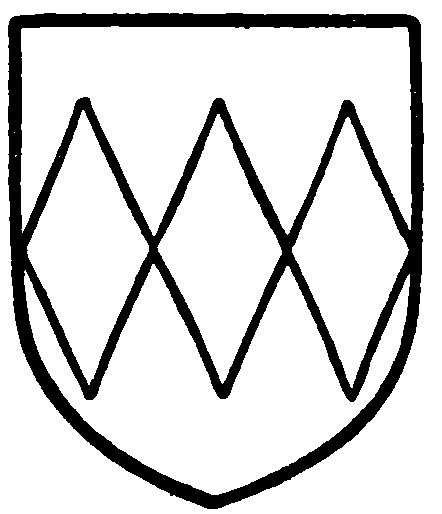
Montagu. Argent a fesse indented of three points gules.
The first undertenant of Sharpricks of whom there is record was John Trenchard, (fn. 80) and before 1331 it passed from him to Henry Trenchard, presumably his son, (fn. 81) who appears to be the last of the name connected with the manor.
Sharpricks was held by service of 6d. per annum immediately of Henry Trenchard by John de Lisle, who died in 1331, leaving a son, Bartholomew, who succeeded to the manor. It then consisted of a messuage, 160 acres of land and a windmill. (fn. 82) In 1339 Bartholomew was entrusted with the defence of the Isle of Wight against a possible French invasion, and for this reason his manor of Sharpricks was free from assessment in the Muster Roll for that year. (fn. 83) Bartholomew de Insula or de Lisle died in 1345, leaving a son John, aged nearly nine years, (fn. 84) for whom the manor was held by his mother Elizabeth. This John de Lisle, who held the manor jointly with his wife Maud, (fn. 85) died abroad in 1370, leaving a son and heir John, aged three. In 1378 his wife Maud died and was succeeded by the said John, then said to be thirteen. (fn. 86) No mention is found of Sharpricks for the next century and a half, but it apparently remained in the Lisle family, following the descent of South Baddesley (q.v.), as it reappears in 1539, (fn. 87) in the possession of Mary wife of Sir Thomas Lisle, who died seised of the manor in that year. From this date it is certain that the two descents are identical.
A rental of Sharpricks is given in a Recovery Roll dealing with the manor in 1781. It had been sold to Ascanius Williams senior for a sum of £1,500, and its copyhold and leasehold estates included a tenement called Fording, a close called Great Saltern Close, Nashes Farm, Lisle Court Farm and a house and garden. (fn. 88)
At the time of the Domesday Survey 2 hides in SWAY (Suei, xi cent.; Sweia, xiii cent.) were held of Earl Roger of Shrewsbury by Fulcoin and NigeJ respectively. (fn. 89) The earl himself was holding, in demesne, land in ' Bermintune' which has been identified as Birmingham in Sway. (fn. 90) It is probable that these holdings afterwards coalesced and became one estate. A certain Edmund at the same date was holding 1 hide in Sway which Algar had held of King Edward. (fn. 91) At a subsequent date the abbeys of Quarr and Christchurch Twyneham both held manors in Sway, but what entries in Domesday Book these manors represented is uncertain.
Some time prior to 1150 Hugh de Witteville gave ' his whole land of Sway with its men and one mill' to the abbey of Quarr, (fn. 92) and about the same date Ralph Fulcher granted a mansura and land at Sway which he had of the fee of Hugh de Witteville and all claim in Sway mill and the mansion of Robert Tanner to the same house. (fn. 93) These possessions were retained by the abbey until the Dissolution, when Sway, then worth £3 15s. 8d., (fn. 94) was granted to Sir John Williams, Master of the Jewels, and others, (fn. 95) by whom it was subsequently conveyed to John Mill, (fn. 96) the purchaser and grantee of much monastic property in the neighbourhood. It then followed the descent of Battramsley (q.v.) until 1627, when the estate henceforth known as the manor of Sway Quarr was sold by George Wroughton to John Button of Buckland Lymington, (fn. 97) and in 1670 he or his son appeared before the justice seat held at Lyndhurst as the lord of the manor of Sway, in right of which he claimed common of pasture for his cattle and common of mast for hogs and pigs at the rate of 4d. for a hog and 2d. for a pig yearly. Other annual payments were leasefee money 5s. 2d., 22½ bushels of oats and 112 eggs. (fn. 98) Before the end of the century, however, it had passed to Edmund Dummer of Swaythling, whose widow Leonora Sophia in 1746 married Denis Bond of Creech Grange, co. Dorset, a member of the Dorset branch of the Cornwall family of that name. Her daughter Mary Dummer, who inherited the Sway property, became the wife of John Bond nephew of her step-father Denis Bond, and from them the property passed in succession to a son and grandson both named John. The latter on his death in 1844 was succeeded by his brother the Rev. Nathaniel Bond, whose son Mr. Nathaniel Bond gave the Sway property to his eldest son Mr. John Wentworth Garneys Bond, the present owner. (fn. 99)
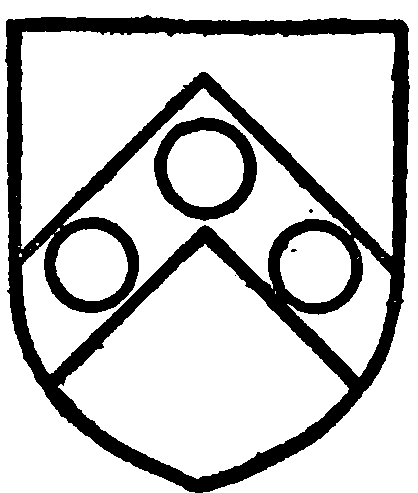
Bond. Argent a cheveron sable with three bezants thereon.
In 1228 Richard de Avon and Maud his wife granted 5s. rent in Sway to Roger, Prior of Christchurch Twyneham, (fn. 100) presumably the 'land of Sway ' for which the prior was liable in 1263 to provide castle guard for eight days in time of war for the castle of Christchurch. (fn. 101) In the following century the possessions of the priory were increased by the grant of three messuages and 49 acres of land in Sway and elsewhere from John vicar of Christchurch in part satisfaction of the £10 worth of land and rent which they had the right to acquire yearly. (fn. 102) Free warren in their demesne lands of Sway was granted to the prior and convent in 1384. (fn. 103) Sway continued in the possession of this house until the Dissolution, when it was granted to Sir John Williams with Sway Quarr and apparently became merged in the latter manor, as henceforth no separate mention of it is found.
In 1086 the abbey of Romsey held I hide in Sway, (fn. 104) afterwards known as the manor of Sway Romsey or South Sway, but when or by whom it was granted there is no evidence to show. The Abbess of Romsey was holding in Sway together with the Abbot of Quarr and the Prior of Christchurch Twyneham in 1316, (fn. 105) and the abbey held lands there until the Dissolution,when they were granted with Sway Twyneham and Sway Quarr to Sir John Williams, (fn. 106) and followed the descent of Sway Quarr (q.v.).
Mention is made of a mill in Sway in the 12th (fn. 107) and 13th centuries, (fn. 108) probably the water-mill granted to Sir John Williams with the manor in 1543, (fn. 109) but there is no later record concerning it.
In 1086 WALHAMPTON (Welnetune, xi cent.), consisting of half a hide, was held by Fulcoin of Earl Roger of Shrewsbury. Formerly it had been held by Alnod and had been worth 15s., but its value was now reduced to 10s. (fn. 110)
Walhampton escheated to the Crown on the forfeiture of the estates of Robert de Bellesme son of Earl Roger at the beginning of the 12th century, and was then granted by the king to Richard de Redvers Earl of Devon, whose son Baldwin gave it to the priory of Christchurch Twyneham. (fn. 111)
In 1263 the possessions of the priory in Walhampton were further increased by the grant of one messuage and 40 acres of land by Ralph le Plumber and Christine his wife to John, Prior of Christchurch Twyneham. In return the prior was to provide reasonable sustenance both of victuals and clothing in the priory for Ralph and Christine. (fn. 112) A somewhat similar arrangement was made in the same year with John Osborn and Ralph his son in respect of other lands in Walhampton. (fn. 113)
In 1285 the prior and convent were granted free warren in their demesne lands at Walhampton. (fn. 114) The manor continued among the possessions of this house until the Dissolution, (fn. 115) at which time it was held by John Castle and Joan his wife and their son William for their lives. (fn. 116) The queen granted a renewal of the lease to William Castle and Elizabeth his wife and their son John in 1564, (fn. 117) and to Elizabeth Castle, by this time a widow, and John Castle and William Castle in 1572, and in 1574 the reversion, after the expiration of the latter lease, was granted to Drew Drury and Edmund Downynge. (fn. 118) Before 1631, however, it had been acquired by Sir George Trenchard, member of the well-known Dorset family of that name, who died seised of it in that year, (fn. 119) leaving his property to his son Sir Thomas, who was holding in 1633. (fn. 120) It passed before 1658 to Francis Hanbury of Lymington, (fn. 121) who held it certainly until 1670. (fn. 122) In 1727 it was in the possession of Charles Bulkeley, probably member of the family of that name, which for many years held the manor of Lymington. He conveyed Walhampton by fine to William Tulse in that year. (fn. 123) From the latter it apparently passed to William Samber, (fn. 124) member of another Lymington family, who sold it in 1742 to Harry Burrard, (fn. 125) bowbearer to the king and riding forester of the New Forest, who represented Lymington in Parliament for forty-three successive years, was created a baronet in 1769, and, having no surviving issue, he settled the estate in tail-male upon his two nephews, sons of his brother William, the elder of whom, Admiral Sir Harry Burrard, succeeded him on his death in 1791. (fn. 126) The latter assumed the surname of Neale on his marriage in 1795 with Grace daughter of Robert Neale of Shaw House, Wilts. (fn. 127) He represented Lymington in many Parliaments during a period of forty-six years, and dying without issue in 1840 was succeeded in his estates by his brother, the Rev. George Burrard, chaplain-in-ordinary to four successive sovereigns. The latter was followed by his son Sir George Burrard, who died without issue in 1870. His half-brother Sir Harry Burrard inherited the estate, from whom it passed to his son Sir Harry Paul Burrard. (fn. 128) It was subsequently alienated by this family to Mr. John Postle Heseltine, who has lately sold it to Miss Morrison.

Burrard, baronet. Party fessewise and battled gules and azure a lion passant erminois between three sixpointed molets or and a quarter argent with a sword erect in its proper colours therein.
The first record of WARBORNE (Werburne, xiv cent.) is found in 1316, when John Warborne and Roger Pilley are returned as joint owners of the vill of Warborne. (fn. 129) Beyond the mention of small parcels of land in Warborne held by the Bocland family in the 14th century, (fn. 130) no further record of Warborne is found until 1478, when the manor of Warborne passed by fine from John Reve and Joan his wife to Edward Berkley. (fn. 131) Before 1505, however, it had been acquired by the family of Filey, (fn. 132) and it then followed the descent of Pilley (q.v.) until 1617, when it was conveyed by Thomas Wroughton and Mary his wife to George Wroughton. (fn. 133) After this no further trace of Warborne is found until 1670, when Henry Bower appeared before the justice seat held at Lyndhurst in that year to assert his claim to the manor. (fn. 134) Warborne reappears with Pilley in a fine of 1726 in which John Chetwynd and Hester his wife, Arthur Hyde and Lawrence Hyde conveyed the manor to Sir James Worsley, (fn. 135) after which the two descents are again identical.
Church
The church of ST. JOHN consists of chancel, nave with a north chapel of three bays and a south aisle of six bays, a tower southwest of the chancel, a north vestry and south porch.
The first three bays of the present nave probably represent the nave of a 12th-century church, which would have had a small chancel. The first enlargement of this church was c. 1200, when a south aisle and the first three bays of the existing south arcade were added. In the first half of the 13th century the nave was lengthened westwards, three more bays being added to the south arcade.
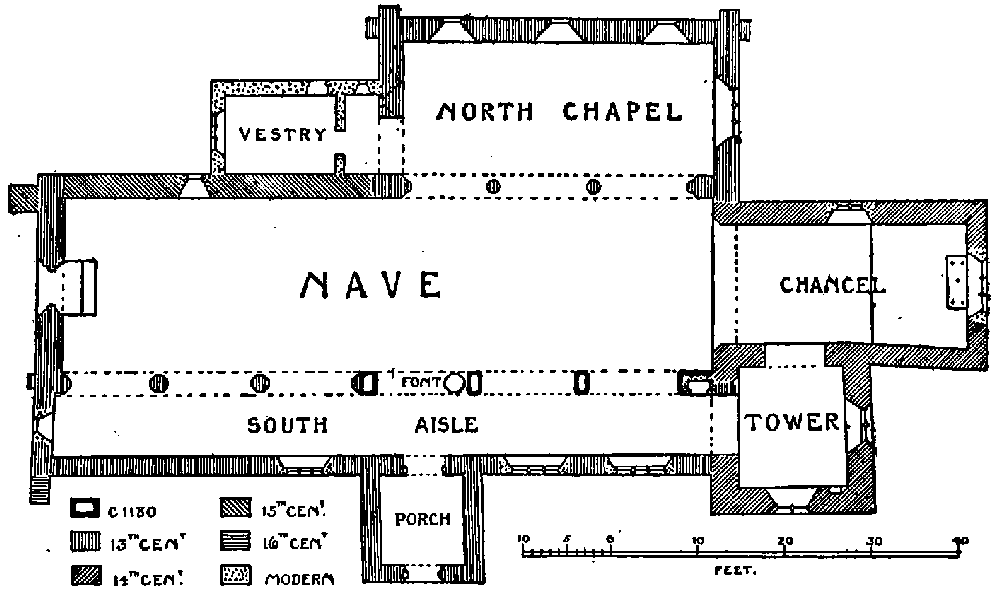
Plan of Boldre Church
A 13th-century arch opening from the west end of the north chapel to the present vestry shows that a south aisle was prepared for if not built at the same time, but it has since disappeared. A north aisle probably existed before this time, but about 1250–60 was replaced by the present north chapel and arcade. In the 14th century, c. 1320, the chancel was enlarged to its present size and the tower built.
The east window of the chancel is a modern threelight traceried window in early 14th-century style, and the chancel has been considerably restored in modern times. In the north wall is a modern twolight window with old inner jambs, and in the south no window, but a two-centred arch of a single chamfered order opening into the ground story of the tower, now used as an organ chamber. It has an east window of two lights with restored tracery, and in the south wall a trefoiled piscina and a window of two trefoiled lights with a quatrefoil over, both of 14th-century date. The 14th-century chancel arch contemporary with the chancel is acutely pointed, of two chamfered orders, dying into the responds with a broach stop between the orders; below the responds are cut away on a slant. The very irregular line of the south wall of the chancel is to be noted, the tower being set nearly square with the nave, while the south wall of the chancel has a marked southward inclination, which can only be due to the method of setting out.
The north arcade is of three bays with arches of two chamfered orders and a heavy chamfered label with good head stops. The responds are of stone and half round with moulded capitals and bases; but the round columns with their capitals, shafts, and bases are of Purbeck marble, the whole arcade being a very beautiful piece of 13th-century work. The chapel is also of very good proportions, and has an east window with modern tracery of three lights in the original shafted jambs. The sill is cut down for the reredos of an altar, and below it runs a roll string, which is continued at a lower level below the north windows and again at a higher level on the west wall, ranging with the springing of the western arch.
In the north wall are three widely splayed lancets with moulded labels, which have apparently been widened on the inside at the glass line. In the west wall is a similar window, but larger and without a label. Below it a plain arch with chamfered angles opens into a modern vestry, which stands on the eastern part of the destroyed (or abandoned) 13th-century aisle, the weathering of its low pent roof still showing on the west face of the chapel wall.
In the north wall of the nave west of the vestry is a modern trefoiled light. The south arcade is of six bays, the three eastern ones having plain round arches with chamfered angles, resting on narrow rectangular piers with chamfered angles stopped out just above the plain bases. There are no capitals, but a chamfered abacus runs round the pier. All the tooling is vertical, and the date must be at the very end of the 12th century. Against its west respond is set the east respond of the later work of three bays which have pointed arches of two chamfered orders and round columns with octagonal moulded capitals of a very good and deeply-cut section and bases hidden by the floor. The west window of the nave is modern in 14th-century style, part of the reveal being old. The west door, contemporary with the arcade, has three external continuous chamfered orders, with undercut label and returned stops. On the outer face of the west wall are a string-course and a shallow buttress, both original. The south aisle opens to the south chapel by a pointed chamfered arch and is lighted by three modern three-light traceried windows. The south door, having a twocentred head continuously moulded, and the porch date from the 13th-century extension of the aisle; above the door externally is a trefoiled opening. In the east respond of the south arcade are the remains of the rood stair with the original 15th-century wood framing in place. The tower is of two stages, the upper having been rebuilt in the 17th century of red brick with square-headed wooden belfry lights and an embattled parapet. The lower stage has a trefoiled light on the west above the south aisle roof and the south and east windows already noticed.
The font is octagonal with a plain bowl of 15th-century date and a tall modern stem and base. The chancel roof is modern, the nave plastered in a barrel vault with moulded ribs and foliate bosses at the intersections; it appears to be of 15th-century date, and may mark the time when the north aisle was destroyed. The aisle roofs are plastered. The altar table is of 17th-century date with carving and heavy moulded legs; in the vestry is another table rather later and less elaborate.
On the north wall of the nave is a very good marble and alabaster wall monument with the lifesized bust of John Kempe, 1652, inclosed in an oval frame under a pediment with cresting. Above is a shield with the sheaves and engrailed border of Kempe, and below a Latin inscription in eight lines. On the floor close to the west door is a portion of a slab with a 14th-century flowered cross.
The bells are three in number, the first and second cast in 1838, the tenor in 1867, all by Mears.
The plate consists of a late 17th-century silver chalice, a paten of 1669, the gift of James Worsley, a pair of patens of 1848 given by the Rev. Charles Shrubb and the Rev. Henry Shrubb, a flagon of 1830 given by Elizabeth Purvis of Vicar's Hill House, and a plated cup and cover.
The registers are as follows: (1) baptisms and burials 1596 to 1621 and 1626 to 1756, marriages 1596 to 1622 and 1627 to 1753; (2) baptisms and burials 1756 to 1795; (3) baptisms and burials 1795 to 1812. There are four printed marriage books: 1754 to 1777, 1777 to 1789, 1789 to 1805, 1805 to 1812.
The small brick church of ST. PAUL, East Boldre, consists of chancel, nave and turret with one bell. It was built in 1839, but was restored and the chancel added in 1891. The plate consists of a silver chalice and paten of 1839, a chalice of 1902, a paten of 1897, and a plated flagon given by Mr. J. Blount Thomas in 1890.
Advowson
Richard de Redvers, who died in 1107, confirmed to the priory of Christchurch Twyneham the church of Boldre with the chapel of Brockenhurst. (fn. 136) This confirmation was repeated by his son Baldwin Earl of Devon and by Henry Bishop of Winchester. (fn. 137) In 1291, by which time a vicarage had been ordained, the church of Boldre with a chapel was assessed at £21 6s. 8d., a pension to the priory of £2 13s. 4d. being chargeable on the vicarage as compensation for tithes in Boldre, Lymington and Brockenhurst. (fn. 138) In the Valor of Henry VIII the church was valued at £14 3s., the charges upon it with the pension reducing it to the net value of £11 2s., (fn. 139) including the small tithes of Lymington; 3s. annually was also paid to the churchwardens of Boldre by the inhabitants of Lymington to provide a dinner for the 'quiristers and others,' a payment which apparently ceased in the 16th century. (fn. 140) The patronage remained with the priory until the Dissolution, when it was granted to George Mill, (fn. 141) who died seised of it in 1568. (fn. 142) From him it passed to his nephew and heir Richard, son of his elder brother Thomas, who held it till his death in 1613. (fn. 143) In 1617 Mary, jointly with her second husband Thomas Wroughton, conveyed the advowson to George Wroughton, (fn. 144) probably a son or brother of Thomas. After this date no connexion can be traced between the various patrons (fn. 145) until 1819, when the advowson was in possession of John Peyto Shrubb, (fn. 146) whose descendant Mr. John Peyto Charles Shrubb is the present patron.
Before 1329 a free chapel dedicated to the honour of the Virgin Mary was founded in South Baddesley for the accommodation of the inhabitants, as the parish church of Boldre was situated 2 miles distant. (fn. 147) A chantry was founded in this chapel by Henry de Welles, the lord of the manor, in 1329, and endowed with a messuage, 13 acres of land and 100s. rent and common of pasture in Baddesley for all beasts except goats. (fn. 148) In the 16th century the chapel was valued at £4 2s. 9d, of which sum the inhabitants were stated to be paying £2 2s. 8d. 'of their only good will to have ministration there.' (fn. 149) Although the advowson in 1429 was said to belong to John Lisle, lord of the manor of South Baddesley, (fn. 150) the chapel was served in the reign of Edward VI by the vicar of Boldre. Thus in the survey of 1546 taken previous to the suppression of the chantry Nicholas Barnard, vicar of Boldre, was serving as chantry priest and was 54 years old. Of ornaments, jewels and chattels belonging to the chapel there were none. (fn. 151) A capital house and mansion with barn, stables, &c., lately belonging to the chapel, were granted in 1549 to Sir John Peryent and Thomas Reve. (fn. 152)
There are Congregational chapels in Warbome and East Boldre and a Baptist chapel in East Boldre.
Charities
The school founded in 1803 by codicil to will of the Rev. William Gilpin. (fn. 153) —The original school having become extinct, the endowment was under a scheme of 23 November 1877 made applicable for educational purposes, including clothing of the children, in the districts of Boldre, Sway, East Boldre and South Baddesley. The official trustees hold a sum of £836 3s. 10d. consols on remittance account, also a sum of .£313 10s. 7d. consols, on an investment account. (fn. 154)
The infant school was built by the late W. J. C. Moens, F.S.A., in commemoration of his ransom from Italian brigands, with the profits of his book recording his experiences.
Unknown donor's charity.—The poor are entitled to an annuity of £2 issuing out of the Pylewell estate.
The 'Minnitt Charity,' founded by the Rev. Francis Allen Minnitt, by deed dated 26 November 1889 is endowed with £60 3s. Bank of England stock, producing £5 14s. a year, or thereabouts, which is applied for the benefit of the poor, as defined by the trust deed.
In 1891 Miss Sarah Watson by will left a legacy for the repair of the fabric of the parish church, now represented by £29 15s. 1d. Bank of England stock, producing about £2 16s. a year. The sums of stock are held by the official trustees.
The Congregational church endowments.—(See under Lymington.) The official trustees hold a sum of £667 stock of the West of India Portuguese Railway, founded by William Lancaster by memorandum in writing of 10 March 1862, producing £33 7s. yearly, and £420 London and North Western Railway 4 per cent, stock given by Charles Rishley by deed 6 October 1884, producing £16 16s. a year. The income is paid to an evangelist.
In 1894 William Ingham Whitaker by will bequeathed £4,000 consols, the dividends to be paid to the incumbent of South Baddesley for the time being. The principal fund has been transferred to the governors of Queen Anne's Bounty.