A History of the County of Sussex: Volume 7, the Rape of Lewes. Originally published by Victoria County History, London, 1940.
This free content was digitised by double rekeying. All rights reserved.
'The borough of Lewes: Parliamentary, economic and religious history', in A History of the County of Sussex: Volume 7, the Rape of Lewes, ed. L F Salzman (London, 1940), British History Online https://www.british-history.ac.uk/vch/sussex/vol7/pp31-43 [accessed 1 May 2025].
'The borough of Lewes: Parliamentary, economic and religious history', in A History of the County of Sussex: Volume 7, the Rape of Lewes. Edited by L F Salzman (London, 1940), British History Online, accessed May 1, 2025, https://www.british-history.ac.uk/vch/sussex/vol7/pp31-43.
"The borough of Lewes: Parliamentary, economic and religious history". A History of the County of Sussex: Volume 7, the Rape of Lewes. Ed. L F Salzman (London, 1940), British History Online. Web. 1 May 2025. https://www.british-history.ac.uk/vch/sussex/vol7/pp31-43.
In this section
Parliamentary History
Lewes is an ancient borough by prescription and the right of voting was, until the Reform Bill of 1832, in those inhabitants of the borough paying scot and lot, with the two constables as returning officers. (fn. 1) The franchise was therefore restricted down to 1832 to inhabitants of the parishes of All Saints and St. Michael, that were wholly in the borough, and to the small sections of the parishes of Saint John-sub-Castro and St. Peter and St. Mary Westout, alias St. Anne's, that were inside the borough boundary. (fn. 2) The parish of St. John the Baptist, Southover, lay entirely without the boundary and so had no voice in elections down to 1832. (fn. 3) The Boundary Commissioners of 1831–2 found that the approximate number of houses in the borough qualifying for voting was 639. (fn. 4) The commission proposed to create a wider boundary for the town of Lewes, taking in more of St. John-sub-Castro and St. Anne, as well as parts of Southover, St. Thomas-in-the-Cliff, and South Malling, and increasing the qualifying houses by about 193. (fn. 5)
Lewes returned two members to the parliament of 1295 (fn. 6) and continued to send two members (fn. 7) until, by the Representation of the People Act of 1867, the number was reduced to one. (fn. 8) In 1885, when Sussex was divided into six divisions, the greater part of Lewes went into the Mid or Lewes Division, which returned one member. (fn. 9) A further rearrangement was made in 1918, when one of the four members for the administrative county of East Sussex was allotted to the Lewes Division, which consists of the rural districts of Chailey, Newhaven, and Steyning East, the municipal borough of Lewes, and the urban districts of Newhaven, Portslade-by-Sea, and Seaford. (fn. 10)
John Cayme, or Kyme, a member for Lewes in 1543, was paid 63s. in wages: (fn. 11) and the two members William Devenish and Thomas Gravesend together received £6 10s. in 1554. (fn. 12)
The names of prominent local landowners begin to appear among the list of members for Lewes from the time of Mary, and especially under Elizabeth, (fn. 13) and the first notice of contested elections occurs in 1627 when the rival candidates were Sir George Goring, Anthony Stapley, and Sir George Rivers. (fn. 14) Later in the century the family of Pelham had great influence in Lewes and county elections generally, through their land-holdings in Sussex. Pelhams were returned for Lewes at frequent intervals from 1679 to 1790, (fn. 15) and their connexions by marriage also figure in the list. (fn. 16) Pelham influence was strongest under Thomas Pelham, later Pelham-Holles, Lord Pelham of Laughton and, from 1715, Duke of Newcastle, (fn. 17) whose methods are revealed in his correspondence, now in the British Museum. (fn. 18)
Markets And Fairs
'From time whereof the memory of man is not to the contrary' down to 1791, the lords of the borough owned a market in Lewes, which might be held every day except Sunday, for the sale of foodstuffs, china, glass, earthenware, and other necessities; they appointed the Clerk of the Market and took the tolls. (fn. 19) Reference has already been made to the importance of Lewes as a market centre at the time of the Conquest. (fn. 20) In about 1089 William II de Warenne gave to the monks of St. Pancras, Lewes, the right of pre-emption, after the lord's needs had been satisfied, in this daily market 'of flesh and fish and all other things which they wish and require to buy for their own needs or those of their guests'. (fn. 21) Presumably the early markets were held near the church of St. Mary-in-Foro, but in 1564 a markethouse was built at a cost of £20, half from a bequest by Mrs. Alice Holter (fn. 22) and the rest contributed by 'The Twelve' of the borough. (fn. 23) This lay in the High Street at the south-west corner of the road leading to the Castle Gateway: (fn. 24) it was rebuilt in 1649 (fn. 25) and removed in 1791. (fn. 26)
Besides the daily provision market, a general market on Saturday is mentioned in 1440 (fn. 27) and as late as 1792. (fn. 28) The daily market had apparently lapsed, as at a public meeting on 20 May 1789 it was resolved: 'That a General Market for all kinds of Provisions and other marketable Commodities, to be held every day (except Sunday) will be for the general good of the Town'. (fn. 29) A committee of householders was empowered to stake out a site for the market-place in the Castle Yard and treat for its purchase. (fn. 30) The site first chosen was part of the copyhold tenement of Robert Chester Cooper, 'situate on the north-west side of the Castle Inn or Publick House within the Precinct of the Castle . . . containing from East to West 50 feet and from South to North 108 feet, (fn. 31) and in 1791 by Act of Parliament Commissioners appointed from the borough were permitted to erect a new market, there or elsewhere, to replace the old prescriptive one, the lords of the borough, however, retaining their right to elect the Clerk of the Market, though losing their right to the tolls, which were vested in the Commissioners. (fn. 32) This body was empowered to pull down the old market, leaving an open space "for the better accomodating of persons passing to the new market or elsewhere".' (fn. 33) Eventually three houses adjoining the Crown Inn were bought from Lord Hampden and pulled down to provide a site for the new market. The old Town Bell, Gabriel, taken from the tower of the 'Broken' Church of St. Nicholas, was in 1792 hung in a tower at the entrance of the new market-place, the hall of which was built in the following year. (fn. 34)
This general market was sold by the Commissioners in 1886 to the corporation. (fn. 35) By 1929 it was leased by the East Sussex Federation of Women's Institutes for the benefit of small producers of garden produce, poultry, eggs, and foodstuffs. (fn. 36)
In 1789 the inhabitants of Lewes resolved that a market for live-stock twice a month would be for the general good of the town. (fn. 37) A cattle market was held in the streets of Lewes, causing 'obstruction, danger and inconvenience', until 1879, when the Lewes Cattle Market Company was incorporated to provide a site near the railway station for a cattle market. (fn. 38) In 1835 this stock-market was being held every alternate Tuesday. (fn. 39) It is now held every Monday. (fn. 40)
There was a market for corn in Lewes at least by 1630, (fn. 41) and proposals were made in 1648 to remove this to another site. (fn. 42) The present Corn Exchange was built in 1893. (fn. 43) It is owned by the Corporation of Lewes and a market is held weekly on Tuesdays. (fn. 44)
A fair in the week of Whitsun is mentioned in 1440, (fn. 45) and was evidently still held in 1483. (fn. 46) This was presumably the origin of the Whit-Tuesday cattle fair which occurs from at least 1744 (fn. 47) to 1835, (fn. 48) but was no longer held by 1888, (fn. 49) when, however, there was a cattle fair on 6 May, which makes its first appearance in 1757. (fn. 50) An annual sale of cattle is still held in May. (fn. 51) A fair for sheep and cattle, held on 21 September, evidently existed in 1720, (fn. 52) but it is not mentioned again until 1757, when it reappears on the equivalent date of 2 October. (fn. 53) From 1827 (fn. 54) there were sheep fairs on both 21 September and 2 October, but the latter date had been altered to 28 September by 1888. (fn. 55) There are now four special sales of sheep held between July and September.
There is evidence that a wool fair was held at Lewes on 26 July in 1792. (fn. 56) This does not appear in Rider's list of fairs until 1832, (fn. 57) but in 1835 was mentioned a summer wool fair of which the late Earl of Sheffield (died 1821) (fn. 58) had for many years been patron. (fn. 59) It is now held on or about 20 July, (fn. 60) in the Corn Exchange, and is the only wool sale in Sussex. (fn. 61) Lewes had been in the 13th century an active seat of the wool trade, (fn. 62) and in the later years of the next century was a subsidiary staple for the export of wool. (fn. 63) Appointments of tronagers, or weighers, of wool for the port of Lewes are recorded between 1382 and 1389; (fn. 64) but the trade decayed, and in 1498 the tronage and customs of wool in the borough yielded nothing 'because no merchants came there this year'. (fn. 65)
The town was never an important industrial centre, its inhabitants being largely concerned with agriculture. (fn. 66) It is interesting to note that in the 17th century certain goldsmiths, possibly the Dodsons, were producing silver spoons bearing the touch, or local mark, of the arms of Lewes. (fn. 67) The vogue of Lewes as a residential and marketing centre made brewing a profitable industry (fn. 68) and led to the establishment of a good many inns. Of these in 1765 the chief were The Star and The White Hart, but the White Horse, Dog, White Lion, Ship, Castle, Dolphin, Crown, and Lewes Arms, as well as two coffee houses (Verrall's and the Bridge) were sufficiently important to receive their share of custom at the time of the election in that year. (fn. 69) A bank was founded by George Whitfield in 1789 and flourished until 1896, when it was merged in Barclay's. (fn. 70) During the Napoleonic Wars ironworks near the bridge were turning out ordnance, (fn. 71) and their successors, the Phoenix Ironworks, were active during the war of 1914–18, as well as in more normal times. Ship-building was carried on here between 1839 and 1866, but seems to have ceased in the latter year. (fn. 72)
Mint
By the Grateley decree of c. 930 Lewes was the only borough in Sussex, and one of the few in England, to be allowed two moneyers. (fn. 73) Coins of this period, the reign of Æthelstan, from the Lewes mint bear the names of Eadric and Wilebald, each striking a different type. (fn. 74) Under Edgar and Edward the Martyr, also, two moneyers are known, (fn. 75) one, Theodgar, occurring in both reigns and also under Æthelred II, whose coinage yields the names of eight other moneyers, most of whom continued under Cnut and Edward the Confessor, three of them also striking coins for Harold II. (fn. 76) One of the only two gold pieces known between 979 and 1066 was found at Hellingly in 1808 and was struck from a Lewes die for a penny of Æthelred II. (fn. 77) The Domesday Survey shows that when new dies were issued each moneyer had to pay 20s., but this had apparently been raised since the Conquest to a total of 112s. (fn. 78) The pennies of William I and II bear the names of five moneyers, of whom Oswold had been employed since the reign of Æthelred (fn. 79) and continued into that of Henry I, when four other names are found. (fn. 80) The Lewes mint was active under Stephen, five names being recorded, (fn. 81) but for the new coinage of Henry II introduced in 1158, although Lewes was the only Sussex mint, only the name of Wulwine is known. (fn. 82) In 1159 the sheriff of Sussex accounted for £10 due from the mint, or moneyer (monet'), of Lewes (for the new dies); £5 13s. 4d. was paid, (fn. 83) and next year Wulwine the moneyer paid another 6s; (fn. 84) in 1163 he paid 18d. (fn. 85) but within the next four years he had evidently ceased work, as in 1168 the sheriff reported that Wulfwin the moneyer owed 79s. 2d., 'but he can not be found'. (fn. 86)
Parishes
A very small part of the parish of ST. JOHN-SUB-CASTRO, including the church, lay within the borough of Lewes; the greatest part extended in a north-westerly direction, bounded on the east by the parish of Hamsey, which intersected it at one point. (fn. 87) This land outside the borough boundaries, known as ST. JOHN WITHOUT, with Hamsey, formed Southborough, one of the three divisions of the hundred of Barcombe (q.v.). (fn. 88) In 1894 St. John Without was formed into a separate civil parish, (fn. 89) and in 1934 part of the detached portion of this parish was added to Hamsey (q.v.). (fn. 90)
Within the ecclesiastical parish of St. John-subCastro was the chapelry of Allington, first mentioned at the end of the 12th century when the chapel was confirmed by Bishop Seffrid II of Chichester to St. Pancras priory. (fn. 91)
Manors
This extra-burgal part of St. John's parish was presumably contained in the Domesday ALLINGTON, in Barcombe hundred, to which pertained in all five haws in Lewes. (fn. 92) From at least 1578 to 1602, however, Allington was reckoned as part of Hamsey. (fn. 93) Before the Conquest 6 hides in Allington were held of King Edward by Ulward, and 2 hides by Eddeva. In 1086 Ralph de Chesney held the 6 hides of William de Warenne, 2 of them being held of him by Warner and Osmund. The other 2 hides were held of William by Hugh son of Golda, the lord of the neighbouring manor of Warningore, and half a virgate was held by Nigel. (fn. 94) Ralph de Chesney's son Ralph gave a hide of land at Allington to St. Pancras, Lewes, for the soul of his father. Hugh's wife Basilia, mother of their son Ralph, also gave to the monastery the tithe of a hide of their land. (fn. 95)
By 1240 a manor of ALLINGTON was held in demesne by the overlord, Earl Warenne, (fn. 96) and continued to descend with the rape, falling to the share of John Mowbray, Duke of Norfolk, in 1439. (fn. 97) It was divided among his four coheirs in 1483, but was subsequently held in moieties by the Duke of Norfolk and the Earl of Derby. (fn. 98)
In 1547, after the attainder of Thomas Howard, 3rd Duke of Norfolk, his moiety of the manor was granted by Edward VI to Thomas, Lord Seymour, the king's uncle. (fn. 99) He was attainted and executed in 1549. (fn. 100) In 1553 his 'manor' was granted to Sir Richard Sackville. (fn. 101) This transaction was confirmed in 1559 by Thomas, 4th Duke of Norfolk, who sold 'the manor' to Sir Richard for £900. (fn. 102)
The other moiety was conveyed in 1576 by Henry, Earl of Derby, to Sir Thomas, Lord Buckhurst and later 1st Earl of Dorset, (fn. 103) son and heir of Sir Richard Sackville; (fn. 104) so that henceforth the undivided manor of Allington descended with the Sackvilles, Earls of Dorset, (fn. 105) until the death of Richard, Earl of Dorset, in 1624, when it was apportioned to his eldest daughter Margaret, who married John Tufton, Earl of Thanet. It was thereafter held by the earls until 1722, when Thomas, Earl of Thanet, sold Allington for £3,340 to Thomas Medley. (fn. 106) His eldest son Thomas in 1729 placed it in trust for his children, and it was delivered in 1753 to his son George Medley, (fn. 107) who was still holding it in 1793. (fn. 108) On the death of Thomas Medley in 1796 his estates passed through his daughter Annabella wife of John Evelyn, to her daughter Julia Shuckburgh-Evelyn, (fn. 109) and in turn to Julia's daughter Julia Evelyn wife of Cecil Charles Cope Jenkinson, later Earl of Liverpool, who after her death (1814) held courts of the manor until his own death in 1851. (fn. 110) In 1851–5 courts were held by Francis Vernon Harcourt (who had married Lady Katherine Julia Jenkinson), Selina, dowager Viscountess Milton and wife of George Saville Foljambe (another daughter), and John Cotes (husband of the third daughter, Lady Louisa Harriet Jenkinson). (fn. 111) The manor was sold in 1856 by Mr. Vernon Harcourt and his wife to Sir Henry Shiffner, 2nd baronet, who died without issue in 1859, when the property passed to his brother George. (fn. 112) Allington has remained in his family, and is now the property of Sir Henry Burrows Shiffner, the 7th baronet. The custom of Borough English obtained in this manor. (fn. 113)

Tufton, Earl of Thanet.Sable an eagle ermine and a border argent.

Medley. Argent two gimel-bars with three pierced molets in the chief all sable.
Richard de Thornwell and Alice his wife in 1279 granted to Ralph de Radmelde land and pasture in Hamsey and Allington. (fn. 114) In 1314, when Robert Affete of Allington gave 2 messuages and 15 acres there to Robert le Husiere of Firle and Denise his wife, John de Rademelde put in his claim. (fn. 115) In 1341 John de Parys and Margaret his wife, widow of John de Rademeld, were sued by William de Rademeld for waste in the third part of a manor of ALLINGTON which they held as dower of Margaret, in pulling down a hall and chamber and cutting down fruit trees. (fn. 116) No more is heard of this manor.
East Allington is first mentioned in 1328 when Richard atte Ok conveyed to Ralph atte Ok one messuage and 20 acres of land for life. (fn. 117) A manor of Allington, later called EAST ALLINGTON, was in the possession of Walter Fawkenor in 1567. (fn. 118) He was succeeded in 1582 by Thomas Fawkenor, (fn. 119) who died in 1613, leaving the manor to his daughter Anne the wife of Arthur Middleton, (fn. 120) and they were still holding it in 1630. (fn. 121) Francis Middleton son of Arthur inherited it before 1659, (fn. 122) and his son John's daughter Frances married Robert Day and was in possession of East Allington in 1751. (fn. 123) Court House, in St. John's parish, may have been the manor house. (fn. 124)
In 1241 Roger de Wimples remitted to Aumfrid de Feringes and Isabel his wife the service of 15s. for one hide in Allington held of him by them. (fn. 125) This probably refers to West Allington. Richard atte Beche had land in 'Westeralyngton' in 1325; (fn. 126) and in 1474 Joan Beche and Agnes, then wife of William Stent, daughters and coheirs of John Beche, conveyed their shares of 110 acres of land in West Allington to their sister Anne and her husband William Breche. (fn. 127)
The 'borough' of WESTOUT, which lay just outside the west gate of Lewes, contained the two parishes of St. Peter and St. Mary (fn. 128) (see below). It was one of the three 'boroughs' of Swanborough Hundred from at least 1296 (fn. 129) down, apparently, to 1861, when the court leet was summoned to meet on Easter Monday, 9 April, at the Running Horse Inn in what was by then the parish of St. Anne's, Westout. (fn. 130) By the beginning of the 17th century half the common fine of Westout was payable by the Earl of Dorset out of divers lands that he had bought; (fn. 131) the rest was levied on the inhabitants and on the lands of William Lane. (fn. 132)
In 1571 Richard Covert conveyed to George and Stephen Board what was described as a manor of WESTOUT with appurtenances in Chailey and Lancing. (fn. 133) In 1755 Joseph Chapman and Catherine his wife possessed ¼ manor of Westout. (fn. 134) Catherine was evidently a co-heiress of Francis Hammond of Mayfield, and was dead by 1769, when Joseph Chapman, together with Mary Woolven of Mayfield, widow (surviving daughter of Francis Hammond), and Henry Freeman of the Cliffe (son of Elizabeth, another daughter) sold the manor for £20 to John Hammond of Waldron and Richard Hook. (fn. 135)
Two hides of land called Ashcombe in Swanborough Hundred were held of William de Warenne in 1086 by William son of Reinald, and had been held by Cola in the time of King Edward. (fn. 136)
These two hides presumably descended with the other estates of William son of Reinald to the family of Poynings, (fn. 137) and the manor of ASHCOMBE next appears among the possessions of Thomas de Poynings at his death in 1375. (fn. 138) It descended with the manor of Poynings (q.v.), passing in 1537 to Sir Anthony Browne, (fn. 139) whose grandson Anthony, Viscount Montagu, died in 1592. The reversion of this manor expectant upon the death of Viscount Montagu had been granted to Thomas Sackville, Lord Buckhurst, afterwards Earl of Dorset, (fn. 140) on whose death in 1608 it was found to be held as ½ knight's fee. (fn. 141) It descended through Robert, 2nd Earl, (fn. 142) to his son, Richard, Earl of Dorset, (fn. 143) who in 1617 conveyed to trustees the manors of Ashcombe-Goring and Ashcombe-Montagu among others, to pay his debts. (fn. 144)
Lands called 'The Hyde' near Lewes, and presumably in Westout, (fn. 145) appear to have been conveyed, c. 1450, by William Brasyer to Thomas Baker, otherwise Sherman, of Lewes. (fn. 146)
In 1566 a manor of HIDE was conveyed by John Vaughan and Anne his wife to Francis Kelleway (fn. 147) and, later in the year, by Francis and his wife Anne to Roger Gratwyck. (fn. 148) Roger and his wife Mary conveyed it in 1569 to Thomas Sherman. (fn. 149) Thomas Sherman, Richard Smyth, and Margaret Sherman, widow, conveyed the manor in 1584 to Thomas Sackville, Lord Buckhurst, (fn. 150) who as Earl of Dorset held the manor of HIDE MARIES WESTOUT at his death in 1608, (fn. 151) as did his successors (fn. 152) until Edward, Earl of Dorset, conveyed it in 1628 to William Wilson and Richard Isted in part payment of a debt. Richard Amherst of Lewes was a party to this conveyance, releasing thereby an annuity of £30 devised to him for life by Richard, Earl of Dorset, from his Sussex manors. (fn. 153) This manor must have come into Amherst's possession, since by his will, dated 1630, he bequeathed it to his wife, with reversion to his daughters Margaret and Frances in equal portions. (fn. 154) In 1654 Margaret Colbrond, widow, one of the daughters, with Francis Smith and Margaret his wife, William Wilson, and others, conveyed the manor to William Newton and William Lane. (fn. 155) By his will, dated February 1688, William Lane left the manor of Hide to his son William for life, together with the manor of Meeching (q.v.), (fn. 156) with which it was leased in 1691 by William Lane and Elizabeth his wife to John Smith and Thomas Medley. (fn. 157) Nothing further is heard of this manor.
Land in Houndean was held in demesne by Earl Warenne by 1230. (fn. 158) The manor of HOUNDEAN is first mentioned in 1240, (fn. 159) and in 1327 it was assessed within the vill of Westout (q.v.) in Swanborough Hundred. (fn. 160) It descended as a demesne manor with the barony (q.v.), passing in 1439 to Edmund Lenthall and forming part of the dower of his widow, Margaret Tresham, (fn. 161) after whose death in 1484 (fn. 162) it was divided, half going to George, 4th Lord Bergavenny, and the rest to the heirs of Anne Mowbray. (fn. 163)
One-half descended with the Bergavenny portion of the barony (fn. 164) until it was increased, between 1829 and 1831, by the acquisition of another quarter of the manor from the heirs of the Duke of Norfolk. (fn. 165) The present Marquess of Abergavenny owns threequarters of this manor. (fn. 166)
One-eighth of the manor passed to John, Duke of Norfolk, (fn. 167) and after various vicissitudes was assured in 1581 to his descendant, Philip, Earl of Arundel. (fn. 168) After later forfeitures it appears to have been granted by the Crown to the Sackville family. (fn. 169) The 1/8 inherited by William, Lord Berkeley, (fn. 170) of which Sir Edward Poynings and others were enfeoffed in 1504, (fn. 171) probably lapsed to the Crown after Poynings's death in 1522 (fn. 172) and may also have been granted to the Sackvilles, Dukes of Dorset, whose representative in 1608 or 1609 died seised of ¼ of the manor of Houndean. (fn. 173) This ¼ descended in the family, sometimes under the name of HOUNDEAN DORSET, (fn. 174) until the death without issue of the 4th Duke of Dorset in 1815. (fn. 175) His mother, Arabella Diana, who married Charles, Earl Whitworth, held a life interest, and then, from 1825 to 1827, this ¼ manor was held jointly by Mary and Elizabeth Sackville, sisters of the 4th Duke, and their husbands, Other Archer, 6th Earl of Plymouth, and George John, 5th Earl De la Warr. (fn. 176) In November 1829 the court of this ¼ manor was held by Earl De la Warr only, and on 11 June 1831 by Henry, Earl of Abergavenny, who thus held ¾ of the manor of Houndean. (fn. 177)
The 1/8 of the manor that fell to Sir John Wingfield in 1484 after Margaret Tresham's death followed the descent of this part of the Lenthall lands (fn. 178) to William Spence, (fn. 179) who died in 1671. (fn. 180) His brother John, with Ruth his wife, (fn. 181) in 1682 settled it on their son John Spence, with his first wife Mary Fagge. (fn. 182) From the younger John Spence (d. 1713) this 1/8 is thought to have passed to his son Robert Spence (fn. 183) and then through collaterals to Henry Spence by 1783. (fn. 184) He sold it before 1 June 1813 to Thomas Bradford, from whom it passed before 17 December 1819, along with the other 1/8 (see below), to John, 1st Earl of Sheffield, (fn. 185) whose descendants continued to hold it until at least 1887. (fn. 186) In 1926 this ¼ was owned by Mrs. FitzPatrick. (fn. 187)

Spence. Sable a fesse battled argent.

Goring. Argent a cheveron between three rings gules.
The Stanley 1/8 of the manor was conveyed in 1575 by Henry, Earl of Derby, and his wife Margaret to George Goring. (fn. 188) He died seised of it in 1602, (fn. 189) and his grandsons George and Charles Goring in January 1649 conveyed this so-called manor to Anthony Stapley, (fn. 190) possibly in trust for George Stone street, who is said to have acquired this 1/8 in this year (fn. 191) and by his will of 2 June 1669 left it for life to his wife Martha. (fn. 192) George Stonestreet left an only son John, (fn. 193) and in 1672 Sir John Stapley son of Anthony (fn. 194) conveyed this 1/8 to John Stonestreet and Martha Stonestreet, widow. (fn. 195) This portion of Houndean is said to have been bought from Martha Stonestreet by her nephew John Spence, (fn. 196) who held the other 1/8 (q.v.). He bequeathed the Stonestreet portion to his wife Anne Spence, for life, with remainder to his daughters Anne (d. 1737) and Elizabeth, as tenants in common, and then to the right heirs of his son Robert. (fn. 197) The widow Spence held a court for this part of the manor in 1739 and courts were subsequently held by Elizabeth Spence, spinster, and later by Ruth Spence her sister, who died at Bath in 1767. (fn. 198) In 1768 a moiety of 1/8 of the manor appears to have been in the possession of Thomas Powys, great-nephew of Robert Spence. (fn. 199) What was probably another moiety of 1/8 of the manor was held in 1771 by Henry Spence and conveyed to Walter Windsor. (fn. 200) The reunited 1/8 was apparently sold to Henry Shelley, (fn. 201) who held courts there, as did his son, another Henry, who died 31 December 1811. (fn. 202) By 1 June 1813 this 1/8 of the manor had been acquired by Thomas Bradford, who also owned the other 1/8 (q.v.) and so held courts for the ¼ of Houndean (fn. 203) which was subsequently acquired by John, 1st Earl of Sheffield (fn. 204) (see above).
The chapelry of SMITHWICK (fn. 205) appears to have lain in Westout, in the neighbourhood of the old road to Brighton. (fn. 206)
Maud widow of Ralph de Smythewic held a sheeprun in Smithwick in 1230 of Earl Warenne, (fn. 207) who then held demesne lands here. (fn. 208) In 1279 John de Warenne claimed free warren in Smithwick, (fn. 209) as did Richard, Earl of Arundel and Surrey, in 1373. (fn. 210)
In 1428 half a knight's fee in Smithwick, described as in Barcombe Hundred, formerly held by Roger Dober and others, was split up between the heirs of John Fos, John Wydere, John Kelsale, John Hanslap, and Margery Mulstone. (fn. 211) This may represent part of the fee in Smithwick and Kingston of which the overlordship was assigned to the Duke of Norfolk in 1439 (fn. 212) and formed part of the dower of his widow Eleanor in 1461. (fn. 213) This fee had formerly been held by Saer and Geoffrey de Rosey. (fn. 214)
This part of a fee in Smithwick probably descended with Hide in Kingston (q.v.), passing from the Gartons to Richard Mitchell, who in 1575 was holding certain customary lands called 'Smythwyke', but of the bedelwick of Plumpton (fn. 215) (q.v.). Thomas Mitchell held these lands, about 30 acres, in 1597. (fn. 216) A little later John de la Chambre held both Hide and land called Brednoore and Smithwick formerly Rosey's. (fn. 217)
Freeholds called 'Ashcomb (fn. 218) Brednore or Smithwick' in Westout were devised in 1783 by William Boys of Ashcombe to his then only son John and his heirs, and failing them to his daughter Hannah, then wife of Samuel Ridge of Falmer. (fn. 219)
An alleged manor of SMITHWICK, held by Amy widow of Sir William Bowet, was to have been settled in 1447, ten years after her death, on Sir Thomas Dacre and Elizabeth his wife, daughter of Sir William. (fn. 220) Eventually this manor, with five others, including Hurstpierpoint (q.v.), devolved upon their daughter Joan wife of Richard Fenys, who died in 1487, holding them of George Nevill, Lord Bergavenny, as 1/20 knight's fee. (fn. 221) Nothing more is heard of this 'manor'.
In 1086 WINTERBOURNE, in Swanborough Hundred, was held as one hide of William de Warenne by Eldeid. (fn. 222) To it pertained 3⅓ haws or burgages in Lewes; and Edith had held the land in the time of King Edward. This land appears to have been absorbed into the manor of Houndean (q.v.) in this parish, (fn. 223) and presumably descended with it. Winterbourne Farm was held by George, Lord Bergavenny, (fn. 224) who died in 1535; and in 1628 Edward, Earl of Dorset, conveyed to William Wilson and Richard Isted the reversion after the death of Anne, dowager Countess of Dorset, (fn. 225) of 'that old messuage or tenement called Winterborne and little parcel of land adjoining lying open to land called the Hides'. It contained about 30 acres and was bounded as follows: 'Kings Highway from the Spittles to Winterbourne and from Winterbourne to the Towne of Lewes and to a parcel of land called the parsonage croft and to the churchyard of St. Maries Westout and to the several landes of William Lane and Richard Knight, gent.' (fn. 226) Winterbourne then descended with the manor of Hide in Westout (q.v.), being described as a manor and croft in 1630. (fn. 227)
The house of the GREY FRIARS at Lewes (fn. 228) was surrendered to the Crown in 1538 (fn. 229) and the site was leased in 1541 for 21 years to Sir John Gage. (fn. 230) In 1544 the Crown granted the reversion to George Heydon and Hugh Stucley (fn. 231) and they immediately conveyed their rights to John Keyme, (fn. 232) or Kyme, (fn. 233) who died in 1585, having bequeathed his house on the site to his niece Elizabeth Kyme and her heirs male. (fn. 234) Her husband John Shurley, (fn. 235) sergeant-at-law, who in 1588 bought the rights of her sister Joan wife of Sir George Paulett, (fn. 236) survived her and in 1610 settled the property on his second wife Frances Capell. (fn. 237) He died in 1612 (fn. 238) and his son John died before his stepmother Frances, in 1631, leaving the reversion of Grey Friars after her death to his son John, then aged 10 or 11 years, (fn. 239) who died in 1637, while Frances was still alive. (fn. 240) Under John Kyme's will, made in 1569, the residuary legatee was Seth Awcocke. (fn. 241) William Alcock held the property at his death in 1662, when it passed to one of his daughters, Hannah wife of Thomas Pellatt of Bignor Park, (fn. 242) and after her death in 1693 to her son William Pellatt, who died in 1725 and was succeeded by his second son Apsley Pellatt. (fn. 243) His son Apsley appears to have left three sons, who sold the property in 1803, the greater portion being bought by George Verrall of Lewes in 1804, who sold much of it for building. (fn. 244) Sir Ferdinand Poole was tenant of the Friary for many years, (fn. 245) as was his father, Sir Francis Poole, of Poole, co. Cheshire. (fn. 246)
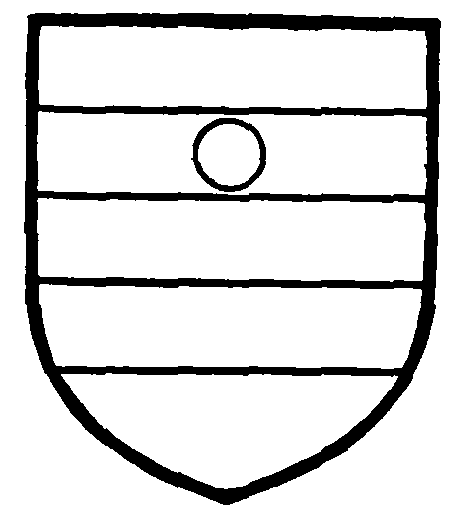
Pellatt. Argent two bars sable with a bezant on the upper bar.
After Mr. Verrall's death what was left of the estate was bought by Nehemiah Wimble, (fn. 247) who was holding the Friary in 1830 when William IV and Queen Adelaide were entertained there. (fn. 248) His representatives sold it to the London and Brighton Railway Company, who built the original Lewes station on the site of the house. (fn. 249)
Churches
The present church of ST. JOHNSUB-CASTRO was built, from the designs of G. Cheesman, in 1839 within the extensive graveyard of the old church which occupies the early fortified enclosure in the NW. corner of the walled town. Built into the east (ceremonial south) wall of the modern church are the inscribed stones of the chancel arch of the early building, and into the north (ceremonial east) wall, its south doorway of pre-conquest date. Within each arch is also preserved a 13th-century coffin lid with floreated cross, and over the doorway is a stone dated 1638, with the names of the churchwardens, Edward Middleton and Henry Saman. The present church is of flint with brick dressings, with aisled nave and chancel and a western tower with embattled angle turrets.
The site of the early church lies north of the modern building, the paved chancel floor being preserved and railed in owing to the vault below being retained for burial by the Crofts family. It consisted of chancel, unaisled nave, and square west tower, and was apparently of Saxon build. In 1587 the chancel was pulled down and it was due to John Rowe (fn. 250) and others that the chancel arch was preserved and built into the exterior of the south wall of the then existing nave. The arch consists of 15 stones, inscribed as follows in two concentric lines:
[CLAVDITUR: HIC: MILES: DANO]RVM: RECIA: PROLES:
MANGNVS: NOMĒ: EI: MAN[GNE]: NOTA: P[ro]GENIEI:
[DEPONENS: MANGNVM: SE: MORI]BVS: INDVIT:
AGNVM:: P[ro]PETE P[ro] VITA: FIT: PAR[VVLV]S: ARNACORITA:
The inscription is in Lombardic characters except in the first four stones and the twelfth (shown in brackets above), which are an early-17th-century restoration. The arch measures about 8 ft. wide.
The Saxon doorway is an interesting example, the jambs and arch being formed of large stones cut roughly into three roll mouldings with a wide channel between them. These mouldings are continuous except where they are interrupted by a horizontal string at the springing. The string-course is square and relieved only by two V-cut lines, leaving a wide band between.
The church possesses two 18th-century bells, dated 1724, by John Waylett. A third by the same founder was re-cast in 1886. (fn. 251)
The communion plate includes a silver cup, given by Elizabeth Powlett (1750); a paten, and two flagons; and a silver almsdish, the gift of John Crofts (1728). (fn. 252)
The registers date from 1602.
In the churchyard is a table-tomb to the memory of Thomas Blunt (1611), barber-surgeon and one of 'the Twelve', who presented a silver cup to Lewes, among other benefactions. There is also an obelisk to the memory of the Russian prisoners of war who died during their internment in Lewes Naval Prison (1855–6).
The only part of the medieval church of ALL SAINTS that remains is the west tower. The original aisleless nave, chancel, and north chancel chapel, probably of 14th-and 15th-century date, were taken down in 1806 and the present brick nave, designed by Mr. Wilds, was built, with end and side galleries. A modern east end was added in stone, by W. Basset Smith and E. J. Munt, in 1883. The tower is of flint, with stone quoins, and is of three stages, the staircase turret being on the north side. It dates from the late 15th century and has diagonal buttresses at its western angles. It is entered by a western door with moulded 4-centred arch and jambs. Above the door are signs of a blocked west window. The ringers' chamber is lighted by small rectangular lights north, south, and west. The belfry has a two-light window on each face; the original battlements have been replaced by a plain parapet.
The monuments in the church have in some instances suffered by the rebuilding. There remain the kneeling effigies, arms, and inscription tablet from a wall-monument to John Stansfield (1627), the grandfather of John Evelyn, and Jane his wife. (fn. 253) The arms for a similar monument to Robert Hassard of Carshalton (1624) and his wife Anne (Moys) is in the nave, but the two kneeling effigies are preserved on brackets in the tower. (fn. 254) There are also mural tablets to Nathaniel Trayton (1714), Samuel Isted (1745), William Durrant (1751), Charles Blunt (1765), and a leger stone to Rev. John Studley (1726). All have shields for arms, (fn. 255) those of Trayton and Durrant being now blank. There is a royal coat of arms (after 1837).
The tower has three bells, the oldest, of the early 15th century, being inscribed 'Sancta Katerina Ora Pro Nobis', accompanied by a cross and shields, one with a cheveron between three lavers and the other a cheveron between three trefoils. The second has the date 1595 and the name of Edmund Giles, bellfounder; the other the date 1625, with the names of the churchwardens and the initials of Roger Tapsell, the founder. (fn. 256)

The PARISH CHURCH of ST MICHAEL.
The communion plate includes a silver cup and paten (1744); a flagon given by Charles Gilbert and Francis Hopkins (1781); and three almsdishes, one of 1674 and the others gifts of Edward Trayton (1733) and Wynne E. Baxter (1875). (fn. 257)
In the churchyard wall is a fountain called Pinwell which takes its name from an ancient well on the site. (fn. 258) At the east end of the churchyard is a 15th-century archway, much restored, which is said to have been removed from the Grey Friars.
The church of ST. MICHAEL stands on the north side of the High Street, some 30 yards within the West Gate, and its churchyard is on the rising ground south-west of the ditch surrounding the Castle mound. Of the original 13th-century fabric, the west wall and the circular western tower alone remain. The 14thcentury arcade of the south aisle of the nave is still standing, but that of the north aisle and both arcades of the chancel were rebuilt in 1748, together with the outer walls. The eastern extension of the chancel, the vestries, and organ chamber are modern.
The nave (44 ft. × 35 ft. across the aisles) and chancel (27 ft.X 35 ft., and 14 ft.X 11 ft. extension) are divided by a two-centred moulded arch of the 14th century, which dies into the wall above the nave arcades at the point where the semi-octagonal respond at the east end of the south nave arcade abuts upon a half-pier of the chancel arcade. Its present form may be due to its being re-set in the 18th century. The two arches of the south aisle of the chancel, and the five uninterrupted arches of the north aisle of both chancel and nave are of wood, two-centred, moulded on the wall surface and panelled on the soffit. They are supported by octagonal wood-cased piers, with Doric capitals, which enclose oak posts to take the weight of the superstructure, and were erected in 1748. At the same time the south wall was rebuilt with squared and knapped flintwork facing. This wall has a stone plinth, quoins to the angles, moulded cornice and ball finials at the ends, all in Portland stone. Two door-ways of the same material and date remain, but the windows have been replaced by modern ones. The date 1748 is contained in a quatrefoil panel over the centre window, and each side of this, along the entire length of the church, are a number of black flints, said to have at one time formed an inscription. The north wall of the church was modernized when the aisle roof (formerly a continuation of the nave roof) was raised. Before this the chancel aisle alone, on this side, had an independent roof, being probably an original chapel.
The three arches of the 14th-century south aisle arcade are of two orders, the outer one having a hollow chamfer. The piers are octagonal in plan, with semioctagonal responds, and have moulded capitals and bases. The roofs are concealed behind a curved plaster ceiling. The west wall contains a blocked 13th-century lancet window at the end of the north aisle, and some of the stones of a similar window to the south aisle are still in position.
The tower, circular in plan (9 ft. diam.), is of flint, formerly rendered with thin plaster and now roughcast. It is of 13th-century date, the belfry story being lighted by quatrefoil lights to the west and south. There was formerly a lancet to the south at a lower level; the present western light is modern, as is also the tower arch. The tower is roofed by a shingled octagonal spire, spreading in broach fashion at the base, and much twisted by the weather.
The memorials include: a brass, the headless effigy of a member of the de Warenne family in armour, c. 1430, with a shield of arms; a brass of John Braydforde (1457), rector, with a half-length figure, vested for Mass; a wall-monument, with the kneeling figures of Sir Nicholas Pelham (1559) and Anne (Sackville) his wife, and figures of their ten children below; and the achievement of arms from the tablet of George Goring (1602) with a copy of the original inscription. (fn. 259)
There are two bells, one inscribed 'Edmundus Giles me fecit 1608', and the other R.B. 1571, with initials of churchwardens or donors. The clock, which used to be attached to the church and which has been removed to an adjoining building, has a bell dated 1696. (fn. 260)

The PARISH CHVRCH of ST ANNE
The church possesses the following pieces of communion plate: Two silver cups and patens of 1753, the gift of Thomas Sergison; a silver cup and paten of 1664; a silver paten of 1734 (given 1735), and a silver flagon of 1753. (fn. 261)
The registers date from 1570, and the church possesses a copy of the 16th-century Churchwarden's Book, the original of which was presented to the Sussex Archaeological Society and is preserved at Barbican House, Lewes. This includes lists of parishioners and their assessment for poor-rate from 1525.
The church of ST. ANNE, formerly St. Mary Westout, consists of a nave and south aisle, with a chapel at its east end, unaisled chancel, west tower, and a modern vestry, which is on the site of an ankerhold. The nave (66 ft. × 21 ft. 6 in.) was originally aisleless and dates from the early 12th century. One of its windows is still to be seen in the south wall, cut into by the westernmost arch of the later aisle arcade. Of the same period are the tower, south chapel, and the western half of the chancel, which is the same width as the nave. The south aisle arcade is of the late 12th century. The chancel was extended towards the east in the 13th century, and buttresses were added to the tower, probably in the 15th century. The external walls are of flint with stone dressings, the whole much modernized in 1889, when the windows of varying dates were removed and replaced by a uniform pattern of 13th-century type. The roofs are of tile with Horsham slabs to the south slope of the nave. The main entrance is on the north by a much restored shallow gabled porch of the 12th century, with a semicircular arch of three orders, the middle one being enriched with cheveron ornament, and carried by nook-shafts with cushion capitals. The priests' door in the north chancel wall has a plain semicircular arch and is also restored Norman work.
The chancel (41 ft. 6 in.X 21 ft.) has no ancient structural features except a moulded and carved corbel in each angle, which suggests an intention to vault the eastern part of the church, probably in two bays. The original squint from the ankerhold in the south wall remains in part. The chancel arch is entirely modern.
The south chapel is structurally part of the early12th-century church and has a contemporary window with semicircular head and wide internal splays in its east wall. This window is now blocked. In its south wall a two-light window was inserted in the 15th century. To the left of the east window, but considerably below it, is a hatch to the ankerhold, still retaining the iron pins for its door. The chapel was vaulted in stone late in the 12th century, with moulded diagonal vaulting-ribs, and at the same time its west wall was pierced by a semicircular arch connecting it with the new aisle, and its arched opening to the nave was probably re-formed to harmonize with the nave arcade. This arcade, of four arches, was cut through the south wall of the nave, the three arches towards the west being pointed, but that communicating with the chapel circular. The arches are supported by three circular piers and two semicircular responds, the easternmost pier being attached to the pierced west wall of the chapel. These piers have remarkably fine capitals with a square moulded abacus, beneath which runs a band of well modelled stiff-leaf foliage, also square in plan. The four angles of the capitals, where they project beyond the circular pier, are supported by carved corbels, some of which are fluted, some carved with foliage and in one instance modelled as human heads. The western bay of the aisle fell into ruin in the 16th century, and the last arch of the arcade, which was then built up, remained unopened until 1927. The carved foliage was thus preserved in its original state and shows that there was a progressive improvement in the quality of the work from east to west. The westernmost pier and the western respond alone retain their water-hollow moulded bases, and when uncovered they showed the original red masoning over a thin coating of lime-wash or plaster.
The remains of the ankerhold, evidently that of the anchoress to whom St. Richard de Wych left 5s. in his will (1253), are preserved within the vestry, built upon the site. They consist of the hatch opening into the south chapel, with a roughly formed but much worn seat on the inside; a cupboard-like recess, and a larger recess eastward, which was pierced by a squint to give a view of the altar. Within this last recess is the grave of the anchoress in which her remains were found and to which they have been re-committed. (fn. 262)
The west tower (11 ft. × 10 ft.) is approached from the nave by a low semi-circular arched door-way. It had no external door, but in its west wall there has recently been inserted a Norman arch of Caen stone, found in the 16th-century blocking to the curtailed aisle, and believed to be the original south door of the church. The tower is of three stages, without any external indication of the floors, and has narrow roundheaded lights to the north and west, louvred openings to the belfry on all but the south side. It is roofed with a shingled broach spire above its original parapet and corbel table.
The nave was apparently re-roofed in 1538, when the union of the parishes of St. Mary and St. Peter Westout took place, the trusses being of queen-post design. The chancel roof retains its medieval tie-beams.
The fittings of the church include the following: Tub-shaped font (12th century) carved with interlacing bands in basket-work pattern between a band of guilloche ornament below, and of circular bosses near the rim. Octagonal carved oak pulpit with two stages of panels covered with enrichment and with centre bosses of lions' heads. The angles have double columns. The pulpit has lost its original top, which had a carved frieze and an inscription recording this as the gift of Herbert Springett in the year 1620; part of the inscription is in the Barbican House Museum. The gallery front at the west end of the church is probably late-18th-century and there is a good royal coat of arms of George IV, carved in the round, beneath it. The processional cross is of brass, pierced and engraved. It is stated to be Abyssinian and to be one of the crosses looted from the churches of Magdala by Theodore and brought to England after the war of 1868.
In the north wall of the chancel is an altar-tomb surmounted by a stone canopy that does not appear to belong to it. On the tomb has been placed a large Purbeck slab from a third monument. One or more of these memorials may have come from St. Peter Westout. On the east wall is a brass to Dr. Thomas Twine (1613) with an inscription and coat of arms, (fn. 263) and on the south wall a brass to Robert Heath (1681) also with his arms. In the south chapel is a mural tablet of marble to Richard Rideout (1732) with arms. In the vestry floor is the leger-stone over the grave of John Rowe (1639), (fn. 264) with his arms, and attached to the wall are stones (fn. 265) recording the death of two infants, Thomas Rowe (1625, with arms) and Edmund Raynes (1636), and also that of Susan Raynes (1637).
The bells are three in number, Nos. 1 and 3 inscribed 'William Hull made mee, 1683' with the names of the wardens. No. 2 is inscribed 'Sancta Katerina ora pro nobis' and bears the royal arms and other emblems (15th century). (fn. 266)
The plate includes a communion cup and paten of silver given by Richard Rideout (1765), and a silver paten (1756). (fn. 267)
The registers begin in 1679.
Advowsons
Soon after the Conquest, William, 2nd Earl Warenne, gave to the Prior and Convent of Lewes the reversion, after the death of Richoard the priest, of the churches of St. John (sub Castro), (fn. 268) St. Peter (the Less), St. Andrew, St. Mary (in Foro), and St. Martin, and, after the death of Bristelm the priest, of St. Nicholas and Holy Trinity, all these within the borough of Lewes. (fn. 269) The parish of St. Sepulchre was in existence by 1237 when a messuage there, in the high street of Lewes, was given to the fraterer of the priory of St. Pancras, (fn. 270) and there is a reference to the tithing of St. Sepulchre in 1287. (fn. 271) Probably this consisted of the group of tenants of the Knights Templars mentioned in 1278, (fn. 272) and on the suppression of the order their chapel no doubt ceased to be used; this in 1337 was one of the churches said to be decayed. (fn. 273) By 1319 two other churches, Holy Trinity and St. Peter the Little, were 'entirely ruined by storms and gales'. (fn. 274) To a third, St. Nicholas, presentation was made in 1410 by the Prior and Convent of St. Pancras, Lewes, (fn. 275) but it was not among those surrendered by the Prior in 1537, (fn. 276) so that it was probably already in that ruinous state which gave it the name of 'The Broken Church'. In 1592 the Queen granted this 'Broken Church' to William Tipper and Robert Dawe of London, who sold it in the same year to John Corle of Lewes, shoemaker, who enfeoffed several men, including John Holter, junior. (fn. 277) It was in the occupation of Henry Townesend in about 1622. (fn. 278) The Broken Church later passed into the possession of the borough, the profits being used to defray the expenses of the constables. (fn. 279)
The church of All Saints was in the patronage of the Bishop of Chichester in 1337, by which time it was said to be impoverished and unserved, as were all the other churches within Lewes, apparently, except St. Michael's and St. John-sub-Castro. (fn. 280) The bishop in this year drew up a scheme, not then carried out, by which the parishes of St. Mary-in-Foro and St. Peter the Less were to be merged in St. John-sub-Castro, in which churchyard their parishioners had formerly been buried, and those parts of the parishes of Holy Trinity, St. Sepulchre, and St. Nicholas which lay to the north of the highway of Lewes were also to go to St. John's. The parish of All Saints was to absorb the parts of these three parishes south of the highway, and also the entire parishes of St. Andrew and St. Martin, but saving in the case of these latter two the rights of burial of the church of St. Michael. (fn. 281)
The Bishops of Chichester presented to the church of All Saints at least to 1501. (fn. 282) In 1713 the Queen presented, by lapse, and the King in 1777. (fn. 283) From 1799 to 1915 the Goring family were patrons. (fn. 284) The rectory is now held in plurality with St. Thomas at Cliffe and is in the gift of E. and N. Harvey Smith. (fn. 285)
St. Michael's, Lewes, was in 1301 in the patronage of the Prior and Chapter of Christ Church, Canterbury, (fn. 286) and so remained until the Dissolution. In 1541 the king granted to the Dean and Chapter a pension of 3s. from the rectory of St. Michael, (fn. 287) but apparently retained the advowson.
The parish of St. Martin may have lost its identity by the early 16th century, since it was not included in the surrender of the Prior of Lewes in 1537, (fn. 288) after which the advowsons of St. Mary-in-the-Market, St. Andrew, and St. John-under-the-Castle, (fn. 289) were given, in 1538, to Cromwell. (fn. 290)
In 1545 the united parish of St. Michael and St. Andrew was formed, since the revenues of St. Michael's were so decreased as not to support a curate, and the church had lain desolate for 6 years. (fn. 291) St. Michael's was retained as being the larger and more beautiful church, but the rector of St. Andrew's was given the new cure. (fn. 292) The Crown presented to the joint benefice in 1550; (fn. 293) later the united parish was known as St. Michael's (fn. 294) and the Lord Chancellor was patron till 1877. The advowson was acquired, before 1891, by the rector, the Rev. Edgar Herman Cross, D.D., (fn. 295) but by 1915 it had come into the hands of the Society for the Maintenance of the Faith (fn. 296) who still hold it. (fn. 297)
The parishes of St. Mary-in-the-Market-Place and St. John-sub-Castro were joined in 1538. (fn. 298) A crown presentation to the two rectories was made in Sept. 1554, (fn. 299) but two years later the title of St. Mary is omitted. (fn. 300) The Crown was still patron in 1559, but in 1561 Sir Richard Sackville presented, (fn. 301) and the advowson descended with the Earls of Dorset until 1662. (fn. 302) In that year Earl Richard sold it to Thomas Stephenson, clerk, on whose death in 1666 it was bought by Francis Chaloner and at once sold to Henry Thurnam. He died in 1668 and the advowson was sold to Richard Clarke, apothecary of London, who in 1674 sold to Philip Shore, distiller; from a later Philip Shore it was bought in 1712 by Richard Davis of Lewes, (fn. 303) and William Davis, clerk, in 1741, conveyed the advowson to John Crofts. (fn. 304) A John Crofts was patron in 1774 (fn. 305) and 1792; (fn. 306) the Rev. Peter Guerin Crofts was patron in 1847, when he resigned the incumbency at the age of 84, (fn. 307) and as late as 1859, (fn. 308) as was Henry Peter Crofts of Sompting from 1868 until 1890. Mrs. Tristram held the patronage from 1891 till about 1915, (fn. 309) and it is now held by Major Guy Tristram. (fn. 310)
There were two churches in Westout, dedicated to St. Peter and St. Mary, and these were given in about 1095 to the priory of St. Pancras, by William II, Earl Warenne. (fn. 311) The parish of St. Peter's lay without the west gate of Lewes but within the extended borough, while that of St. Mary's lay outside not merely the walls of the town but also outside the boundaries of the borough as at first extended. (fn. 312) In 1622 'the bounderstone' of the borough of Lewes lay over against the east end of the chancel of St. Mary's, (fn. 313) as it still does, though since 1881 it no longer marks the boundary of the borough.
The Prior and convent of Lewes presented the rectors of these two churches (fn. 314) until their surrender to the Crown in 1537. (fn. 315) The advowsons were straight away granted to Thomas Cromwell. (fn. 316) By this time, however, the church of St. Peter had fallen into disuse and disrepair, since the parishioners could no longer support a rector, and so, at their petition, this parish was united on 20 March 1539 with that of St. Mary, whose rector then took charge of the joint parishes, (fn. 317) which are frequently referred to as the parish of St. Peter and St. Mary Westout. (fn. 318) St. Anne's was used as the name of this parish instead of St. Mary's on 24 May 1538, (fn. 319) and in 1622 the church is called St. Mary Westout alias St. Anne's. (fn. 320) By 1669 the united parish seems officially to have been described as St. Anne's; (fn. 321) the designation St. Anne's Without applied only to the civil parish outside the borough. (fn. 322)
The Crown had regained the right of presentation by 1551, (fn. 323) and later the right was transferred to the Lord Chancellor, who still presents. (fn. 324)
John Sherman of the parish of St. Andrew, by will dated 20 July 1474, directed that he should be buried 'in Capella mea in honorem Sancte Marie Virginis de nouo edificata in simiterio ecclesie Sancti Petri in Lewes' (fn. 325) and endowed a chantry therein. His brother Thomas Sherman increased the endowment in 1494. (fn. 326) This was Sherman's Chantry in St. Peter's, Westout, which was confiscated under Edward VI, (fn. 327) and was sold by the Crown in 1549 to Henry Tanner and Thomas Bocher of London. (fn. 328) The grant included the chapel and a rood of land annexed to it called 'the Churche Yarde of Seynt Peters', and the house called 'the Chauntrie Howse', and all lands belonging to Sherman's chantry in Lewes, Denton, Chiltington, Arlington, and Kingston near Lewes. (fn. 329) The property was acquired by John Kyme, who bought the site of the Grey Friars in Lewes (q.v.). He died in 1585 (fn. 330) and John Kyme bequeathed it to his niece Joan, (fn. 331) later wife of Sir George Paulett of Crondall, co. Hants; (fn. 332) but part, at any rate, of the chantry lands apparently went to John Kyme's sister-in-law, Margaret, widow of Richard Kyme and subsequently wife of Richard Jefferey of South Malling, (fn. 333) since 'Richard Jefferayes gentleman' was holding in 1587–8 a tenement called 'the Chappell House', subsequently known as the Chantry House. (fn. 334) Mrs. Mary Jenkins in 1708 bought the former chantry house, and gave it in 1709 to be inhabited by the school-master of the free Grammar School in Southover (fn. 335) (q.v.). The school removed here in 1714. (fn. 336)
Lewes has long been a centre of nonconformity. (fn. 337) The West Gate Unitarian chapel was opened in 1700 and received accessions of Independents from an earlier chapel in Crown Lane in 1711, and of others from Watergate Lane in 1756. (fn. 338) A chapel in St. Mary's Lane (now Station Street), erected by Thomas Mantell for the Countess of Huntingdon's connexion, was taken over in 1807 by the Wesleyans, (fn. 339) and the present Methodist church was built in 1867. (fn. 340) The Congregational Tabernacle, near the bridge, dates from 1816; the Baptists, whose first chapel was built in Eastport Lane, Southover, in 1741, (fn. 341) have a place of worship in Eastgate; the Presbyterian Church of England in Market Street; and the Friends in Friars Walk. The Roman Catholic church, in St. Anne's parish, was opened in 1870.
Charities
Town Brook and Hangman's Acre. It appears from the deeds relating to these charities that the former was given by John Rowe in 1603 upon trust towards the expenses of the constables, and the latter, of which the date of acquisition is unknown, was assigned towards defraying the constables' expenses and in aid of the town tax. The land known as the Godfreys in East Chiltington was acquired in 1703 and settled upon trust in aid of the constables' rate. (fn. 342) By a scheme of the Charity Commissioners, dated 9 June 1922, the Corporation of Lewes are trustees of the charities and the income of Godfrey's and Hangman's Acre, amounting to £7 10s. and £5 5s. annually, respectively, is applied in aid of the Borough Fund of the Corporation, and that of the Town Brook, amounting to £25, in support of the Public Baths erected on land belonging to the charity.
Ann Smith's Charity. By an indenture dated 20 November 1572, a rent-charge of £2 issuing out of the manors of Wilting and Hollington was granted to trustees to the use of the poor dwelling within the town of Lewes. The rent-charge was redeemed in 1936 and the annual dividends of £2 are divided equally between the parishes of All Saints, St. John, St. Michael, and St. Anne.
Thomas Blunt, by will dated 26 August 1611 gave his messuage in Lewes upon trust, and directed his trustees to pay out of the rents thereof, £3 yearly to the free School of Lewes, and £3 yearly to the poor (£1 yearly to be paid to the poor of the parish of St. John-under-the-Castle, and the remaining £2 yearly to the poor of five other parishes, viz.: St. Michael, All Saints, St. Mary Westout, Southover, and St. Thomas at Cliffe). The endowment now consists of property known as Nos. 171 and 172 High Street, garden land, and £43 3s. 7d. 3½ per cent. War Stock, the whole producing a yearly income of £85 2s. 4d. One moiety of the net income is applied for educational purposes and the remaining moiety paid to the poor of Lewes as follows: parish of St. John 2/7 and 1/7 to each of the remaining five parishes mentioned above.
The British Workmen's Institute. By a deed dated 25 October 1872 Eliza Payne conveyed to trustees land, with the building thereon, to be used as a place of resort by working men of Lewes for the promotion of their moral, intellectual, and religious improvement. She also by her will, proved 25 February 1895, gave certain shares as an endowment for the Institute, and John Hodgkin by his will, proved 29 July 1875, gave £50. The Institute was sold in 1922 and by a scheme of the Charity Commissioners, dated 26 February 1924, the income arising from the proceeds of the sale and from the endowments, amounting in all to £41 4s. 6d., shall be applied towards the support of the Lewes Branch of the Y.M.C.A. or any other similar institution in Lewes.
The Hon. and Rev. Sidney Godolphin Osborne by will proved 31 May 1889 gave £500, the income thereof to be distributed in coal to widows having children dependent on them and being resident in Lewes. The endowment produces £13 2s. 8d. annually.
Gateway House Shelter Home. By a deed dated 20 February 1930, property known as 18 East Street, Lewes, was conveyed upon trust as a Shelter Home for Girls in connexion with the Chichester Diocesan Purity Association. The Home was sold, and the income derived from the investment of the proceeds of sale, amounting to £37 a year, is paid to the Lewes Branch of the Chichester Diocesan Moral Welfare Association under a scheme of the Charity Commissioners of 13 March 1931.
Mary Ann Haire by will dated 13 December 1845 gave £400 upon trust, the interest thereon to be divided into eight equal parts, of which three such parts to be distributed in bread among the poor inhabitants of All Saints, Lewes. A further sum of £142 was received by way of a gift from the Rev. William John Langdale in augmentation of the legacy. The income of the charity, amounting to £2 11s. 4d. per annum, is distributed to the poor in kind in accordance with a scheme of the Charity Commissioners dated 16 August 1901.
Thomas Matthew by will dated 21 December 1688 gave his house on Keere Hill for the use and benefit of the poor of the parish of St. Michael's, chiefly poor widows. By an order of the County Court of Sussex dated 16 March 1858 it was directed that the building or Almshouse should be used as a residence for six deserving poor widows or poor single women not less than fifty years of age. A Scheme of the Charity Commissioners, dated 21 February 1936, appoints a body of trustees to administer the charity and provides regulations for the management of the Almshouses.
Henry Cecil Sotheran, by will proved 29 December 1928, gave £500 in augmentation of the rectory of St. Michael's, Lewes. The endowment now produces £25 3s. 8d. annually in dividends which are paid to the rector.
Spital Houses, Westout. (fn. 343) Tradition reports this charity to have been founded and endowed by the founder of the Priory of Lewes about 1085 for the maintenance of 13 poor brethren and sisters. The endowment consisted of 6 cottages, with a garden and small croft of land in the parish, the rent of which was distributed to the poor. Part of the property was sold in 1869 and the remainder in 1901, and the proceeds invested.
Unknown Donor. A rentcharge of 18s. 4d. in aid of the Spital Charity is charged upon land and hereditaments in High Street in Westout, the property of the Marquess of Abergavenny.
Market Lane Property. Upon the suppression of the Priory of Lewes, land or garden ground and a slaughter-house and buildings thereon, in Market Lane, Lewes, seems to have come into the possession of the parish of St. Mary Westout. The premises were let and the rent applied to deserving parishioners. The land was sold in 1897 and the purchase money invested.
Parkhurst's Charity. There is a tradition in the parish that Richard Parkhurst (fn. 344) by will dated in or about 1586 devised a piece of ground for the residence of poor people of the parish. It appears that four houses formerly stood on the site but have long since gone entirely to decay. The land was sold in 1867 and the proceeds invested.
Trustees of the above-mentioned charities for the parish of St. Anne's are appointed by an Order of the Charity Commissioners and the total income of the charities, amounting to about £43 annually, is distributed to old and necessitous inhabitants in accordance with a scheme of the said Commissioners dated 24 April 1868.
Mary Ridge, by will, proved 18 August 1876, gave £400, the interest therefrom to be applied in carrying on the services of the Westgate Unitarian Chapel in Lewes. The endowment produces £9 7s. annually.