A History of the County of Warwick: Volume 6, Knightlow Hundred. Originally published by Victoria County History, London, 1951.
This free content was digitised by double rekeying. All rights reserved.
'The hundred of Knightlow', in A History of the County of Warwick: Volume 6, Knightlow Hundred, ed. L F Salzman (London, 1951), British History Online https://www.british-history.ac.uk/vch/warks/vol6/pp1-2 [accessed 30 April 2025].
'The hundred of Knightlow', in A History of the County of Warwick: Volume 6, Knightlow Hundred. Edited by L F Salzman (London, 1951), British History Online, accessed April 30, 2025, https://www.british-history.ac.uk/vch/warks/vol6/pp1-2.
"The hundred of Knightlow". A History of the County of Warwick: Volume 6, Knightlow Hundred. Ed. L F Salzman (London, 1951), British History Online. Web. 30 April 2025. https://www.british-history.ac.uk/vch/warks/vol6/pp1-2.
KNIGHTLOW HUNDRED
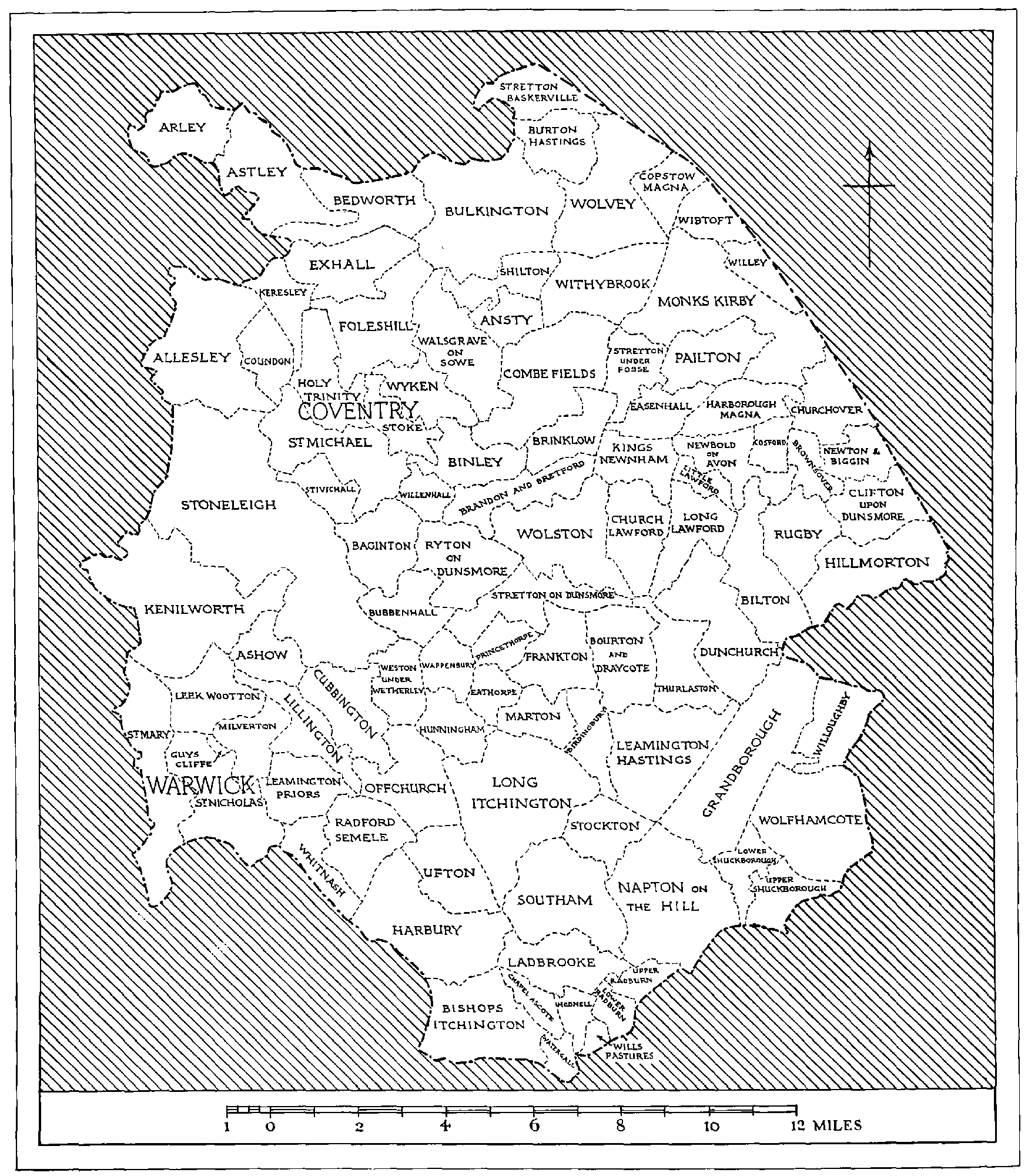
Map of Knightlow Hundred
This, the largest of the Warwickshire hundreds, lying on the east of the county contiguous to Leicestershire and Northamptonshire, was represented at the time of the Domesday Survey by three hundreds. Of these 'Bomelau', the northernmost, evidently had its centre in Brandon at a place still called 'Bumbelowe' in 1313 but now lost. Later the site of the court must have shifted to the neighbouring parish of Brinklow, of which the hundred took the title. (fn. 1)
South of this, the hundred of 'Stanlei', of which the centre was no doubt Motslow Hill in Stoneleigh, lay to the west and that of 'Meretone', or Marton, to the east.
During the 12th century these three were combined to form what was known as the 'sipesocha' of Knightlow, a term that had been replaced by 'hundred' by the beginning of the next century. The Domesday hundreds of Brinklow, Marton, and Stoneleigh continued to function, obscurely, as 'leets' until the end of the 16th century. (fn. 2) The use of the term 'leet' implies some kind of jurisdiction, though there is no evidence of courts subordinate or supplementary to the main hundred court. Early in the 17th century the hundred of Knightlow was reorganized on a basis of four High Constables' divisions—Kenilworth, Monks Kirby, Rugby, and Southam. These, in turn, were replaced in 1828 by the Petty Sessional divisions of Ansty, Leamington Priors, Rugby, and Southam, with a special sessions for licensing and the appointment of parish officers at Stretton-on-Dunsmore. (fn. 3)
A return of 1236–7 (fn. 4) shows that the hundred was then farmed for 40 marks (£26 13s. 4d.), sheriff's aid came to £15, and other issues, such as view of frankpledge, brought the total value to £46 10s. 5d.—the other hundreds of the county being, in round figures, Hemlingford £26, Kington £25, and Barlichway £15. Approximately the same figures were returned some 25 years earlier. (fn. 5) In 1283 the farm of the hundred, which had been in the hands of Richard de Stretton, was £29 17s. (fn. 6) The hundred remained with the Crown, being farmed out to various persons from time to time, until Charles I on 29 July 1628 granted it to Sir Francis Leigh with a number of small rents and a very long list of franchises. (fn. 7) From Sir Francis, later Lord Dunsmore, it descended with the manor of Dunchurch (q.v.) (fn. 8) to the Dukes of Montagu and so to the Dukes of Buccleuch, being still held by the present duke.
Among the issues of the hundred in 1236–7 was 'warth-penny' and among the franchises in 1628 'the wroth monies'. The payment of the 'wroth silver', as it is now called, has continued to the present time. (fn. 9) At dawn on St. Martin's Day (11 November) the steward of the Duke of Buccleuch and the representatives of such parishes and townships as owe these dues assemble on Knightlow Hill (in Ryton-on-Dunsmore) round a large stone, the base of a former cross, with a square hole (originally for the shaft of the cross) in it. The steward reads the 'Charter of Assembly' and calls the names of the parishes; their representatives then cast the required money into the hollow of the stone, saying 'Wroth Silver'. The penalty for non-payment is to provide a white bull with red nose and ears, or to pay a fine of 20s. for every penny not produced. The fees paid in this century are: 1d. from Arley, Astley, Birdingbury, Bramcote, Barnacle and Shilton, Little Walton, and Woolscot; 1½d. from Bourton and Draycot, Napton, Radford Semele, and Whitley; 2½d. from Bubbenhall, Churchover, Ladbroke, Princethorpe, Stretton-on-Dunsmore, Toft, and Weston-underWetherley; 4d. from Hillmorton, Hopsford, Wolston and Marston, and Lillington; 1s. from Leamington Hastings; 2s. 2d. from Long Itchington; and 2s. 3½d. from Harbury. These, with the exception of Harbury, occur with similar sums in the list given by Dugdale (c. 1650) (fn. 10) and in another of 1687; (fn. 11) Dugdale also includes Baginton, Bilton, Cestersover, Frankton, Harborough Magna, Newnham Paddox, Rugby, Shuckborough, and Whitnash, but the 1687 return lists these under the heading—'Wroth money denied to be paid'. For the most part the same figures apply to a list of 'warth' payments in 1367. (fn. 12) The sums appear to be arbitrary, and their significance is unknown. The idea that 'warth' is a corruption of 'ward' (fn. 13) is borne out by its appearance as 'wardpeni' in a return of the time of King John, (fn. 14) but it is not clear in what sense the word was used, and the persistence of the 'th' spelling, to which this is the only known exception, combined with the curious bull forfeiture, makes this derivation very doubtful. In this early return the same due was being paid in the other hundreds of Warwickshire, but not in those of the associated county of Leicester. Payments in the other hundreds have not been traced beyond the return of 1367, nor have we any knowledge whether similar forfeitures for non-payment were demanded in them.