A History of the County of Berkshire: Volume 4. Originally published by Victoria County History, London, 1924.
This free content was digitised by double rekeying. All rights reserved.
'Parishes: Brimpton', in A History of the County of Berkshire: Volume 4, ed. William Page, P H Ditchfield (London, 1924), British History Online https://www.british-history.ac.uk/vch/berks/vol4/pp51-55 [accessed 30 April 2025].
'Parishes: Brimpton', in A History of the County of Berkshire: Volume 4. Edited by William Page, P H Ditchfield (London, 1924), British History Online, accessed April 30, 2025, https://www.british-history.ac.uk/vch/berks/vol4/pp51-55.
"Parishes: Brimpton". A History of the County of Berkshire: Volume 4. Ed. William Page, P H Ditchfield (London, 1924), British History Online. Web. 30 April 2025. https://www.british-history.ac.uk/vch/berks/vol4/pp51-55.
In this section
BRIMPTON
Brinniggetun, Bryningtune (x cent.); Brintone (xi cent.); Brinton, Brimton, Brumton, Brumpton, Brimpton.
The parish of Brimpton lies on the Hampshire border, and is bounded on the north by the River Kennet and on the south for some distance by the Enborne Brook, which then crosses the parish and again for a time forms the boundary. The greater part of the parish lies at the end of a ridge, the highest point, in the west of the parish, being 340 ft. above the ordnance datum, while the valley, where the Kennet leaves the parish, is 150 ft. lower. The parish contains 1,705 acres, of which 561 are arable, 766 permanent grass and 263 woods and plantations. (fn. 1) The chief crops are wheat, barley and oats. The soil is principally gravel, but there are patches of clay, and alluvium in the Kennet valley. There are no railways in the parish, the nearest railway station being at Midgham, 2 miles away, but the high road from Newbury to Silchester runs through it from west to east.
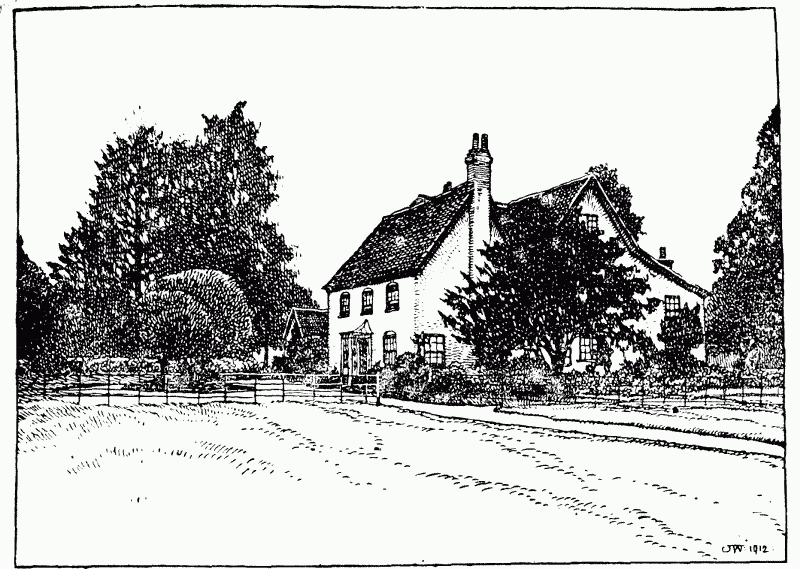
Shalford Fram, Brimpton
The village lies at the extreme west of the parish on the road from Newbury, on the top of a small hill and consists of brick cottages and a few houses, with an inn, a schoolhouse and some almshouses.
The Shalford Manor Farm House is a brick building with a plastered front and tiled roof, dating from the 17th century. On the Brimpton Manor Farm is the small desecrated chapel of St. Leonard which represents the Domesday church of Shalford Manor. It is a rectangular building measuring 35 ft. 5 in. by 20 ft. outside. The east window, now blocked, is of the 14th century, with three trefoiled ogeeheaded lights under a two-centred arch. In the north wall is an early 13th-century lancet with chamfered and rebated jambs. Near the west end of the north wall is a doorway of the late 11th century, with a semicircular head inclosing a tympanum on which is carved an enriched cross paty on a scale-pattern background. In the south wall is a wide blocked lancet window and a blocked 14th-century doorway with wave moulded jambs and a two-centred head with a label. There was formerly a window high in the west wall, but only the internal jambs are now visible. The walls, which have been restored, are of flint with stone quoins, and the roof is tiled.
There are groups of houses at Hyde End in the south-west and by Shalford Farm in the east of the parish. The commons were inclosed in 1815, and the award is deposited with the clerk to the parish council. There is a Baptist chapel here, and the seven almshouses were built and endowed in 1854 by the Countess of Falmouth, and called St. Peter's Almshouses.
At the south-east corner of the parish are five barrows, two of which were explored by Canon Greenwell. (fn. 2) A mediaeval bronze steelyard weight was found in the garden of the old moated house at Brimpton Manor. (fn. 3)
Manors
In 944 King Edmund granted to his servant Ordwulf certain lands at Brimpton which the latter gave to the abbey of Abingdon, (fn. 4) but the monks seem to have held no lands here after the Norman Conquest.
The manor of BRIMPTON, which belonged in the time of Edward the Confessor to Godwin, was held by Ralph de Mortimer at the time of the Domesday Survey. (fn. 5) The overlordship passed from him to his son Hugh, the founder of Wigmore Priory, who died in 1181, (fn. 6) and from Hugh to his son Roger, who married Isabel Ferrers and died in 1214, and afterwards followed the descent of the family of Mortimer of Wigmore and later of the earldom of March. When Edmund fifth Earl of March died childless in 1424 his heir was his nephew Richard Duke of York. (fn. 7) After his death in 1460 the overlordship remained in the hands of his widow Cicely, (fn. 8) and on her decease in 1495 it reverted to the Crown. A rent from the manor was granted by James I in 1604 to his consort Anne, (fn. 9) and amounted to nearly £20. (fn. 10)
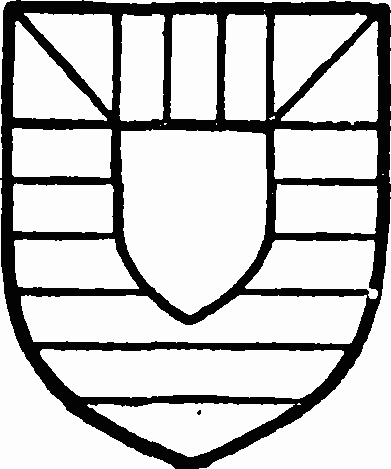
Mortimer. Barry or and azure a chief or with two pales between two gyrons azure therein and a scutcheon argent over all.
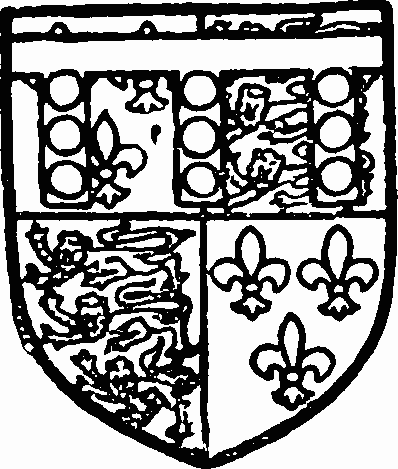
York. The royal arms of FRANCE and ENGLAND with the difference of a label argent with roundels gules.
Gilbert de Brinton, the first under-tenant of whom we have mention, rendered account for land in 1166–7, (fn. 11) and in 1216 Adam de Brinton was in revolt and his lands were given to his brother John. (fn. 12) Either this Adam or a successor held the fee in the reign of Henry III (fn. 13) and died in 1274–5, when he was succeeded by his son Adam. (fn. 14) The latter died before 1315–16, when John de 'Brumpton' held this manor. (fn. 15) He received a grant of free warren in 1320, (fn. 16) and died in 1336 seised among other property of a messuage and 2 carucates of land in Brimpton. (fn. 17) His son, then aged twenty-five, succeeded him, his mother Isabel retaining a life interest in Brimpton. (fn. 18) The manor was settled by him and his wife Agnes in 1364. (fn. 19) He seems to have died before 1379, when John de Lichefeld and Elizabeth his wife, possibly trustees for a settlement, granted the manor to Thomas de Brumpton. (fn. 20) A John 'Brounton' is mentioned as holding two-thirds of a fee here in 1398, (fn. 21) but at this point the history of the manor becomes obscure.
Before 1424 the manor came into the hands of William Stokes, (fn. 22) who died seised of it in 1427. (fn. 23) He was succeeded by his son John, who was holding half a fee here in 1428 (fn. 24) and in 1434. (fn. 25) His son William died seised of the manor of Brimpton in 1477, (fn. 26) and in 1490 it was claimed by his sisters Agnes the wife of Richard Everard and Elizabeth the wife of John Hannington. But Sir Thomas Delamare, one of the trustees of a former settlement, resisted their claim and produced Joan, said to be the daughter of William, aged eleven at her father's death. (fn. 27) It seems probable that he made good this claim, as Joan with her husband Thomas Boteler (fn. 28) conveyed the manor in 1529 to Walter Barton and others, (fn. 29) trustees for Sir Thomas Englefield, who died possessed of the manor in 1538, (fn. 30) when he was succeeded by his son Francis, who was afterwards knighted. Sir Francis was attainted in 1586, and in the next year some of his forfeited lands were let to farm to Humphrey Forster on a lease of twenty-one years under the Crown. (fn. 31) In 1589 the manor was granted to Thomas Crompton, Gellie Meyrick and Robert Wright, (fn. 32) who in 1595 sold it to William Wollascott the younger and Anne his wife. (fn. 33) This William was the son of the William Wollascott who had some years previously obtained the manor of Shalford in this parish, (fn. 34) and in 1614 he settled the manor of Brimpton on himself and his wife Anne and his eldest son William on the occasion of the latter's marriage with Susan daughter of Thomas Freer, M.D. (fn. 35) In 1617 he obtained a grant of view of frankpledge. (fn. 36) In 1618 William Wollascott the elder died and the son inherited the manor of Shalford and other adjoining lands, (fn. 37) of which he died seised 9 May 1637. (fn. 38) His son William, who succeeded him, and who in 1654 and 1656 made settlements of the manor, (fn. 39) died in 1660. (fn. 40) In 1662 his executor, who was his brother Martin, was holding the manor, (fn. 41) probably as guardian of William's heir. William's son William, who married Dorothy Paston, (fn. 42) seems to have predeceased his father, but their daughter and heir Katherine, wife of Thomas Wollascott, had a son Martin who was born in 1661. (fn. 43) This Martin succeeded to the manor, holding in 1691, (fn. 44) and dying seised in 1713. (fn. 45) His son and heir William, a minor in 1713, (fn. 46) made a settlement in 1717. (fn. 47) This William married Henrietta Maria daughter of Sir Baldwin Conyers, on whose issue he settled these estates. He died 9 January 1757 and the manors of Brimpton and Shalford seem to have passed to his only daughter Henrietta Maria, who was married in 1755 to Arthur James Plunkett, seventh Earl of Fingall, when the manors were settled on them. (fn. 48)
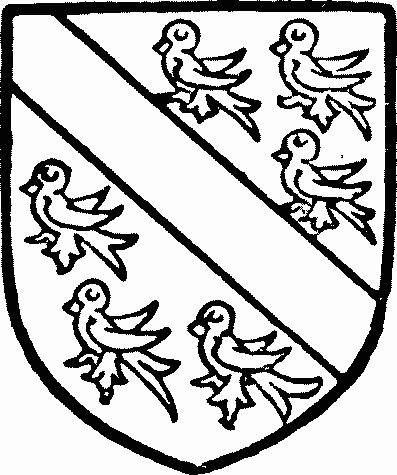
Wollascott. Sable a bend between six martlets or.
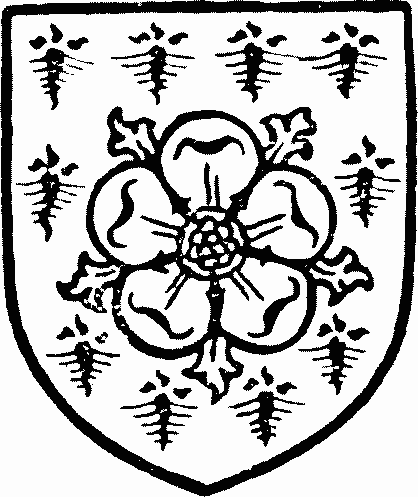
Boscawen, Viscount Falmouth. Ermine a rose gules.
In 1784. the Earl of Fingall still held the manors of Brimpton and Shalford, (fn. 49) but sold them about two years later to John Crewe of Bolesworth Castle, Cheshire, whose widow Elizabeth was holding them early in the 19th century. (fn. 50) Their only child, Elizabeth Anne, married in 1784 George Evelyn Boscawen, third Viscount Falmouth, and died in 1793. At the death of Elizabeth Crewe Brimpton and Shalford seem to have passed to their son Edward fourth Viscount Falmouth, who held them in 1811, (fn. 51) and descended with the title until 1856, when Lord Falmouth sold these manors to James Blyth, (fn. 52) who died in 1873, leaving six daughters. The eldest, Isabel, had been married in 1859 to Robert Burn, and the second, Euphemia Anna, had in 1860 become the second wife of James Pattison Currie. By his will dated 30 March 1865 James Blyth left these manors to his son-in-law Robert Burn, (fn. 53) who with his wife Isabel obtained a royal licence in 1874 to add the surname of Blyth to that of Burn. (fn. 54) Robert BurnBlyth died (fn. 55) without issue in 1890 and his widow in 1904. The manors then passed to the younger sister and her husband, who assumed by licence in 1904 the additional surname of Blyth, and put the manors of Brimpton and Shalford up to auction on 29 May 1905. As the reserve was not reached, these lands were shortly afterwards sold by private treaty, (fn. 56) and the greater portion of the Brimpton estate was bought by Mr. W. A. Mount, M.P., J.P., of Wasing Place, its present owner. (fn. 57) All manorial rights seem to have lapsed.
The Domesday Survey states that there was a mill belonging to this manor, (fn. 58) and at later dates there is mention sometimes of one and sometimes of two mills. (fn. 59) A mill at Brimpton still exists, and seems always to have belonged to the lord of the manor until it was sold in 1905 to its present owner and occupier, Mr. T. James. (fn. 60) Another mill, at Hyde End, Brimpton, was recently converted into a trout hatchery, which is the property of the Hyde family.
A free fishery in the water of Brimpton was in 1627 conveyed by John Hyde, Anne his wife, and John Hyde, junior, their son, to James Hunt and another, (fn. 61) and is mentioned later. (fn. 62)
The manor later known as SHALFORD (Scealdanford, x cent.; Scaldeford, xiii cent.; Shaldeford, xiv cent.; Shalforde, xvi cent.) was held in 1086 by Robert the son of Girold as 3½ hides in Brimpton. It had been held in alod of King Edward by Brictric. (fn. 63) Robert's estates seem to have passed at his death through his brother Gerald to the latter's son Roger and then to his son William de Roumare. William died before 1168, and as his son William had predeceased him in 1151 he was succeeded by his grandson William de Roumare, Earl of Lincoln, who died without issue before 1198. It seems to have been a tenant of this William, by name Simon de Ovile, who granted this manor, which was still assessed at 3½ hides, to the Knights Hospitallers of St. John of Jerusalem. (fn. 64) We have a reference to the Hospitallers as holding land here in 1251 (fn. 65) and again in 1275–6, when they are described as of Shalford. (fn. 66) In 1302 the king appears to have been the guest of the Knights here, for Letters Patent were dated from Shalford 29 November, (fn. 67) and the Hospitallers continued to hold this manor till their dissolution in 1540, when Shalford passed to the Crown.
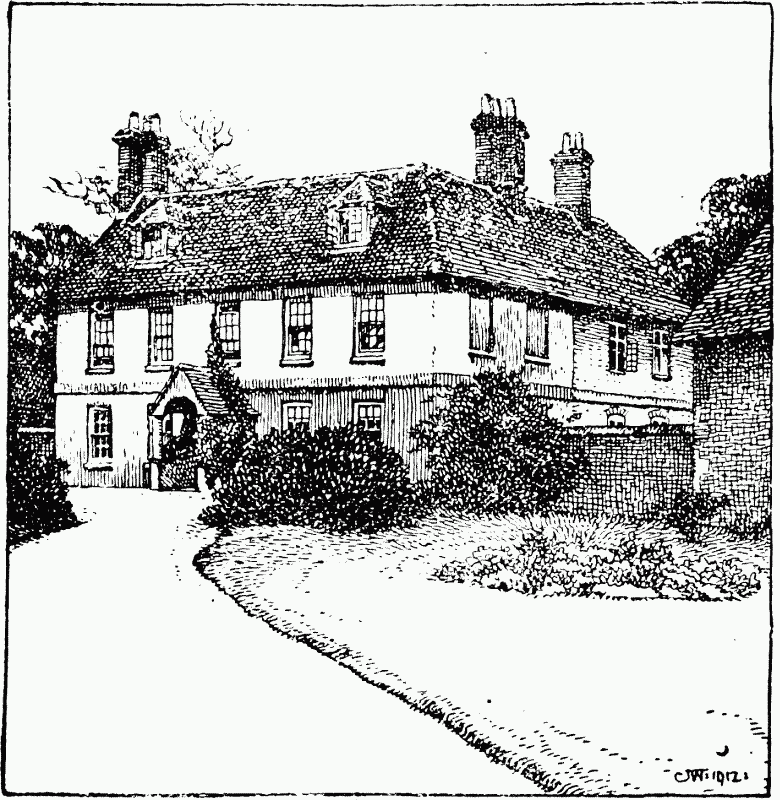
Brimpton Manor Farm
In 1544 the king exchanged this manor for the manor of Dalehall in Lawford, Essex, with William Wollascott, (fn. 68) who settled it in 1587 on the marriage of his son to Anne daughter of Edward and Mary Martin. (fn. 69) William died in 1618 seised of the manor of Shalford and the advowson of Brimpton (fn. 70) and was succeeded by his son William, who had purchased the manor of Brimpton (q.v.) in 1595. The subsequent history of the two manors is the same.
It is stated in the Domesday Survey that there were two mills belonging to this manor, worth 26s. 3d. yearly. (fn. 71) In 1336 one of these was held by John de Brumpton of the master of the hospital of St. John of Jerusalem. (fn. 72) The other seems to have disappeared before 1654, when William Wollascott had only two mills with the two manors. (fn. 73) In 1717 only one mill is mentioned, (fn. 74) and none exists there at the present day.
The nuns of Kington in Wiltshire held part of a fee in Brimpton in the 14th and 15th centuries. (fn. 75) They may have held by grant of Adam de Brinton, who, with other members of his family, and with the Mortimers, made several grants to this house. (fn. 76) Possibly it was this land which was held as the manor of KINGS BRIMPTON by Sir Peter Bessels at his death in 1426 and afterwards by his widow, (fn. 77) and in the 16th century by Sir Francis Englefield, (fn. 78) when, doubtless, it was amalgamated with the main manor.
At Hyde End, in the south-west of the parish, was an estate called HYDE, occasionally termed a manor. (fn. 79) The family of Hyde, who possessed it from at least the 16th to the 18th century, had a vault in the old church. One of the later stones inscribed to their memory records the death of John Hyde in 1715 and of his widow Mary four years later. (fn. 80)
Church
The church of ST. PETER was erected in 1869 on an old site, (fn. 81) and is designed in the 14th-century style. It consists of a chancel, north organ chamber, south vestry, nave of three bays with north and south aisles and shallow transepts, a west tower and a south porch.
The walls are of flint with stone dressings and are faced inside with ashlar. The columns of the nave arcade and some shafts in the chancel are of polished granite. The porch is of wood and all the roofs are tiled. The tower is of three stages and has an octagonal shingled spire. All the internal fittings are modern. In the spandrel of the north transept window is a small fragment of glass, possibly old. The font (fn. 82) of the old church is said to have been a plain Norman one without ornament.
The belfry contains four bells, the treble being simply dated 1642; the second was cast by Thomas Mears, 1842; on the third is the inscription 'Love God 1642,' and the fourth is a recasting by Mears & Stainbank in 1876 of an old bell which was inscribed 'Prayes ye the Lord 1624.'
The plate comprises a paten and cup, apparently of the late Elizabethan period, the only mark being TS. There are also a paten of 1800 and a modern chalice, paten and flagon.
The parish registers begin in 1678.
Advowson
The Domesday Survey mentions a church on Ralph de Mortimer's (fn. 83) manor of Brimpton. Before the 14th century (fn. 84) it came into the hands of the Hospitallers and in a survey (fn. 85) of Greenham Preceptory made in 1338 the impropriate church of Brimpton is valued at 60s. In their hands it may have remained till the Suppression. In the Valor (fn. 86) the vicarage of Brimpton is returned at £6 18s. 2d. In 1588–9 the advowson was included in the grant to Thomas Crompton and others. (fn. 87) It continued to pass with the manor until 1717, when it is mentioned in the settlement then made. (fn. 88) It appears to have been sold not long afterwards, for it is not referred to in the settlement of 1755. (fn. 89)
William Wollascott presented in 1626, (fn. 90) but in 1638 a presentation was made by Sir Thomas Vachell, Richard Libbeare and Thomas Hayward. (fn. 91) Whether these were executors under the will of William Wollascott, who died the previous year, is not certain, for as the family were recusants they were unable to present and so disposed of their right. This seems the more likely explanation, as Thomas Hunt presented in 1684 and Anthony Chute in 1732. (fn. 92) In 1769 John Deane presented, as did Maria Cove in 1800. (fn. 93) Lysons states that the patronage of the vicarage had long been annexed to the manor, (fn. 94) and this statement is repeated without comment in the History of Newbury (1839). (fn. 95) It must, however, have been separated from the manor shortly afterwards, as in 1849 the Rev. George Benjamin Caffin was vicar of Brimpton and patron of the living. He died in 1878, leaving the advowson to his son the Rev. George Crawford Caffin, at whose death in 1895 it passed to his son Mr. G. F. C. Caffin. (fn. 96) The latter sold it in 1904 to Mrs. Matilda C. de Courcelles, who died recently, leaving the advowson in the hands of her executor as trustee. (fn. 97)
The second church (fn. 98) which according to the Domesday Survey lay in Brimpton is represented by the desecrated chapel of St. Leonard. (fn. 99) When Shalford, or as it was sometimes called Brimpton Court, (fn. 100) formed a member of Greenham Preceptory the Hospitallers paid 26s. 8d. towards the stipend of a chaplain (fn. 101) here, who celebrated three times a week. He received no commons and was evidently not attached to the order. Christenings and burials were reserved to the vicar of the mother church. (fn. 102) In 1338 the Hospitallers' house at Shalford was in bad repair, and it is probable that soon after the whole estate was leased to the holders of the adjacent manor of Brimpton, to whom also the patronage of the free chapel seems to have passed, since in the 15th century the Stokes family (fn. 103) were in possession, while in 1538 Sir Thomas Englefield died seised of this advowson. (fn. 104) In 1535 the gross value of the free chapel of Brimpton was returned at 40s. (fn. 105)
Under the Chantries Act Brimpton Chapel was scheduled for suppression. The incumbent at this time was William Smith, and there existed an endowment for a mass annually on St. Lawrence's Day. (fn. 106) The net stipend (fn. 107) of the priest was 36s. On the suppression one Edmund Cryspyn bought the chapel—of which the endowments were 3 a. in two closes known as Parsonage Closes, 4 a. of arable in the common fields and tithes arising from the manor or farm of Brimpton Court—at twenty-two years' purchase for £49 10s. He found, however, on attempting to get possession that Sir William Smyth, the parson, had already let the tithes at the Michaelmas before to one William Perkins at 40s. a year. The priest died a month after this lease, but Perkins refused to leave and occupied as tenant at will of Sir Francis Englefield, famous later as statesman, recusant and exile. Litigation accordingly ensued. The exact result is unknown, but Perkins's contention was that St. Leonard's was not a free chapel under the Act. It is possible that even in the reign of Henry VIII the chapel was hardly used except for the mass once a year. In 1576 the chapel (fn. 108) with the rectorial tithe was granted by the Crown to John Mershe and others, and later, in 1614, all the tithes in Brimpton were among the property settled by William Wollascott, (fn. 109) and the chapel had become entirely secularized.
Charities
William Wollascott, by will 1628, charged the manor of Somerford Boles, Wilts., with certain annuities, amounting to £3 0s. 10d., for certain charitable and public purposes. The rent-charges were redeemed in 1870 by the transfer to the official trustees of £101 13s. 4d. consols.
In 1906 the sum of £28 2s. 8d. consols was apportioned as an ecclesiastical charity in satisfaction of the annuities for the church, &c., and £73 10s. 8d. consols for the non-ecclesiastical purposes.
In 1906 there were accumulations in the savings bank of £30 1s. 6d. in respect of the ecclesiastical branch and £54 19s. 7d. in respect of the non-ecclesiastical charities.
The annual sum of £1 4s. is paid out of a field in Woolhampton, no. 636 on the ordnance map, in respect of a devise by will of Thomas Goddard, 1680, for the donor's poorest kindred.
An annuity of 10s. is also paid out of the Woolhampton estate in respect of a devise by will of Richard Goddard, which is distributed among ten poor widows on St. Thomas's Day.
Church lands. The churchwardens are in possession of two cottages and gardens, and 4 a. 2 r. under an inclosure award dated in 1815, producing £13 16s., applied usually for the repairs of the church.
The school. In 1864 Ann Frances Countess of Falmouth, by her will proved 26 May, bequeathed £666 13s. 4d. consols, the dividends, amounting to £16 13s. 4d., to be applied as an addition to the salary of the schoolmistress. The stock is held by the official trustees.
St. Peter's almshouses for aged married couples and aged widows were erected by the above-mentioned Countess of Falmouth, who by her will bequeathed £3,000 for the repair, maintenance and support thereof. The trust fund, with accumulations, is represented by £3,198 0s. 4d. consols with the official trustees, producing an income of £79 19s. a year. Each inmate receives 4s. a week, with an extra payment at Christmas and Easter.
By an award dated in 1815, made under the Inclosure Act of 1811, (fn. 110) two plots, containing together 4 a. 2 r. 3 p., were allotted to the lord of the manor, the vicar and churchwardens and overseers of Brimpton, as trustees of the poor, as fuel allotments.