A History of the County of York North Riding: Volume 2. Originally published by Victoria County History, London, 1923.
This free content was digitised by double rekeying. All rights reserved.
'Parishes: Seamer', in A History of the County of York North Riding: Volume 2, ed. William Page (London, 1923), British History Online https://www.british-history.ac.uk/vch/yorks/north/vol2/pp483-489 [accessed 30 April 2025].
'Parishes: Seamer', in A History of the County of York North Riding: Volume 2. Edited by William Page (London, 1923), British History Online, accessed April 30, 2025, https://www.british-history.ac.uk/vch/yorks/north/vol2/pp483-489.
"Parishes: Seamer". A History of the County of York North Riding: Volume 2. Ed. William Page (London, 1923), British History Online. Web. 30 April 2025. https://www.british-history.ac.uk/vch/yorks/north/vol2/pp483-489.
In this section
SEAMER
Semær (xi cent.); Semere (xi–xviii cent.); Semar (xii-xvi cent.); Seymer, Semour (xvi-xviii cent.).
This parish is composed of the townships of Seamer and Irton and the chapelry of East Ayton. Its area is 8,450 acres, of which 18 acres are covered by water, 4,422 acres are arable, 2,178 acres permanent grass and 738 woodland. (fn. 1) The subsoil is Alluvium, Oxford Clay, Corallian Beds and Inferior Oolite. In Ruston Cliff Wood by the Derwent, the western boundary, are Whetstone Quarry, Whetstone Trod, Ayton Forge Cottages and Wallis Quarry, and there is a quarry at Crossgates. This hamlet lies at the junction of the Scarborough and Filey roads, which unite before passing through Seamer on their way to York and Driffield. The chief crops are wheat, barley, oats, potatoes and turnips. In 1768 1,337 acres were inclosed in East Ayton. (fn. 2) The village of Seamer is built upon practically level ground and contains no features of any antiquity. The church of St. Martin and the vicarage are in the centre. A short distance to the west of the church are some scanty remains of the manor-house. A ruined fragment of wall containing a 15th-century doorway is now all that is standing above ground, but extensive foundation mounds may be traced in connexion with it.
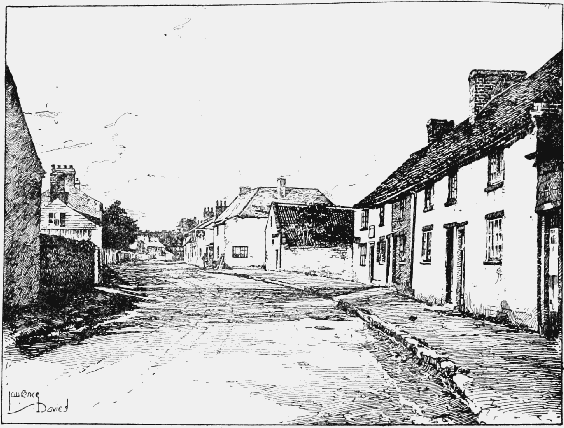
View in Seamer Village
Although Topcliffe was the chief Yorkshire seat of the Percys, they were frequently at Seamer. Their house here is mentioned in 1304. (fn. 3) It seems to have been used as a dower-house, (fn. 4) and is called a castle in 1547. (fn. 5) Henry Lord Percy in 1349 bequeathed 1 mark to 'Robert of the Wardrobe Chamber of Seamer,' (fn. 6) Philippa wife of Sir Ralph Percy, kt., was abducted from here in or before February 1384–5, (fn. 7) Katharine Countess of Northumberland dated letters to Cromwell in January 1534–5 and 1538 at Seamer, (fn. 8) and Sir Thomas Percy, brother of the seventh Earl of Northumberland, (fn. 9) was described as 'of Seamer,' where the manor-house was evidently used as a dowerhouse, at the time of his trial and attainder for his share in Aske's rebellion. (fn. 10) Their successors the Gates lived here, and a brass in the church records the noble and royal descent of Dame Lucy Gate, who died 'in Aedibus Semeriis' in 1577. (fn. 11)
Seamer was formerly of much greater importance than it is now. Leland went 'from Shirburne by hilles on the right hond and low ground with carres on the lift hond a v. miles to Semar, a great uplandisch toune, having a greate lake on the south west side of it, whereof the toun takithe name.' (fn. 12) In 1376 it was declared that it would not be to the king's damage or that of neighbouring towns if Henry Lord Percy had a market and fair in his 'borough' of Seamer, (fn. 13) and in 1382 the king granted him a market every Monday and a fair yearly in July on the feast of St. Martin and for seven days following. (fn. 14) The market died out, and its revival about 1576 by Sir Henry Gate roused the protests of the burgesses of Scarborough, 3 miles away. An inquiry was held in January 1583–4, when the inhabitants of neighbouring villages said that Seamer market was much more accessible and better stocked than that of Scarborough, that the roads to Scarborough were 'evil and miry' in the winter, and that the loss of the new market would be the greatest that had ever befallen these parts. (fn. 15) In 1592 Scarborough again complained of its impoverishment and threatened inability to pay its subsidies, (fn. 16) but in 1609 James I granted Thomas Mompesson, lessee of this manor (fn. 17) a market and fair as in the grant of Richard II, with court of pie-powder, &c., 'if the said market and fair are not to the damage of other towns.' (fn. 18) A cattle market is now held every Monday and a yearly fair in July.
The village has seen several scenes of violence. In 1319 prisoners having been sent from York gaol to Scarborough Castle, the convoy was attacked at Seamer on its way home by twenty-three men including the parson, goods taken from the wagons, the horses shot with arrows, and the king's men assaulted and imprisoned. (fn. 19) In 1548 some of the inhabitants rose against the commissioners for the suppression of the chantries. They lighted the beacon at Staxton and collected a company of 3,000 persons, who carried Matthew White, one of the commissioners, and two others from their beds to the wolds above Seamer and there murdered them. The ringleaders were executed at York on 21 September 1549. (fn. 20) Then in February 1640–1 Lord Carnarvon's troops stationed at Hutton Bushel and Ayton gave cause for bitter complaints. They severely wounded Robert Wyvill of Osgodby, a justice of the peace, in the town street of Seamer for interfering with their conduct, and he having escaped from the town they 'swaggered about the street with drawn swords.' Sir John Conyers wrote that this was 'a foul fact.' (fn. 21)
East and West Ayton are contiguous townships separated by the River Derwent on which were various mediaeval mills (fn. 22); the river is crossed at Ayton Bridge, a modern stone bridge of four arches. The Scarborough race-course is on Seamer Moor to the north. On a tumulus at the highest point of the moor (about 600 ft. above the ordnance datum) is Seamer Beacon, the repair of which was paid for by the eastern division of the wapentake in the 16th and 17th centuries. (fn. 23)
At Irton are the Scarborough Waterworks.
The Wesleyan chapel at Seamer was rebuilt in 1893. There are Primitive Methodist chapels at Seamer and East Ayton. Seamer has a station on the York and Scarborough section of the North Eastern railway at the junction of the branches to Pickering and Driffield.
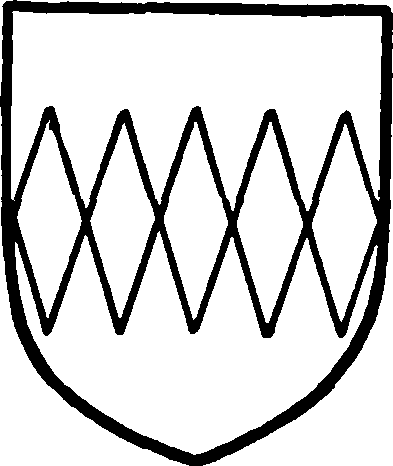
Percy. Azure a fesse indented or.
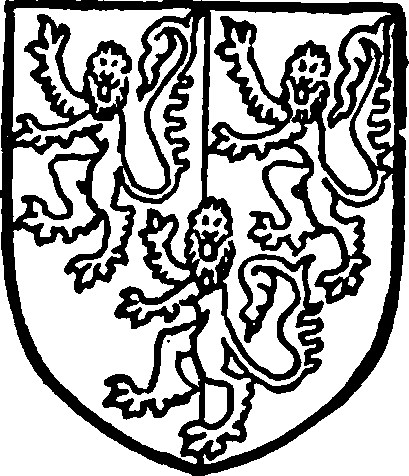
Gate. Party gules and azure three leopards rampant or.
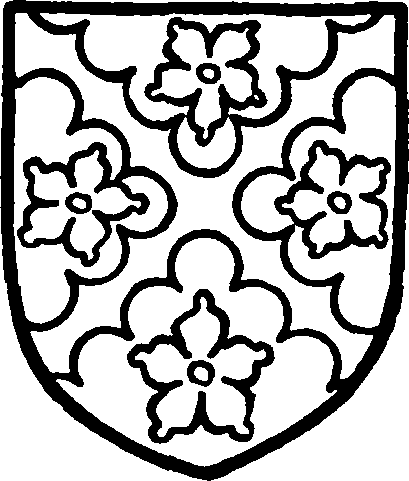
Napier. Argent a saltire engrailed between four cinqfoils gules.
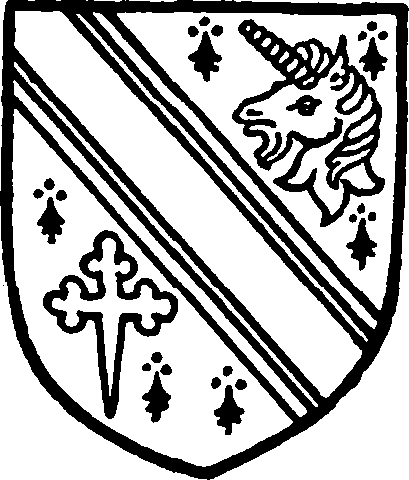
Denison. Ermine a bend azure cotised sable between a unicorn's head razed and a crosslet fitchy both gules.
Manors
Before the Conquest Carle held in SEAMER 6 carucates of land at geld as one 'manor,' (fn. 24) which was given by William I to William de Percy (fn. 25) with Topcliffe (q.v.) and other places, and continued to descend with Topcliffe as a member of that 'honour' (fn. 26) until Henry Percy Earl of Northumberland made over this and other manors to the Crown early in 1536–7. (fn. 27) Queen Mary granted the manor to Sir Henry Gate in 1555. (fn. 28) Sir Henry, a member of the Council in the North, (fn. 29) died in 1589 seised of the manor, capital messuage, advowson and rectory of Seamer and chapels of Cayton and Ayton, leaving a son and heir Edward, (fn. 30) who early in the 17th century made leases and conveyances to various people, including Edward Mompesson. (fn. 31) Edward Gate with Sir John Thornburgh his guardian (fn. 32) and others made a settlement in 1613, (fn. 33) perhaps for a conveyance to Sir Nicholas Salter of London, kt., (fn. 34) who was lord of Seamer, East Ayton and Irton in 1619–21. (fn. 35) Sir Nicholas Salter, Nicholas Polehill, John Mompesson and William Lacy in 1623 conveyed the manor and advowson to Edward Wareham and William Talbot, (fn. 36) who in 1631 enfeoffed Sir Robert Napier, jun., kt. (fn. 37) Robert Napier of Luton Hoo (Beds.), father of the new owner, was created a baronet in 1611 and was succeeded in 1636–7 by this son, who died in March 1660–1. (fn. 38) Robert, eldest son of the latter, died in his father's lifetime, leaving a son Robert, who appears to have been disinherited by his grandfather and died in 1675. (fn. 39) John, son of the second baronet by his second wife Penelope daughter of John Earl of Bridgewater, (fn. 40) was owner of Seamer in 1661. (fn. 41) He became insane and died in 1711, leaving sons Theophilus and Archibald. Theophilus inherited Seamer (fn. 42) and died childless in 1719. (fn. 43) The Napiers presented to the church, with which the manor appears to have descended, until 1782. (fn. 44) The Denisons of Leeds and London (fn. 45) had succeeded to the advowson by 1790. (fn. 46) William Joseph Denison of Seamer died unmarried in 1849, and his sister Mary dying childless, most of his estates went to Lord Albert Denison Denison (who then took that surname), son of his sister Elizabeth by Henry first Marquess Conyngham. Lord Albert Denison was in 1850 created Lord Londesborough and died in 1860. (fn. 47) His son and heir William Henry Forester, in 1887 created Viscount Raincliffe and Earl of Londesborough, was in 1900 succeeded at Seamer by his son William Francis Henry second and present Earl of Londesborough. (fn. 48)
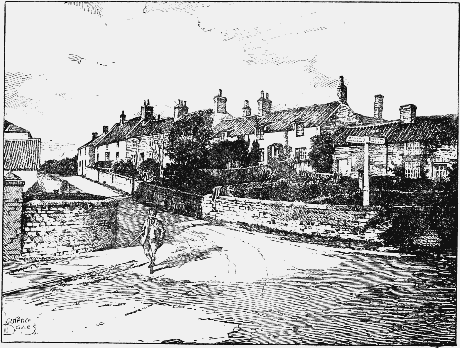
View in East Ayton Village
In 1284–5 it was declared that the ancestors of Henry de Percy had held their courts at Seamer, and had had gallows and amendment of the assize of ale. (fn. 49)
In 1252 Henry III granted to Ellen de Percy that her woods of Raincliffe (Ravensclive), Cumbes and Eggel in the forest of Pickering, appurtenant to this manor, should be quit of the regard of the forest for her lifetime. (fn. 50) In 1334 Henry Percy established his claim to have this manor and its woods, to have free warren, to hunt foxes, hares, cats and badgers, to root up heath, and have forges, minerals, vaccaries, sheepfolds and agistment in the manor, and to take what wood he pleased within the manor without view of the foresters. (fn. 51) In 1339 he claimed to have a woodward carrying bow and arrows in his wood for protecting the venison and to take roebucks at will. He was summoned to appear, as it was said to be contrary to the assize of the forest for a woodward to carry bow and arrows and his ancestor had been fined for hunting the roebuck at the last forest eyre; but it was determined that the roebuck was a beast of the warren, not of the forest, and it was not found that his woodward had caused destruction of the deer by carrying bow and arrows. (fn. 52)
Blacre, Ghilander and Torbrand held 6 carucates in EAST AYTON (Atune, xi cent.; Aton, xiii–xvii cent.; Hayton, Haton) before the Conquest, as three 'manors.' These were held by William de Percy in 1086, when another 2 carucates which had previously belonged to Gamel were among the lands of Berenger de Toni. (fn. 53) Unlike most Yorkshire places its value had increased since 1066. (fn. 54)
The 2 carucates held by Berenger de Toni descended to the Bigods, (fn. 55) but did not form a manor.
Early in the 13th century Nicholas de Stutevill held three knights' fees of Niel de Mowbray in Irton, Ayton 'and elsewhere' (fn. 56); but these fees are no further heard of, and, like Seamer, the manors of Irton and East Ayton were held in chief by the Percys. The manor has descended with Seamer (fn. 57) and belongs to the Earl of Londesborough.
In Thorpfield (Torp) (fn. 58) and IRTON (Iretune, xi cent.; Herton, Hirton, Urton, Hurton, Yreton) Carle and Blacre held 4½ carucates as two 'manors' before the Conquest, when these lands were granted to William de Percy. (fn. 59) They have since descended with Seamer and East Ayton. (fn. 60)
The family of Irton held lands here in the 13th and 14th centuries. (fn. 61)
Churches
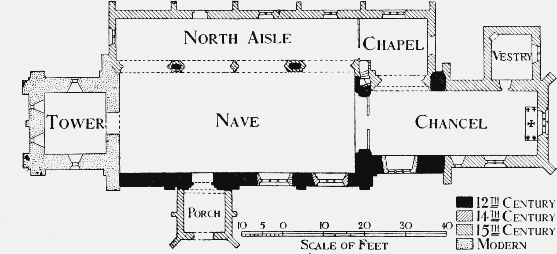
The church of ST. MARTIN consists of quire 44 ft. 7 in. by 15 ft. 8 in., with a chapel and vestry on the north, nave 57 ft. 7 in. by 24 ft. 7 in., a modern west tower and a south porch. The original 12th-century building was aisleless, and a central tower was evidently first contemplated, but was probably never erected.
Plan of Seamer Church
The quire is of two periods, the western portion being of mid-12th-century date. It appears to have formed the base to the original central tower, the walls here being considerably thicker than in the contemporary work in the nave, while the chancel arch has been cracked and distorted by a superincumbent weight. In addition to this the external stringcourse on the north side indicates that the 12thcentury eastern buttresses occupied the same position as the existing 15th-century buttresses, which would make the space beneath the tower a square of about 16 ft. The head of an original 12th-century window opening remains in the north wall, which has been cut away in the 15th century to form an opening into the small chapel on the north side. The chancel arch is a fine specimen of 12th-century work recessed in three orders with roll mouldings on the angles. The outer order is further ornamented with a series of small fluted pallets, one to each voussoir. The responds have side shafts, the inner one being cut back a short distance below the capital when the rood screen and stair were erected, c. 1480. The eastern tower arch with the sanctuary was pulled down in the 15th century and the existing east end erected, the 12thcentury masonry being largely used in the rebuilding. The east window of three lights has restored tracery, and in the south wall is a square-headed window of the same date and a small piscina. On the north side of the quire is a small vestry of late 15th-century date entered by a door within the altar rails. It is roofed with a pointed barrel vault and has a two-light east window and a fireplace across the north-west angle.
The original 12th-century nave remains largely intact. It is four bays long, the exterior being divided up by flat buttresses and faced with ashlar. The walls internally are divided vertically by a plain stringcourse chamfered on the lower edge, and forming a sill to the windows. Of these last the four on the north side remain entire, as do two with the blocked head of a third on the south. They are plain single lights with a roll moulding to the arch and a deep rebate to the internal jamb, which, however, is only occupied by a side shaft in the eastern window on the north side. The south door has a semicircular head and is now recessed in two orders with side shafts with fluted capitals. Originally it possessed a third order, of which only the base remains, and was finished with a gabled pediment, but both these features were cut away when the south porch was added in the 15th century. Considerable alterations were made to the nave in the 14th and 15th centuries. A large threelight window was inserted c. 1350 in the eastern part of the south wall, probably to light an altar of which the piscina remains beneath it. A second window was subsequently cut further west in the same wall in the 18th century. About 1480 the north aisle was added, the arcade was built into the existing wall piece by piece and two large masses of 12th-century masonry were allowed to stand after the alterations were completed, throwing the four arches out of the centres of the 12th-century windows above them. The arcade rises rather above the early string-course and the lower parts of the windows were consequently blocked up. The later work is of very rude and poor execution and the aisle windows of two lights have plain uncusped heads. This aisle was continued one bay eastward beyond the nave, forming a small chapel, of which the east window is now blocked.
The tower with the west end is an entirely modern work, taking the place of a ruined structure rising as high as the nave parapet only. It had massive clasping buttresses at the angles and was apparently of late 12th-century date. (fn. 62) The present tower contains three bells, the earliest being inscribed, 'Nil Desperandum Christo Duce er rn kb 1639.' The other two are dated 1793 and 1887.
Beneath the chancel arch is a handsome Jacobean rood screen, five bays in width, the centre bay or doorway being arched with two shields in the spandrels, repeated also on the east face. The first is charged with the arms of Napier quartered with Menteith; on the other is painted a crest of a bird standing on a hat gules. As Sir Robert Napier, jun., only acquired the manor in 1631 the screen cannot be earlier than that date.
The pulpit is mainly modern, but has some excellent Tudor panelling, and the old communion table, of 17th-century date, is now in the vestry.
The monuments are not of great importance. In the north chapel is a lengthy inscription on brass to Lucy wife to Sir Henry Gate, who died in 1577, tracing her descent from Edward III. On the floor of the same chapel is the casement of a large brass with a single figure and canopy. In the quire is a brass inscription to the Rev. John Lisle, who died in 1694, with his coat of arms, two others to Stephen Lee, 1736, and James Galpin, 1751, and a casement of two figures under a canopy.
A sanctus bell found near Seamer station is preserved in the church. It has a deep cut in the rim and bears three embossed panels representing St. Mary the Virgin, St. Michael and the Resurrection, with an inscription and the date 1548.
The plate of this church is all modern.
The registers previous to 1812 are as follows: (i) all entries 1587 to 1671; (ii) all entries 1672 to 1748; (iii) marriages 1749 to 1753, baptisms and burials 1749 to 1812; (iv) marriages 1754 to 1812.
The chapel of ST. JOHN BAPTIST, East Ayton, is a small building of rubble masonry consisting of quire 28 ft. 1 in. by 12 ft. 7 in., an aisleless nave 44 ft. 5 in. by 17 ft., a south porch and a western tower.
The quire is a 13th-century structure much patched and altered in the 15th and 18th centuries. One lancet window remains in the south wall and further west are two windows and a blocked priest's door of the 15th century. The tie-beams of the old roof remain exposed, but a flat plaster ceiling has been inserted about 2 ft. above them. This alteration was probably made when the east wall and the threelight Renaissance east window were erected in the 18th century. The chancel arch, a plain semicircular structure with chamfered imposts, dates from the early 12th century and is unusually lofty for the period. The inner ring or order of the arch was probably added for strength in the 18th century.
The nave of three bays is of the same date as the chancel arch, but both the north and south walls have been raised in the 15th century, when the buttresses were added and the windows inserted in the south wall. These latter, three in number, are all of the same character with square heads, the two western being placed high in the wall. The south door is a mid-12th-century work with a semicircular arch ornamented with a series of carved 'beak-heads.' The jambs of this door have been renewed and the porch is an 18th-century addition. A second door, now blocked, remains in the centre bay on the north side.
The western tower has been built across the line of the west wall and projects some 18 in. into the nave. The acutely-pointed tower arch with moulded imposts may date from the 15th century, but the upper part of the tower belongs to a much later period. It is three stages high with single-light windows to the belfry and an embattled parapet, and contains one bell, which is inaccessible.
The circular font (c. 1120) is ornamented with an arcade of semicircular arches in low relief resting on columns with capitals and bases. The wooden cover is of the 18th century.
The plate consists of a 17th-century cup without date mark, a paten of 1892 and a modern plated paten and flagon.
Advowson
There was a church with a priest at Seamer in 1086. (fn. 63) The advowson was given to Whitby Abbey by William de Percy, grandson of the Domesday tenant, (fn. 64) with the stipulation that Richard his chaplain was to retain his interest for life. (fn. 65) Roger Archbishop of York (1154–81) (fn. 66) confirmed the grant, (fn. 67) as did Henry Percy in 1294. (fn. 68) The abbey appropriated the church with royal licence in 1323, (fn. 69) and retained it until the Dissolution, (fn. 70) after which, in 1560, the reversion of the rectory and church and dependent chapels of Ayton and Cayton were granted, on the expiration of a lease, to Sir Henry Gate in fee, (fn. 71) and, with the exception of leases, seem to have followed the descent of the manor (q.v.) until 1866, when the patronage was transferred to the Archbishops of York. (fn. 72)
Walter de Grey, clerk, to whom in 1234 his kinsman the Archbishop of York had granted the collation of the church (it having lapsed), (fn. 73) obtained a grant of free warren here in 1257. (fn. 74) In 1328 Henry Lord Percy had licence to grant a messuage and land in Seamer to two chaplains in the chapel of St. Mary in his manor of Seamer, (fn. 75) and in 1330, at the request of Henry Percy, these chaplains, celebrating divine service for the soul of Eleanor his mother, were exempted from all payments to the Crown or the pope. (fn. 76) Henry in 1349 bequeathed £20 to the chantries of Seamer. (fn. 77) There were two chantries in 'the castle' in 1547, and they were said to be necessary for assisting the curate in ministering the sacraments, there being 280 'houseling people' in the parish. (fn. 78)
In the early 13th century John, 'canon of the chapel,' is mentioned in a document concerning Ayton, (fn. 79) and at about this time John de Cayton granted to the altar of St. John Baptist in the chapel of St. Mary of Ayton land in Ayton, near the cemetery; it was to be held by Martin son of Ralph the deacon of Ayton and his heirs, who should pay 2s. yearly to find a light. (fn. 80) William de Ayton, lord of Hutton Bushel (q.v.) and West Ayton in that parish, obtained licence in 1383 to grant tenements in these places to a chaplain in the chapel of St. John the Baptist in Ayton. (fn. 81) This chapel is on the east of the Derwent. Its lands were leased by its churchwardens to William Proctor of Hackness in 1541 for life for finding one priest to administer divine service. (fn. 82)
The living is a chapelry annexed to Seamer, in the gift of the Archbishop of York.
The free chapel called West Spittal in Seamer Manor 'with one bedman's right' was granted to Ralph Eyre (? Eure), groom of the chamber, in 1539, for life. (fn. 83) The only trace left of this is in the name of Spittal Crossing over the railway line.
There do not appear to be any endowed charities in this parish.