A History of the County of York North Riding: Volume 1. Originally published by Victoria County History, London, 1914.
This free content was digitised by double rekeying. All rights reserved.
'Parishes: Wensley', in A History of the County of York North Riding: Volume 1, ed. William Page (London, 1914), British History Online https://www.british-history.ac.uk/vch/yorks/north/vol1/pp268-280 [accessed 3 May 2025].
'Parishes: Wensley', in A History of the County of York North Riding: Volume 1. Edited by William Page (London, 1914), British History Online, accessed May 3, 2025, https://www.british-history.ac.uk/vch/yorks/north/vol1/pp268-280.
"Parishes: Wensley". A History of the County of York North Riding: Volume 1. Ed. William Page (London, 1914), British History Online. Web. 3 May 2025. https://www.british-history.ac.uk/vch/yorks/north/vol1/pp268-280.
In this section
WENSLEY
Wendreslaga (xi cent.); Wendeslay, Wandesle (xiii cent.); Wendeslagh, Wendeslawe (xiv cent.); Wenslawe (xv cent.).
This parish contains the townships of Castle Bolton, Leyburn, Preston-under-Scar, Redmire and Wensley, and covers some 8 miles of the northern slope of Wensleydale, and certain lands of the township of Wensley on the south side of the river. Its level ranges between 1,800 ft. in the north and about 350 ft. near the river. Its area is about 14,445 acres, over 7,000 of these being permanent grass, nearly 825 wood and barely 273 arable land. (fn. 1) The chief crop is hay. A large portion of the parish consists of high moorland. The subsoil is limestone and the soil various. Coal and lead were worked here in the 16th and 17th centuries, (fn. 2) and old smelting-mills, quarries and limekilns abound; freestone and lime are still worked. Stations at Leyburn, Wensley and Redmire, on the Northallerton and Hawes branch of the North Eastern railway, were opened in 1877. (fn. 3)
Wensley has been described as the prettiest village in Wensleydale. It lies on the Ure, at the point where it is crossed by a 15th-century bridge, probably built with £40 left by Richard first Lord Scrope for the repair of an earlier bridge. (fn. 4) It was repaired in the 17th century (fn. 5) and was widened about 1812. (fn. 6) The road from the bridge runs through the village green, with its groups of picturesque cottages. This probably represents a former market-place, for in 1202 Hugh Malebiche gave King John a palfrey for having a market here on Thursdays. (fn. 7) James de Wensley in 1307 obtained a market on Wednesdays and an annual fair on the eve, feast and morrow of the Holy Trinity, (fn. 8) this grant being renewed in 1318. (fn. 9) Leland described Wensley as a 'litle, poore market.' (fn. 10) Both fair and market have been long disused. The church is at the south end of the green and there is an elementary school in the village. On the west side of the green is Wensley Hall, the residence of the Hon. William G. A. Orde-Powlett, M.P., J.P.; Wensley House, the residence of Mr. E. T. Umpleby, Lord Bolton's agent, is in Bolton Park. Between them and faced by a large elm is the entrance to Bolton Park, whence an avenue leads to Bolton Hall, the seat of Lord Bolton. The house has projecting wings on the east and west, with steps leading to the main entrance in the centre. Though the park is mentioned in 1630, (fn. 11) the building originally dated from about 1655. (fn. 12) It was almost entirely destroyed by fire in 1902 and has since then been rebuilt. Several highly decorated lead water-pipes from the previous building dated 1678 are fixed on the present walls. A mill at Wensley is mentioned in 1203 (fn. 13) and 1672. (fn. 14)
A road leads north-east from the village, rising steadily for 1½ miles until it reaches Leyburn, at first sight a bare and unattractive town, standing on the edge of a steep descent into the valley. It consists mainly of two open squares. The larger, which forms the market-place, is sloping and narrow at the bottom, where the church, built in 1868, (fn. 15) stands, but it widens at the western end. The town hall, built by the late Lord Bolton in 1857, occupies the centre of the widest part. The old market-cross was destroyed by the fall of an elm in 1821. (fn. 16) A market on alternate Tuesdays for the sale of goods and chattels was granted in 1684 to Charles Marquess of Winchester, (fn. 17) who obtained a confirmation two years later. (fn. 18) A market is now held on every Friday for corn, vegetables, &c., and every other Friday for cattle. Fairs for cattle are held on the second Saturday in October and the second Friday in February, May and December, and for sheep on the second Friday in October.
The Roman Catholic church of St. Peter and St. Paul was opened in 1835 in succession to a chapel dating from 1771 (fn. 19); the Congregational chapel dates from 1795. There is also a Wesleyan chapel, (fn. 20) and in 1689 there was a Quaker meeting-house. (fn. 21) The public elementary schools were erected in 1864 and enlarged in 1896.
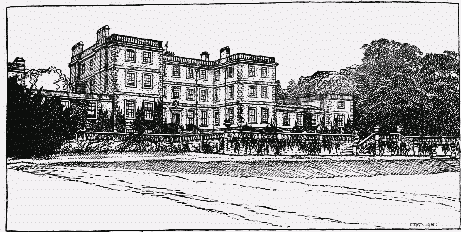
Bolton Hall, Wensley
Leyburn Hall, the property of Mrs. Arabella Yarker, widow of Charles B. Yarker, (fn. 22) and the residence of Mr. Thomas Bolle Bosvile, lies on the west of the town, and commands a magnificent view over Wensleydale. The house is H-shaped on plan, and may perhaps date from the 17th century. None of the existing features, however, are earlier than the 18th century; a rain-water head on the north front bears the initials A.I.Y. The wings on the south or garden front are pedimented, and the house is entered by a modern porch.
Near it is supposed to have stood a chapel of St. Peter and St. Paul; in one of the out-buildings is a pointed doorway of one chamfered order, evidently reset. A hemispherical stone bowl preserved in the grounds is said to belong to an ancient font.
Thornburgh, formerly known as the Grove, stands to the north-west of the town; it once contained a secret hiding-place. It was almost entirely rebuilt in 1873, and is now the property of Mr. E. F. Riddell-Blount of Cheeseburn Grange. (fn. 23) It may be the Leyburn Hall which belonged to Francis Thornburgh in 1734. The present 'Grove,' formerly called the Mansion or Leyburn House, was built about 1720, tradition says, on the site of a tannery. It was bought by Mr. F. H. Riddell about 1872 from Mr. Matthew Dobson. It is now the property of Mr. E. F. Riddell-Blount and the residence of Mr. F. W. Riddell. (fn. 24)
Leyburn makes an excellent centre for visitors to Wensleydale. West of the town is the 'Shawl,' a terrace which runs for over a mile above the wooded slopes of the dale, and commands a fine view of the valley, with Penhill on the south-west. The Shawl was laid out in 1841. (fn. 25)
Mills in Leyburn are mentioned in 1318, 1324, 1336 and 1362. (fn. 26)
Preston-under-Scar is a remote terrace-village lying off the main roads to the west of Leyburn Shawl; it consists of a single street of grey cottages backed by a precipitous scar. The manor-house is near the middle of the village, which contains a Church of England mission-room, opened in 1862, and a Wesleyan chapel. In 1854 it was chiefly inhabited by miners. (fn. 27) Preston Mill, first mentioned about 1421, (fn. 28) lies to the south-east of the village.
Further west is Castle Bolton, another of the bleak villages, with a single street lying along a limestone terrace on the hill-side, not uncommon in this district. The greyness of Bolton is, however, modified by vestiges of a green, and most of the houses have gardens in front. The ruins of the castle stand near the church at the western end of the village. A mill at East Bolton, mentioned in 1246, (fn. 29) was possibly on Apedale Beck, which forms part of the eastern boundary of Castle Bolton. Near the beck is Low Bolton, now a farm-house.
Redmire is a pretty village situated by the road between Wensley and Carperby. It is built round an irregular green, in the centre of which is a stone cross. The maypole was destroyed by lightning in 1849. (fn. 30) There is a Wesleyan chapel and a public elementary school. The church is half a mile to the south-east. Redmire, like Preston, was chiefly inhabited by miners in 1854. (fn. 31)
The Mill Farm near the Ure probably indicates the site of a mill mentioned in 1420 (fn. 32) and 1595. (fn. 33)
Manors
In 1086 there were two berewicks in WENSLEY, one of 4 and another of 3 carucates, each attached to Count Alan's manor of East Witton (fn. 34) (q.v.), the overlordship subsequently following the descent of the honour of Richmond (q.v.).
One fee in Wensley was held by a family which was also enfeoffed of land in Lincolnshire under the honour, (fn. 35) and subsequently took its name from Ingoldsby in that county. Towards the close of the 12th century the lord of Wensley was Niel son of Alexander. (fn. 36) He was succeeded by a son Osbert, who from 1203 to about 1207 was engaged in disputes concerning Wensley Church with Hugh Malebiche. (fn. 37) Osbert followed the barons in their rising against John, and was taken prisoner, but liberated in 1217. (fn. 38) He is last mentioned in 1231, (fn. 39) and four years later his son Roger de Ingoldsby was in possession. (fn. 40) In 1246 he sub-enfeoffed Wischard de Charron of 3 carucates in Ulshaw, Thomas son of Hugh holding a mesne lordship and granting to Roger 60 acres of land in Wensley. (fn. 41) Roger had been succeeded by his son of the same name by 1275–6, (fn. 42) and he in 1280 held direct of the honour half a knight's fee of the value of £20 2s. In 1285 he agreed to divide certain lands, chiefly wood, with Nicholas de Wensley son of Thomas de Ulshaw (see below). (fn. 43) Roger de Ingoldsby died in 1313, (fn. 44) when a portion at least of his lands passed to Ranulph de Paris, (fn. 45) who with Elizabeth his wife in 1331 sold rent in Wensley and quitclaimed the manor and advowson to Henry le Scrope. Meanwhile Geoffrey Luttrell, of Irnham, Lincs., as trustee granted the manor in 1317 to Henry le Scrope, to be held of Walter de Gloucester son of Walter de Gloucester, defunct, who quitclaimed his right in the manor to Henry in the same year. (fn. 46) It henceforth followed the descent of Bolton.
The name of Peter son of John de Wensley occurs in 1285, (fn. 47) and it is said to have been as guardian of his son, but probably as trustee for the Scropes, that Geoffrey Luttrell of Irnham paid the subsidy here in 1301, (fn. 48) and was returned as joint lord in 1316. (fn. 49) John Wychard paid subsidy here in 1327–8, (fn. 50) his assessment of the same sum as that of Henry le Scrope being possibly for land in Ulshaw. (fn. 51)
Of the early history of the second fee little is known, but it seems evident that in the 12th century it was in the hands of the family of the lords of Thornton Steward (q.v.). Wymar son of Warin appears to have left a daughter Beatrice, who married Hugh Malebiche. (fn. 52) Hugh was in possession here in 1202, (fn. 53) but by 1213 this land was held by Hugh son of William, who had married Helewise widow of Wymar without royal licence. (fn. 54) In 1240 John de Monmouth settled 3 carucates here, probably as trustee, upon Thomas son of Hugh on his marriage with Beatrice daughter of Wymar, lord of Thornton (fn. 55) (q.v.). The arrangement made by Thomas with Roger de Ingoldsby has already been mentioned.
Nicholas de Wensley, son of Thomas de Ulshaw, held half a knight's fee valued at £16 3s. 1d. in 1280. (fn. 56) Five years later he was holding 1 carucate 5 oxgangs here and at Ulshaw in demesne and directly of the honour; sub-tenants held of him 1½ carucates and 5 oxgangs respectively. (fn. 57) Nicholas was living in 1295, (fn. 58) but James de Wensley was the tenant in 1301 (fn. 59) and was joint lord in 1316. (fn. 60) It was possibly a portion of this fee that Henry le Scrope bought from Stephen Turpyn and Cecily his wife in 1301 (fn. 61); he at least in 1318 bought from Nicholas de Wensley 4 oxgangs leased for three years to Robert de Swinithwaite. (fn. 62) In the same year Henry le Scrope's land in Wensley was called a 'manor,' (fn. 63) and in the following year he bought four messuages, land and 5s. rent here from Robert Hastangs and Emma his wife. (fn. 64) John and James de Wensley each paid 1s. subsidy in 1327–8, (fn. 65) while Henry le Scrope was assessed for 2s. Finally, about 1459 Henry le Scrope obtained from John Wensley a third of certain tenements and 16 oxgangs here in exchange for the office of bailiff of Eston. (fn. 66)
The whole of Wensley, thus acquired from divers sources by the Scropes, followed the descent of the manor of Castle Bolton (q.v.), Lord Bolton being the present owner.
At CASTLE BOLTON (Bodelton, xi and xii cent.; Bouelton, Estbolton, (fn. 67) xiii cent.) before the Conquest the four sons of Balt had four 'manors' and 6 carucates. Castle Bolton was afterwards granted to Count Alan (fn. 68) and became a member of the honour of Richmond (q.v.). One moiety of 3 carucates was given by a lord of Richmond (probably Earl Conan) to the Tunstall family in drengage; their service of carrying the earl's wine from the castle to the forest and feeding his dogs and birds was commuted by the time of Henry III for an annual rent of 9s. (fn. 69) Acharis de Tunstall gave a house and land here to Rievaulx Abbey, and this grant was confirmed by Richard his son, who added land and rent. Imaynia daughter of Richard confirmed his grants. (fn. 70) In 1231 she and her husband Reynold de Bolton gave further lands, (fn. 71) and in 1246 Imaynia and her second husband, Peter son of William de Bolton, gave the abbey a mill here. (fn. 72) She survived Peter, (fn. 73) but apparently died without issue, whereupon her cousin Roger son of Roger de Tunstall quitclaimed to Richard son of Wymar de Leyburn all the lands she had held, (fn. 74) and Richard conveyed them to Rievaulx Abbey. (fn. 75) Among the lands granted to Rievaulx by Acharis were 25 acres, portions of which were held by five tenants. (fn. 76) These Acharis compensated with other land elsewhere in Bolton. William son of Unfrid and Dolfin both released their claims to the abbey. (fn. 77) The heirs of William the Clerk were subsequently tenants of 1 carucate. (fn. 78) William le Scrope was paying the rent of 9s. in 1285, (fn. 79) and was probably in possession of the land, though it was not until 1315 that William's son and successor Henry effected a formal exchange with the abbey, taking the whole of their Bolton lands in exchange for land in Newsham and elsewhere. (fn. 80) Sir Henry was at different times Chief Justice of England and chief baron of the Exchequer. (fn. 81) He died in 1336, having previously settled his lands, to avoid division, upon his three sons, William, Stephen and Richard, successively. William succeeded (fn. 82) and died in 1344. Stephen being then dead, (fn. 83) Richard was his heir. (fn. 84) He fought at Crecy and was knighted at Nevill's Cross. He vindicated his right against Sir Richard Grosvenor to bear the arms, 'Azure, a bend or.' He was summoned to Parliament as the first Lord Scrope of Bolton in 1371. (fn. 85) Dying in May 1403, he was succeeded by his son Roger, who died in December of the same year. (fn. 86) His son Richard, a minor, fought at Agincourt and died in 1420. (fn. 87) He was succeeded by an infant son Henry, who proved his age in 1440. (fn. 88) He died in 1458–9, his heir being his son John, (fn. 89) who took part in the siege of Norham Castle and died in 1498. The sixth Lord Scrope, Henry son of John, died in 1506. His son, another Henry, who fought at Flodden, (fn. 90) with 'all Richmondshire its total strength,' (fn. 91) died in 1533; his heir was his youngest but only surviving son John, to whom in 1549 succeeded a son Henry, Warden of the Western Marches, who died in 1592. (fn. 92) His heir was his son Thomas, who, dying in 1609, was succeeded by his son Emmanuel, eleventh Lord Scrope. (fn. 93) He was created Earl of Sunderland in 1627, and died in 1630 without lawful issue, having previously settled all his available estates on his illegitimate children, John, Mary, Elizabeth and Annabel, with remainder to his right heir. (fn. 94) John Scrope alias Jeanes alias Sandford, who succeeded, held the castle for the king and suffered sequestration; he died in London of the Plague in 1646. (fn. 95) Of his three sisters and heirs Mary married first Henry Carey, son and heir of the Earl of Monmouth, and secondly Charles Paulet Lord St. John, afterwards Marquess of Winchester; Elizabeth married Thomas Savage, third Earl Rivers; and Annabel married John Grubham Howe, ancestor of the Earls Howe. (fn. 96) Castle Bolton appears to have been divided for a time between the three co-heirs, (fn. 97) but ultimately it became the sole property of Mary. Mary's second husband, the Marquess of Winchester, was created Duke of Bolton in 1689, and five of their descendants in the male line were successively lords of the manor. The fifth duke died in July 1765, having previously bequeathed Castle Bolton, should his brother and successor die without male issue, to his illegitimate daughter Jean Mary. The title became extinct when the sixth duke died in 1795, and the manor passed under the settlement to Jean Mary wife of Thomas Orde of Hackwood, Hampshire. Thomas took the additional surname of Powlett, and was created Lord Bolton of Bolton Castle in 1797. (fn. 98) His greatgrandson is now lord of the manor.
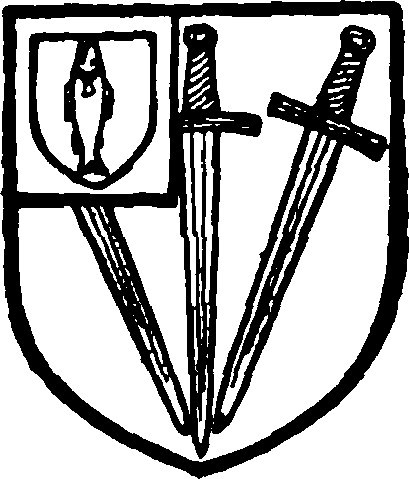
Orde-Powlett, Lord Bolton. Sable three swords argent set pilewise with their hilts or and a quarter argent with a scutcheon sable therein charged with a salmon rising.
In 1286–7 the second moiety of 3 carucates was divided into two equal portions, both held in demesne by William le Scrope. (fn. 99) The first he held direct of the honour; of the second he was tenant under the successive mesne lordships of the lords of Spennithorne, Middleham and Thornton Steward. (fn. 100) The whole 3 carucates followed the descent of the first moiety.
Castle
Bolton Castle has played but a slight part in the history of the country. The principal event with which it is connected is the imprisonment of Mary Queen of Scots, who was confined here for some six months from July 1568 to January 1569. (fn. 101) Though at night either Lord Scrope or Sir Francis Knollys kept the keys, plans were proposed for her rescue, (fn. 102) and tradition relates that she once escaped and was recaptured upon Leyburn Shawl, at the spot known as the Queen's Gap.
During the civil wars John Scrope the Royalist was besieged in the castle in 1645, and it was only after considerable trouble that the Parliamentary forces took it. (fn. 103)
The castle was built by Richard le Scrope, who in 1379 obtained licence to crenellate his manorhouse. (fn. 104) It is one of the finest extant examples of a fortified house of the 14th century, a great rectangular stone building, with square towers projecting at its four angles, and inclosing a courtyard 91 ft. by 54 ft. By a fortunate chance the building contract for the eastern and part of the southern range of the house is preserved, being now in the hands of Lord Bolton, owner of the castle. It is dated 14 September 1378, and suggests by its terms that it is a continuation of other work, an idea which is borne out by the architectural evidence; it seems that the western and northern ranges, with part of the southern, were first built, i.e. shortly before 1378, and the rest followed with little or no interval. In 1399 the chapel in the castle was dedicated to the honour of St. Anne, (fn. 105) so that the completion of the work may possibly be assigned to about this date.
The contract, which is in French, is made between Sir Richard le Scrope and John Lewyn, mason. It makes provision for a 'tower for a kitchen' (evidently the north-east tower, the measurements of which closely approximate), to be vaulted and embattled, and to be 50 ft. in height below the battlements, 10 yds. long and 8 yds. wide, with outside walls of the thickness of 2 yds.; between the kitchen-tower and the gate-tower a building (meson), vaulted and embattled, 40 ft. in height below the battlements, having above the vault three rooms, one above another, each 12 yds. long and 5½ yds. wide, the outside walls of the building to be of the thickness of 2 yds. and the inside walls (i.e. on the bailey side) 4 ft.; an embattled tower, 50 ft. in height below the battlements, containing a vaulted gateway, and above the gateway three rooms, one above another, each 10½ yds. long and 5½ yds. wide; in the same tower, to the south of the gateway, a vaulted room, and above it three rooms, one above another, each 13 yds. long and 7 yds. wide, the outside walls to be of the thickness of 6 ft. and the inside walls 4 ft.; adjoining the tower, on the side towards the west, a room vaulted and embattled, 40 ft. in height below the battlements, (fn. 106) with a second vaulted building over it, and above this again another room, each 10 yds. long, inclusive of the entrance passage, and 5½ yds. wide, the outside walls to be of the thickness of 2 yds. and the inside walls 4 ft. All these buildings and rooms were to be provided with entrances, fireplaces, doorways (huyses), windows, privies and all other necessaries; and there were to be three staircases (vices), one within the kitchen and two for the gate-tower. All the internal partition walls were to be either 3 ft. or 4 ft. in thickness. John Lewyn was to execute at his own cost all works appertaining to the masonry and to provide all stone and lime, while Sir Richard was to find wood for burning the lime and for centres and scaffolds, and to pay the carriage for all stone, sand and lime. John Lewyn was to be paid 100s. for each perch of masonry, the perch to be 20 superficial feet, one yard thick, and the arches and vaults to count as wall masonry. The sill of the gateway was to be taken on the datum, or point from which the height of the walls was to be measured. He was to receive over and above this 50 marks in all.
The castle consists of four lofty ranges of building standing round an oblong courtyard, with projecting towers at the outer angles and turrets midway on the north and south sides. The principal entrance is from the east, and the disposition of the rooms is that the ground story, stone vaulted, is given up to kitchens, bake-houses, brew-houses, stables, &c. The great hall is on the first floor of the north range, with the principal living rooms adjoining it to the west and in the western range, while the chapel is on the third floor of the south range. The west range alone retains its roof, but a great deal is left of the rest of the castle, nothing except the north-east corner tower, the kitchen tower and part of the east range being seriously ruined. The whole is built of excellent stone, the ranges being three stories in height, while the towers have or have had four and five stories. The detail is simple, and the castle, though not primarily a fortress, is well adapted for defence, and has portcullis grooves not only at the entrance gate, but at each of the doorways opening to the courtyard. The vaults of the ground stage were all plain barrel vaults and remain intact in the west and part of the south range. The first floor of the latter range, beneath the chapel, is also stone vaulted. The most interesting part of the ground floor is in the south range, where the brew-houses and bake-houses were placed, parts of the ovens and vats, and shoots from the floor above (perhaps for malt) being yet to be seen. The ground floor of the south-west tower was perhaps a threshing-floor. The rooms under the hall are cellars, and under the butteries at the east end of the hall is a well, from which water could be drawn at the first-floor level. The stairs from the cellars to the hall open to a lobby which gave on to the screen and has had a ribbed vault of more elaborate character than usual in the castle. Below it is a vaulted chamber, having in its floor a trap-door, through which another chamber is reached, which, from the garderobe in its east wall, has clearly been a prison, lighted only by a narrow slit high in its north wall. The hall has been a fine room, with tall, narrow windows having a wall passage at their sills. There is no fireplace, but there was a hearth in the middle of the hall, the smoke from which, as Leland noticed, escaped through wall-flues in the heads of the windows, instead of through a louvre. The roof was open and of flat pitch, but none of it remains beyond the corbels, showing its spacing. A curious feature here and in most of the rooms of the castle is the narrow stone brackets, always built into the walls at a considerable height from the floor. They seem too narrow to have been shelves for cressets, but their use must have been to carry lights of some sort. The larger fireplaces, as those in the west range, which are in perfect condition, have the usual corbels for lights on either side of their chimney-pieces, and in the middle chamber in the south-west tower, part of the set used by Mary Queen of Scots while here as a prisoner, is an opening in the splay of the fireplace communicating with a square opening in the wall-face close by and making an L-shaped passage. There is a similar feature also in the great chamber. The whole castle is amply provided with garderobes in the thickness of the walls and the passages and stairways are planned with great ingenuity. The projecting turret on the south face is also a garderobe tower in its lower part, but above it opens to the chapel, its story on the chapel level being a vestry, with two living rooms over it for the priest. The chapel, in the third floor of the south wing, was lighted from the north and south only by tall cinquefoiled windows and has at the west a narrow stone gallery carried over an arched recess. The battlements at the north-west corner of the south-west tower, to which the chapel adjoins, were carried up as a small turret, and doubtless contained the chapel bell. The situation of the castle, high on the north slopes of the dale, backed by still higher wooded ground, is very fine, and the great height of the walls most imposing. Very little alteration has been made in the original features, the most noticeable being some 16thcentury windows in the south-west tower. Leland refers to it as a very fair castle, (fn. 107) and Sir Francis Knollys wrote from Bolton in 1568, 'This house appeareth to be very strong, very fair and very stately after the old manner of building and is the highest walled house that I have seen and hath but one entrance thereinto.' (fn. 108) The rooms in the west range have been fitted up by Lord Bolton as a museum.
A park at Little Bolton is mentioned in 1314, when Henry le Scrope obtained licence to close a road running through it, provided he made as good a way on the north side. (fn. 109) In 1377 Richard le Scrope complained of poachers. (fn. 110) Leland speaks of a pretty park walled with stone. (fn. 111)
In Domesday Book LOW BOLTON (Little Bolton, xiii cent.; Midelboulton, Bolton Kellok or Kellow, xiv cent.) was apparently assessed with West Bolton. (fn. 112) Count Alan (fn. 113) then had the 'manor' once held by Ghilpatric, Ribald holding it of his brother.
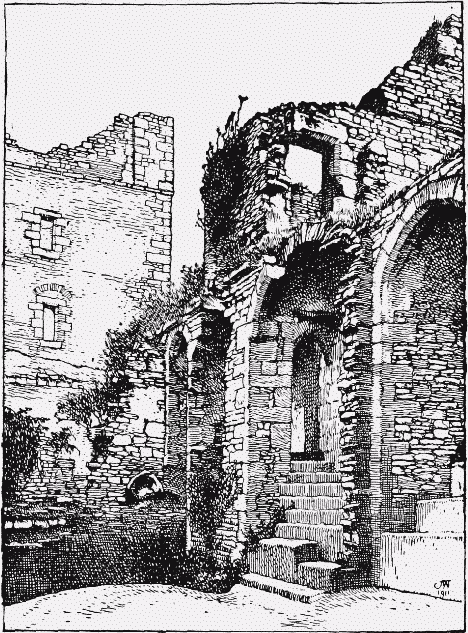
Bolton Castle: Interior of the Chapel of St. Anne, showing the South-east Tower
The tenancy of Ribald (fn. 114) followed the descent of Middleham (q.v.), a further mesne lordship being held by the lords of Constable Burton (fn. 115) (q.v.). The 3 carucates in Low Bolton were held by one Cecily de Harmby in 1286–7, when William le Scrope was holding of her in demesne. (fn. 116) The fee followed the descent of Castle Bolton. (fn. 117)
The two 'manors' and 7 carucates in LEYBURN (Leborne, xi cent.; Layboun, xiii cent.) held by Aschil and Andulf before the Conquest had passed by 1086 to Count Alan, (fn. 118) whose successors retained the overlordship.
The tenant of Count Alan was Wymar ('Wihomac') (fn. 119) his steward, who gave tithes in Leyburn to St. Martin's, Richmond, while his descendant Ralph son of Roger of Thornton Steward gave a toft here to St. Leonard's, York. The mesne lordship followed the descent of Thornton Steward (q.v.). Of the several tenancies under this fee in the 13th century one at least was held by a family bearing the territorial name. Michael de Leyburn, son of Robert and lord of Downholme (q.v.), was living in 1184–5; he gave two-thirds of the tithes of his lordship of Leyburn to St. Mary's Abbey, York, 'when he recovered his land.' His son Richard was living in 1220 (fn. 120) and Wymar son of Richard de Leyburn gave land to Easby Abbey. (fn. 121) In 1236 Wymar and Elias de Leyburn were two of five lords (fn. 122) here, and Wymar in 1241 obtained a quitclaim of land in Harmby and Leyburn from Gilbert son of Alan, parson of Ali Saints, York. (fn. 123) Wymar was succeeded by William (fn. 124) his son, who in 1286–7 was holding a mesne lordship over 4 oxgangs in Leyburn; John son of William is mentioned a few years later. (fn. 125) In 1286–7 a second fee of 13 oxgangs was held by an unnamed tenant, and 1 carucate was held under John de Aldburgh by four sisters, Cecily de Leyburn, Alice, Isabel and Agnes, (fn. 126) in common. They were sisters and co-heirs of Richard de Ryboef, and were also the tenants of 6 oxgangs under the mesne lordship of the lords of Middleham (fn. 127) (q.v.).
This mesne lordship seems to have comprised at least 2½ carucates beyond these 6 oxgangs, though the jurors of 1286–7 did not say of whom these 2½ carucates were held. (fn. 128) In 1318 this fee consisted of 2 carucates, only one of which paid foreign service. (fn. 129) Some, if not all, of this land must be that which Ranulph son of Robert acquired, as heir of his mother Helewise, about 1205 from William de Stutville, after the death of William's wife Berta. (fn. 130) In 1286–7 this fee was held by two tenants. The 2 carucates held by Richard de Wodington (fn. 131) passed to his daughter Agnes, who alienated tenements here while under age and subsequently recovered seisin. (fn. 132) She may be identified with the Lady of Leyburn who held the vill in 1316. (fn. 133) In 1325 she with her husband Thomas de Yarm conveyed one-third of a mill and messuage with tenements in Leyburn to William de Swinithwaite. (fn. 134) This moiety, described afterwards as 'a third of the manor,' was settled about 1334 on Thomas de Swinithwaite, jun., with remainder to his brother William and sister Ivetta successively and final contingent remainder to William de Swinithwaite. (fn. 135) In 1336 Henry le Scrope died seised of a messuage, lands and a water-mill in Leyburn, (fn. 136) and Richard le Scrope in 1362 obtained a mill and lands from William de Lakenby and Jane his wife, Walter de Erghon (? Eryholme) and Margaret his wife, Thomas de Harlsey and Agnes his wife, and Walter Kerwoure and Cecily his wife, (fn. 137) the four wives being obviously co-heiresses. The Scrope property, called in 1420 the 'Manor of Leyburn,' followed the descent of Castle Bolton (q.v.).
The second fee, consisting of half a carucate, was held in 1286–7 by Richard de Ryboef, (fn. 138) probably identical with the Richard de Ryboef who was a tenant of the Stutvill fee in Derbyshire. (fn. 139) He was succeeded by a son of the same name, (fn. 140) but his lands were divided between his sisters, and no mention of the family in connexion with Leyburn has been found after 1305. (fn. 141) Some land was certainly held in demesne by the lords of Middleham (q.v.), which it followed in descent.
Various leases of the manor and capital messuage of this fee were made between 1534 and 1586. (fn. 142) In 1555 it was leased to John Waite, (fn. 143) whose father John Waite had died in 1548 seised of the capital messuage of the Scrope manor. (fn. 144) John Waite surrendered his Crown lease before 1570, and in 1628–9 Leyburn 'Manor' was in the tenure of Thomas Penereth of Middleham. (fn. 145)
The above John Waite, jun., made various settlements of his 'manor of Laybourne,' (fn. 146) and James Waite died seised of the capital messuage in 1587, leaving an infant son George. The Waite (or Wayte) property in Leyburn passed early in the 18th century to the Thornburghs through the marriage in the 17th century of Frances Wayte to Francis Thornburgh of Selside, and to the Riddells through the marriage in 1769 of Mary Thornburgh with Ralph second son of Thomas Riddell of Swinburn Castle. The house is now known as Thornburgh, and is the property of Mr. E. F. Riddell Blount. (fn. 147)
A 'manor' and 3 carucates in PRESTON-UNDERSCAR (Preston, xi–xiii cent.) formed part of the land of Count Alan in 1086, this lordship following the descent of Richmond (q.v.).
Under the Confessor Torphin was tenant, and under Count Alan Bodin. (fn. 148) This mesne lordship was subsequently divided equally between the successors of Bodin, (fn. 149) the lords of Ravensworth and of Bedale (fn. 150) (q.v.). The fee was held before the division by subtenants, whose family afterwards bore the territorial name. Robert son of William de Preston held land here in 1204, and sub-enfeoffed Laurence de Preston of 36 acres, (fn. 151) and in 1286–7 William de Preston was tenant of the whole fee. He had 1½ carucates in demesne, the remainder being held under him by Thomas de Preston, (fn. 152) perhaps son of Henry son of Laurence. (fn. 153) In 1316 Gilbert Haunsard, who had clearly married a co-heiress of the Prestons, was returned as lord of Preston. (fn. 154) The Lettice de Nodariis ('Nowers') who, as subsequently appears, had an interest in the manor, was descended from another co-heir. (fn. 155) In 1318 the 'manor' of Preston was settled upon Lettice de Nodariis and her brother-inlaw John Mawe of 'Thurgalby' for life, with remainder to William son of Gilbert Haunsard, and contingent remainders to the sisters of William (Alice, Lettice, Elizabeth and Joan) successively, and finally to the right heirs of Lettice de Nodariis, who left a daughter Alice wife of William de Place. (fn. 156) John Layton and Lettice his wife (possibly Lettice Haunsard) sold the manor in 1365 (fn. 157) to Richard le Scrope of Bolton, to whom Geoffrey son of William de Swinithwaite released all his right in it, (fn. 158) and henceforth the manor followed the descent of Castle Bolton.
Before the Conquest two 'manors' and 5 carucates in REDMIRE (Ridemare, Ridmere, xii cent.; Ryddemare, Ridmer, xiii cent.) were held by Gamel and Ghilpatric. In 1086 they formed part of the land of Count Alan and subsequently followed the descent of Richmond. (fn. 159) One fee Count Alan retained for a time, the other, consisting of 3½ carucates in 1286–7, (fn. 160) he granted to Ribald of Middleham (q.v.).
The chief tenancy was that of a family bearing the territorial name. Osbert son of Copsi of Redmire was living in 1166–9, (fn. 161) and had a sister Cecily. (fn. 162) In 1253 Imaynia daughter of Richard de Tunstall and her husband Peter de Bolton gave half a carucate, a capital messuage and one-third of a mill of this fee to Richard son of Reynold de Redmire, (fn. 163) and he granted them to Coverham Abbey. (fn. 164) In 1336 Henry le Scrope died seised of a messuage and lands here held of the abbey. (fn. 165) These lands subsequently followed the descent of Castle Bolton, (fn. 166) and Lord Bolton is now lord of the manor.
Richard de Preston in 1270 held a further carucate of this fee, (fn. 167) possibly that subsequently held by Robert Sutton and his heirs, Thomas de Brynsal, Thomas de Swinithwaite, Ralph Harpour and Beatrice widow of John atte Townend. (fn. 168)
Count Alan's demesne was granted to a lord of Barden (q.v.). In 1286–7 it was held of Jervaulx Abbey. (fn. 169) Agnes daughter of John de Staveley and wife to John de Walkingham (fn. 170) was tenant in 1262, when she gave it to her son Alan, (fn. 171) who died seised of it in 1284, his heir being his infant son Adam. (fn. 172) In 1286–7 it was held by the heirs (fn. 173) of Alan. In 1294 Sir Thomas de Colvill granted his manor of Redmire to Robert son of William de Holtby. (fn. 174) In 1303 Nicholas and Robert sons of William de Holtby divided lands here; Nicholas received the more important share, (fn. 175) and in 1316 was lord of Redmire. (fn. 176) Sir Nicholas de Cantlow, kt., and Joan his wife settled land here and elsewhere in 1354 (fn. 177) on their grandson William son of William, with contingent remainder to his brother Nicholas. William the younger survived his only son until 1391 (fn. 178); his heirs were distant relatives, who had apparently no connexion with Redmire. Meanwhile the manor had been granted by William de Holtby to William Darell and Joan his wife, who conveyed it to their sons Thomas and John. (fn. 179) In 1364 Sir Richard le Scrope obtained all the demesne lands which John Darell had, and in 1365 Marmaduke Darell son of Sir William Darell of Sessay quitclaimed to Sir Richard all his right in the manor of Redmire, which manor the said Richard had of the gift of Thomas and John Darell his brothers. (fn. 180) Redmire afterwards followed the descent of Castle Bolton, and Lord Bolton is now lord of this manor.
Richard le Scrope obtained free warren in Castle Bolton and 'Little Bolton' in 1296; James de Wensley in February 1306–7 received the same liberty in Wensley, and this was confirmed in 1318. (fn. 181)
Churches
The church of the HOLY TRINITY, Wensley, consists of a chancel 42 ft. 6 in. by 18 ft., with a north vestry 13 ft. by 11 ft., nave 50 ft. by 18 ft., north aisle 9 ft. 9 in., and south aisle 10 ft. 3 in. wide, both as long as the nave, south porch and a western tower 17 ft. 6 in. by 17 ft., all the measurements being internal.
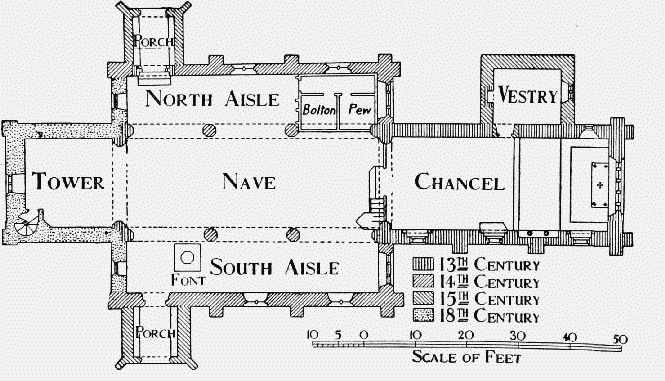
Plan of Wensley Church
The church dates from about 1240, the south chancel wall being almost intact of that date. The chancel was then of the same size as at present, but the east window and the piscina appear to be somewhat later, and the north wall of the chancel has evidently been rebuilt upon the old foundations. The chancel arch and the capitals and bases of the two nave arcades are also work of this date. The arcades are unusually lofty; the aisles were rebuilt about 1330, when these arches seem to have been raised to the same height as the chancel arch. The north vestry, with priest's lodging above, and the north and south porches are work of the 15th century. The tower and the west ends of the aisles were rebuilt in the 18th century. The east window is of five trefoiled lights. The only suggestion of tracery is in the pierced trefoils over the outer lights with a sunk spandrel over them, all under a two-centred arch. It has two chamfered orders and a double chamfered label. The cusping of the heads springs from the soffit only, and has no sunk face; the arch and head are early 14th-century work and the jambs of the 13th century. In the north wall the only window is a plain lancet of about the same date; it has been partly restored, and is of a single chamfered order, with a segmental rear arch and wide splayed jambs internally.
The north door into the vestry is old and has a two-centred single chamfered head. The three south windows are good work of about 1240. They are large lancets of two orders on both sides, those outside being plainly chamfered; inside the outer order is square with a detached shaft in the angle, the shafts having moulded capitals and bases. The edges of these outer orders are enriched with dogtooth ornament between the capitals and bases; the arches are richly moulded and have a moulded label. The sill of the easternmost is raised for the piscina which is set below it. The western one has its sill much lower and is divided by a transom to form a low-side window. The middle window formerly had its sill at the same level as that to the west of it, but it has been raised since for the insertion of a small doorway below it. The large piscina has a trefoiled head to the recess; its mould is a small fillet between two rounds. On either side of the head are small trefoiled circular sunk panels, slightly differing in form. The projecting basin has been broken off. The sedilia are of three bays with twocentred heads, and are divided by free shafts with moulded capitals and bases, the outer jambs and the arches are all enriched with dog-tooth mould. In the west wall of the vestry is a similarly enriched recess with a pointed head. It stands but 11 in. above the floor. It is presumably not in its original position, but whether it was formerly a piscina (for which it would be large) is uncertain, but it is certainly in keeping with the sedilia, with which the present piscina forms a strong contrast. There is a two-light square-headed trefoil window and a piscina drain in the east wall of the vestry. The priest's chamber above has a similar east window. A fragment of string-course breaks over the sedilia and appears to have inclosed the piscina, but it is now cut back level with the wall. The chancel arch has semi-octagonal responds with capitals and bases of 13thcentury character; the lower roll of the base, which is of the usual deep hollow between two rolls, appears to have been cut away to a chamfer, probably because of the damage it has suffered. The arch is two-centred and of two chamfered orders.
The arcades on both sides of the nave are of three lofty bays, the octagonal piers have 13th-century moulded bell capitals and bases, the arches are of the same height and similar to the chancel arch and have plain double chamfered labels. The western responds are probably restorations of the time when the tower was rebuilt, as was likewise the tower arch, which matches the others more or less in style and size.
The north aisle has an east window of about 1330 of three trefoiled lights with pierced spandrels under a two-centred head of two orders, the outer with a half-round hollow in a chamfer, and the other similar but with another hollow on the innermost edge. The two north windows are of like character and details, but are of two lights each. The 13th-century north doorway has two orders, the inner having a plain chamfer, the other a hollow, while in the angle are small shafts with large moulded capitals of 13thcentury section. The arch is moulded, and at its apex it is trefoiled, while its outer mould is carried up above the arch to form a gabled head. The west window of the aisle is an 18th-century round-headed light.
The north porch is later than the aisle; it has original diagonal buttresses which appear to have been once topped by pinnacles. The doorway has a continuous hollow sunk in a chamfer and a moulded label with large head stops. Over the doorway is a rectangular moulded panel in which is a shield of the arms of Scrope.
The south aisle has east and west windows similar to those of the north aisle, and its two side windows are also like those opposite. The south doorway has a two-centred drop arch with a continuous hollow chamfer. It is probably late 14th-century work. The south porch is later than the aisle, the plinth of which appears inside the porch. It has an outer doorway with a continuous moulding of a hollow and an ogee and a two-centred arch with a moulded label.
An important work of the 15th century was the raising of the eight aisle buttresses, the lower parts of which appear to be contemporary with the early 14th-century walls of the aisles. The upper parts have, below their square embattled copings, niches under ogee heads, each containing a shield of arms of the Scropes and the families with which they were allied. These shields are Scrope, De la Pole (twice) for Blanche wife of Richard first Lord Scrope, Roos (twice) for Cecily wife of Sir William Scrope his brother, Nevill of Raby (twice) for Margaret wife of Richard the third lord, Nevill of Raby impaling an indented fesse, perhaps for Ralph second Earl of Westmorland her nephew, who married Elizabeth Percy, Scrope of Masham for Elizabeth wife of Henry fourth Lord Scrope, and Fitz Hugh for Joan who was married to John fifth Lord Scrope in 1447. This shield would seem to fix the date after which the raising of the buttresses was undertaken.
The tower is of three stages with shallow clasping buttresses at the corners. The lowest stage contains a west window of two lights with segmental heads in a semicircular arch with projecting abaci and keystone. In the tympanum is the date 1719. The second stage is lighted in its west and south faces by small rectangular piercings. The belfry stage has in each wall a single large light with a round head. The staircase rises in the south-west corner and is lighted by slits on the south side.
The roofs of the church are all modern; the old steep-pitched chancel roof has been replaced by one of much lower pitch with braced tie-beams. The nave roof is low-pitched and the aisle ceilings are plastered.
The carved wooden quire screen is 15th-century work. The quire stalls are dated and named by a carved inscription on a series of shields as the gift of Henry Richardson, rector, in 1527. The poppy heads are supported by magnificently carved beasts and heraldic monsters, among which the crowned leopard, the dragon and the greyhound of the Tudors are to be observed. The two principal stall ends are carved respectively with a shield of Scrope and Tiptoft supported by two eagles and surmounted by a helm with the Scrope crest of a bush of ostrich feathers coming out of a crown, and Scrope and Tiptoft impaling Dacre quartering Vaux.
Near the north door of the church is a wooden aumbry of a rare type, work of about 1400. It was perhaps used as a cupboard for relics, and has a money-box attached to it.
On the chancel floor is the famous Flemish brass of Simon of Wensley, rector of the parish 1361–94, who gave evidence in the Scrope and Grosvenor trial in favour of his patron Henry Lord Scrope. This well-known memorial shows him in mass vestments, with his hands crossed and a chalice upon his breast, his head upon a cushion and his feet on two small hounds. The inscription which surrounded the figure has long been lost.
At the east end of the north aisle is the Bolton pew, made up of woodwork of two dates, the later of the 17th century, the earlier of c. 1510. The latter is said to have been brought from Easby Abbey at the Dissolution; it has seven bays along the north wall and four against the east, and across the west two whole bays and parts of others. These bays have ogee crocketed heads and are divided into two openings with multifoiled heads and tracery above. On the lower panel of the west face of the pew are carved these shields: (1) Scrope and Tiptoft quartered and impaling Scrope of Masham, for Henry fourth Lord Scrope of Bolton and his first wife Elizabeth daughter of John fourth Lord Scrope of Masham; (2) Scrope and Tiptoft in a garter, for John fifth Lord Scrope of Bolton, K.G.; (3) Scrope and Tiptoft impaling Fitz Hugh and Marmion, for John fifth Lord Scrope of Bolton and his first wife Joan Fitz Hugh; (4) Scrope and Nevill impaling Percy quartering Lucy, for Henry sixth Lord Scrope of Bolton and his wife Elizabeth Percy; (5) Scrope and Nevill impaling Dacre with these quarterings, Grey of Greystock, Greystock, Boteler of Wem, Morvile and Vaux, for Henry seventh Lord Scrope and his second wife Alice daughter of Thomas second Lord Dacre of Gillesland.
Inside the pew is another shield, similar to those on the west face, of Scrope impaling Fitz Walter, for Sir Henry Scrope, chief justice, d. 1336, and his second wife Margaret Fitz Walter. The old doorway of the pew, now set up against the north wall, has a magnificent carved shield of Scrope and Tiptoft impaling Dacre of six quarterings, supported by two eagles. The south front of the pew is Jacobean work of red pine. In the cornice is an inscription now imperfect; it originally read as follows: 'Here lyeth Henry Scrope, Knight, the vii of that nayme, the ix Lorde of Bolton ande Mabell his wife, daughter to the Lorde Dakers de Greys. Here lyeth Henry Scrope, the thirde of thate name, ande the righte Lorde Scrope of Bolton, and Elizabeth his wiffe daughter of Henry Earl of Northumberland.' On the mid rail inside are these words remaining: 'Henry the first . . Phylip the fyrst Symonde the first Henry the . . Wyllyam the fyrste Henry the thyrd Henry the fyrst the forlt lord scrop.' The chancel seats are good examples of 16th-century work. The west doorway has 18th-century doors, and the pews and the south front are of the same date.
In the east window are four shields of old painted glass. They are (1) France quartering England; (2) Scrope quartering Tiptoft impaling Dacre quartering Vaux; of (3) only a Tiptoft quarter remains; (4) Scrope and Tiptoft impaling Fitz Hugh quartering Marmion. (fn. 182)
Two bells from the York foundry were provided in 1725. They bear the inscriptions: (1) 'Sursum corda I. Clayton rector 1725'; (2) 'Ut tuba sic sonitu domini conducto cohortes 1725.' A third bell was recast in 1847.
The plate consists of two flagons, a cup and a paten, all with London marks and date letters for 1678, and maker's mark O.S. They are all inscribed 'Ex dono honorandae feminae Dominae Mariae Marchionessae Wintoniensis.' A cup and paten are lent to Leyburn Church.
The registers begin in 1538.
The church of ST. OSWALD, Castle Bolton, consists of chancel and nave of equal width, measuring internally 60 ft. by 20 ft., south porch and west tower 8 ft. 8 in. by 6 ft. 3 in.
The whole building is of one date, c. 1325, and in spite of mutilations retains a good many features of its original work. The windows in the chancel and nave are of two trefoiled lights with leaf tracery, all except the south-east window of the chancel having transoms; the heads of the main lights are half cut away, apparently to save the glazier the trouble of fitting his glass to the tracery.
The chancel has an east window, on either side of which is a trefoiled niche for an image, a single north window and two on the south, besides a small blocked low-side window of the same date. The sill of the south-east window is kept up to allow for a piscina and three sedilia below it, all original. The piscina recess has a trefoiled ogee head and a moulded label, and in its east side is a small niche, perhaps to hold the cruets. The sedilia are triple and have trefoiled ogee heads, the divisions between the seats being pierced with trefoiled openings. There is no chancel arch, but the corbels for a rood-loft remain.
The nave is lighted by a single window on the north and south, of the same type as those in the chancel, and is entered from the south by a pointed doorway of one moulded order with a label of original date.
The porch is comparatively modern, but its outer entrance is spanned by a moulded wooden lintel of 15th-century date, carved with a line of four-leaved flowers, and evidently brought from some more important position; it may have been in the castle. In the north wall of the nave is a stone inscribed 'Thomas Ro . . .,' apparently a corbel for a former west gallery.
The tower is small and without buttresses or strings, and ends like the nave and chancel, with a plain coped parapet. It has a west belfry window of two trefoiled lights, and in the ground stage a west window now without tracery. On the south side is a single lancet light with its head just below the level of the sill of the west belfry window.
The font is plain, having an octagonal bowl with beaded angles on an octagonal stem, and may be as early as the 14th century. The interior of the church is whitewashed and has a flat plaster ceiling; none of the wooden fittings are ancient.
There is one small modern bell in the tower and also a disused bell in the vestry. It is uninscribed but ancient.
The plate includes a cocoa-nut cup with silver rim and stem, a pewter paten with the mark of John Harrison of London and a pewter paten.
The registers, including those of Redmire except for the modern period when separate marriage books have been used, begin in 1684.
The church of ST. MARY THE VIRGIN, Red mire, consists of a chancel, nave and south porch, the total length internally being 62 ft., the chancel 25 ft., and the nave 37 ft.
The walls of the church are probably contemporary with the south doorway, which dates from the middle of the 12th century. The east window is of two trefoil-headed lights with a square head, and to the south of it is an image bracket. In the south wall of the chancel are two plain lancets with wide internal splays and a recess, which may have once contained a piscina. On the north wall of the nave close to the angle where it meets the chancel is a projecting corbel to carry a rood beam. In the upper part of this wall is a square splayed window with an external hollow chamfer. There are three lancets in the south wall of the nave; they are somewhat larger than those in the chancel, and have been much renewed, while the westernmost is set low in the wall. The south door has a round-headed arch of one order with zigzag moulding and a plain tympanum, c. 1150. The arch rests on square chamfered abaci with lightly scalloped capitals; the shafts are covered with a diamond pattern, the one on the east being a modern copy of the other.
There are no windows in the north wall except one at the north-west inserted to light the gallery now taken down. There is a low-pitched timber roof, probably of the 15th century, continuous over chancel and nave. In the north-west angle of the nave close to the roof is a stone with portions of interlaced flower decoration. The royal arms of the Georgian period hang from the east beam of the nave. The font is an irregular octagonal bowl without stem on a round base.
On the exterior of the south chancel wall is a square low-side window, blocked, and close to it a sundial stone. At the west end is a small gable containing one modern bell dated 1853.
The plate includes a cocoanut cup similar to that at Castle Bolton, and two fine pewter flagons.
The registers are as at Castle Bolton.
The church of ST. MATTHEW, Leyburn, was built in 1868 and consists of a chancel 22 ft. by 17 ft., a nave 48 ft. by 21 ft., a north aisle 11 ft. wide, and a west tower 10 ft. square containing one modern bell and a south porch in the style of the 14th century.
The plate is wholly modern and without interest, but an ancient cup and paten belonging to Wensley are in use here.
Advowsons
The church of Wensley is first mentioned in 1199, and the first known patron was Niel son of Alexander. (fn. 183) In 1203 the right of presentation was successfully claimed by Osbert son of Niel, lord of a moiety of Wensley, against the representative of Wymar son of Warin, whose daughter Beatrice seems to have married Hugh Malebiche. (fn. 184) Two years later Hugh alleged that seven of the twenty-four jurors had committed perjury, (fn. 185) but he failed to establish his claim. (fn. 186) The patronage was still disputed, (fn. 187) however, and in 1231 the Abbot of Crowland called on Osbert son of Niel to warrant the advowson to him. (fn. 188) Roger de Ingoldsby was in possession at a later date, and the advowson (fn. 189) appears to have remained in the hands of his family after the alienation of the manor, for in 1318 it was granted to Henry le Scrope by Walter de Gloucester, and quitclaimed with the manor (q.v.) by Ranulph de Paris and his wife Elizabeth. (fn. 190) From this time it followed the descent of Bolton, Lord Bolton being the present patron.
In 1400 Richard le Scrope had licence to make the church collegiate under a warden and as many fellows as might seem expedient. They were to find chaplains for his chapels at Bolton, (fn. 191) and he bequeathed to them the residue of his goods. (fn. 192) Richard le Scrope in 1420 made a bequest for erecting and endowing a college of the Annunciation for five priests, five clerks and three poor men (fn. 193); nothing further is known of this.
The chantry of our Lady in the church of Wensley was apparently also founded by Richard le Scrope. The chaplain was supplied by Easby Abbey. (fn. 194)
The chapel of St. Oswald of Bolton, first mentioned in 1399, (fn. 195) had rights of baptism and was dependent on Wensley. (fn. 196) The living now forms with Redmire (fn. 197) a vicarage in the gift of the rector of Wensley. In the castle was a domestic chapel, dedicated to St. Anne, (fn. 198) and mentioned in 1393, when Sir Richard le Scrope obtained licence to found in it and endow a chantry of six chaplains. (fn. 199)
The chapel of St. Mary of Redmire, though said in 1547 to be without foundation, was not without endowment. (fn. 200) About 1572 Queen Elizabeth leased the chantry and the mansion-house of Redmire to James Philips, (fn. 201) and nineteen years later she granted them in fee to Edmund Downing and Roger Rante (fn. 202); their descent cannot be traced further.
The church at Leyburn occupies a site presented by the third Lord Bolton and the Hon. W. T. OrdePowlett, and forms a chapel of ease to Wensley.
Charities
In 1759 William Hammond by will left £500 to be invested, and the income applied for the benefit of the poor of the parish in such manner, shares and proportions as the trustees should think proper. The legacy was invested in £648 0s. 9d. consols. The dividends, amounting to £16 4s., were in 1904 distributed among ten recipients in Wensley, eight in Leyburn, six in Preston, and eight in Redmire.
In 1772 Peter Hammond by will directed his executors to place out £500 on government or real securities, the income to be paid to the rector of Wensley, the curate of Redmire, and the churchwardens, to be applied on Easter Monday in every year in apprenticing as follows; namely, two fifth parts thereof for one or more poor boys or girls born in the township of Wensley, one fifth for the like purpose in the township of Leyburn, one fifth for the like purpose in the township of Preston, and the remaining one fifth for the like purpose in the township of Redmire and Castle Bolton. The trust fund, with accumulations, now amounts to £1,040 18s. 8d. consols. The dividends, amounting to £26 a year, are in practice not restricted to apprenticing. In 1904 £10 was given in money to four recipients.
In 1905 the Hon. Amias Lucien Orde-Powlett, by will proved 29 May, bequeathed £936 7s. 11d. consols for the salary of the organist of Wensley Church, and a like sum of £936 7s. 11d. consols for the salary of the organist of Leyburn Church. The two sums of stock are held by the official trustees, and by order of the Charity Commissioners of 5 January 1906 the rector and churchwardens of Wensley were appointed to be the administering trustees, to whom the annual dividends of £23 8s. for each sum of stock are remitted.
Parham's Charity.—It appears from an inscription on a tombstone in the churchyard that William Parham, gardener to the Duke of Bolton, left to the poor of Wensley the use of £100 for ever, on 20 March 1670. The produce arising under this gift is an annual sum of £7 16s. 8d. (subject to deduction for land tax) paid out of the manor of Walburn, now the property of Mr. J. T. D'Arcy Hutton. In 1904 the sum of £6 6s. 8d. was distributed among seven recipients. There is also a sum of £15 deposited in the Leyburn Savings Bank representing three benefactions of £5 each by—Foss,—Metcalfe, and—Bearpark, the interest of which is periodically distributed among the poor.
Township of Leyburn.—The Poor's Estate formerly consisted of land acquired in 1817 by exchange with the then Lord Bolton for lands previously belonging to the poor. (fn. 203) The property has been sold, and the proceeds invested in £1,534 4s. 8d. consols with the official trustees. The annual dividends, amounting to £38 7s., are administered under a scheme of the Charity Commissioners of 25 November 1898, as varied by an order of 27 September 1904, made under the Board of Education Act 1899, by the title of the Poor's Fund. In 1904 £20 was expended in prizes and outfit and the balance of income in the distribution of money to twenty-seven recipients.
The poor are also entitled to receive an ancient annual payment of 6s. issuing out of a field called Kerbers.
Mrs. Phillis Wray, who died in 1778, gave a rentcharge of £1 15s. issuing out of Northfield Close. By an order of the Charity Commissioners dated 7 February 1905, made under the Board of Education Act, 1899, it was determined that under the trusts of the charity an annual sum of £1 10s., part of this rent-charge, was applicable for educational purposes, the remaining 5s. having been given for the benefit of two widows annually.
Thornburgh School is regulated by a scheme of the Charity Commissioners, 1864, whereby the children of the township have a preferential right of admission and then the children of Wensley.
The sum of £30 a year is paid by the trustees of Matton Hutton's charity (see General Charities under Richmond) to the Dispensary for medical aid to the poor of Reeth, Grinton and Marrick. It receives also the interest of a legacy of £1,100 bequeathed by the late Mr. John Hammond.
The old Wesleyan Chapel founded in 1815 was authorized by the Charity Commissioners to be sold, and the proceeds applied towards building the new chapel, founded 1884.
In 1902 Peter Blenkinsop, by will proved at York on 12 April, bequeathed (subject to the life interest of his widow) to the trustees of the Roman Catholic Church of St. Peter and St. Paul £600, to be invested and one moiety of the income to be paid to the incumbent of the church, and the other moiety towards the support of the Roman Catholic school. The charity is not yet in operation.
Township of Preston.—The Wesleyan Chapel at Preston, founded by deed 1812, is regulated by a scheme of the Charity Commissioners, 1881.
Township of Redmire.—For the school, founded by will of the Rev. Thomas Baynes, 1725, see 'Schools.' (fn. 204)
The Wesleyan Chapel, founded by deeds of 1816 and 1866, is regulated by a scheme of the Charity Commissioners, 1881.