A History of the County of York North Riding: Volume 1. Originally published by Victoria County History, London, 1914.
This free content was digitised by double rekeying. All rights reserved.
'Parishes: Lastingham', in A History of the County of York North Riding: Volume 1, ed. William Page (London, 1914), British History Online https://www.british-history.ac.uk/vch/yorks/north/vol1/pp524-529 [accessed 1 May 2025].
'Parishes: Lastingham', in A History of the County of York North Riding: Volume 1. Edited by William Page (London, 1914), British History Online, accessed May 1, 2025, https://www.british-history.ac.uk/vch/yorks/north/vol1/pp524-529.
"Parishes: Lastingham". A History of the County of York North Riding: Volume 1. Ed. William Page (London, 1914), British History Online. Web. 1 May 2025. https://www.british-history.ac.uk/vch/yorks/north/vol1/pp524-529.
In this section
LASTINGHAM
Lestingan (vii cent.); Lestingeham (xi cent.); Laystyngham (xiii cent.); Laisingham (1316); Lassyngham (1538).
Lastingham parish in 1831 consisted of the townships of Lastingham, Appleton-le-Moors, Farndale Eastside, Hutton-le-Hole, Rosedale Westside and Spaunton. (fn. 1) Of these Appleton-le-Moors was formed into a district chapelry in 1868. (fn. 2) Farndale Eastside was in 1873 made part of the new ecclesiastical parish of Bransdale-cum-Farndale, (fn. 3) and Rosedale Westside now forms with Rosedale Eastside the parochial chapelry of Rosedale. (fn. 4) Yoadwath, Oxclose, Doughtwaite Dale, Lund, Barmoor and Lingmoor are hamlets near Hutton-le-Hole.
The area of this widely scattered moorland parish, now covering 10,000 acres, was in 1831 18,499 acres. (fn. 5) There are in Hutton-le-Hole with Spaunton, Farndale, Appleton-le-Moors and Lastingham 2,899 acres of arable land, 2,794 of permanent grass and 450 of woods and plantations. (fn. 6) The soil is alluvium, peat and loam, the subsoil being very varied. Stone is worked for building purposes. The crops are chiefly wheat, oats and barley. An Inclosure Act was obtained in 1787–8 for Lastingham. (fn. 7) On Spaunton Moor (7,500 acres in extent), at a height of 850 ft. above ordnance datum, rises Hole Beck, which under the name of Ellers Beck descends 400 ft. to Lastingham. Here, when Ethelwald son of Oswald King of Deira wished to found a monastery where he might pray, Cedd, Bishop of the East Saxons, chose a site 'among mountains, difficult of access and remote, where appeared to be fitter dwelling-places for thieves and wild beasts than for men.' (fn. 8) The monastery was established on the lines of Lindisfarne, and on the death of Cedd during the Great Plague of 664 his brother, the sainted Chad, Bishop of the Mercians, became abbot. Not long afterwards the wooden church was replaced by one of stone and Cedd's body was brought from the churchyard and buried beside the high altar. (fn. 9) Lastingham was still a centre of learning in the time of Bede, (fn. 10) but was probably destroyed by the Danes about 870. Its ruins survived the Norman Conquest, and in 1078 Stephen and certain other monks of Whitby established a monastery here by leave of King William. Of the church which Stephen of Whitby built there are interesting remains, but the monastery was shortlived, as before 1086 (fn. 11) the monks had moved to St. Olave's at York, which in 1088 William Rufus enlarged and endowed to form his abbey of St. Mary. (fn. 12)
The village of Lastingham lies 300 ft. above ordnance datum. The Crown Inn is a stone building of an L-shaped plan, two stories in height with stepped gables having console kneelers. The windows all have double hung sashes with flush frames, and over the main entrance is a stone lintel inscribed 'John Page, 1776.' The post-office is a small rectangular building of stone with a tiled roof, which dates from the first half of the 17th century, but has been almost entirely modernized. The only old detail which remains is the ogee-moulded square-headed entrance doorway. The lintel of this is formed of a large stone on which is the inscription: 'The . . . hap . of . a . . . life good . . . or . . . ill . . . the . . . choyce . of . a . . . wife.'
The Rev. Thomas Brown, writer of Yorkshire dialect poems, was born at Lastingham in 1771, (fn. 13) and William Nicholas Darnell, theological writer and antiquary, held the vicarage here for several years previously to 1828. (fn. 14)
South-west of Lastingham is Spaunton, the wood of which is mentioned in 1086. (fn. 15) Henry II commanded that the Abbot and monks of St. Mary's Abbey, York, should hold all his wood and land from the Dove to the Seven as they held it before it was a forest, gave them the custody of the forest and forbade his foresters to enter. (fn. 16) In 1335 Edward III granted the abbey all the venison of Spaunton forest in exchange for their tithe of venison in the forest of Galtres, and licensed them to bring the forest into cultivation. (fn. 17) The abbot's park at Spaunton is mentioned in 1433, (fn. 18) but in 1528 Sir John Bulmer, who had a house at Lastingham, (fn. 19) was forbidden to kill deer in this lordship. (fn. 20) Spaunton Hall is mentioned in the early 13th century. (fn. 21)
Appleton-le-Moors lies east of Spaunton Moor on the River Seven. A capital messuage at Appleton was mentioned in 1571. (fn. 22) From Lastingham a moorland road runs to Hutton-le-Hole, a small hamlet in the valley by Hutton Beck. Douthwaite (Duthethwayt, xiii cent.) Mill is near Hutton-le-Hole on the Dove. The names Hogtweit and Piperthwaite occur in the 12th or 13th century. (fn. 23) Lastingham is 3½ miles from Sinnington station on the Gilling and Pickering branch of the North Eastern railway. There are Wesleyan chapels at Lastingham and Appleton-le-Moors and Wesleyan and Primitive Methodist chapels at Huttonle-Hole. A National school at Lastingham founded in 1836 was rebuilt in 1885 in memory of Harriett Louisa Darley. That at Hutton-le-Hole was built in 1875; that at Farndale Eastside, erected in 1833, was enlarged in 1896. A National school was erected in 1870 at Appleton-le-Moors.
Manors
The monastic foundation at LASTINGHAM appears to have been endowed with 2 carucates, and these were retained by the house after its removal to York. (fn. 24) A further carucate, previously held by Gamel as a 'manor,' was in 1086 in the hands of Berengar de Toni and was held under him by the Abbot of St. Mary's, York, to whom William I granted it shortly before the completion of the Survey. (fn. 25) This holding did not develop into a manor, but became a member of the manor of Spaunton (q.v.), which it followed in descent.
At APPLETON-LE-MOORS (Apeltun, xi cent.; Appelton, xii cent.; Wode Appilton by Spaunton, Duel Dapelton, Dwelapelton, Apilton-le-Moors, xiv cent.) the Abbot of St. Mary's, York, was holding 2 carucates of the king in 1086. (fn. 26) William I gave or confirmed 4 carucates here to the abbey, which obtained from Hugh son of Baldric 3 carucates and the site of a mill. (fn. 27) Savary, 'lord of Appleton,' granted lands here to St. Mary's, (fn. 28) and William son of Savary, to whom the abbey must have granted the mill, made a demise of it in 1236. (fn. 29) Appleton was regarded as a member of the manor of Spaunton (fn. 30) (q.v.).
The first mention of FARNDALE (Farendale, Farendal, Farnedale, xiii cent.) is found at the beginning of the 13th century. (fn. 31) It formed part of the fee of the lords of Kirkby Moorside (q.v.), of which manor it was parcel. (fn. 32) Robert de Stutevill gave the nuns of Keldholme the right of getting wood for burning and building in Farndale, (fn. 33) and in or about 1209 the Abbot of St. Mary's obtained from King John rights in the forest of Farndale which the king had recovered from Nicholas de Stutevill. (fn. 34) The abbot and Nicholas came to an agreement concerning common of wood and pasture here, this being renewed in 1233. (fn. 35)
Like Appleton, HUTTON-LE-HOLE (Hoton in Ridale, Hotton, Hoveton, Hoton Underheg, xiii cent.; Huton in Spanton, xvi cent.; Hutton-in-le-Hole, xvii cent.) was in the fee of Hugh son of Baldric, who gave his 8 carucates here to the abbey of St. Mary, York. (fn. 36) Robert de Stutevill, his successor, (fn. 37) at about the end of the 13th century granted the vill with its appurtenances as far as the River Dove to St. Mary's Abbey. (fn. 38) The land that thus became part of the liberty of St. Mary was parcel of the manor of Spaunton (fn. 39) (q.v.).
ROSEDALE WESTSIDE must have been included in one of the grants of Spaunton (fn. 40) and its neighbourhood to the abbey of St. Mary, York. (fn. 41) It was in the 16th century a member of the manor of Spaunton (q.v.), which it followed in descent. (fn. 42)
Before the Conquest a 'manor' and 6½ carucates in SPAUNTON (Spantun, xi-xiv cent.; Scapton, 1316; Spawnton, xvi cent.) were held by Gamel. (fn. 43) Berengar de Toni, who had the overlordship in 1086, (fn. 44) gave 6 carucates to the abbey (fn. 45) which had been removed from Lastingham and refounded outside York. (fn. 46) William I also gave the abbey 1 carucate of land here, (fn. 47) both the grants having been made before 1086. (fn. 48) The abbey retained Spaunton until the Dissolution. (fn. 49)
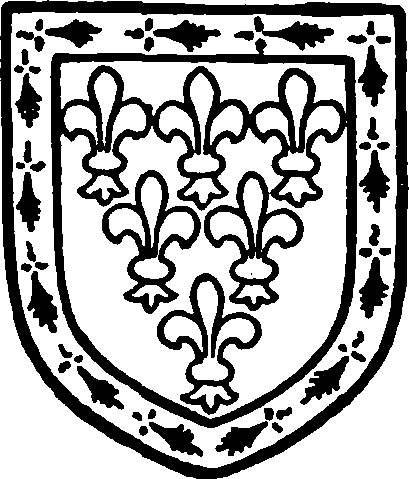
Darley of Spaunton. Gules six fleurs de lis argent with a border ermine.
In 1549 Edward VI granted the manor to William Lord Grey (fn. 50) of Wilton. Lord Grey was a supporter of Lady Jane Grey, and was attainted but restored in 1559. He died in 1562 and was succeeded by his son Arthur, (fn. 51) who in 1565–6 conveyed the manor to John Bonville (fn. 52) (Bonnell, Bonny, Bunney). In November 1582 John Bonville settled the manor on his daughter Anne and her husband William Carrington. John died in the following February, leaving daughters and heirs Alice, Katharine and Anne. (fn. 53) William Carrington and Anne, Thomas Smith and Alice his wife and Katharine Bonville had livery of their third shares in 1584, (fn. 54) but William and Anne had the whole under the settlement. William died before Anne in 1626, leaving a son and heir William, (fn. 55) who (fn. 56) in 1639 conveyed the manor to James Brooke for forty-one years. (fn. 57) Anne, only child of the younger William Carrington, married William Medd of Lastingham, (fn. 58) and in 1675–6 a William Medd and Mary his wife, William Horsley and Elizabeth his wife and Jonas Rigden and Mary his wife conveyed the manor to John Thompson. (fn. 59) In 1676 it was settled on William Medd and his heirs, (fn. 60) but Sir James Brooke, second baronet, was lord in 1716, (fn. 61) his younger son Montagu Brooke in 1746, (fn. 62) and like East Layton (fn. 63) (q.v.) the manor descended from the Brookes to John Jenkins and Honora his wife, who held it in 1770. (fn. 64)
Her trustees conveyed it in 1784 to Henry Brewster Darley, (fn. 65) whose descendant (fn. 66) Mr. Cecil G. Darley is the present owner. This manor includes the township of Appleton-le-Moors, where the owners of land in the 17th century did service at the courts held for the manor of Spaunton (fn. 67) and the township of Huttonle-Hole. (fn. 68)
The Abbot of St. Mary's complained of the breaking of his free warren here in 1397. (fn. 69)
Churches
The church of ST. MARY THE VIRGIN consists of an apsidal chancel, measuring internally about 16 ft. in length, including the apse, by 20 ft. in width, nave 49 ft. 6 in. by 23 ft. 6 in., north aisle 6 ft. 9 in. wide at the east end and 6 ft. wide at the west end, south aisle 13 ft. 9 in. wide at the east end and 12 ft. 7 in. wide at the west end, a west tower, a south porch and an aisled crypt under the chancel and eastern half of the nave.
The history of the building is of peculiar interest, the remains of the monastery built by Stephen, monk of Whitby and first Abbot of St. Mary's, York, forming the nucleus of the present church, which appears to have been converted into the form it now takes early in the 13th century.
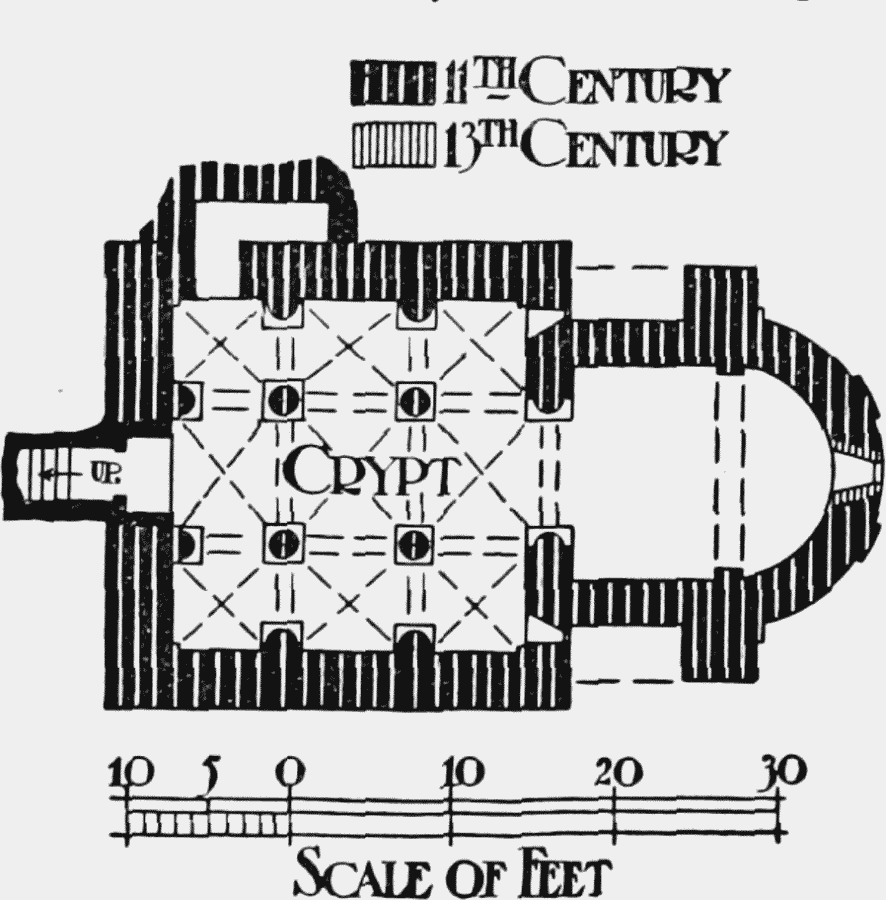
Lastingham Church: Plan of the Crypt
The crypt of the present building, which was built under the apse and the presbytery of the monastic church, is entirely the work of Stephen and must have been commenced immediately upon his arrival in 1078. The erection of a presbytery, terminating at the east in an apse and at the west end in the lower part of a central tower, followed in due course, but it is doubtful if the transepts and any of the church west of the tower were begun, considering the short stay of Stephen and his followers in Lastingham. There is nothing above ground now to suggest this, although foundations of a nave are reported to have been found in the churchyard to the west of the present building.
Nothing further appears to have been done until early in the 13th century, when arcades of two bays were built into the north and south walls of the presbytery and the space between the east and west tower piers was treated in a similar manner. North and south aisles were added and a wall was built across the west end of the church centrally between the west piers of the tower. In the church thus formed the apse and the east end of the presbytery became the chancel, while the western portion of the presbytery and the crossing formed the nave. Late in the 14th century the south aisle was rebuilt and widened, and early in the century following a tower at the west end of the nave was added. From then until comparatively recent years little was done to the structure. Some buildings were erected at the east end of the church in the early years of the 19th century by the late Mr. John Jackson, R.A., but these were removed when the church was generally restored in 1879 by the late Mr. Pearson, R.A. It was at this restoration that the chancel and nave received their present vaults, while the church was entirely reroofed and the south porch built, the whole expense being borne by Dr. Sidney Ringer.
In the apsidal end of the crypt chancel is a small single light having wide inner splays and semicircular rear arch, although at some later date an external trefoil head has been inserted, the inner jambs sloped off at a steeper angle and a flat head cut in the rear arch. Over the apse is a semi-dome and the arch between the apse and chancel is semicircular and of one continuous order. The chancel arch is similar, but carried on half-round responds having cushion capitals of a slightly elaborated character and cavetto moulded bases standing upon square plinths. Over the chancel is a barrel vault. The nave is divided into three bays by arcades on either side with semicircular arches of a single order carried on short circular pillars having carved capitals with chamfered abaci and moulded bases. The capital to the east pier of the north arcade is a plain 'cushion,' while that of the west pier has an interlacing pattern above the necking, over which are small rude angle volutes supporting the abacus. The west respond is semicircular and has a cushion capital. The east pier of the south arcade has a row of pointed leaves encircling the lower part of the capital, over which are roughly carved angle volutes. The west pier has a cushion capital with tiny angle volutes, and the west respond has a similar capital. In the west wall of the nave, approached by three steps, is a segmental-headed doorway with a semicircular arch opening upon a flight of stone steps which lead up to the nave of the upper church. In the east wall of the north aisle is a small round-headed opening with splayed inner jambs and a small external chamfer, and on the north wall are two piers with half-round responds having chamfered abaci, cushion capitals, and circular cavettomoulded bases standing on square chamfered plinths, the abaci being continued round the piers, which have uncarved capitals. In the western bay of this aisle is a deep segmental-headed opening which leads into a narrow passage running eastwards parallel with the aisle, which probably formed the entrance to the crypt chapel before the upper church was ready for use. The south aisle has a small east window and piers in the south wall similar to those in the north aisle, the responds having cushion capitals with indications of small volutes at the angles. The nave and aisles are each vaulted in three quadripartite bays of groined rubble vaulting with transverse arches springing from the arcade piers, those to the nave being semicircular, while those to the aisles are stilted. The vaulting against the walls was originally intended to be carried by wall arches, as seen by the springers built upon the piers against the north, south and west walls of the chapel, but this was found to be unnecessary, and the arches were never completed. The marks left by the centreing of the vaulting which was partly carried on the walls and partly on the transverse arches can still be seen, and pieces of the original boarding are still left stuck into the vault over the east bay of the north aisle. The masonry generally in the crypt is roughly axed and set with very thick mortar joints.
The apse of the upper church is lighted by three semicircular-headed windows of two orders, the inner one being continuous, while internally the outer order is carried by small shafts having carved cushion capitals and cavetto moulded bases. The inner order of the central light has been chamfered. Under the south-east window is a trefoil piscina with a foliated basin, and to the west of this are trefoil sedilia cut out of the walling. Dividing the apse from the original presbytery is a modern semicircular arch carried on original shafted jambs. Lighting the presbytery on the north and south are restored windows similar to those in the apse. The western arch is modern and of two square orders; the outer one is continuous, but the inner one is carried by an original half-round respond having a crudely carved voluted capital with chamfered abaci and bases. Over the presbytery is a modern barrel vault, and the apse is covered with a plastered semi-dome, at the springing of which is a small modern cornice which is continued round the presbytery. Between the windows of the apse and at the junction of the walls of the apse and presbytery are flat projecting external buttresses stopping beneath a modern corbel table, while below the windows and continued round the walls of the apse and presbytery is a moulded string, which has been largely restored. The north and south walls of the presbytery have a modern corbel table and are carried upon two deeply recessed arches, in the west responds of which are the windows lighting the aisles of the crypt. The 13th-century arcades of two bays pierced in the walls of the original quire have pointed arches of two chamfered orders carried on a central pier composed of four clustered keel shafts with bell capitals under common circular abaci, and moulded bases. The eastern responds are of two square orders with chamfered abaci, which are cut off flush with the wall above, but the western ones are the full width of the wall. Over the central pier of each arcade is a modern lancet with widely splayed inner jambs and small external chamfers under a moulded hood mould having carved stops. The arch between the quire and the crossing of the original church is of two square orders and is carried by shafted responds having capitals with rudely carved angle volutes, moulded abaci and bases. Over the quire is a modern groined vault of coursed rubble springing from the walls. The eastern bay of the north arcade is blocked up by a wall dividing it off from the vestry and partly covering the central pier, the bottom part of which is completely encased by a modern pulpit. The vestry, which is entered from the quire through a pointed doorway, has an extraordinarily thick east wall in which is a single round-headed light having widely splayed inner jambs, flat rear arch and small external chamfers. The vestry is separated from the north chapel by a wall running north from the central pier of the north arcade.
Between the east and west piers of the crossing 13th-century arcades of two bays, like those of the quire, have been inserted. Their responds are formed by the shortened responds of the intended north and south arches of the crossing, and, as the thinner inserted walls are built flush with the inner face of the intended tower walls, the improvised responds do not come centrally under their load, necessitating capitals of irregular form.
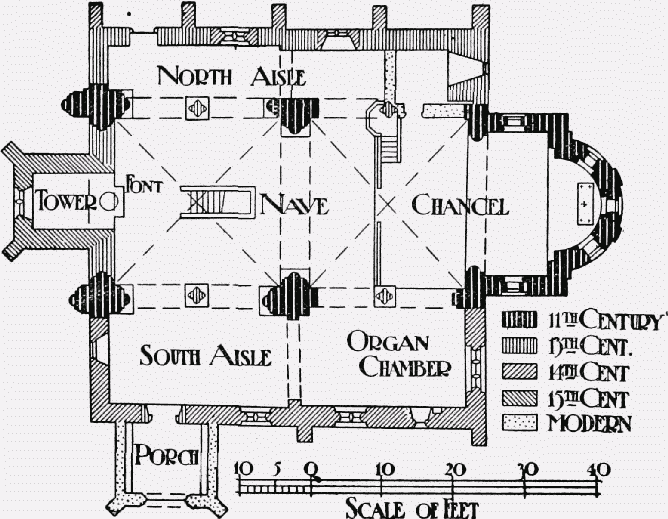
Plan of Lastingham Church
The west responds to the west piers of the crossing can be seen projecting beyond the end wall of the present church. Over the central piers are modern lancet windows, and the crossing is vaulted like the quire. In the middle of the crossing inclosed by a low modern stone parapet wall is the stair down to the crypt. Between the quire and the crossing is a modern external buttress taking the thrust of the vaulting, and the continuous parapet which was built when the walls were raised in 1879 is carried on a modern corbel table.
The north chapel at the east end of the north aisle is lighted on the north by a 14th-century window of two trefoiled lights under a square head with a moulded external label stopped on the east by a beast's head, but the west stop is missing. The tracery is flush with the external face of the wall. Between the north chapel and aisle is a pointed arch of two chamfered orders which springs from the walls. The north aisle is lighted by a 14th-century window of two trefoiled lights under a square head, the tracery being set in the middle of the wall with no external label. West of this is a pointed segmental-headed doorway with a small external chamfer. The rear arch is flat, and the outer one is in one stone. The roof is carried on the south side by modern stone corbels. Along the outside of the north wall of the aisle, chapel and vestry are five buttresses, all in three stages, stopping below a modern parapet.
The east window of the south aisle, which is of 14th-century date, is of three trefoiled lights with tracery set in the middle of the wall under a pointed head and moulded external label. This aisle is lighted on the south by three 14th-century windows. The eastern one is a single cinquefoiled light with two quatrefoils under a square head, but only the outer jambs are original. Under the east jamb is a small pointed piscina with a foliated basin and a credence table over. The second window is of two cinquefoiled lights with tracery under a flat head, but only the jambs are original. The third window is of two trefoiled lights with tracery under a square head, but here again the mullions and tracery are modern. To the west of this is a 13th-century round-headed doorway which was evidently reset when the aisle was widened. The external head springs from impost mouldings, while the flat rear arch is constructed of an ancient tomb slab shouldered at the west end by a moulded corbel. The square-headed west window is of 14th-century date and of two trefoiled lights with tracery built flush with the external wall. The inner jambs are splayed, and over the window is an external moulded label with four-leaved flower stops. Between the eastern pier of the crossing and the south wall is a modern two-centred arch of two hollowchamfered orders springing from square responds with chamfered abaci. On the north side of the aisle are modern corbels taking the rafters of the aisle roof. There are two buttresses on the south wall, one of 14th-century date in three stages at the east end, the other one, which is much restored, opposite the eastern pier of the crossing. On this buttress are marks of an old sundial. Both stop under a modern embattled parapet.
The tower arch is pointed and of three chamfered orders, and springs from the walls, being the full width of the tower. The west window is of two trefoiled lights with vertical tracery under a flat head. The inner jambs are splayed, and there is a moulded external label. Externally the tower is of two stages with an embattled parapet, modern stone slate roof and diagonal buttresses of three offsets at the western angles stopping at about half the height. At the level of the bell-chamber, which is lighted on each side by two square-headed trefoiled lights with moulded labels, is a moulded string-course. Over the south window to the bell-chamber is a gargoyle, and underneath it a modern clock face. Over the north window was a similar gargoyle, but this is now broken off.
Covering the doorway to the south aisle is a modern porch with diagonal buttresses in two stages at the angles and a pointed outer doorway in 15th-century style under a finialled ogee hood mould. The modern roofs to the church throughout, with the exception of the tower, are lead-covered. The floor of the upper church gradually rises from west to east, while the ground outside falls in the same direction. The font is circular and of late 12th-century date. Against the west wall of the south aisle is a 15th-century holy water stoup.
The crypt contains many fragments of grave slabs, crosses and other carved stones, some of pre-Conquest date. (fn. 70) Two pieces of wood carving, each about 4 ft. by 7 in., are also preserved here; one is rudely carved with the figure of a serpent and the other with that of a wyvern. It is possible that they may have formed part of a wall-plate of a 12th-century high-pitched roof. There is also a board of 14thcentury date carved with four-leaved flowers, and a shield carved with the emblems of the Passion.
In the churchyard are several 18th-century gravestones.
There are three bells: the treble by T. Mears, 1813; the second inscribed 'Soli Deo Gloria Pax Hominibus 1663'; and the tenor 'Deo Gloria 1735.'
The plate includes a cup of 1617 with the mark of Peter Pearson of York, a modern paten and a pewter flagon.
The registers begin in 1559.
CHRIST CHURCH, Appleton-le-Moors, is a building of stone in the 13th-century style, and consists of apsidal chancel, nave, north and south aisles, vestry, west porch and south-east tower with spire containing a ring of six bells.
Advowson
The stone church built in Lastingham Monastery in honour of the Virgin Mary about the end of the 7th century was no doubt destroyed with the monastery. A fresh church was erected by Stephen of Whitby about 1078. (fn. 71) By about 1292 the church had become appropriated to St. Mary's Abbey, York, and a vicarage ordained. The abbey retained this church until the Dissolution. (fn. 72) In 1545 the 'rectory and church of Spaunton' were granted to the see of York, but the error in the description of Spaunton for Lastingham nullified the grant, (fn. 73) and the Crown presented until 1899, when the patronage again came into the hands of the Archbishop of York, (fn. 74) the present owner. The free chapel of Appleton-leMoors was in 1585 granted to Theophilus Adams and Thomas Butler, (fn. 75) and in 1616 the site was granted to Samuel Jones and others. (fn. 76) The living of the new parish of Appleton-le-Moors is a vicarage in the gift of the Rev. R. N. Warner, vicar of Almeley, Hereford, and others.
Charities
This parish is in possession of an acre of land called Harwood Garth, given to the poor by George Hobson, of the annual value of £5. The poor also receive 10s. a year in respect of a charity known as Hill's charity.
John James, by will proved 1875, bequeathed £150 consols held by the official trustees, the dividends of which, amounting to £3 15s., are distributed among the poor of Lastingham with Spaunton in money.
The National school, founded by deed 1836, receives £8 6s. 8d. a year from John Stockton's charity. (See under Kirkby Moorside.)
Township of Appleton-le-Moors.—Sophia Glaves, by will proved 1882, bequeathed £100 15s. 1d. consols, the dividends, amounting to £2 10s. 4d., to be distributed amongst poor widows and widowers. The same testatrix bequeathed the like sum, the dividends to be applied towards church expenses. Both sums of stock are held by the official trustees.
This township receives a sum of £8 6s. 8d. from John Stockton's educational charity. (See under Kirkby Moorside.)
Township of Farndale.—The National school receives £8 6s. 8d. a year from John Stockton's charity. (See under Kirkby Moorside.)
Township of Hutton-le-Hole.—This township receives a sum of £8 6s. 8d. a year in respect of John Stockton's educational charity. (See under Kirkby Moorside.)
Township of Spaunton.—This township receives a sum of £8 6s. 8d. a year in respect of John Stockton's educational charity. (See under Kirkby Moorside.)