Survey of London: Volume 24, the Parish of St Pancras Part 4: King's Cross Neighbourhood. Originally published by London County Council, London, 1952.
This free content was digitised by double rekeying. All rights reserved.
'The Foundling Hospital ', in Survey of London: Volume 24, the Parish of St Pancras Part 4: King's Cross Neighbourhood, ed. Walter H Godfrey, W McB. Marcham (London, 1952), British History Online https://www.british-history.ac.uk/survey-london/vol24/pt4/pp10-24 [accessed 30 April 2025].
'The Foundling Hospital ', in Survey of London: Volume 24, the Parish of St Pancras Part 4: King's Cross Neighbourhood. Edited by Walter H Godfrey, W McB. Marcham (London, 1952), British History Online, accessed April 30, 2025, https://www.british-history.ac.uk/survey-london/vol24/pt4/pp10-24.
"The Foundling Hospital ". Survey of London: Volume 24, the Parish of St Pancras Part 4: King's Cross Neighbourhood. Ed. Walter H Godfrey, W McB. Marcham (London, 1952), British History Online. Web. 30 April 2025. https://www.british-history.ac.uk/survey-london/vol24/pt4/pp10-24.
In this section
CHAPTER 2: XCII THE FOUNDLING HOSPITAL
The Foundling Hospital, which owed its inception to Captain Thomas Coram, has an honourable place in the long chain of charitable institutions, generally known as "hospitals," which extends back through the Middle Ages and reaches forward to the present day. London's hospitals were famous, and it was singularly appropriate that the Governors of the Foundling Hospital should incorporate, in the decoration of their Court Room, eight medallion paintings of the general hospitals of St. Bartholomew and St. Thomas, founded in the 12th century, Bedlam (for the insane), Christ's Hospital (for children), Charterhouse, the 17th century Royal Hospitals at Chelsea (for soldiers) and at Greenwich (for sailors), as well as the Foundling. In the first half of the 18th century illegitimacy was rife and there was an appalling increase in the number of infants abandoned by their mothers. Concealment of birth was the chief motive, since only in this way could these unfortunate women have any hope for their future. That society was not unmoved by this spectacle is proved by the wide support which Coram got for his scheme, but as so often happens, it needed the zeal and single-minded devotion of one man to point the way to a remedy and his untiring advocacy to secure its adoption. (fn. n1)
Thomas Coram was a sea-captain who spent much of his life in New England. He retired in 1719, and from the following year lived at Rotherhithe. He devoted himself to philanthropic work and his sympathies must have early turned towards the children. For many years he laboured to get support, and eventually engineered an influentially-signed petition to the King by ladies, followed by one by noblemen and gentlemen in 1735. Two years later Coram petitioned the King himself and was successful in obtaining a royal charter for incorporating his "Hospital for the Maintenance and Education of Exposed and Deserted Young Children." At a memorable meeting at Somerset House on 20th November, 1739, he presented the charter to the Duke of Bedford and a distinguished company, including William Hogarth and Dr. Richard Mead. Coram was then about 70 years old.
Foundling Hospital
The interesting story of how the hospital was started, the rules for the admission of the children, the anxious consideration of their diet, upbringing, and preparation to earn their livelihood is told by R. H. Nichols and F. A. Wray in their History of the Foundling Hospital (1935). Temporary premises were taken in Hatton Garden, the first admission being on 25th March, 1741. The site for the permanent buildings in Bloomsbury Fields was purchased from the Earl of Salisbury and comprised 56 acres. The architect selected was Theodore Jacobsen, of the family long connected with the Steelyard in the City of London. He was a Fellow of the Royal
Society and his only other known architectural work was the Haslar Royal Hospital for sick soldiers at Gosport. The general superintendence of the buildings was undertaken by James Horne, who acted as surveyor without fee. Another architect employed was John Sanderson, who presented the marble table in the Court Room. The foundation stone was laid on 16th September, 1742, the buildings being completed in 1747. (fn. 9)
Although the Foundling Hospital received state recognition and at times was in receipt of public grants, it was remarkable how widespread was the private support accorded it. Men of wealth and position were honoured by election to the Board of Governors and eminent physicians helped with their professional advice and services. The patronage of the hospital by distinguished people was facilitated, too, by the benevolence of artists of high rank, and not only did the chapel become famous for its musical performances, initiated by Handel, who presented the organ and conducted his Messiah there in person, but the court room and picture gallery were filled with paintings by Hogarth, Gainsborough, Reynolds, and many other artists. These pictures drew a large number of visitors, and the artists themselves met here to confer with one another and to dine. These meetings are said to have been an important factor in the founding of the Royal Academy. (fn. 9) Both concerts and exhibitions were most useful in augmenting the funds of the Foundation.
One of the most striking things about the design for the Foundling Hospital was its lay-out, which was simple, practical, and remarkably effective as a setting to the whole scheme (Plate 12). The site was some 400 feet wide and its southern frontage to Guilford Street had a pleasant screen-wall broken in the centre by a wide stretch of gates and railings in the middle of which was the statue, by William Calder Marshall, of Coram on a high pedestal (Plate 39). This screen superseded the earlier circular wall and archways removed when Guilford Street was laid out (Plate 11). Behind the walls, and for some 350 feet on the returns northwards, was a continuous colonnade, supporting the roof of a covered walk, so that the whole of this part of the site was a wide court enclosed on three sides. The side walks, where the children were employed in rope-making, had each a central pedimented pavilion (Plate 41); on the south the walk was enclosed to form two lodges, flanking the entrance, with storerooms, etc. At each end of each section of the frontage was a small square building with pyramidal roof, the easternmost having been replaced later by a large room to accommodate the college band.
The great front court had a wide central approach between two stretches of turf around which stood trees. The main buildings formed a courtyard open to the south looking on to this approach (Plate 17), but originally closed by a dwarf wall, railings, and gates. The broad scheme of the hospital plan embraced a large chapel, built 1747–1753, forming an independent north block, and two long three-storey ranges to the east and west, the former allocated to girls and the latter to boys. The ground floor of the chapel was surrounded by an open cloister which was utilized later to support galleries above. The southern section preserved its open character and consisted of seven vaulted bays opening on to the courtyard by semicircular headed arches (Plate 23). East and west of the chapel was originally a barrel-vaulted passage, fifteen feet wide between the piers. These were later enclosed to form lobbies, the western being the main entrance. This was furnished with a two-way stair to the galleries and a pair of arches north and south of an inner lobby. The eastern section, known as the chapel cloister (Plate 23), which contained a number of memorials, was also enclosed by doors and communicated with a lobby on the north side that gave access to the chapel and to the chaplain's vestry. Another vestry was accommodated in the northern section towards the west. The east and west galleries were an extension in 1754 of the original plan.
The ground floor had three sets of enclosed pews, set longitudinally, on each side of the central aisle, facing one another. The altar, within ornamental iron altar rails (presented by Mr. Wragg, His Majesty's smith), was at the east (Plate 20). The lofty pulpit and clerk's reading desk (Plate 26) stood north and south of the central aisle respectively, and the font was placed east of the desk. The walls were lined with long panels above a moulded dado, and the doors had pediments over a carved frieze, with pairs of swags of fruit and flowers above them. Similar carved drops divided the panels. The gallery surrounded the chapel on all sides and was protected by an elaborate wooden balustrade over the wall cornice. From the balustrade rose tall Ionic columns carrying an entablature on the north and south and three arches on the east, where the columns were coupled (Plate 21), a feature repeated towards the eastern and western ends of the side galleries. The eastern gallery communicated with the side galleries by doors with pediments beneath swags of fruit and flowers. To the north and south the gallery walls were pierced by five large windows, the centre window being of Venetian type—a central circular-headed light flanked by small rectangular openings between columns carrying an entablature. The remaining windows were plain circular-headed, and all were fitted with stained glass, most of it heraldic (see p. 20 and Plate 22). The side galleries (Plate 21) and that to the east were vaulted with groined plaster vaults with enrichment, and the flat ceiling of the centre of the chapel was raised above a bold plaster cove high enough to be intersected by the arches of the eastern gallery. It had an elaborate centre design. The western gallery, which held the organ in a handsome organ case (the gift of Handel to the hospital, but rebuilt in 1769), (fn. n2) was curved in plan and was given sufficient depth in 1774–5 (enlarged in 1813) to accommodate the choir. It projected into the chapel over two columns and the main cove of the ceiling was originally carried behind it in apsidal form, but this was replaced later by a high arched vault. The chapel was designed with a view to musical performances which, as stated above, brought large sums of money to the hospital funds, and the organ was first used by Handel himself at a special performance of the Messiah.
The east and west wings were originally independent buildings, touching the chapel only at the ground floor where they adjoined the open lobbies. They were each planned in two long parallel rooms, back to back, on all floors (except the ground floor, west), and adjoined rectangular blocks, north and south, which projected very slightly from the main wings on the outer sides, and in a more pronounced manner towards the courtyard (see plans, Plates 12 and 13). The wall dividing the wings into parallel sections was not in the centre, the outer compartments being wider than the inner, nor were the two wings planned alike. On the ground floor the long room facing the courtyard had groined plaster ceilings, the west being the boys' dining room (Plate 37) and the east the girls' play room, each being over 100 feet long by 20 feet wide. The girls' dining room adjoined their play room, with a section on the south allocated to infants. A large boys' play room was added later to the north of the west wing, and the whole outer section of the west wing on the ground floor was devoted to the principal administrative rooms, the court room and sub-committee room to the south, and the picture gallery to the north of an entrance hall. These rooms are described below. In the centre of the blocks north and south of the west wing and north of the east wing were spacious staircases (Plate 38) which rose to the top of the building, with rooms on each side. In the south part of the east wing a smaller stair was planned in the north-west angle of the block. The first and second floors of the wings were occupied almost entirely by the boys' and girls' wards or dormitories respectively.
The above gives a general idea of the lay-out of the hospital, which is shown in detail in Mr. Sheppard's drawings reproduced here. The internal arrangements had no doubt been altered from time to time and additional buildings were constructed, such as the boys' play room, already mentioned, to the north of the west wing, and an infants' school-room to the east of the offices built north of the east wing.
The three principal rooms in the west wing merit a more detailed description on account of their architectural treatment, and because they have been reconstructed with all their main features in No. 40 Brunswick Square, where they can still be seen. The court room (Plate 28) was lighted by four large sash windows in its west wall, filling the space between the moulded dado that surrounded the room and the modillion cornice above. Between the two outer pairs of windows were swags of fruit and flowers overhanging the busts of Caracalla and Marcus Aurelius standing on brackets, casts from the antique presented by Richard Dalton. Between the centre windows an enriched oval frame enclosed a mirror, surmounted by a plaster design with pendants, within which hung a pair of chains. Below was a marble table, supported by a group of two children and a goat (Plate 29b), presented by John Sanderson, architect, who assisted in the construction of the hospital. In the centre of the east wall was the fireplace with a simple stone mantel, having a horizontal entablature and side pilasters, beneath a stone overmantel signed and presented by J. Devall, who was responsible for the stonework at the hospital. The centre of the overmantel had a large panel in low-relief by John Michael Rysbrack representing children engaged in navigation and husbandry, flanked by consoles and surmounted by a pediment, over which were festoons of fruit and flowers (Plate 30). Each side of the chimneybreast the wall was chiefly occupied by a large eared frame, with scrolled top and escutcheon below, in which were the paintings: (left) "The finding of the infant Moses in the bulrushes," by Francis Hayman, R.A., and (right) "Little Children brought to Christ," by James Wills. Similar frames on the north and south walls held "Moses brought to Pharaoh's daughter," by Hogarth, and "Hagar and Ishmael," by Joseph Highmore. At the sides of these four pictures were small circular frames, carved with leaf ornament with festoons above and below, depending from masks, eight in all, containing paintings of the following hospitals: North wall, St. Thomas' Hospital (Samuel Wale), St. George's Hospital (Richard Wilson); East wall, Foundling Hospital (Richard Wilson), Chelsea Hospital (Edward Haytley), Charterhouse (Thomas Gainsborough), Christ's Hospital (Samuel Wale); South wall, Bethlehem Hospital (Edward Haytley), and Greenwich Hospital (Samuel Wale) (Plate 29a). They form a beautiful series and are all dated. At the extremities of the north and south walls are two doorways (one blind in each case) with handsome frames of architrave, cornice and enriched frieze, with carved festoons over. The ceiling was an elaborate design in relief, the gift of the father of Joseph Wilton, R. A., who was an ornamental plasterer and carried out many of the ceilings of French character which were then in fashion (Plates 28 and 31). This has been re-erected in the room at Brunswick Square.
Adjoining the court room on the south was the committee room (or secretary's room) with two windows looking south and one west. A simple dado and modillion ceiling cornice surround the room and it has a good carved fireplace, the design of which is ascribed to Hogarth, beneath an overmantel framing a landscape by George Lambert, the founder of the Beef Steak Club (Plate 35).
North of the court room was a paved vestibule and then the picture gallery, a long room with six windows in its west wall. The treatment was quite simple: moulded dado, modillion cornice and plain ceiling, with sixpanelled doors within moulded architraves. The fireplace was of marble with Ionic columns supporting its entablature, and a framed overmantel with scrolled terminals enclosing a portrait of Thomas Emerson, by Joseph Highmore. Over the entrance door was an oval relief with figures. This gallery contained the important collection of pictures and statuary presented to the hospital, including Raphael's "Murder of the Innocents," Hogarth's portrait of Captain Coram, and Roubiliac's bust of Handel in the original plaster, which can be seen to the right of the fireplace in Plate 34.
In 1926, consequent upon the decision of the Governors to remove the Foundling Hospital to the country, the site was sold and the children were provisionally accommodated at St. Anne's Schools, Redhill. (fn. 9) The new hospital was built at Berkhamsted from the designs of Mr. John M. Sheppard, (whose drawings of the old hospital illustrate this volume), its foundation stone being laid in 1933 and the children transferred there in 1935. The memorials, heraldic glass, and the statue of Coram went to the new hospital, but the court room, picture gallery, etc., and the works of art were retained in a new building at No. 40 Brunswick Square. When the main buildings were removed the major part of the site was bought by Lord Rothermere and those supporting him, to be preserved as a playground for children and the Foundling Hospital re-purchased the remainder to provide for the existing infant welfare centre. (fn. 10)
Memorials
1. CAPTAIN THOMAS CORAM, 1751. The following inscription was cut in stone in the south cloister of the Chapel, and has been transcribed from a photograph:
Captain THOMAS CORAM Whose Name will never want a Monument so long as this Hospital shall subsist, was born in the Year 1668. A Man eminent in that most eminent Virtue, the Love of Mankind.
Little attentive to his Private Fortune, and resusing many Opportunities of increasing it, his Time and Thought were continually employed in Endeavours to promote the Public Happiness, both in this Kingdom and elsewhere, particularly in the Colonies of North America, and his Endeavours were many Times crowned with the desired Success.
His unwearied Solicitation, for above Seventeen Years together which would have baffled the Patience and Industry of any Man less zealous in doing Good, and his Application to Persons of Distinction of both Sexes, obtained at length the Charter of the Incorporation bearing Date the 17th. of October, 1739, FOR THE MAINTENANCE AND EDUCATION OF EXPOSED AND DESERTED YOUNG CHILDREN, by which many Thousands of Lives may be preserved to the Public, and employed in a frugal and honest Course of Industry. He died the 29th. of March, 1751, in the 84th. Year of his Age, poor in Worldly Estate, rich in Good Works, and was buried at his own Desire in the Vault underneath this Chapel (the first there deposited) at the East End thereof, many of the Governors and other Gentlemen attending the Funeral to do Honour to his Memory. READER
The Actions will show whether thou art sincere in the Praises thou may'st bestow on him, and if thou hast Virtue enough to commend his Virtues, forget not to add also the Imitation of them.
The following tablets, which were formerly to be seen in the vaulted lobbies to the east and north of the chapel and in the vault below, are now preserved at Berkhamsted. The names are given in alphabetical order.
2. CHARLES ABBOTT, first Lord TENTERDEN, 1832, Lord Chief Justice and vice-president of the hospital, 1821–1832, and his wife, MARY, daughter of John Langley Lamotte. The memorial consists of a bust on a pedestal within an architectural frame standing on a sarcophagus, and is signed by P. Sarti. The inscription is in Latin and was composed by himself. He was buried in the chapel vault. (Tablet originally on east wall of east lobby, see Plate 24a.)
3. FANNY ARDEN, 1836, wife of Richard Edward Arden (elected governor, 1834), and their daughter CLARA HIRST ARDEN, 1835, and son Alfred Mason Arden, 1836. Marble tablet surmounted by an urn, originally on west wall of east lobby (see Plate 24a).
4. ROBERT ATCHISON, 1818. He was appointed schoolmaster in 1780 and was for 39 years a "diligent and affectionate master of the boys." A plain stone; he was not buried here.
5. HENRY BLANSHARD, 1870, elected governor 1858, and his wife, Miriam, 1871. A marble tablet within a cusped pointed arch, originally on the west wall of the east lobby.
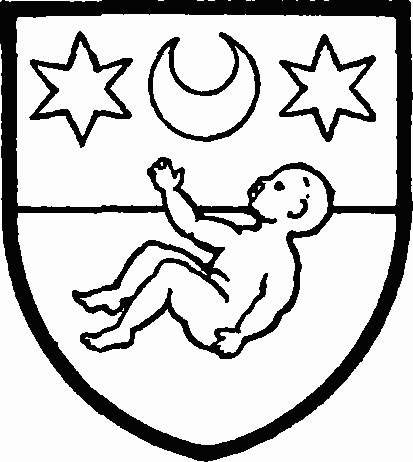
Shield of arms: gules a chevron or between two bezants in chief and a griffin's head erased or in base, a crescent for difference (Blanshard), impaling azure a chevron or between three lozenges or. Crest: a griffin's head erased.
6. JAMES KENDLE BROWN, 1854, elected governor in 1845. Plain marble tablet on dark ground, originally on north wall of east lobby (see Plate 24a), signed S. Manning.
7. JOHN BROWNLOW, 1873. He was a foundling and was employed in the secretary's office in 1814, became treasurer's clerk in 1828 and was appointed secretary in 1849 and held the office until 1872. He wrote a history of the hospital. The tablet is marble of gothic design, formerly on the west wall of the east lobby, and is signed by Burke of 17 Newman Street, London.
8. SAMUEL COMPTON COX, 1839, treasurer of the hospital for 33 years (1806–1839) and formerly a master of the High Court of Chancery. Also Anna, 1829, his wife, daughter of Percival Pott, senior surgeon of St. Bartholomew's Hospital. Samuel Cox was vice-president in 1805–6 and Colonel commanding the Bloomsbury and Inns of Court Association. His memorial is in the form of a sarcophagus with a relief depicting himself seated with three foundlings. It is signed J. Lough, whose full name was John Graham Lough (1806–1876). The memorial was formerly fixed over the door in the west wall of the north lobby (see Plate 24b).
9. HENRY DEALTRY, 1823, secondary of the Crown Office, his wife ELEANOR, 1831, their eldest son, PEREGRINE, 1842, master of the Crown Office and elected governor of the hospital, 1826, and their youngest son, WILLIAM, 1826. A marble tablet erected by Frances and Anne their surviving daughters.
10. HUGH EDWARDS, 1839. Elected governor, 1804. Plain marble tablet.
11. THOMAS EVERETT, M.P., 1810. Vice-president 1797–1810 and a generous benefactor to the hospital. A marble tablet surmounted by an urn, formerly on the west wall of the east lobby.
Shield of arms: gules a chevron ( ) between 3 mullets ( ) (Everett) impaling party per chevron or and ( ) 2 mullets ( ) in chief and a crescent ( ) in base. Cansick gives his wife, Martha, also (d. 1825).
12. PETER FADDY, 1848. A foundling apprenticed to an "Enamelled and Dial Plate Painter" in Old Street in 1808, who was afterwards employed for 20 years as messenger in the hospital. A plain stone commemorates him as "Honest Peter Faddy."
13. EDWIN JAMES FAIRLAND, Colonel A.M.S., 1909. Elected governor 1894. Lead plate mounted on marble.
Shield of arms: argent a saltire engrailed gules between four roses gules barbed and seeded proper.
14. JAMES FARRER, 1826. Elected governor 1819. Shaped marble tablet with shield of arms which Cansick gives as or cotised sable 3 horseshoes ( ) (Farrer) impaling argent a griffin sable, on a chief sable 3 stars or.
15. JOSIAH FORSHALL, 1863. Keeper of the Manuscripts (1827–1837) and secretary (1828–1850) of the British Museum. Chaplain to the hospital (1829–1863). Also his wife Frances, 1865. An arched marble tablet in the gothic manner with a Latin inscription recording his publications, formerly on the north wall of the north lobby.
16. Sir STEPHEN GASELEE, 1839, Justice of the Court of Common Pleas, elected governor, 1815, and vice-president of the hospital, 1824–1838. Also HENRIETTA, 1838, his wife, daughter of James Harris of the East India Company, and their two daughters HENRIETTA, 1840, and EMMA 1841. Plain marble tablet formerly on the west wall of the east lobby.
17. Rev. JOHN WILLIAM GLEADALL, 1882, morning preacher in the hospital chapel, 1845–1882. Marble tablet with portrait in relief by Thomas Woolner, R.A. (1825–1892). There is a bust of Gleadall by S. J. P. Haydon at the hospital.
18. CHARLOTTE JOSEPHINE GREGORY, 1859, daughter of George Burrow Gregory (see No. 19 below) and Maria Teresa his wife. Marble tablet with arched head to panel, signed J. S. Farley.
19. GEORGE BURROW GREGORY, 1892, for eighteen years M.P. for Sussex and treasurer of the hospital 1857–1892. Marble tablet enclosing alabaster escutcheon with inscription, formerly on north wall of east lobby (see Plate 24a).
20. ROBERT GREY, 1914. Treasurer of the hospital 1892–1914. Lead plate with portrait in relief on marble tablet.
22. WILLIAM HAMMOND, 1834, his wife ANN, 1824, and their son WILLIAM, 1855, elected governor of the hospital, 1824.
Tablet with scrolled pediment and shield of arms: argent a chevron sable between 3 mullets ( ) impaling argent a saltire engrailed gules between 4 roses gules (? Fairland).
23. MARK HEALEY, 1912. Private, 19th Hussars. A foundling who was drowned at Aldershot in trying to save a comrade. Brass plate.
24. JOHN HEATH, 1830, Justice of the Peace for Middlesex and elected governor 1814. Also his wife, Jane Louisa, 1834. Marble tablet shaped like a sarcophagus supporting an urn.
25. Rev. JOHN HEWLETT, 1844. Morning preacher at the hospital 1798–1826. He was a biblical scholar and professor of belles lettres at the Royal Institution. He was instituted to the rectory of Hilgay, Norfolk, in 1819.
His marble tablet bears a shield of arms: ermine on a chevron ( ) 3 hinds' heads rased, a quarter ( ) charged with a lion ( ) impaling azure 3 arrows in pale fesswise, points to chief ( ), a quarter ( ) charged with a lion ( ). (Cansick draws the coat, he does not show the arrows fesswise and the quarter in the impalement has a leopard rampant).
26. CLEMENT HUE, M.D., 1861, and his wife LUCY, 1851. He was physician to St. Bartholomew's, Christ's Hospital, and the Foundling Hospital. He was elected governor in 1819 and was vice-president, 1847–1861. The memorial, which used to be on the south wall of the north lobby, consisted of a large inscribed slab between two tall urns standing on a base supported by corbels (see Plate 24b). The hospital possesses a portrait of Dr. Hue by R. Buckner.
27. JAMES CHICHELEY HYDE, 1867. Lieut.-Colonel, Indian Army, elected governor, 1862.
Shaped marble tablet with shield of arms: azure a chevron between 3 lozenges or (Hyde). Crest: an eagle rising wings addorsed and inverted.
28. Rev. CORRIE JACKSON, 1895, chaplain to the hospital for nine years. A lead plate fixed to marble.
29. CHARLES JAMES JOHNSTONE, M.B., 1838. Attended at the hospital. He died at the age of 28. Memorial consists of an inscribed tablet surmounted by a large relief with an angel descending to the dying man.
30. JOSEPH KAY, 1847, architect. He was appointed surveyor of the hospital buildings and superintendent of the estate in 1814. He is described on the simple tablet that was on the east wall of the east lobby as a "faithful officer of this institution." The design of the east side of Mecklenburgh Square was his work (see p. 28). The tablet is signed J. S. Farley.
31. LUKE LYNCH, 1892. "Faithful Servant in the Hospital." A brass let into a stone tablet with scrolled pediment.
32. GEORGE PARDOE, M.D., 1850. Plain marble tablet with pedimental head.
33. ROBERT RAINY PENNINGTON, 1840. Elected governor, 1810. Monument in stone with carving in relief.
35. CHARLES PLUMLEY, 1860, second son of William Plumley of Shepton Mallet, elected governor, 1841. Also LOUISA, his widow, 1868. Marble tablet with shield of arms: ( ) floretty ( ), a bend checky ( ) and ( ). Crest: a dexter arm vambraced embowed holding a spear, point to dexter.
36. CHARLES POTT, 1864, treasurer, 1839–1852, vice-president, 1856–1864, and Anna, his wife, 1876. Marble tablet of gothic design formerly on north wall of north lobby.
37. DANIEL ROWLAND, 1859. Elected governor, 1810. Plain marble tablet, formerly on west wall of east lobby, signed Bedford. (Cansick gives Rowlands.)
38. WILLIAM GEORGE SIBLEY, 1807. Treasurer to the East India Company, elected governor of the hospital, 1790, and his wife, Jane AMPHILLIS, 1832.
Marble tablet with shield of arms: per pale ( ) and ( ) a griffin ( ) between 3 crescents ( ) impaling ( ) a chevron gules between in chief 3 mullets ( ) and in base 3 ermine spots. Crest: a demi-lion ( ) holding in its paws a ducal coronet.
39. JOHN STEPHENSON, 1822, elected governor 1795, and his wife, Mary, 1814. Marble tablet surmounted by urn formerly on west wall of east lobby.
Shield of arms: gules on a bend argent 3 leopards' faces ( ) (Stephenson) impaling ( ) a chevron sable.
40. JOHN THOMAS, 1849. Elected governor, 1818, and his wife, ANN, 1833, daughter of Josias le Marchant. Marble tablet surmounted by an urn, formerly on the east wall of the east lobby.
Shield of arms: or on a pale azure a lion ( ) between two oak trees ( ), a crescent for difference impaling azure a chevron or between 3 owls argent legged or (le Marchant).
41. WILLIAM WATSON, F.R.S., 1818. Serjeant at Arms attendant on the Great Seal at the House of Lords, Senior Common Pleader of the City of London. Vice-president of the hospital, 1813–1818. Also his wife, Susan, 1814. Stone tablet with urn, formerly on west wall of east lobby.
42. THOMAS WEEDING, 1856, merchant of the City of London. Elected governor 1818, also his first wife, Sarah, 1835, and his second wife, Mary, 1860. White marble tablet surmounted by an urn, formerly on the east wall of the east lobby.
Shield of arms: or 2 bars gules, in chief 3 martlets gules impaling argent on a saltire azure 5 crescents ( ) between 2 buckles ( ), and two stags' heads erased one in chief and the other in base ( ). Crests: dexter, a martlet, sinister a tower. (Cansick gives the saltire engrailed.)
Heraldic Glass
The following is a list of coats of arms of governors and others connected with the hospital, formerly in the windows of the chapel. The glass has been re-fixed in the chapel and hall at Berkhamsted and has been listed as it stands. The original position of the glass has been given wherever known. The blazon of each shield is given in a list compiled by Mr. Albert Manchester and deposited in the library of the London County Council. The dates (except those in brackets) appear with the names in the windows, and seem usually to be the year of election as governor.
Chapel
Chancel, north side. A window to H.R.H. the Prince of Wales, president, 1809. Royal arms.
Chancel, south side. A window to H.R.H. Arthur, Duke of Connaught, president, 1904.
Nave, north side: Window No. 1 (from the east). Nos. 1 to 11 formed the upper part of the second window from the east on the south side of the old chapel. The remainder of the shields are now No. 21 (window north 2) and Nos. 22, 21, 23, 24 (window north 4). Centre achievement. H.R.H. Frederick, Duke of York, president 1820, royal arms of George III.
Window No. 2. This (excepting No. 21) appears to have been the second window from the east on the north side of the old chapel.
Window No. 3. This appears to have been the easternmost window on the south side of the old chapel, with additional shields.
Window No. 4. With some exceptions at the end, the shields in this window seem to correspond with the second window from the west, on the north side of the old chapel.
Nave, south side. Window No. 1 (from the east).
Centre: achievements of H.R.H. Adolphus, Duke of Cambridge, president 1827, and H.R.H. George, Duke of Cambridge, president 1851.
Window No. 2. This window was the northernmost of the three windows in the east wall of the old chapel (see Plate 22).
Upper part: royal arms of King George III.
Window No. 3. This was the centre window in the east wall of the old chapel. It contains no heraldic glass but is composed of three shaped panels in the centre of which is a group of Faith, Hope and Charity by Wilmshurst.
Window No. 4. This was the southernmost of the three windows in the east wall of the old chapel. Upper part, the present royal arms.
Hall
North side (from the east). Window No. 1.
Window No. 2.
Window No. 3.
Window No. 4.
Window No. 5.
South side(from the east). Window No. 1.
Window No. 2.
Window No. 3.
Window No. 4.
Window No. 5.