Survey of London: Volume 23, Lambeth: South Bank and Vauxhall. Originally published by London County Council, London, 1951.
This free content was digitised by double rekeying. All rights reserved.
'Norfolk House and Old Paradise Street', in Survey of London: Volume 23, Lambeth: South Bank and Vauxhall, ed. Howard Roberts, Walter H Godfrey (London, 1951), British History Online https://www.british-history.ac.uk/survey-london/vol23/pp137-140 [accessed 1 May 2025].
'Norfolk House and Old Paradise Street', in Survey of London: Volume 23, Lambeth: South Bank and Vauxhall. Edited by Howard Roberts, Walter H Godfrey (London, 1951), British History Online, accessed May 1, 2025, https://www.british-history.ac.uk/survey-london/vol23/pp137-140.
"Norfolk House and Old Paradise Street". Survey of London: Volume 23, Lambeth: South Bank and Vauxhall. Ed. Howard Roberts, Walter H Godfrey (London, 1951), British History Online. Web. 1 May 2025. https://www.british-history.ac.uk/survey-london/vol23/pp137-140.
In this section
CHAPTER 28 - NORFOLK HOUSE AND OLD PARADISE STREET
In 1397 a certain John Beaufitz was granted (fn. 5) a messuage and twelve acres of ground in Lambeth, part of the property forfeited by Richard FitzAlan, Earl of Arundel and Surrey, on his attainder (fn. n1). How long the FitzAlans had held land in Lambeth it has not been possible to ascertain, but in 1399, (fn. 19) when his father's attainder was reversed, Thomas FitzAlan regained possession of his lands, and it seems most probable that, after Thomas FitzAlan's death in 1415, they passed to his sister, Elizabeth, and her husband, Thomas Mowbray, Duke of Norfolk, and ultimately to their great grandson, Thomas, Earl of Surrey and second Duke of Norfolk of the Howard house. (fn. 6) The latter built the Howard chapel in St. Mary's, Lambeth, and, at his death in 1524, left (fn. 7) his house and freehold and copyhold lands in Lambeth to his second wife, Agnes. Five of his sons, who died while still children, were buried in the church, (fn. 4) as was his widow, who bequeathed a chalice and paten of silver gilt to her “chappel” there. (fn. 8)
It was at Norfolk House that the ill-fated Catherine Howard, granddaughter of Thomas, second Duke of Norfolk, through his first wife, Elizabeth, spent her neglected childhood, nominally in the charge of her stepgrandmother, Agnes, Dowager Duchess of Norfolk. The story of the latter, after Catherine's arrest, rummaging through the coffers Francis Dereham had left at Norfolk House to remove incriminating papers, is well known. (fn. 3)
Thomas Howard, third Duke of Norfolk, used Norfolk House, Lambeth, as a suburban residence (fn. 2) until his attainder in 1547. His life was saved by the death of Henry VIII, but his estates were seized and granted to William Parr, Marquess of Northampton. (fn. 19) On the accession of Queen Mary, however, Norfolk's attainder was reversed and he regained possession of his Lambeth property, which, at his death in 1554, descended with his title to his grandson, Thomas, fourth Duke of Norfolk. (fn. n2) The latter sold (fn. 9) the Lambeth estate to Richard Garthe and John Dyster, thus terminating the long connection of the family with Lambeth. The property is described in the sale as a capital messuage “wherin the ancestors of the said duke have accustomed to lye,” two inns, formerly called the George and the Bell, the former being annexed to the mansion house on the west and the Bell, on the east; Bell Close, at the rear of the Bell, containing two acres, two perches; 23½ acres in “Cottmansfeld,” an acre of pasture in St. George's Field, a close lying near the Bishop of Rochester's House (Carlisle House) containing four acres, three acres of meadow near Prince's Meadows, and eight acres of marsh called “the hopes.” Garthe and Dyster divided the property into three parts, two-thirds of which, including the land in Cotmansfield and Lambeth Marsh, ultimately came into the hands of Thomas Cure (see pp. 25 and 56). The remaining third, which included Norfolk House and the Bell and Bell Close (the latter being copyhold), was sold first to John Glascocke (fn. 9) and then to Margaret Parker, (fn. 10) wife of Archbishop Parker, and, at her death in 1570, it passed to her younger son, Matthew. (fn. 11)
The days of Norfolk House as a great house were numbered. In 1575, when Matthew Parker died, (fn. 12) he left the whole of the property to his brother John, with the proviso that his wife, Frances, might occupy the central portion during the remainder of her life if she wished. Within a few years John Parker had divided the property into three. The eastern part, which contained a messuage, a garden, an orchard, and four acres of ground extending as far as the road, now Lambeth Walk, he sold to John Gryffyth. (fn. 13) From the description it appears that this was the ground on which Hodge's Distillery afterwards stood and through which Norfolk Row (referred to in 1610 as a cartway to a lane on the back side of Lambeth) was subsequently made. The middle section, on which a small part of the original house (perhaps the stables) stood, he sold to Richard Adams, (fn. 14) who erected new buildings which were stated in 1610 to be in the occupation of Thomas Blague, rector of Lambeth. (fn. 15) The western portion, on which stood the main part of the original house, he sold in 1590 to Archbishop Whitgift. (fn. 16) Sir George Paule bought the house from Whitgift's son in 1608 and lived there until his death in 1635. From the details contained in this sale (fn. 17) some idea can be gained of the size of Norfolk House and the disposition of the buildings. There was a great gate from “the King's highway leading from Lambeth Town to St. George's Fields” (i.e. Lambeth Road) leading into a paved yard. On the west was the Duke's chapel which, by 1590, had been partitioned to make a hall, buttery and parlour, and a number of small rooms; on the east were the kitchen offices with “a greate chamber” on the first floor, a gallery, oratory and several closets and the hall opening on to the garden on the south. The total width of the garden was 125 feet, and it is a reasonable assumption that the street frontage was approximately the same. Sir George Paule left (fn. 18) the house with some copyhold land adjoining to his nephew, John Oldbury, in trust for his wife and son, and ultimately with the exception of three messuages and gardens sold (fn. 19) to John Dawson in 1681, Paule's property was bought (fn. 20) by Archbishop Tenison for the endowment of the girls' school in the High Street and for a burial ground (see p. 142). It is probable that the messuages sold to Dawson comprised the original street frontage of Norfolk House, since none of the property devised by Archbishop Tenison had a frontage to Lambeth Road.
Old Paradise Street
[See plate 117.]
This street was formed in the late 17th century on land which had formerly belonged to Norfolk House. Nos. 2–18 formed part of the endowment left by Archbishop Tenison to the school for girls founded by him in High Street. In the 18th century they were let by the school trustees on long lease to Richard Summersell, who held the offices of bailiff of the manors of Kennington, Vauxhall, Lambeth and Walworth, surveyor of the Parish Roads and surveyor of Thrale's Brewery. His daughter, Elizabeth Pillfold, widow of Alexander Pillfold, surrendered the lease when land was required to enlarge the burial ground (fn. 21) (see p. 142).
Architectural Description
Nos. 2–8 form a plain brick-built terrace probably dating from about 1760. Nos. 2–6 are identical and have open pedimented doorcases carried on Tuscan type pilasters. No. 2 has been partly demolished.
No. 8, of slightly wider frontage though with its parapet at the same height, has a doorway with flat hood and sunk panelled surrounds. The house has good panelling on the first floor and formed a pair with No. 10, which was pulled down in 1950.
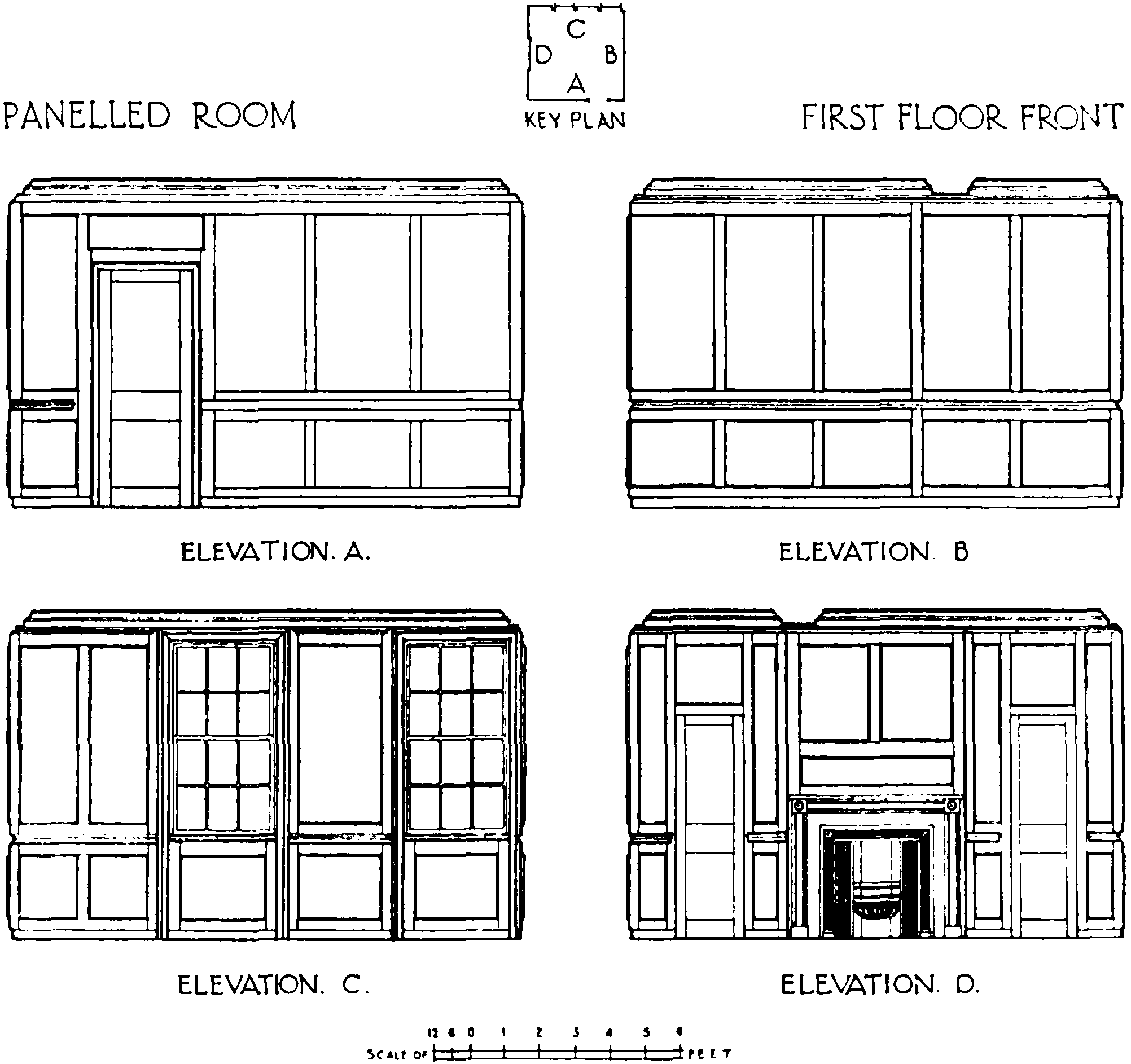
No. 8 Old Paradise Street, panelled room on first floor (front). Measured drawing.
No. 14 probably dates from the late 17th century. It also has three
storeys, but the upper storey is in the roof. On the street and west elevations is a heavy eaves gutter and wood boxed cornice supported on block modillions. It has a first floor brick band raised at the ends. Though the house is derelict and due for demolition the first floor windows still retain their flush frames. (fn. n3)
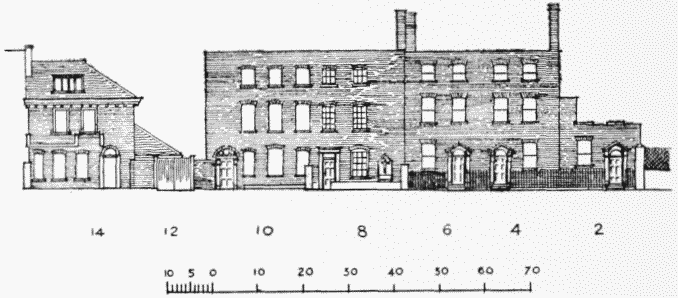
Elevation of Nos. 14–2 Old Paradise Street. Measured drawing