Magna Britannia: Volume 3, Cornwall. Originally published by T Cadell and W Davies, London, 1814.
This free content was digitised by double rekeying. Public Domain.
Daniel Lysons, Samuel Lysons, 'Parishes: Launcells - Launceston', in Magna Britannia: Volume 3, Cornwall(London, 1814), British History Online https://www.british-history.ac.uk/magna-britannia/vol3/pp185-192 [accessed 9 May 2025].
Daniel Lysons, Samuel Lysons, 'Parishes: Launcells - Launceston', in Magna Britannia: Volume 3, Cornwall(London, 1814), British History Online, accessed May 9, 2025, https://www.british-history.ac.uk/magna-britannia/vol3/pp185-192.
Daniel Lysons, Samuel Lysons. "Parishes: Launcells - Launceston". Magna Britannia: Volume 3, Cornwall. (London, 1814), British History Online. Web. 9 May 2025. https://www.british-history.ac.uk/magna-britannia/vol3/pp185-192.
In this section
Launcells
LAUNCELLS, in the hundred of Stratton and in the deanery of Trigg-Major, lies about a mile and a half east-south-east from Stratton, which is the post-office town; and between seven and eight west from Holsworthy in Devonshire. The principal villages in this parish are, Can-Orchard, Grimscott, and Hesham.
At Launcells was a cell of Austin canons, belonging to the abbey of Hartland in Devonshire, which, in the year 1537, was leased, by King Henry VIII., to Sir John Chamond (fn. n1), and became the seat of that family. In the parish-church is the monument of John Chamond, the last of the family, who died in 1624. Sir John Chamond the elder had been "knighted at the Sepulchre (fn. n2) :" his son, Sir John Chamond the younger, lived to a great age; Carew says, that he served in the office of a Justice of Peace almost sixty years, that he knew above fifty several judges of the Western Circuit, and that he was uncle and great uncle to at least 300 persons. The barton of Launcells, which had been for a considerable time in the Orchard family, was leased by the late Paul Orchard, Esq., for a long term of years, to the late Rev. Cadwallader Jones, and is now the seat of Joseph Hawkey, Esq., who married his widow.
The manor of Norton-Rolle, to which the bailiffry of the hundred of Stratton was annexed, belonged to the abbot and convent of Newenham (fn. n3). This manor, and that of Yellow-Leigh, were many years in the family of Rolle. NortonRolle passed by inheritance, with other estates, to Lord Clinton; Yellow-Leigh is now the property of Mrs. Mary Harris, who resides at East-Leigh in this parish, formerly a seat of the Rolles. The manor of Thorlebeare or Thurlibear came into the family of Arundell of Trerice, by marriage with the heiress of Durant. It has passed with the Trerice estate, and is now the property of Sir Thomas Dyke Acland, Bart.
The extensive manor of Mitchell-Morton, partly in this parish, and extending into the parishes of Kilkhampton, Morwinstow, and Jacobstow in Cornwall, and Week St. Pancras in Devonshire, belonged, before the year 1660, to the family of Smith, and was divided amongst its coheiresses. Two-thirds, having passed through several hands by purchase, are now the property of Wrey J'Ans, Esq. of Whitstone. The remaining third, with the barton, belonged many years to the Orchard family, and is now vested in the Rev. F. H. Morrison, as heir of the late Paul Orchard, Esq. The manor of Anderson was the property and residence of a family of that name; John Anderdon, Esq. sold it to Edmund Speccot, Esq.; about the year 1700, Edmund Spoure, his descendant (fn. n4), sold it to Nicholas Rowlands of Launcells; it is now the property of the Rev. Charles Orchard. The manor of Grimscott, which had been formerly in the Langdons, was purchased by Edmund Speccot, Esq., of John Cory, Esq. of Whalesborowe, and sold by Edmund Spoure, Esq., about the year 1700, to John Grenville, Earl of Bath: it is now divided into small tenements, charged with high rents to the Rev. F. H. Morrison, as heir of the late Mr. Orchard.
Tre-Yeo in Launcells, said to have been the ancient seat of the Yeos, is now the property and residence of Robert Kingdon, Esq. Norton, formerly a seat of the Arscotts, is now a farm-house belonging to the Rev. F. H. Morrison.
There is the site of an ancient chapel at Morton (fn. n5), and another at East-Leigh. The Rev. F. H. Morrison is impropriator of the great tithes, which belonged formerly to the abbey of Hartland, and patron of the vicarage.
There is an almshouse at Launcells for four poor persons, endowed with a rent charge of 2l. 2s. per annum, issuing out of an estate at Holsworthy: it is said to have been founded by one of the Chamond family.
Launceston
LAUNCESTON, in the north-division of the hundred of East, and in the deanery of Trigg-Major, an ancient market and borough town, formerly called Dunheved, lies on the great mail-coach road from London to the Land's-end, about 214 miles from the former, and 84 from the latter.
The manor and honor of Launceston (fn. n6), which had a very extensive jurisdiction (fn. n7), belonged from time immemorial to the Earls of Cornwall, who had their chief seat at Launceston castle. It was taken from the native Earls by William the Conqueror, and given to his half brother Robert Earl of Morteyne, whom he made Earl of Cornwall. It passed with the earldom (fn. n8); and when Cornwall was erected into a duchy, was annexed to it by act of parliament.
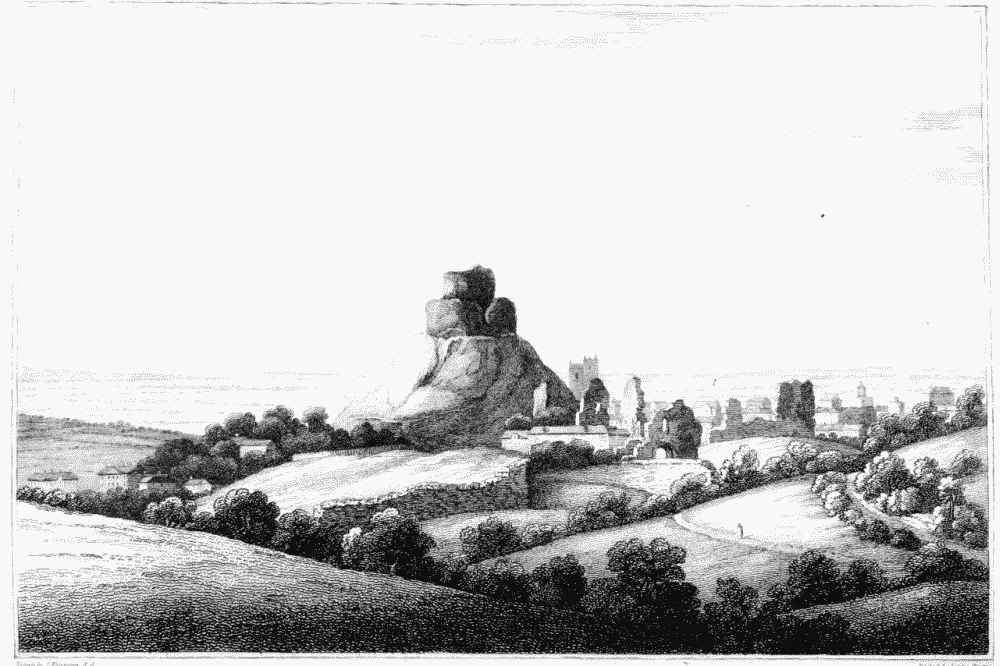
Launceston Castle
Walter Reynell was castellan of Launceston in the reign of Richard I. (fn. n9) Hubert de Burgh, who had large possessions in Cornwall, was made governor of the castle, and sheriff of the county, by King John (fn. n10). William de Bottreaux was governor in the reign of Edward II. (fn. n11) From its strong position, and its situation at the entrance of the county, this castle became an important post during the civil war. It was originally in the hands of the parliament, being commanded by Sir Richard Buller, who, on the approach of Sir Ralph Hopton with the King's forces, quitted the town, and fled (fn. n12). In 1643 Sir Ralph was attacked by MajorGeneral Chudleigh, without success (fn. n13). In the month of August 1644, it was surrendered to the Earl of Essex (fn. n14), but fell into the hands of the Royalists again, after the capitulation of the Earl's army. In 1645 the Prince of Wales made some stay in Launceston (fn. n15). In the month of November, the same year, Launceston was fortified by Sir Richard Grenville, who, being at variance with Lord Goring (another of the King's generals), caused proclamation to be made in all the churches of Cornwall, that if any of Lord Goring's forces should come into Cornwall, the bells should ring, and the people rise to drive them out (fn. n16). Not long after this, Sir Richard Grenville, having refused to take the chief command of the infantry under Lord Hopton as generalissimo, was committed to the prison at Launceston, Colonel Basset being then the governor: he was soon afterwards removed to the Mount (fn. n17). In the month of March 1646, the garrison of Launceston was surrendered by Colonel Basset to Sir Thomas Fairfax. (fn. n18)
During the interregnum, the castle and park (fn. n19) being put up to sale, by authority of the then ruling powers, were purchased by Robert Bennet, Esq. (fn. n20) After the Restoration, Sir Hugh Pyper, for his good services, had a grant of the castle as lessee, and was made constable and keeper of the goal. It continued in the family till the death of Hugh Pyper (his grandson), in 1754. The Duke of Northumberland is now lessee of the castle; Edward Coode, Esq. of the park.
An official survey, taken in the year 1337 (fn. n21), speaks of Launceston castle as being then in a very ruinous state. It describes a hall with two chambers; a smaller hall, called the Earl's chamber, with another chamber and a small chapel adjoining; a larger chapel; another small hall; a few other rooms; and two prisons, one of which was called larder. There were then two rooms in the tower, on the keep, much out of repair. Carew, whose Survey was published in 1602, speaking of Launceston castle, says; "The base court compriseth a decayed chappell, a large hall for holding the shire assizes, the constable's dwelling-house, and the common gayle." The survey of 1650 (fn. n22) describes the castle as being then much out of repair, the hall and chapel level with the ground; only one old tower (then a prison) in reasonable repair: the soldiers had carried away the lead that covered it. No other part of the castle then remained but the gatehouse, inhabited by the constable. George Fox, the celebrated quaker, who was imprisoned in this castle for several months, describes in his journal a most filthy dungeon, in which he was some time confined, called Doomsdale. There are now scarcely any remains of Launceston castle, except the keep, which Leland describes as "the strongest, though not the biggest he had ever seen in any aunciente worke in Englande:" this has been particularly described under the head of Ancient Castles. The town in Henry the Eighth's time was walled, and had three gates and a postern. "Dunevet, otherwise Lawnston, is a walled towne," says Leland, "ny yn cumpas a myle, but now ruinus. On the north side of the towne is a castel stonding on a hye hille with yn the sayd towne, hath 3 rownd wardes. Part of the castel standing north-west ys parcel of the walle of the towne. Ther be withyn this town 3 gates and a postern; also a gate to go owt of the castel ynto the old parke. The wall of Dunhevet ys hy larg and strong and defensably set." The walls and the west gate have been pulled down; the north and south gates remain: over the latter is the town-gaol.
The town of Dunhevet (now Launceston) was made a free borough in the reign of Henry III., by Richard Earl of Cornwall, who granted various privileges to the burgesses, and a piece of ground to build their guildhall upon, to be held of him and his heirs, by the annual render of a pound of pepper (fn. n23). The town was incorporated by Queen Mary in the year 1555, the corporation consisting of a mayor, eight aldermen, and a recorder. This borough has sent members to parliament ever since the reign of Edward I.: the right of election is vested in the corporation and free burgesses, the number of voters being only sixteen. John Anstis, Esq., Garter-King of Arms, (who made large collections from public records, relating to the county of Cornwall, and is said to have compiled a history of this town, which he left behind him in manuscript,) was one of its representatives in parliament in the reign of Queen Anne.
The market at Launceston is held by prescription. In the reign of King John the burgesses gave five marks for the King's licence to change their market-day from Sunday to Thursday (fn. n24). There are now two market-days, Thursday and Saturday; the former is the principal market, and well supplied with corn and provisions of all sorts; the other is only for butchers'-meat. There are fairs on Whit-Monday, July 5, November 8, and December 11, for bullocks; and on the first Thursday in March, and the third Thursday in April, for cattle of all sorts, free of toll. There is an extensive manufactory of serges at Launceston.
In the thirty-second year of Henry VIII.'s reign, an act of parliament passed for the encouragement of re-building certain decayed towns, of which Launceston was one. Norden observes, that though this statute took little effect, the town was "much repayred in buyldings, and increased in wealth of late yeares." The number of houses in the town of Launceston, in 1801, was 226, that of inhabitants 1483; in 1811 the number of houses 278, that of inhabitants 1758. These numbers do not include the population of St. Stephen or St. Thomas.
When the act of parliament passed (in the year 1540) for abolishing the privilege of sanctuary, except in churches and church-yards, Launceston was one of the eight towns which were made sanctuaries for life, for all criminals excepting such as had been guilty of murder, rape, highway robbery, burglary, houseburning, or sacrilege. This continued till the reign of James I., when the privilege of sanctuary was wholly abolished.
The assizes for the county were formerly held wholly at Launceston, as hath been already particularly stated (fn. n25); they have for more than half a century been held alternately at Launceston and Bodmin. It seems by a passage in Leland (fn. n26), that the quarter-sessions also were formerly held at Launceston. The county-gaol, before-mentioned, was repaired and improved (fn. n27), when the new gaol was built at Bodmin; and is made use of by the county at the assizes.
The barton of Hurdon, near this town, formerly esteemed a manor (fn. n28) was the property of John Carpenter, Esq.; now, by purchase, of Edward Coode, Esq. The mansion is occupied as a farm-house.
In the parish-church of Launceston, (dedicated to St. Mary Magdalen,) the architecture of which has been already spoken of, are memorials for the families of Lawrence, Pyper, and Vyvyan of Tresmarrow, a younger branch of the Trelowarren family. In the epitaph of Sir Hugh Pyper, Knt., he is described as "lieutenant-governor of the royal citadel and island of Plymouth, captain of the castle of Exeter, constable of the castle of Launceston, alderman and representative in parliament for the borough of Dunheved, &c. &c. He served in the civil wars as an ensign, lieutenant, and captain, under Sir Richard and Sir Beville Grenville, at the siege of Plymouth, the battles of Stratton and Lansdowne, where he was wounded in the neck (fn. n29) and thigh, and shot through the shoulder: his estates were sequestered by the rump parliament for his loyalty to his master and injured sovereign King Charles I. He died July 14, 1687, ætat. 76."
In the registers of the see of Exeter, mention is made of the chapel of St. Thomas, in Launceston castle; of the chapels of St. Giles, Tresunny, Walrington, and Laneast (fn. n30), in the parish of Launceston; and of the chapels of St. Catherine, St. Sidwell, and St. Mary Magdalen at Launceston (fn. n31). St. Catherine's, which stood a little without the town (west-north-west), had been desecrated in Leland's time, and has been long since pulled down; that of St. Mary Magdalen has become the parish-church of Launceston. The church-yard was consecrated in Bishop Voisey's time (fn. n32), which marks the date of its becoming parochial. In the Exeter Registers is recorded an indulgence for contributing to the support of a company of minstrells of St. Mary Magdalen, in Launceston. It appears by the Launceston charters, that there were chapels also at this place, dedicated to St. John and St. James: of these there are no traces.
The impropriate tithes, which belonged to the priory of Launceston, are vested in the Duke of Northumberland. The mayor and corporation are patrons of the curacy.
There is a grammar-school at Launceston, founded by Queen Elizabeth, and endowed with 16l. per annum, payable out of the duchy of Cornwall; an additional endowment of 10l. per annum was given, in the year 1685, by George Baron, Esq., whose descendants have the right of nominating ten boys, to be educated free of expence. There was formerly a hospital for lepers, near Poulston bridge, dedicated to St. Leonard. The income, arising from certain fields which had belonged to this hospital, (about 25l. per annum,) is now vested in the corporation, and applied to charitable uses.
Adjoining to the town of Launceston, of which they appear to form a part, are the parishes of St. Stephen and St. Thomas. St. Stephen's is in the Survey of Domesday, called Lanstavetone. The church of St. Stephen was collegiate before the Conquest, and filled with secular canons. King Henry I. gave this college to the church of Exeter. Hals says, that Reginald, Earl of Cornwall, was a great benefactor to the college of St. Stephen, and that he used all his influence with King Stephen to get the bishop's see again removed to Cornwall, and that St. Stephen's should be the cathedral church; but this was successfully opposed by William Warlewast, Bishop of Exeter, who being then resident at Lawhitton, on his first triennial visitation, suppressed the college of secular canons, and in its stead founded a priory of Austin monks in the parish of St. Thomas, about half way between St. Stephen's and the castle. This priory flourished till the general dissolution of religious houses, when its revenues were estimated at 354l. 11½d. clear yearly value. Not many years ago there were considerable remains of the conventual buildings, which have since been wholly destroyed. Leland describes it as in the west part of the suburb, "under the hill, by a fair wood side; an arrow shot northward from the castle." It is probable, that the Saxon gateway of the White Hart Inn had been part of Bishop Warlewast's building, removed on occasion of the demolition of the priory. When Leland visited Cornwall, Sir Gawen Carew had the custody of the priory. The immediate site is now the property of —— Hill. It seems probable that it was the town of St. Stephens or Newport, to the burgesses of which various privileges were granted by the name of Launceston, there being contemporary charters to the burgesses of Dunheved, now Launceston. Newport has sent members to parliament ever since the reign of Edward VI. The right of election is vested in freeholders, whether resident or not, and in the inhabitants paying scot and lot: the number of electors is about thirty-five. Two officers, called vianders, are the returning officers. The manor of Newport or Launceston, which belonged to the Morice family, is now the property of the Duke of Northumberland.
There are three fairs in the parish of St. Stephen, May 12, July 31, and September 25, for horned cattle and sheep. The manor and barton of Newhouse, in the parish of St. Stephen, formerly a seat of the Langfords (fn. n33), has been lately advertised for sale by Sir A. O. Molesworth, Bart., together with the great and small tithes of St. Stephen's.
The parish-church of St. Stephen was rebuilt at the expence of Charles Cheney, Lord Viscount Newhaven, M.P. for Newport, as appears by an inscription at the entrance. The nomination of the minister is vested in the inhabitants.
Mr. John Horwell, who died about the year 1717, founded a school for the maintenance and education of twelve poor boys; the master of which has a salary of 15l. per annum; but we have not been able to obtain any further particulars respecting the endowment. The Duke of Northumberland is the principal feoffee.
The barton of Carnedon, in the parish of St. Thomas, was purchased in 1690, of John Blighe, Esq., by John Cloberry, Esq. It is now the property of Thomas Bewes, Esq., whose ancestor purchased it, in 1715, of Nicholas Clark, to whom it had been sold in 1700 by the trustees, for paying Mr. Cloberry's debts. Carnedon is now a farm-house.
The barton of Tredidon belonged anciently to a family of that name, from whom it passed, by successive female heirs, to the families of Windsor and Jolliffe. The latter possessed it for several generations: it was afterwards many years in the family of French; and is now the property and seat of George Francis Collins Browne, Esq., who purchased it, in 1805, of the Rev. Simon Webber.
The church of St. Thomas was appropriated to the priory of Launceston: the estates in this parish are now tithe-free. The parishioners nominate the perpetual curate.
In this parish is an ancient fortification called Kestle or Castle wood.