A Topographical Dictionary of England. Originally published by S Lewis, London, 1848.
This free content was digitised by double rekeying. All rights reserved.
'Thakeham - Thetford', in A Topographical Dictionary of England, ed. Samuel Lewis (London, 1848), British History Online https://www.british-history.ac.uk/topographical-dict/england/pp321-326 [accessed 9 May 2025].
'Thakeham - Thetford', in A Topographical Dictionary of England. Edited by Samuel Lewis (London, 1848), British History Online, accessed May 9, 2025, https://www.british-history.ac.uk/topographical-dict/england/pp321-326.
"Thakeham - Thetford". A Topographical Dictionary of England. Ed. Samuel Lewis (London, 1848), British History Online. Web. 9 May 2025. https://www.british-history.ac.uk/topographical-dict/england/pp321-326.
In this section
Thakeham (St. Mary)
THAKEHAM (St. Mary), a parish, and the head of a union, in the hundred of East Easwrith, rape of Bramber, W. division of Sussex, 3 miles (N. N. E.) from Storrington; containing 620 inhabitants. It comprises by measurement 2800 acres, chiefly arable land. The living is a rectory, valued in the king's books at £14. 9. 9½., and in the gift of the Duke of Norfolk: the tithes have been commuted for £700, and there are 27 acres of glebe. The church, which is partly in the early and partly in the later English style, is a cruciform structure, with a square embattled tower at the west end, and contains some interesting monuments to the Apsley and other families. The poor-law union comprises fourteen parishes or places, and contains a population of 7578.
Thame (St. Mary)
THAME (St. Mary), a market-town and parish, and the head of a union, in the hundred of Thame, county of Oxford, 13 miles (E.) from Oxford, and 44½ (N. W. by W.) from London; containing, with the hamlets of Priestend, North Weston, and Moreton, 3060 inhabitants, of whom 1177 are in New Thame township, 1134 in Old Thame, and 51 in the hamlet of Thame-Park. This town, which is evidently of Roman origin, is mentioned as a place of some importance at the commencement of the 10th century, when Wulfhere, King of Mercia, granted a charter dated "in the vill called Thames." In the year 970, Osketyl, Archbishop of York, died at Thame. It suffered much from the Danish invasions, particularly in 1010, and a fortification was erected here. At the Conquest it belonged to the Bishop of Lincoln, and till the reign of Edward VI. formed part of the extensive possessions of succeeding prelates, who conferred many benefits on the town, among which was the diverting through it the road that previously passed on its side. In 1138, a monastery for Cistercian monks was established at Thame-Park in honour of the Virgin Mary, the revenue of which, at the Dissolution, was valued at £256. 13. 7.; the site is occupied by the mansion of Lady Wenman. About the time of Edward IV., an hospital for destitute persons was endowed with lands by Richard Quatremain, a member of a family of high repute. In the civil war of the 17th century, Thame was a centre of military operations, and experienced much consequent distress; during the late war with France it became one of the depôts for prisoners.
The town derives its name from its situation on a gentle declivity on the bank of the river Thame, which here separates the counties of Oxford and Bucks, and across which is a bridge of considerable length. It consists principally of one long and spacious street, with a convenient market-place in the centre, over which is the town-hall, a handsome and commodious building. The manufacture of lace is carried on, but the inhabitants are chiefly employed in husbandry. The market, which is of great antiquity, is on Tuesday, and is well supplied with corn and cattle; fairs are held on Easter-Tuesday, the Tuesday before Whit-Sunday, the first Tuesday in August, and a statute-fair on October 11th. The powers of the county debt-court of Thame, established in 1847, extend over the registration-district of Thame, and the parish of Illmire. The Living was anciently a prebend in the Cathedral of Lincoln, valued in the king's books at £82. 12. 3½., but impropriated and dissolved in 1547: it is now a discharged vicarage, valued in the king's books at £18; net income, £170. The patronage belongs to the Slater family, and the impropriation to Lady Wenman: the tithes were commuted for land and a money payment in 1823. The church, built in 1138, is a large and handsome cruciform structure in the decorated English style, with an embattled tower rising from the intersection, supported on four massive pillars, and surmounted by an octagonal turret of nearly equal height. The interior, which in 1839 was thoroughly restored at an expense of £500, is entered by a stone porch with an elegant canopied niche, in which was formerly a statue of the tutelar saint. In the chancel is a tomb of white marble, to the memory of Lord Williams, with the recumbent effigies of himself and his lady in the costume of the time of Elizabeth; and against the south wall is a curious brass with a kneeling effigy of Sir John Clerke, of Weston, who, according to the legend, took prisoner Louis of Orleans, Duke of Longueville, in the reign of Henry VIII. The north transept is the burying place of the Dormer family, and the south transept the sepulchral chapel of the Quatremains; both contain handsome monuments.
Lord Williams, in 1558, bequeathed estates for the foundation of a free grammar school, which was built by his executors in 1574, near the church; and for the maintenance of a master and usher. Hampden, the patriot; Dr. Fell; Justice Sir George Croke; Pocock, the learned orientalist; King, Bishop of Chichester; Anthony a Wood, the antiquary; and the notorious John Wilkes, were educated in the establishment. A free school was instituted by bequests from the second Earl of Abingdon and others; the income is £26. Several small annuities have been left for apprenticing boys; and other benefactions, amounting to £150 per annum, for the poor. The union of Thame comprises thirtyfive parishes or places, containing a population of 15,413. A little north of the church are the remains of the prebendal house originally attached to the monastery at Thame-Park, and which, till 1837, consisted of nearly three sides of a quadrangle; in that year, Mr. Charles Stone converted the remains into a mansion-house, retaining the character of the ancient edifice, and in 1840 restored the chapel, at the east end of which is a triple lancet window circumscribed by a circular arch. George Hetheridge, an eminent Hebraist and Grecian in the reign of Elizabeth, and regius professor of Greek at Corpus Christi College, Oxford, and Lord Chief Justice Holt, were natives of the town.
Thames-Ditton.—See Ditton, Thames.
THAMES-DITTON.—See Ditton, Thames.
Thanington (St. Nicholas)
THANINGTON (St. Nicholas), a parish, in the union of Bridge, partly within the boundary of the city of Canterbury, but chiefly in the hundred of Westgate, lathe of St. Augustine, E. division of Kent; containing 379 inhabitants. The parish comprises 1212 acres, of which 30 are in wood. The ancient road called Stane-street passes through. In Wincheap-street, a suburb of Canterbury extending into Thanington, was the hospital of St. James, founded in the reign of John, by Archbishop Walter, for female lepers, and of which the revenue at the Dissolution was £46. 6. 3. Some small remains of the hospital still exist. The living is a perpetual curacy; net income, £98; patron, the Archbishop; impropriators, G. Gipps, Esq., whose tithes have been commuted for £610, and whose glebe comprises 3 acres.
Tharston (St. Mary)
THARSTON (St. Mary), a parish, in the union and hundred of Depwade, E. division of Norfolk, 1½ mile (N. W.) from Long Stratton; containing 388 inhabitants. It comprises 1571a. 3r. 36p., of which 1234 acres are arable, 318 meadow and pasture, and 18 woodland. the living is a discharged vicarage, valued in the king's books at £5. 1. 8., and in the patronage of the Bishop of Ely, the appropriator: the great tithes have been commuted for £420, and the vicarial for £120; the glebe comprises 5½ acres. The church is an ancient structure in the early and later English styles.
Thatcham (St. Luke)
THATCHAM (St. Luke), a parish, in the union of Newbury, partly in the hundred of Faircross, but chiefly in that of Reading, county of Berks, 3 miles (E.) from Newbury; containing, with the chapelries of Greenham and Midgham, 4250 inhabitants, of whom 2677 are in Thatcham township. This place appears, from the Norman survey, to have been a town of some importance; and tradition has assigned to it the rank of a borough, but there is no proof that it ever sent representatives to parliament. A market on Sunday was confirmed by charter of Henry II., to the monks of Reading, then possessors of Thatcham, and was changed to Thursday in 1218, by Henry III.; but it has long been discontinued: the remains of the butter-cross still exist. The parish comprises 10,925a. 1r. 32p.: the town is pleasantly situated on the Bath road, near the navigable river Kennet, and the inhabitants are well supplied with water. The Kennet and Avon canal passes a little to the south. A paper-mill at Colthrop affords employment to 80 persons. A statute-fair is held on the first Tuesday after October 12th. The living is a vicarage, valued in the king's books at £20; patron, J. Hanbury, Esq.; impropriators, various proprietors of land: the vicarial tithes have been commuted for £735, and the impropriate for £806. 1. 7. The church has portions in the early, and some in the later, English style; at the south entrance is a fine Norman arch: in the interior are an altar-tomb to William Danvers, chief justice of the court of common pleas, and a mural monument to Nicholas Fuller, Esq., barrister of Gray's Inn. At Greenham and Midgham are chapels of ease; and at Crookham, or Crokeham, was formerly another, of which there are no remains. The Independents have a place of worship. A free school was founded in 1707, by Lady Frances Winchcomb, who gave a rent-charge of £53 for its support; it was opened about 1713, but continued only for a few years, in consequence of the attainder of Lord Bolingbroke, owner of the estate charged. In 1741, however, arrears were recovered; since which period the funds have continued to increase, the amount of stock being now upwards of £5000, exclusively of the rent-charge, which is regularly received. The school was re-opened in 1794, and is now united with a national school.
Thaxted (St. Mary)
THAXTED (St. Mary), a parish, in the union and hundred of Dunmow, N. division of Essex, 19 miles (N. N. W.) from Chelmsford; containing 2527 inhabitants. This parish, which is of considerable extent, lies on the river Chelmer, near its source, and on the road from Chelmsford to Cambridge. The village is pleasantly situated on the banks of the river, and contains several well-built houses. It was formerly a town of importance, and received a charter from Philip and Mary, vesting the government in a mayor, recorder, two bailiffs, and a council of 20 principal burgesses; but on a writ of quo warranto issued by James II., the corporation resigned their functions, and the market, which was on Thursday, was discontinued. The market was subsequently revived, but it never recovered its early celebrity: fairs are held on the 27th of May and 10th of August, the latter for cattle. The living is a vicarage, valued in the king's books at £24; net income, £450; patron and impropriator, Viscount Maynard, whose ancestor gave £2000 in augmentation of the vicarage. The church is a spacious embattled structure, strengthened by buttresses with canopied niches, and having a tower and crocketed spire 183 feet high, the exact length of the church; the south porch is much enriched. There are places of worship for Baptists, the Society of Friends, and Independents. A free grammar school, founded by Thomas Yardley, is now merged into a national school; and near the church are almshouses for 16 persons, partly supported by sums from various charity funds. A number of Roman coins, and a beautiful amphora, were discovered some years since.
Theakstone
THEAKSTONE, a township, in the parish of Burneston, union of Bedale, wapentake of Hallikeld, N. riding of York, 3¼ miles (S. E. by E.) from Bedale; containing 78 inhabitants. The township comprises 935a. 1r. 31p. The Hall is a handsome mansion, near which are several thriving plantations; and the Duke of Cleveland has property here called the Grange. The village is pleasantly situated near a small rivulet. The vicarial tithes have been commuted for £63. 14. 6., and the impropriate for £46. 12.
Thealby
THEALBY, a hamlet, in the parish of Burtonupon-Stather, union of Glandford-Brigg, N. division of the wapentake of Manley, parts of Lindsey, county of Lincoln; containing 207 inhabitants.
Theale
THEALE, a parish, in the union of Bradfield, hundred of Reading, county of Berks, 4¼ miles (W. by S.) from Reading. This place was formerly in the parish of Tilehurst, but has been separated from it by act of parliament, and made distinct. An elegant church in the later English style was erected in 1830, at the expense of Mrs. Sophia Sheppard; and under the provisions of the act, the living of Tilehurst will be divided, and a portion appropriated to this church, to be attached to the headship of Magdalen College, Oxford. The Rev. Thomas Sheppard, D.D., bequeathed £20 per annum for the establishment of a school.
Theale
THEALE, a chapelry, in the parish of Wedmore, union of Axbridge, hundred of Bempstone, E. division of Somerset, 7 miles (S. S. E.) from Axbridge. The living is a perpetual curacy; net income, £100; patron, the Vicar of Wedmore.
Thearne
THEARNE, a township, in the parish of St. John, union, and liberties of the borough, of Beverley, E. riding of York, 3½ miles (S. E. by E.) from Beverley; containing 88 inhabitants. It is situated on the road from Beverley to Hull, and comprises 805 acres, of which two-thirds are arable, and one-third meadow and pasture; the surface is low and level, the soil a strong clay, and partly moorland. The river Hull passes on the east, and at Wawn ferry is a landing-place for coal, lime, and gravel. A chantry chapel at Thearne, dedicated to the Virgin Mary, was dissolved pursuant to the statute of Edward VI. for the dissolution of colleges and chantries.
Theberton (St. Peter)
THEBERTON (St. Peter), a parish, in the union and hundred of Blything, E. division of Suffolk, 4 miles (N. E. by E.) from Saxmundham; containing 580 inhabitants. It comprises by measurement 1945 acres, chiefly of a light and mixed soil, but in some parts wet and heavy; the surface is generally flat. The living is a discharged rectory, valued in the king's books at £26. 13. 4., and in the patronage of the Crown: the tithes have been commuted for £427, and there are 13½ acres of glebe. The church has a round tower and other ancient details of Norman character; a gallery was erected in 1840.
Theddingworth (All Saints)
THEDDINGWORTH (All Saints), a parish, in the union of Market-Harborough, partly in the hundred of Rothwell, N. division of the county of Northampton, but chiefly in the hundred of Gartree, S. division of the county of Leicester, 4½ miles (W. by S.) from Harborough; containing, with the hamlet, of Hothorpe, 270 inhabitants, of whom 254 are in Theddingworth township. The parish is situated on the road from Harborough to Lutterworth, and the Grand Union canal passes through it; the scenery is in many places remarkably pleasing. The living is a discharged vicarage, valued in the king's books at £8. 15. 7.; net income, £137; patron, J. Cook, Esq.; impropriator, the Earl Spencer. The church, which is generally in bad repair, has a very handsome spire, and contains some monuments to members of the Bathurst family. There is a place of worship for Independents. An allotment of 25 acres of land, made under an inclosure act in 1715, is partly let out to cottagers, and partly given for pasturing cattle; the proceeds of the first portion, and a sum of £12. 12. per annum arising from several bequests, are distributed among the poor.
Theddlethorpe (All Saints)
THEDDLETHORPE (All Saints), a parish, in the union of Louth, Marsh division of the hundred of Calceworth, parts of Lindsey, county of Lincoln, 10½ miles (N. N. E.) from Alford; containing 326 inhabitants. It is situated on the sea-coast, and comprises 1684a. 3p. The living is a vicarage, valued in the king's books at £7. 5. 2½.; net income, £98; patron and impropriator, J. Alcock, Esq., whose tithes have been commuted for £400. The parish participates in the benefit of the school in the adjoining parish of Theddlethorpe St. Helen; and a few sums of small amount are distributed among the poor.
Theddlethorpe (St. Helen)
THEDDLETHORPE (St. Helen), a parish, in the union of Louth, Marsh division of the hundred of Calceworth, parts of Lindsey, county of Lincoln, 9¾ miles (N. by E.) from Alford; containing 347 inhabitants, and comprising 1758a. 2r. 32p. The living is a rectory, with that of Mablethorpe St. Peter united in 1745, valued in the king's books at £18. 10. 2½.; patron, Lord Willoughby de Eresby. The whole of the tithes have been commuted for £517, and there are 36 acres of glebe, with a house. The Wesleyans have a place of worship. A school-house was erected in 1810; and some small rent-charges are distributed to the poor of the parish.
Thelbridge (St. David)
THELBRIDGE (St. David), a parish, in the union of Crediton, hundred of Witheridge, South Molton and N. divisions of Devon, 2 miles (S. W. by W.) from Witheridge; containing 267 inhabitants. It is intersected by the road from Crediton to South Molton and Barnstaple. The living is a rectory, valued in the king's books at £10. 6. 5½.; net income, £198; patron, G. Tanner, Esq.: the glebe consists of about 130 acres, with a small house. The church is a very old edifice.
Thelnetham (St. Nicholas)
THELNETHAM (St. Nicholas), a parish, in the union of Thetford, hundred of Blackbourn, W. division of Suffolk, 6 miles (S. S. E.) from East Harling; containing 561 inhabitants. It is bounded on the north by the Lesser Ouse, which separates the counties of Norfolk and Suffolk. The living is a discharged rectory, valued in the king's books at £16. 18. 4.; net income, £508; patron, the Rev. E. H. Sawbridge. There is a glebe of about 22 acres, with a commodious house erected in 1840 by the patron. The church is in the decorated style, and has an embattled tower; in the south aisle is a handsome marble monument to the memory of Henry Bokenham, Esq., and his lady. An allotment of 28 acres of land, now let for £32. 12. per annum, was appropriated to parochial purposes under an inclosure act in 1821, together with another of about 40 acres for cutting turf.
Thelveton (St. Andrew)
THELVETON (St. Andrew), a parish, in the union of Depwade, hundred of Diss, E. division of Norfolk, 3 miles (E. by N.) from Diss; containing 169 inhabitants. It is intersected by the road from London to Norwich, by way of Scole; and comprises 1200 acres, of which about one-third is pasture. The Hall is an ancient mansion, in the Elizabethan style. The living is a discharged rectory, valued in the king's books at £9, and in the patronage of the Crown: the tithes have been commuted for £290, and there are 8½ acres of glebe. The church is in the decorated style, and is situated in the grounds belonging to the Hall, attached to which is a neat Roman Catholic chapel.
Thelwall
THELWALL, a township, in the parochial chapelry of Daresbury, parish of Runcorn, union of Warrington, E. division of the hundred of Bucklow, N. division of the county of Chester, 3 miles (E. S. E.) from Warrington; containing 334 inhabitants. This is a place of great antiquity: a garrisoned town was founded here by King Edward the Elder in 923, which is mentioned in the Saxon Chronicle. The name is derived from two Saxon words; Thel, which signifies the trunks or bodies of trees, and wall, as now used, meaning a fence; the fortifications surrounding the ancient town being composed of these materials. The earliest lords were the Lacys, barons of Halton, who possessed the manor by grant from Hugh Lupus, Earl of Chester, nephew of William the Conqueror; and hence it is still described as of the fee of Halton. From them it passed to the Duttons, of Dutton; and subsequently, by successive sales, through the Claytons (the last of whom was Sir Randal Clayton, Knt., of Thelwall, living in the early part of the 17th century), the Brookes of Norton, the Mores of Kirtlington, in the county of Nottingham (of whom was Sir Edward More, Bart.), and the Pickerings. These last were possessed of the manor from about the middle of the 17th century until the year 1837, when it was devised by the last representative of that family to William Nicholson, Esq., the present proprietor, who resides at Thelwall Hall.
The Duke of Bridgewater's canal, and the turnpike road from Chester to Manchester, pass through the township; and the road from Warrington to Knutsford immediately adjoins it. The Mersey forms its boundary on the north side, with the exception of a small portion of it which lies across the river, owing to the channel having at some remote period altered its course. The manufacture of gunpowder has been carried on for many years; the works, situated on the banks of the Mersey, are the property of James Stanton, Esq., of Greenfield. The township comprises about 1150 acres, of which two-thirds belong to the lord of the manor, who has the exclusive privilege of a ferry over the Mersey, for which toll is payable. A court leet is held yearly on the eve of Palm Sunday, at which a constable is sworn in. A very ancient Manor-house here was taken down about the middle of the last century, when the present Hall was erected: the latter is an exceedingly neat and substantially built mansion of brick, consisting of three stories, with a pediment in the centre, and a double flight of steps leading to the principal entrance. The living of Thelwall is a perpetual curacy, in the patronage of Mr. Nicholson; net income, £100, with a commodious parsonage-house, erected a few years since. The church, dedicated to All Saints, was rebuilt in 1843, at a cost of about £1400, and is a stone edifice lined with brick, in the early English style, with lancet windows and a campanile tower: the windows at the east end, and one on the south side, are of stained glass. A school is supported by subscription.
Themelthorpe (St. Andrew)
THEMELTHORPE (St. Andrew), a parish, in the union of Aylsham, hundred of Eynsford, E. division of Norfolk, 1¾ mile (E. by S.) from Foulsham; containing 94 inhabitants. It comprises 652a. 3r. 23p., of which 386 acres are arable, 249 pasture and meadow, 2½ woodland, and 10 in gardens, &c. The living is a discharged rectory, annexed to that of Bintree, and valued in the king's books at £4. 2. 8½.: the tithes have been commuted for £131, and the glebe comprises 19 acres. The church is chiefly in the early English style of architecture.
Thenford (St. Mary)
THENFORD (St. Mary), a parish, in the union of Brackley, hundred of King's-Sutton, S. division of the county of Northampton, 4½ miles (E.) from Banbury 3 containing 155 inhabitants. The parish is situated near the road from Banbury to Brackley, and comprises 882a. 8p. Lace-making employs a few persons here. The living is a discharged rectory, valued in the king's books at £10, and in the patronage of the Crown, with a net income of £120: the tithes were commuted for about 60 acres of land in 1776. The church is small, and mostly of the 14th century, with some portions of earlier date and a tower of the 15th century: there is some stained glass in the windows. A school is supported by Mr. Severne; and the produce of about 11 acres of land, left by Mr. Tooley, is distributed among the poor. Here is a mineral spring.
Theobald-Street
THEOBALD-STREET, a hamlet, in the parish of Aldenham, poor-law union of Watford, hundred of Cashio, or liberty of St. Alban's, county of Hertford; containing 62 inhabitants.
Therfield (St. Mary)
THERFIELD (St. Mary), a parish, in the union of Royston, hundred of Odsey, county of Hertford, 2½ miles (S. W. by S.) from Royston; containing 1224 inhabitants. It comprises 4761 acres, of which 456 are common or waste. The living is a rectory, valued in the king's books at £50, and in the gift of the Dean and Chapter of St. Paul's, London: the tithes have been commuted for £1100, and there is a parsonage-house, with a glebe of 91 acres.
Thetford
THETFORD, a chapelry, in the parish of Stretham, hundred of South Witchford, union and Isle of Ely, county of Cambridge, 2¼ miles (S. by W.) from Ely; containing 250 inhabitants. It comprises 1042 acres, of which 481 are common or waste land; and is situated near the Cambridge and Ely road. The chapel is dedicated to St. George. A rent-charge of £124. 17. has been awarded as a commutation for the tithes of the chapelry.
Thetford
THETFORD, a borough and market-town, having exclusive jurisdiction, and the head of a union, locally in the hundred of Shropham, W. division, of Norfolk, and the hundred of Lackford, W. division of Suffolk, 79 miles (N. N. E.) from London; containing 3934 inhabitants. This ancient place, called Theodford by the Saxons, evidently derives its name from the river Thet, which here unites its stream with the Lesser Ousc; the latter river then passes through the town, separates the two counties, and is navigable hence to Lynn. The majority of antiquaries consider Thetford to be the site of the celebrated Sitomagus of the Romans, who possessed it in 435, and it is known to have been the metropolis of East Anglia; on which account, and from its proximity to the North Sea, it was during the heptarchy frequently desolated by the Danes, who, having retained possession of the town for fifty years, totally destroyed it by fire in the ninth century. In 1004, it sustained a similar calamity from their king, Sweyn, who had invaded East Anglia; and in 1010 it became, for the third time, the scene of plunder and conflagration by these marauders, into whose hands it again fell, after a signal victory which they had obtained over the Saxons. In the reign of Canute, Thetford began to recover from the effects of these repeated calamities, and in that of Edward the Confessor had nearly regained its former prosperity, containing not less than 944 burgesses, who enjoyed various privileges. In the time of the Conqueror (in 1070), the see of North Elmham was transferred hither, but the episcopal chair was removed to Norwich by Herbert de Lozinga, in the year 1094: Henry VIII. made the town the seat of a bishop suffragan to Norwich, which it continued during his reign. From the time of Athelstan to that of King John here was a mint, in which coins of Edmund and Canute were struck; and the ancient extent and importance of the town may be gathered from the fact that, in the reign of Edward III., it comprised twentyfour principal streets, five market-places, twenty churches, six hospitals, eight monasteries, and other religious and charitable foundations, of which there are but few remains. Thetford has been honoured with the presence and temporary residence of several sovereigns, particularly Henry I. and II., and Elizabeth, the last of whom rebuilt the ancient mansion of the earls of Warren, on its lapse to the crown, and occasionally resided in it, as did also James I. for the purpose of hunting: the house is still called the King's House.
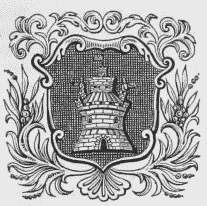
Arms.
The town has of late been much improved. It comprises five principal streets, partly paved; and the main portion is conuected with the few remaining houses on the Suffolk side by a handsome iron bridge over the Ouse, erected in 1829: the modern buildings are plain and neat, and the inhabitants are supplied with water from wells and springs. At the east end of the town is a chalybeate spring; the waters are similar to those at Tonbridge-Wells. Races took place here at an early period, but from the tumults they occasioned in the former part of the 17th century, the sports were suppressed by order of the privy council; they were revived a few years since, and held in June, upon the common, on the Suffolk side of the borough, but have been again discontinued. Assemblies occasionally take place, and a subscription library is supported. In addition to a very large paper-mill, there are an iron-foundry, two agricultural-machine factories, some good breweries, several malting establishments, a flour-mill, and a tanyard; and the navigation of the river, in its course to Lynn, having been improved between this place and Brandon, a brisk business is carried on in corn, wool, coal, and other articles. The Norwich and Brandon railway has a station here, 31 miles from the Norwich station. The market is on Saturday; the market-house has been taken down, and neat shambles erected, covered with cast iron, with a portico, and palisades in front. Fairs are held on May 14th and August 2nd and 16th, for sheep, and on September 25th, for cattle; there is a wool-fair in July.
A charter of incorporation, granted by Elizabeth in 1573, was surrendered to the crown in the 34th of Charles II., and a very imperfect one obtained in its stead, which in 1692 was annulled,and the original restored, by a decree in chancery. The corporation now consists of a mayor, four aldermen, and twelve councillors, under the act 5th and 6th of William IV., cap. 76; the mayor, late mayor, and recorder are justices of the peace, and the total number of magistrates is nine. The borough sends two members to parliament: the right of election was extended in 1832, to the £10 householders of a new district: the mayor is returning officer. There has been a re-grant of the court of quarter-sessions for the borough, and petty-sessions are held by the corporation every Monday. The powers of the county debt-court of Thetford, established in 1847, extend over the registrationdistrict of Thetford. The county assizes, which had been held here, in Lent, ever since 1176, were removed a few years since. The guildhall is a fine building, erected at the expense of Sir Joseph Williamson, Knt., secretary of state to Charles II.; the gaol is a plain edifice of flint and white brick, commodiously arranged: on these buildings many thousand pounds have been expended by the inhabitants.

Corporation Seal.
Thetford comprises the parishes of St. Cuthbert, containing 1543; St. Peter, 1184; and St. Mary the Less, 1207 inhabitants; the livings of all which are in the patronage of the Duke of Norfolk. St. Cuthbert's is a discharged perpetual curacy, with the rectory of the Holy Trinity united; net income, £50. The church contains a nave, chancel, and south aisle, with an embattled tower. The living of St. Peter's is a discharged rectory, with that of St. Nicholas' united, valued in the king's books at £5. 1. 5½.; net income, £55. The church, commonly called "the Black church," being constructed chiefly of flint, comprises a nave, chancel, and north aisle, with an embattled tower, which, with part of the body of the edifice, was rebuilt in 1789. The living of the parish of St. Mary the Less is a perpetual curacy, valued in the king's books at £1. 13. 6½.; net income, £83; impropriators, the Duke of Norfolk and others. The church, which stands in Suffolk, consists of a nave and chancel, with a square tower. There are places of worship for the Society of Friends, Independents, Wesleyans, and Roman Catholics. A preachership in St. Mary's church, a grammar school, and an hospital for two men and two women were founded and endowed in 1610, under the will of Sir Richard Fulmerston, Knt., who died in 1566: the income now amounts to £555 per annum. Some boys and girls are apprenticed from a fund of £2000 vested in an estate producing £290 per annum, left by Sir J. Williamson in 1701. In 1818, Mr. P. Sterne bequeathed £1000 for the benefit of the poor; and about £70, derived from the inclosure of the common, are yearly distributed with several minor benefactions. The union of Thetford comprises 34 parishes or places, of which 19 are in Norfolk, and 15 in Suffolk; and contains a population of 17,542.
The relics of antiquity consist chiefly of the fragments of a nunnery established in the reign of Canute, by Urius, the first abbot of Bury St. Edmund's; some of the walls, buttresses, and windows, with a fine arch and cell, are still visible, the conventual church having been converted into a barn, and a farmhouse built with the other ruinous portions. Of a priory founded on the brink of the river in 1104, by Roger Bigot, for Cluniac monks, and which at the Dissolution was valued at £418. 16. 3., the gateway, constructed with freestone and black flint, and parts of the church, which was cruciform, alone remain. Of the monastery of St. Sepulchre, instituted in 1109, by the Earl of Warren, and further endowed by Henry II., the church has been converted into a barn. The site of St. Augustine's friary, founded in 1387, by John of Gaunt, for mendicants of that order, still bears the name of Friars' Close. At the eastern extremity of the town are remains of a Danish fortification, which consisted of a large keep and double rampart, erected on an artificial mount called Castle Hill, of which the height is 100 feet, the circumference of the summit 81 feet, and of the base 984: the remains of the ramparts are 20 feet high, and the surrounding fosse 70 feet wide. It is somewhat singular that no trace is visible of any steps, or path, by which military stores could be conveyed up the very steep ascent to the fortress. The mineral spring was discovered about 80 years since, by Matthew Manning, Esq., M.D., and at that time was much resorted to; it was afterwards shut up for many years, but in 1819 was re-opened, and the waters having been analysed, were found to be very effectual in strengthening the stomach. A handsome pump-room was erected, to which hot and cold baths were attached, situated near the river side, and approached by pleasant sheltered walks; but for want of sufficient patronage the establishment has been closed. Thomas Martin, F.A.S., and author of the History of Thetford, was born here in 1696, and educated at the free school, of which his father was master. The notorious Thomas Paine, author of the Rights of Man, was also born here, and educated at the school.